

Learning how to tell which cannabis seed deals are worth it means looking beyond the discount percentage or advertised price. Customer reviews can reveal whether buyers actually received what was promised, whether shipping was reliable, and how the seller handled problems after purchase.
In this guide, The Seed Connect explains how to separate useful reviews from vague hype, compare deal terms, and check guarantees, shipping, and support before deciding whether a promotion offers genuine value.
Key Take Away
- Check reviews for specific purchase details.
- Confirm whether promo seeds are covered by guarantees.
- Look at shipping and tracking reliability. Judge seller support, not just star ratings.
- Compare total value, not only the discount.
What Are We Really Looking For in Cannabis Seed Reviews?
Star ratings don’t decide value—predictable outcomes do. When you read a cannabis seed review, your goal isn’t to judge whether someone “liked the seeds.” Your goal is to figure out whether their experience can inform your purchase. That comes down to three review ingredients:
-
Offer identity you can match: enough detail about what was purchased (batch/listing/pack info) to confirm you’re comparing the same thing.
-
Context that explains the result: timing plus basic conditions (so germination and delivery outcomes aren’t apples-to-oranges).
-
Resolution trace: what happened after problems—because seller support and policy execution are what you’ll likely experience, not the genetics alone.
Cheap deal versus good deal
A lower price is a real bargain only when the review evidence is detailed enough to forecast what you’ll experience once the seeds arrive and the seller needs to step in. Next, we’ll convert these “actionable evidence” signals into a quick-scan set of red flags and trust markers you can use immediately (see Section 5).
How to Read Cannabis Seed Reviews Without Getting Misled
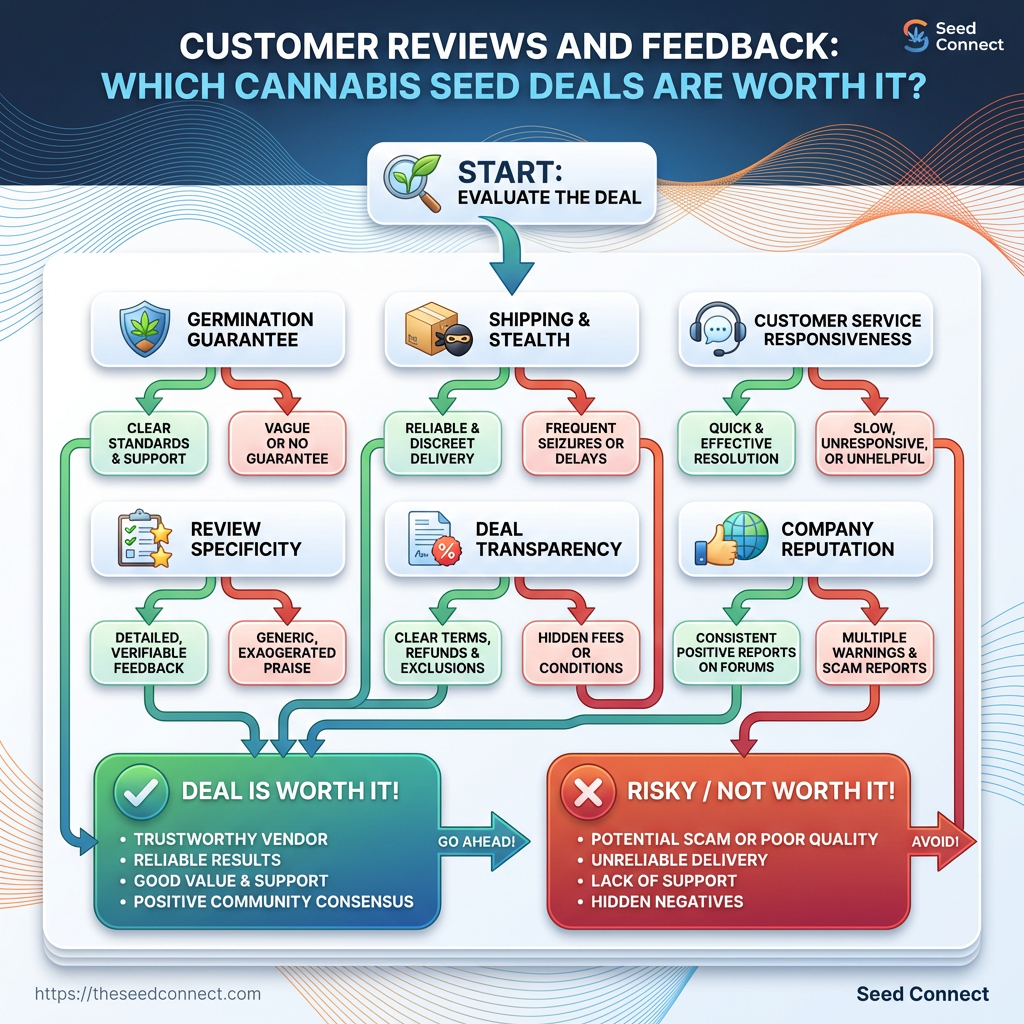
Guarantee language is common. The differentiator is whether the review shows the seller actually followed through for the buyer’s specific situation. When you scan a review, look for signals of claim execution—not just promises:
-
Vague / low-evidence phrasing: “They guarantee germination.” / “They replaced my seeds.”
-
Specific / high-evidence phrasing: dates and timelines (e.g., “I contacted them within X days”), what the seller asked for (order details, photos, batch/listing info), and what the buyer ultimately received (replacement vs refund) with a stated timeframe.
If a review never shows what the seller required, how the process worked, or what the buyer ended up getting, then treat it as story-level feedback, not decision-level proof—use it for context, but don’t rely on it to validate the promo. To make the decision with confidence, apply the same verification logic across the deal: review match (what you actually receive), guarantee coverage (what’s included/excluded), shipping follow-through (timing/tracking), and seller resolution steps (replacement vs refund, and the reported timeline).
Which Deal Types Usually Deliver Real Value?
Is the cheapest seed deal really the best one?
Not usually.
A bundle can look fantastic on the banner, then turn awkward when the bonus seeds are excluded from germination coverage or the refund policy says all sales are final.
The smarter move is to judge the deal by what happens after checkout.
Leafly’s 2026 roundup of the best cannabis seed companies still centers tested genetics and reliable shipping, which tells you plenty: the market keeps rewarding consistency, not just flashy discounts. The best cannabis seed companies
Our own deals page follows the same logic.
A real discount should lower risk, not just lower the sticker price.
Comparing deal types by risk and payoff
|
Deal type |
Typical savings |
Best for |
Main risk |
Review clues to check |
|---|---|---|---|---|
|
Buy-one-get-one or bundle deal |
Strong value if you planned to buy multiple packs anyway |
Growers who want more seed count for the same order |
Bonus units may be excluded from germination coverage |
Check whether free or bonus seeds are covered, and whether the paid pack still has a clear guarantee |
|
Seasonal sale |
Good when the discount applies to fresh inventory |
Buyers who can wait for the right window |
Sale items may move fast or be older stock |
Look for breeder names, storage notes, and recent customer feedback |
|
Free bonus seeds |
Highest sticker surprise, but not always the safest value |
Experimental grows and collectors |
The “free” part can hide zero protection |
Confirm whether bonus seeds are excluded from claims or replacements |
|
Starter pack |
Moderate savings with a cleaner entry point |
New growers and small-space setups |
Curated does not always mean top-tier genetics |
Check strain list, breeder disclosure, and expected germination terms |
|
Clearance or closeout |
Often the deepest markdowns |
Bargain hunters who can verify freshness |
Older stock and weaker storage are common here |
Look for pack dates, shell firmness, storage details, and recent buyer comments |
Price drops help most when they come with clarity.
They start to look thin when the seller hides behind vague wording, and customer feedback cannabis deals tends to punish that fast.
The best reliable seed promotions make the tradeoff plain: what is discounted, what is covered, and what is not.
That is where bundle deals and seasonal sales usually win, while clearance and free-bonus offers deserve a closer look.
How We Should Evaluate a Seed Seller Before Buying
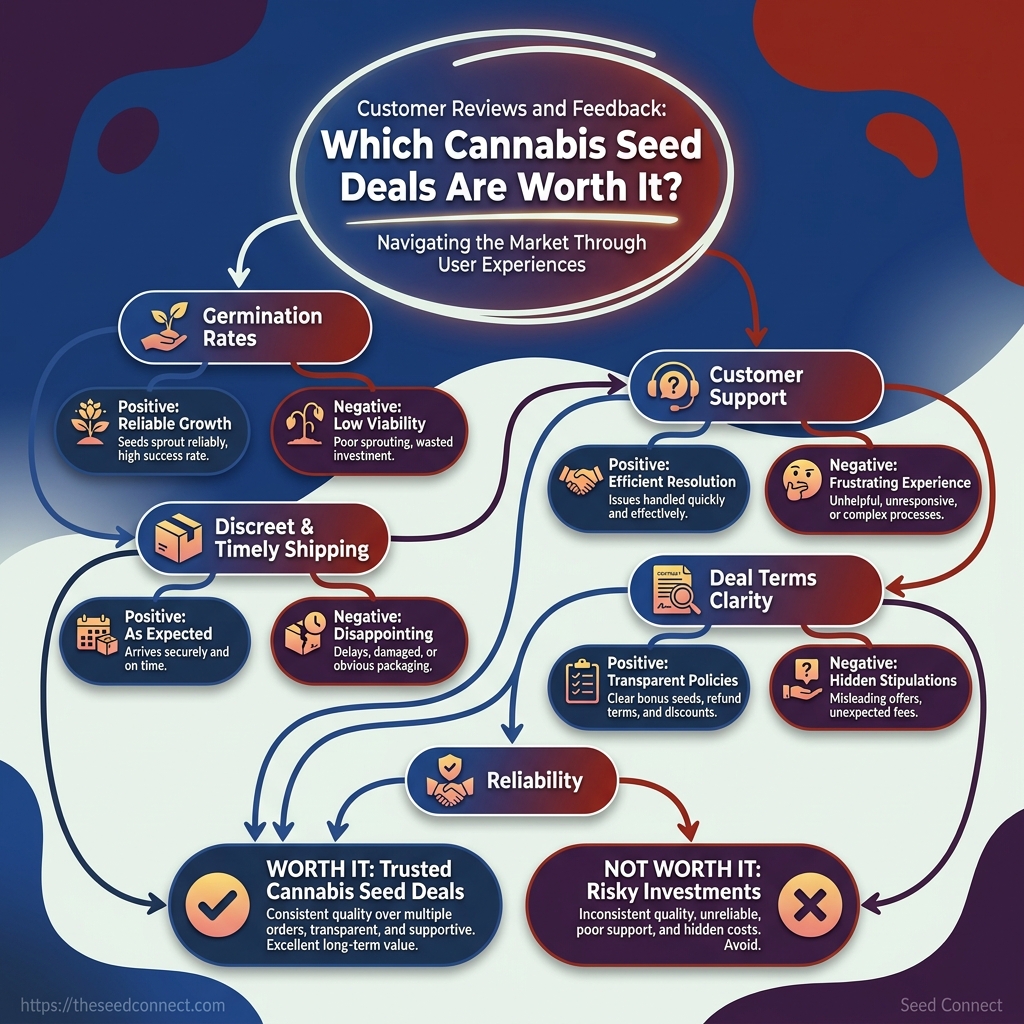
Price is only the start. What matters is the seller’s process—how reliably they deliver the product, protect it in transit, and follow through when something goes wrong.
Customer feedback is most valuable when it discusses the practical details that affect your results: dispatch and delivery timing, packaging/labeling that preserves seed condition, and whether the seller’s claim process is straightforward (replacement/refund steps, proof required, and timelines).
Where Seed Connect fits into this decision
|
What buyers care about |
What to look for |
Seed Connect fit |
Why it matters |
|---|---|---|---|
|
Seed quality |
Clear genetics, freshness notes, and signs of proper storage |
Yes |
Helps buyers avoid weak or poorly handled seeds |
|
Germination guarantee |
Written window, stated threshold, and a claim path |
Yes |
Reduces buying risk when a batch underperforms |
|
Shipping confidence |
Tracking, delivery window, and discreet packaging |
Yes |
Makes delivery easier to predict and easier to trust |
|
Support |
Real help after delivery, not just pre-sale answers |
Yes |
Useful when questions come up after the order lands |
|
Value |
Fair pricing, honest promo terms, and shipping perks |
Yes |
Makes reliable seed promotions easier to judge |
Seeds Here Now’s 2026 guidance often cites a healthy germination range around 85% to 95%, with under 80% as a potential red flag—useful as a sanity check when scanning reviews.
For Seed Connect specifically: our 30-day germination guarantee includes a documented claim process and a stated 90% success threshold for seeds bought directly from us.
When delivery expectations and the support workflow are clearly described, the purchase stops feeling like a gamble—and starts looking like a solvable problem if outcomes fall short.
What Global Buyers Need to Check Before Trusting a Deal
Shipping across borders turns a “good deal” into a different kind of deal—one where timing, customs, and local rules affect the outcome. Global buyers should treat delivery like part of the purchase, not an afterthought. Ask yourself whether the vendor is truly set up for international customers, and whether their timing claims hold up once the shipment leaves their control. If you want a quick way to spot transparency, compare delivery estimates by region.
Different established sellers can offer very different timelines, which changes the real cost of the deal. Here’s what to watch:
Shipping origin: “Ships worldwide” doesn’t tell you where the parcel starts.
Region-specific delivery estimates: U.S., Canada, and EU timelines usually indicate a clearer process than vague ranges.
Customs language: Buyers are often responsible for knowing import rules, even when sellers promise discreet packing.
Review location clues: Overseas reviews can reveal whether delays cluster in one country, one carrier, or one customs route.
Tracking pattern details: Look for repeated notes about stalled tracking, rerouting, or unexpected handoffs.
Customs is where many buyers get overconfident. A seller can ship quickly and still leave you exposed to paperwork delays, seizure risk, or border import limits. So for global shoppers, reliable seed promotions should be judged on clear delivery terms and verifiable tracking behavior—not just on a low price.
A Simple Way to Judge Whether a Cannabis Seed Deal Is Worth It
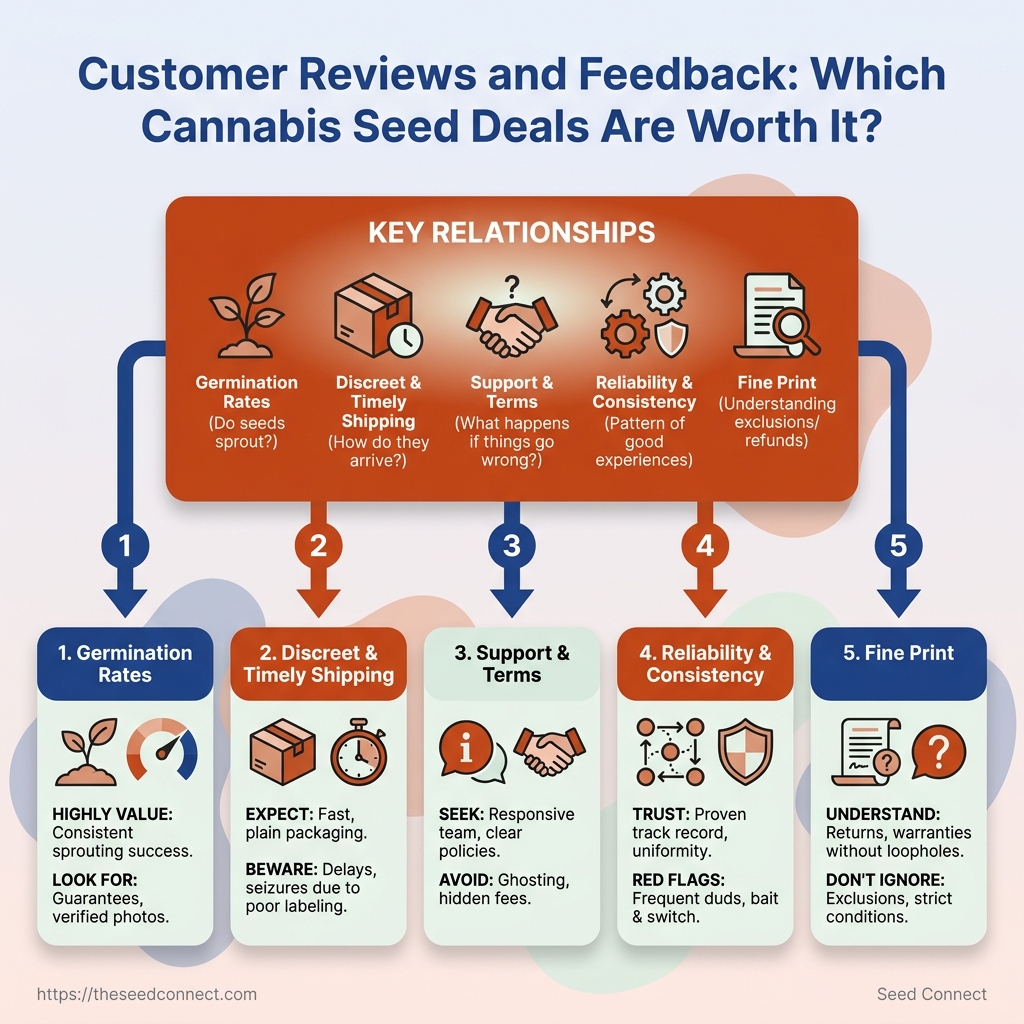
Here’s a practical 5-check verification test for any promo. If a key item is vague or missing, the “discount” may be unproven value.
1) Use only review evidence you can actually verify
Look for reviews that describe:
-
what item/strain/batch they received (enough to match the listing)
-
the conditions and timing behind any results (so outcomes are comparable)
-
what happened when something went wrong (and whether the seller resolved it)
2) Confirm the guarantee matches what you paid for
Don’t just look for “guaranteed.” Check:
-
whether the coverage applies to the exact seeds (including whether promos/bonus/BOGO units are included or excluded)
-
the claim mechanics: proof required, the deadline to report issues, and whether the outcome is replacement vs refund
3) Match the deal type to your risk tolerance
Different promotions carry different “unknowns.” Use the deal format to decide whether you’re comfortable with what’s typically excluded or harder to verify (especially around bonus/free units and clearance/closeout).
4) Validate shipping + tracking realistically (internationally if relevant)
You want consistency in:
-
dispatch timing and expected delivery windows
-
tracking behavior (not just “tracking available,” but what it actually shows)
-
customs/local-rule responsibility, since those can affect outcomes even with careful packing
5) Make sure the support/claims path is actually followable
A deal is only “worth it” if you can clearly see how to submit a claim and what resolution steps to expect. If you can’t confirm these five checks, the cheapest price won’t be the cheapest outcome.
Do cannabis seed bank reviews predict real germination results?
They can—when the reviews include decision-grade specifics. Look for reviews that:
match the exact pack/listing the buyer received,
describe timing and conditions (so results are comparable), and
explain what happened next (replacement vs refund, and what documentation/timeline the seller required).
If you want the full, step-by-step way to judge whether a review is usable for your purchase, see the checklist in Section 11.
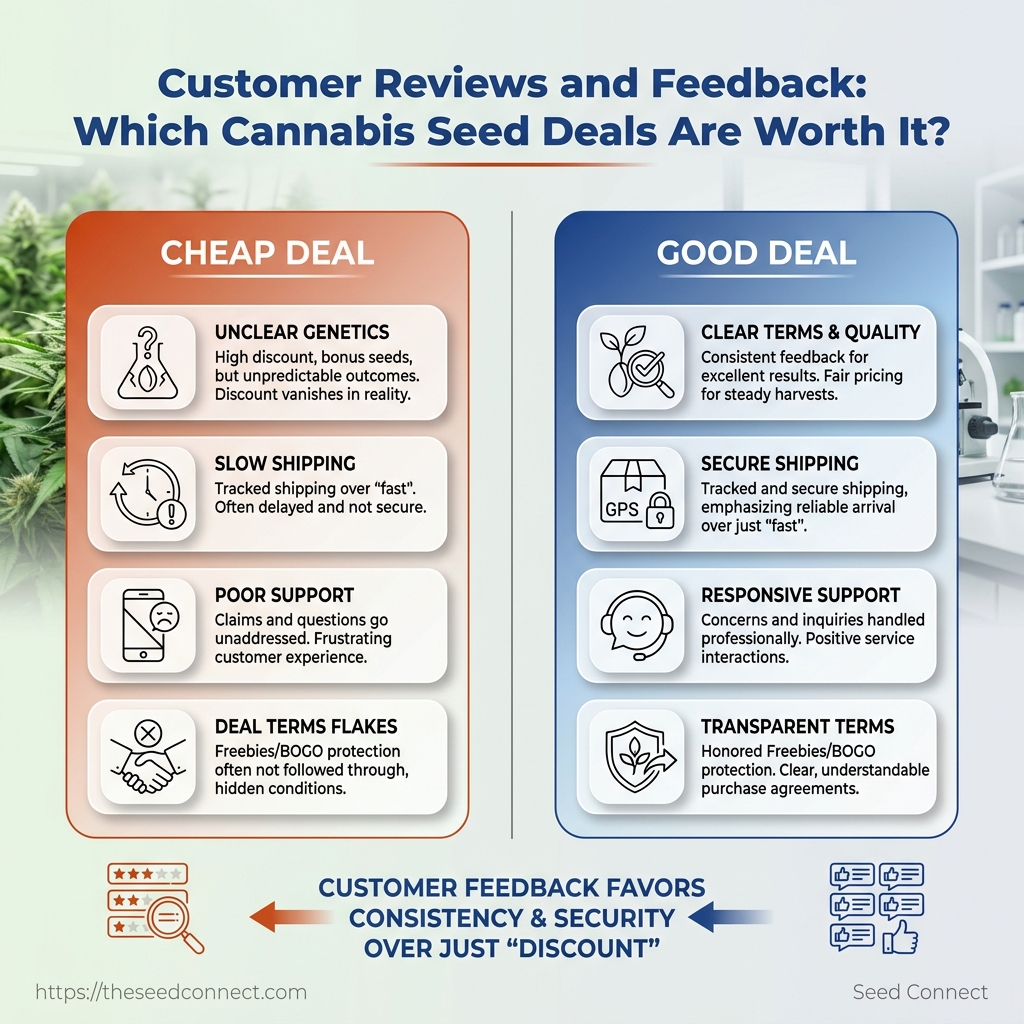
Conclusion
The best cannabis seed deals aren’t the flashiest discounts—they’re the ones you can verify.
Use customer reviews to confirm what buyers actually received, then rely on the 5-check verification test in Section 11 to judge the deal on what matters after checkout.
Bottom line: if the deal’s coverage (including exclusions), shipping/tracking realism, and support/claims path are clear and match the promo you’re buying, you’re far more likely to get value—not just a low sticker price.