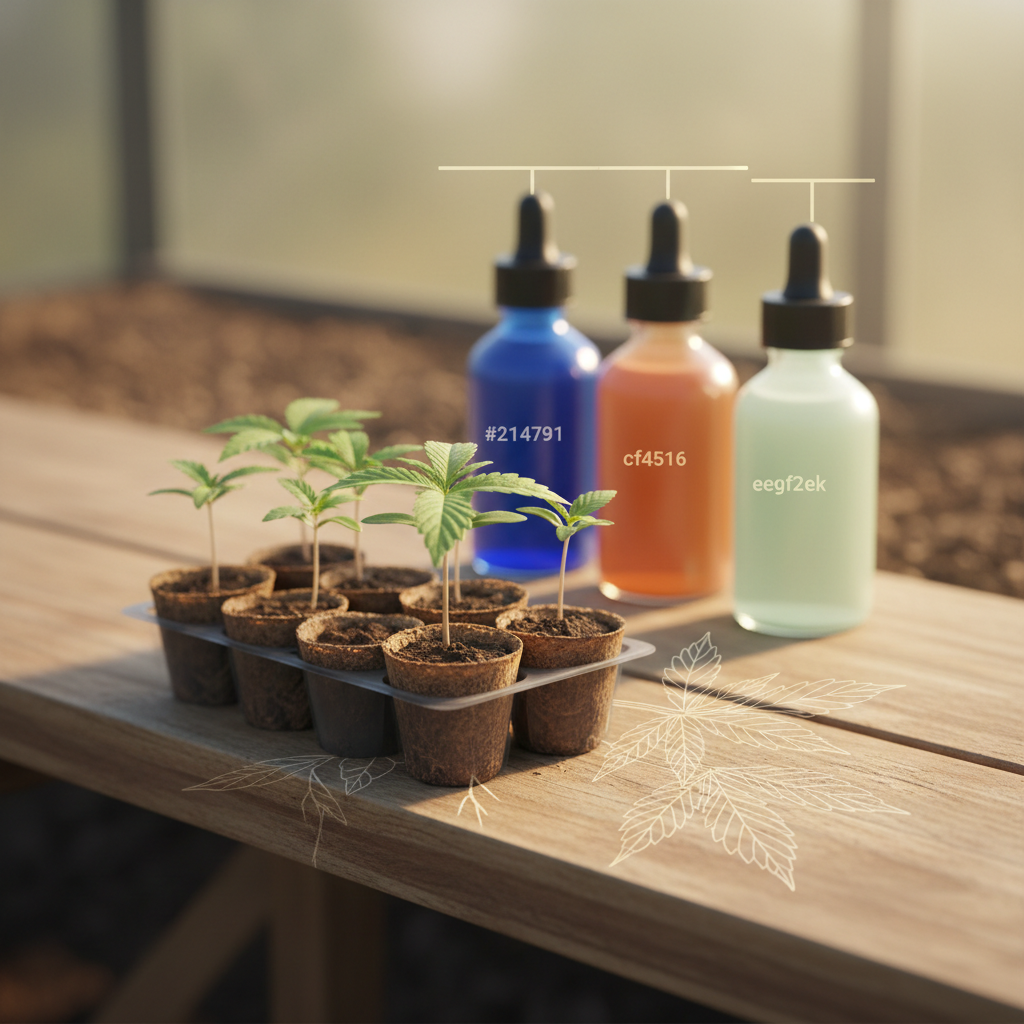
Quick Answer: Feed cannabis seedlings only after their cotyledons have been used up and the first true leaves are developing, because cotyledons can carry the plant for a short time and the seedling is far more likely to be burned by early, heavy feeding than helped. Watch for pale leaves, stalled growth, or crispy edges as signals you fed too soon, and prioritize root-building with restraint until growth stays compact and color remains steady.
What if your seedlings do not need nutrients right away?
Fresh seedlings usually do not need feeding on day one.
The seed already carries a built-in food supply, and that reserve powers the plant through the earliest stretch of growth.
That matters in seedling stage care, because overfeeding too early is one of the fastest ways to slow a young plant down.
In the first days after sprouting, the roots are tiny, delicate, and still learning how to work.
The plant is not asking for a full meal yet.
It is asking for time.
The first clue is the cotyledons , those smooth seed leaves that appear before the first true leaves.
If they still look healthy and green, the seed is often doing its job.
Once the first true leaves open and start building real growth, that is when post-germination nutrition starts to matter more.
A simple way to think about nutrients for cannabis seedlings is this: feed the plant when it starts showing active demand, not just because a calendar says so.
A grower might see a seedling sit for several days with no change, then suddenly push out a second set of leaves.
That shift usually tells you the seed’s stored energy is fading.
The plant gives clear signals when it needs help.
Pale new growth: Fresh leaves losing color often point to hunger, especially if the plant was healthy a day or two before.
Slow, stalled growth: A seedling that stops making progress after the first true leaves may be ready for a very light feed.
Weak stems and droop: Limp growth can mean the plant is struggling to move enough resources through its system.
Cotyledons fading early: If the seed leaves yellow too soon, the reserve supply may be running low.
Burned leaf edges after feeding: This is a warning sign that the mix is too strong, not that the plant needs more.
A practical test works better than guesswork.
Wait until the first true leaves are open, the stem is holding itself well, and the plant is actively stretching toward light.
Then begin with a very mild feeding, or a light medium if your setup already provides some nutrition.
If the seedling looks compact, green, and steady, patience usually wins.
Strong starts come from restraint, not force.
The first feeding window: what to give and what to skip
A seedling fed like a full-grown plant usually slows down before it speeds up.
In early seedling stage care, the goal is not force; it is balance.
Good post-germination nutrition stays almost invisible at first.
A gentle starter mix should support roots, not announce itself with dark leaves or burnt tips.
That means keeping nutrients for cannabis seedlings light, complete, and boring in the best way.
Think one-quarter strength, not a heavy pour, and only after the plant is clearly asking for more.
A gentle starter mix and why weaker is better
Seedling signal
Recommended action
Safe nutrient choice
What to avoid
Cotyledons still green
Wait and watch
Plain water or no feed yet
Any added fertilizer
First true leaves are open and growth is steady
Start with a very light feed
One-quarter-strength complete seedling mix
Full-strength nutrients
Medium is inert, such as coco or a soilless blend
Feed lightly and monitor closely
Mild base nutrients with calcium and magnesium support
Bloom boosters or PK additives
Leaf tips darken or curl downward
Pause feeding
Plain water for the next watering
Increasing the dose
New growth looks pale after several days
Increase slightly, not aggressively
Slightly stronger base mix at the next feed
Jumping straight to heavy feeding
A starter mix works because seedlings have tiny roots and a low appetite.
Too much salt in the root zone creates stress fast, especially in coco or very light media.
Nitrogen, phosphorus, and potassium in plain language
Nitrogen drives leafy growth, so seedlings need only a small amount.
Too much makes them stretch, darken, and look soft.
Phosphorus helps roots and early energy use, but seedlings need only a modest dose. Potassium supports water movement and general plant function, yet it should stay in the background this early.
The easiest rule is simple: choose a balanced base feed, then keep it mild until the plant shows faster growth and stronger stems.
Micro-nutrients that matter early without overcomplicating it
Calcium and magnesium matter early, especially in coco, reverse osmosis water, or very soft water. Iron, zinc, manganese, boron, and copper are needed in tiny amounts, and a quality complete mix usually covers them.
If a label lists a full trace element package, that is usually enough for this stage.
Seedling stage care gets messy when growers chase separate bottles before the plant has real demand.
A light, complete mix protects the roots and keeps growth clean.
That is the sweet spot for nutrients for cannabis seedlings: enough to support, not enough to push.
A short story from the grow room: how overfeeding starts small
A grower once celebrated a seedling that looked perfect on day six: upright stem, even color, and fresh new growth.
Then came one heavy feed, and by the next morning the leaves had gone pale at the edges and started curling down like tired hands.
That change did not happen because the plant was weak.
It happened because the mix was too strong for a plant still in seedling stage care .
The fix was simple, but it took discipline.
The grower stopped feeding, gave plain water, and waited for fresh growth to settle before reintroducing a lighter mix.
No drama.
No rescue formula.
Just a smaller dose and more patience.
A healthy seedling can look damaged fast after one strong feed, especially when the root system is still small.
The real mistake was assuming that more nutrients for cannabis seedlings would speed things up.
In practice, the opposite often happens.
The plant spends energy coping with excess salts instead of building roots and leaves.
Too much too soon: The first sign was a pale, washed-out look near the leaf tips.
Reading the plant too late: The grower noticed the problem after the leaves had already started to taco slightly.
Correcting with restraint: One plain-water irrigation and a pause on feeding gave the plant room to recover.
Restarting light: The next feed was cut back hard, with a gentler focus on post-germination nutrition rather than pushy growth.
A small case like this shows why early feeding should feel almost boring.
The best results usually come from slow, steady progress, not from forcing a seedling to act older than it is.
That is why overfeeding often starts with good intentions.
A grower sees healthy growth, gets impatient, and tries to help too much.
One strong feed can undo that confidence fast.
A lighter hand keeps the plant moving, and that pace usually wins.
Surprising stat: most seedling problems are not caused by hunger
Most weak seedlings are not starving.
They are usually dealing with a root zone problem, and that changes the entire diagnosis.
A pale leaf can send growers straight to nutrients for cannabis seedlings, but early growth often fails for simpler reasons: too much water, off-target pH, or light that is a little too harsh.
In seedling stage care, those three variables matter faster than post-germination nutrition ever will.
Root stress is the quiet culprit.
When roots stay too wet, sit in dense media, or work in the wrong pH range, the plant cannot take up what is already there, even if the mix is perfectly fine.
A good reset starts with the basics.
Check whether the medium is drying a little between waterings, confirm the pH fits the grow medium, and look at the distance and intensity of the light before adding more food.
Water: Seedlings want moisture, not saturation.
Constantly wet media crowds out oxygen, and roots slow down fast.
pH: Even a strong feed becomes less useful when the root zone is off.
If uptake looks blocked, fix the pH before chasing deficiencies.
Light: Stretching, leaning, or canoeing leaves often point to light stress, not hunger.
Gentle, steady light helps seedlings build roots instead of fighting their environment.
Yellowing starts low or all over: check watering habits first, then pH.
Stem looks thin and stretched: move the light closer or increase intensity carefully.
Growth stalls after transplant: inspect root damage, compacted media, or a pot that stays wet too long.
Leaves droop while the soil is moist: pause watering and let the root zone breathe.
New growth looks twisted or dull: review the full environment before changing nutrients.
When seedlings stall, the fix is usually boring, and that is good news.
Healthy roots make every later feed easier, and clean seedling stage care saves far more time than guessing at the bottle.
Contrarian take: the cleanest feeding plan is often the simplest one
The cleanest feeding plan for young plants often looks almost boring.
In seedling stage care, nutrients for cannabis seedlings should feel like insurance, not a meal.
Rich compost, worm castings, and seed-starting mixes can already hold enough nutrition for days, sometimes longer.
Add a tea too early, and the root zone gets busy before the roots are ready.
A plant that is reaching for light may still be asking for less food, not more.
New growth, tight spacing, and steady color matter more than a crowded feeding schedule.
When the medium already does enough
A loaded medium can carry the first stretch with no extra help at all.
That is especially true when the mix already contains organic matter, slow-release inputs, or pre-amended soil.
Imagine a seedling in a dark, rich starter mix.
It looks calm, leaves stay even, and the stem thickens without help.
That is not a signal to feed; it is a signal to leave the bottle closed.
Do: Start with plain water if the mix already feels rich and damp.
Don’t: Assume organic tea is gentle just because it is natural.
Do: Watch new growth before deciding on post-germination nutrition.
Don’t: Feed on a calendar when the plant is still cruising.
The first real test is restraint
Organic teas can still be too strong early on because seedlings have tiny root systems and limited buffering.
A mild-sounding brew can still push salts, microbes, or nutrients faster than the plant can use them.
That is why the safest move is often to wait for a clear need.
Pale new growth, slowing development, or a medium that has been heavily leached are better reasons to feed than habit.
Hold back completely when the seedling sits in amended soil and the color stays even.
Feed lightly only after the plant asks for it with slower growth or faded new leaves.
Let the medium work when roots are still exploring and the surface looks dry but the root zone is not depleted.
A simple plan is not lazy.
It gives the plant room to build roots first, then handle food later without drama.
That restraint usually saves more seedlings than a perfect-looking recipe ever will.
Scenario: your seedlings are three days old, and you are unsure what comes next
Three days after germination, the tray can look almost unchanged, and that is normal.
The seedling is busy building roots, not showing off top growth yet.
That is why seedling stage care at this point should feel calm and deliberate.
Post-germination nutrition is mostly about restraint, moisture control, and reading the plant’s cues before adding anything stronger.
Day-by-day post-germination feeding timeline
Day after germination
Seedling stage cue
Water or feed
Notes
Days 1-3
Cotyledons open
Water only
Keep the medium lightly moist, never soaked.
Days 4-5
First true leaves start to form
Water only
Check that the stem stays upright and the surface dries slightly between waterings.
Days 6-7
True leaves flatten and expand
Very light feed if needed
Use a weak seedling mix only if growth is steady and the medium is not already rich.
Days 8-9
Root activity starts to pick up
Light feed or plain water
Feed only if color fades or growth slows.
Days 10-11
Second set of leaves appears
Light feed
Keep the dose modest and avoid chasing size too early.
Days 12-14
Seedling begins active veg growth
Gradual feed increase
Step up slowly if the plant looks healthy and new growth is clean.
A simple test helps here: if the seedling is making compact new growth, your plan is probably working.
If the newest leaves twist, darken, or stall, back off before changing anything else.
For different grow media, the same plant needs a different hand.
Soil: Start with just water if the mix is buffered or nutrient-rich. Many soils already carry enough food for the first week.
Coco: Begin earlier, but lighter.
Coco holds less nutrition on its own, so nutrients for cannabis seedlings usually need to arrive in small doses sooner.
Hydro: Keep post-germination nutrition very mild at first.
Roots can access food fast, so overfeeding shows up quickly.
A light foliar spray can help when roots are slow and the room is stable.
It is a bad idea under strong light, in high humidity, or on wet seedlings that do not dry fast.
Use foliar mist only when leaves are open, the spray is extremely light, and the room stays gentle.
If droplets sit on the plant too long, skip it and keep the root zone steady instead.
That rhythm is usually enough for the first two weeks.
When the seedling is still small, patience protects more growth than extra feed ever will.
Question: how do we know if a seedling is getting the right amount of food?
A seedling rarely says “feed me” in a loud way.
It tells the truth through the newest leaves, the stem posture, and the pace of fresh growth during post-germination nutrition.
Healthy seedlings usually hold a steady green, stand with a calm upward angle, and add small amounts of new growth without forcing it.
If the leaves darken sharply, curl down, or stop moving forward, seedling stage care has likely drifted off course.
The most reliable check is simple: compare today’s new growth with yesterday’s.
Old leaves can be misleading, but the next set of leaves shows whether nutrients for cannabis seedlings are landing in the right range.
If the plant looks pale and slows down, cut feeding back by one notch.
Give plain, pH-balanced water once, then watch the next 48–72 hours for color and posture changes.
If the leaves go very dark, shiny, or claw downward, stop feeding immediately.
Hold nutrients until the plant’s newest growth looks lighter and more relaxed.
If the stem stays firm and the leaves keep reaching upward, stay patient.
That usually means the current feed level is close enough, even if the seedling looks small.
If the plant recovers, keep the next feeding gentler than the last one.
Small corrections work better than big swings at this stage.
Where reliable seed sources differ
Seed source
Germination guarantee
Support level
Seed variety selection
Best for
Seed Connect Cannabis Seeds
Yes
Expert support
Wide variety
Growers who want reliable starter seeds and guidance
Breeder-direct store
Sometimes, usually breeder-specific
Moderate to high
Narrow to moderate
Growers who want a specific genetics line
Large online seed bank
Sometimes, terms vary by seller
Moderate
Wide variety
Buyers comparing many strains in one place
Marketplace-style reseller
Rare
Low to moderate
Mixed
Shoppers focused on selection over service
Local dispensary seed program
Usually no
Low to moderate
Limited
Growers who prefer in-person purchase
Peer-to-peer seed exchange
No
Low
Unpredictable
Hobbyists trading with trusted contacts
Support matters more than people think when a seedling is small.
A strong source reduces bad starts, and a clear guarantee helps separate a normal slow phase from a real problem.
For growers still learning seedling stage care, the best choice is usually the one that pairs healthy genetics with actual help when questions come up.
That combination saves time, saves plants, and makes the next correction much easier.