

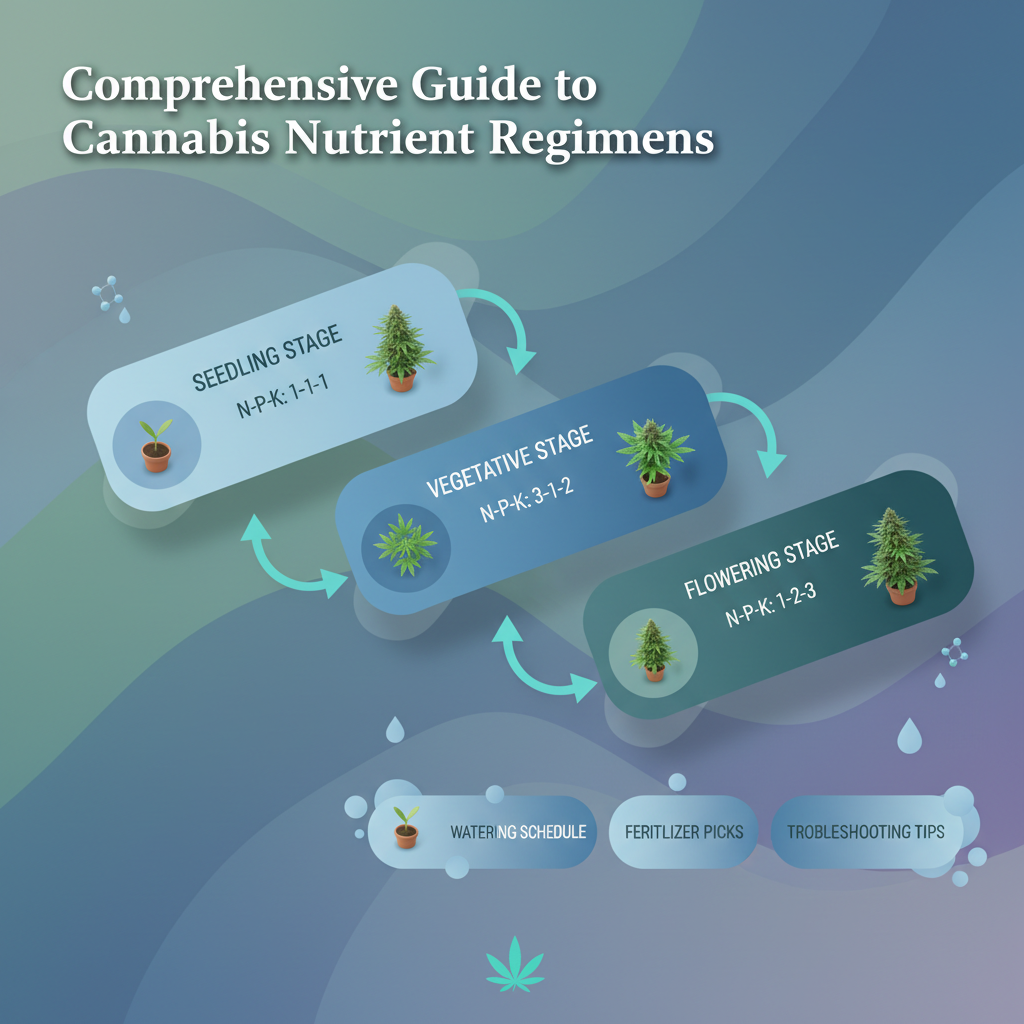
A practical Cannabis Nutrient Regimens Guide should help growers understand what plants need at each stage without turning feeding into guesswork. Seedlings, vegetative plants, and flowering plants have different nutrient demands, so using the same strength and balance throughout the entire grow can lead to deficiencies, excesses, or unnecessary stress.
In this guide, The Seed Connect explains how to build a stage-based feeding plan, understand NPK, monitor pH and EC, and adjust nutrients based on plant response instead of following a chart blindly.
Key Take Away
- Feed according to growth stage.
- Start seedlings lightly.
- Use EC/PPM to track feed strength.
- Keep root-zone pH stable.
- Adjust based on plant response, not the calendar alone.
Table of Contents
-
Start here: a common nutrient challenge and what it costs you
-
Choosing fertilizers: organic vs synthetic and brand comparisons
Start here: a common nutrient challenge and what it costs you
A plant turning yellow two weeks into flowering can make even calm growers reach for the bottle too fast.
The usual scene is familiar: healthy green growth, then pale lower leaves, then a creeping panic that something is already going wrong.
That yellowing often sends people chasing fixes in the wrong order.
They add more cannabis nutrients, switch bottles, or double up on feeding, and the plant ends up dealing with a second problem on top of the first.
A clean feeding plan matters because strong genetics still need the right support at the right stage.
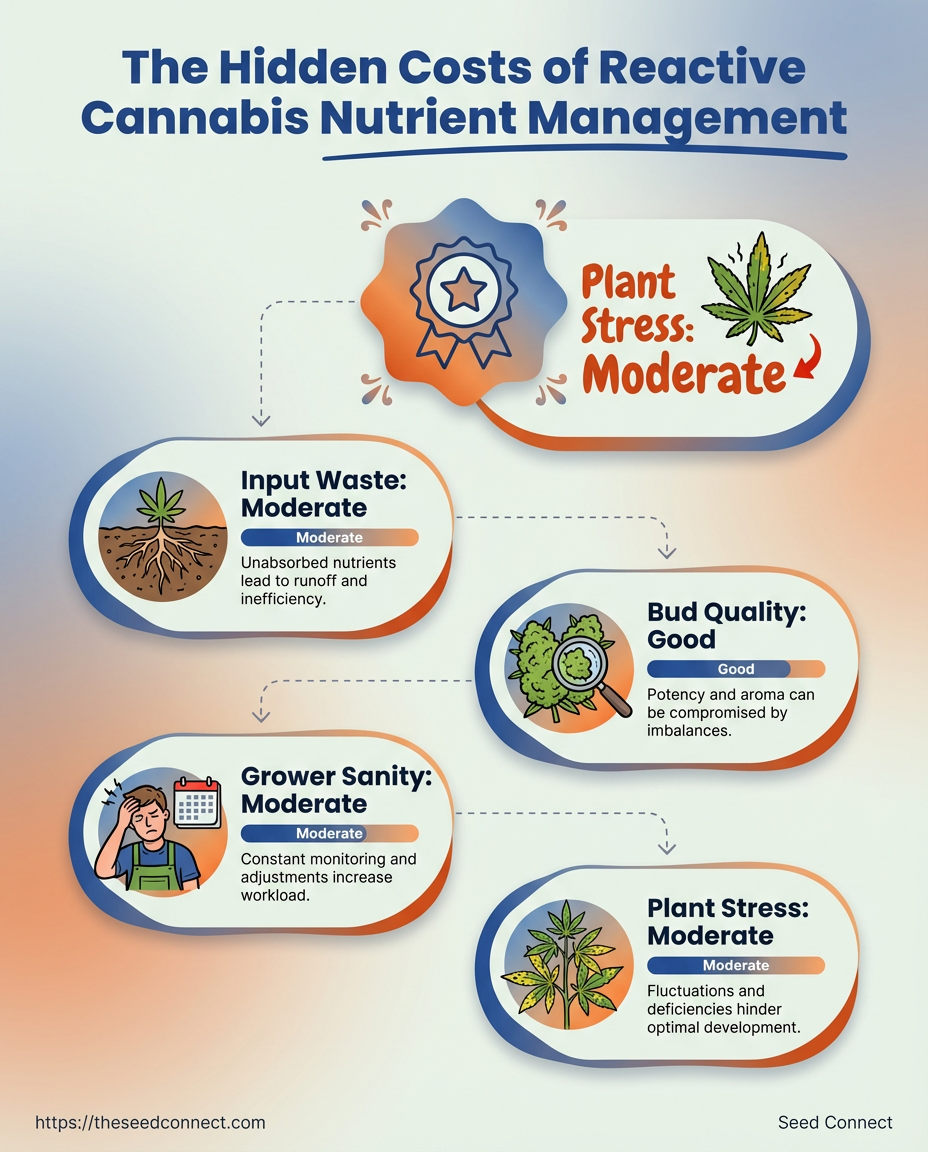
When fertilizing cannabis plants is reactive instead of planned, you waste time, burn through inputs, and make every symptom harder to read.
The cost shows up fast.
-
Plant stress: A hungry plant slows down, and a overfed plant can lock out nutrients just as easily.
-
Lower bud quality: Late fixes often keep the plant alive without fully restoring flower performance.
-
Wasted inputs: Extra bottles and emergency feeds add cost without solving the real issue.
-
Guesswork: Without nutrient schedules cannabis becomes a game of symptoms, not strategy.
A simple stage-based plan keeps the mess under control.
In veg, the goal is steady growth and healthy roots.
In early flower, the plant needs a shift in balance, not a dramatic feeding spike.
Consider a grower who sees yellow lower leaves and assumes nitrogen deficiency.
If the medium is already wet and roots are under stress, adding more food can make things worse.
A better move is to check runoff, watering rhythm, and the last feeding before changing anything.
That habit saves money and sanity.
It also protects the work that went into starting with quality seeds in the first place.
The fastest growers are not the ones dumping in the most nutrients.
They are the ones following a clear plan, reading the plant early, and making small corrections before the problem gets expensive.
Cannabis nutrient fundamentals
What if the problem is not that the plant is “hungry,” but that the feed is out of balance? That mistake happens a lot with cannabis nutrients.
A grower sees pale leaves or slow growth and reaches for more fertilizer, when the real issue may be a missing secondary nutrient, a pH lockout, or a feed that is simply too hot.
The clean way to think about fertilizing cannabis plants is simple: macronutrients build most of the plant mass, while micronutrients act like the crew that keeps the whole machine running.
The numbers on the bottle matter too, but they only make sense when you read them alongside N-P-K, EC/PPM, and pH.
Macronutrients vs micronutrients
|
Nutrient |
Role in plant |
Common deficiency signs |
Common excess signs |
Quick corrective step |
|---|---|---|---|---|
|
Nitrogen (N) |
Leaf growth, chlorophyll, overall vigor |
Older leaves yellow first, weak growth, lower vigor |
Very dark green leaves, clawing, soft growth |
Raise feed slightly and keep the root zone in range |
|
Phosphorus (P) |
Root growth, energy transfer, flower development |
Dark dull leaves, slow growth, purpling in some plants |
Stunted growth, micronutrient lockout |
Check pH, then adjust bloom feed carefully |
|
Potassium (K) |
Water movement, enzyme function, flower quality |
Leaf edge burn, weak stems, mottling |
Salt stress, calcium and magnesium issues |
Reduce strength and balance the feed |
|
Calcium (Ca) |
Cell walls, root tips, new growth |
New leaves twist, tips deform, spotting on young growth |
Rare, but can drive other nutrient problems |
Use a calcium source and stabilize pH |
|
Magnesium (Mg) |
Chlorophyll center, energy capture |
Older leaves yellow between veins |
Can interfere with calcium uptake |
Add magnesium lightly and verify pH |
|
Sulfur (S) |
Protein formation, enzyme activity |
Young leaves pale, overall uniform yellowing |
Burned tips, harsh salt buildup |
Back off salts and recheck the mix |
|
Iron (Fe) |
Chlorophyll formation, new leaf color |
New growth turns pale between veins |
Very uncommon, often tied to low pH |
Bring pH into range before adding more iron |
|
Manganese (Mn) |
Enzyme support, photosynthesis |
Speckling, interveinal yellowing on new growth |
Brown spots, leaf distortion |
Correct pH and avoid overfeeding |
Most deficiency patterns show up in a predictable way.
Mobile nutrients like nitrogen, phosphorus, and magnesium usually fail in older leaves first.
Immobile nutrients like calcium, iron, and manganese usually show stress in new growth, which is why the youngest leaves tell a useful story.
The numbers that guide feeding
A bottle of nutrients can look scientific and still be wrong for the plant. N-P-K tells you the ratio of nitrogen, phosphorus, and potassium, but it does not tell you how strong the mix really is.
That is where EC/PPM and pH come in.
EC shows how much dissolved mineral content is in the solution, while pH controls whether the roots can actually absorb those minerals.
N-P-K: Read it as the fertilizer’s basic balance, not a full recipe.A higher number does not automatically mean better cannabis nutrients.
EC/PPM: Use it to track feed strength.If the reading climbs too fast, the plant may be getting more salts than it can use.
pH: Keep the root zone in the right range so nutrients stay available.Outside range, even a well-made mix can behave like a bad one.
A simple habit: Check the solution before watering and the runoff after.That pattern catches problems early and keeps nutrient schedules cannabis growers use from drifting too far off track.
Once those three numbers make sense, feeding gets a lot less mysterious.
The plant stops looking like a guessing game and starts looking like a conversation.
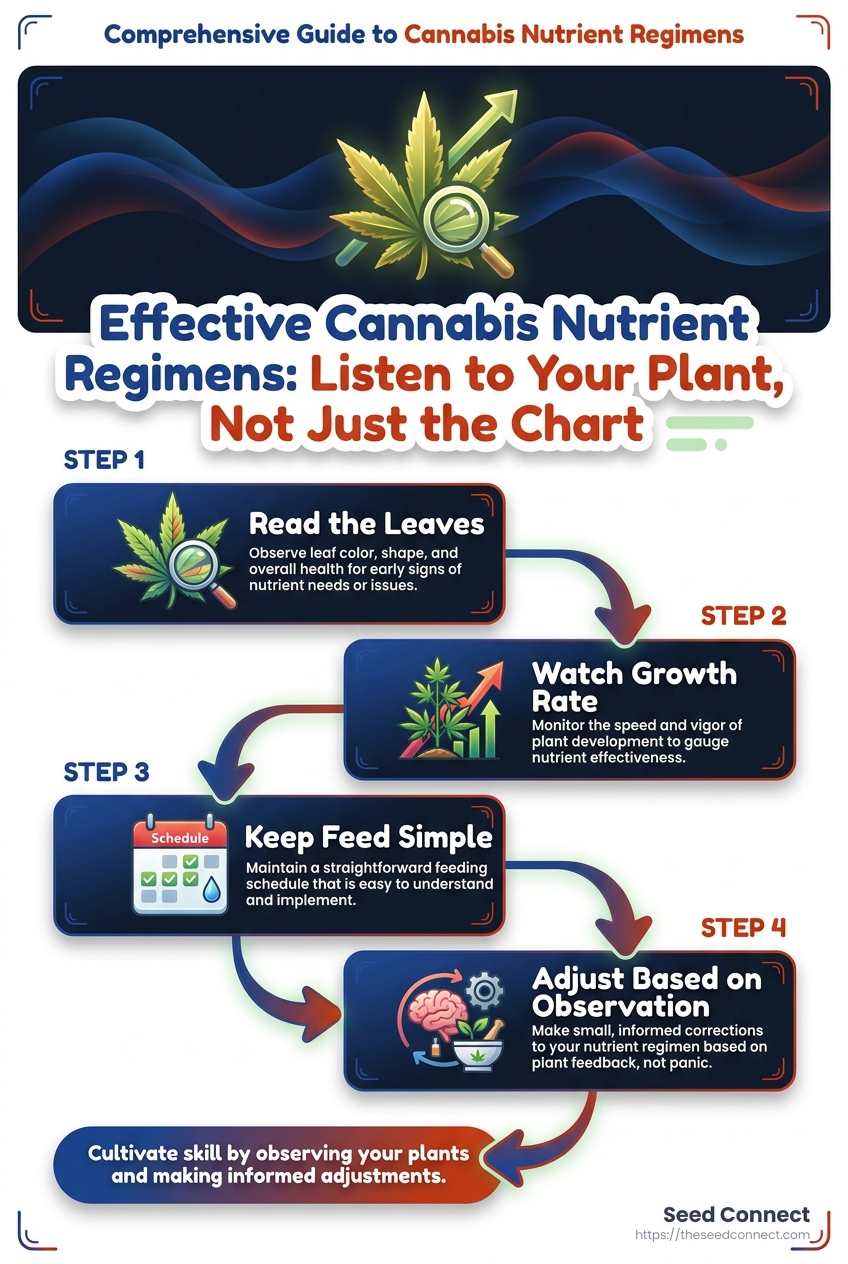
Stage-by-stage nutrient schedules (seedling → veg → flower)
A seedling does not want a heavy plate of nutrients.
It wants a light meal, then a bit more once the roots start moving.
With cannabis nutrients, the schedule changes faster than most new growers expect.
The safest pattern is simple: start very light after the first true leaves, step up slowly through veg, then shift the balance toward bloom once pistils show.
Seedling and early veg feeding guide
|
Stage |
Typical age (days/weeks) |
Recommended N-P-K ratio |
EC/PPM target |
Feed frequency |
Notes |
|---|---|---|---|---|---|
|
Germination / seedling |
0-10 days |
|
0.2-0.5 EC / 100-250 ppm |
Every 2-3 waterings, or plain water only |
Start only after the cotyledons open and the first true leaves appear. |
|
Early veg (first true leaves) |
10-21 days |
|
0.5-0.9 EC / 250-450 ppm |
1 light feed, then plain water |
Keep it gentle. New roots burn fast under strong feeds. |
|
Active veg |
3-6 weeks |
|
0.9-1.4 EC / 450-700 ppm |
Every 1-2 waterings |
Raise strength only if growth stays fast and leaf color stays even. |
In practice, the best nutrient schedules cannabis growers follow are boring in the best way.
They begin with half-strength at most, then watch leaf tips, color, and growth speed before raising the dose.
For fertilizing cannabis plants, the plant usually tells the truth within a week.
Pale new growth can mean it is time to step up slightly, while dark, clawed leaves usually mean the mix is too hot.
Late veg to flower
Once stretch starts, the goal changes.
Nitrogen still matters, but phosphorus and potassium take a bigger role, and that shift should begin before the plant is deep into bloom.
-
Late veg, 1-2 weeks before bloom: Ease down nitrogen and bring the feed closer to a bloom-leaning ratio, often around
2-2-3. -
Flower weeks 1-3: Keep feeding steady while the plant stretches.
This is not the time for a dramatic jump.
-
Mid flower: Move into a stronger bloom mix, often
1-3-4or similar, depending on the line. -
Final flush: Start 7-14 days before harvest in soil, or a little earlier in faster media if the leaves are still deep green.
That last step matters more than many people think.
A clean finish helps the plant use up what is already in the media, and it keeps the final taste from feeling harsh.
A smooth schedule beats a dramatic one every time.
Slow changes keep the plant stable, and stable plants reward you later.
Creating a realistic feeding schedule for your setup
A schedule that works in coco can wreck a soil run, and hydro can make both look sleepy by comparison.
That is why the container, the roots, and the irrigation style matter as much as the bottle label.
With cannabis nutrients, the medium sets the pace.
Soil tends to buffer mistakes, coco feeds more like a conversation, and hydroponics responds almost immediately when the mix shifts.
Match the pace to the medium
Soil usually needs the gentlest hand because it holds minerals and moisture longer.
Coco dries faster and has less natural nutrition, so feeding tends to happen more often, with tighter control.
Hydroponics moves the fastest, which is great when the mix is right and annoying when it is not.
-
Soil: Start lighter and leave room for the mix already in the pot.
-
Coco: Feed more consistently and watch runoff, since coco can pull calcium and magnesium out of balance.
-
Hydroponics: Keep the feed clean and stable, because the root zone changes fast.
That difference matters for nutrient schedules cannabis growers use every day.
A “one chart fits all” plan usually fails because the root environment changes how much the plant can absorb.
Scale the manufacturer chart to your plants
A feed chart is a starting point, not a commandment.
Most charts assume ideal conditions, a healthy root zone, and a plant that is already taking up nutrients well.
-
Start at the low end. Use the weakest suggested mix for your medium and plant size.
-
Watch the plant for 48 to 72 hours. New growth should stay steady, not claw, bleach, or twist.
-
Check input and runoff. If runoff climbs hard, the root zone is holding more salts than you want.
-
Adjust in small steps. Move up or down one small notch at a time, not half the bottle.
A grower can think of it like seasoning soup. Too much at once is hard to undo.
Keep a simple log
A notebook beats memory every time, especially once multiple plants start looking similar.
Good records make fertilizing cannabis plants less guesswork and more pattern recognition.
Record these each time:
Date and medium: Soil, coco, or hydro.
Mix strength: EC or PPM, plus dilution.
Watering volume: How much went in.
Plant response: Leaf color, edge burn, droop, or fresh growth.
Runoff notes: If you collect runoff, log its EC or PPM too.
A simple template works fine: Day 1: Medium, feed strength, water volume, plant look Day 3: New growth, leaf posture, runoff reading Day 5: Any changes made, and why Keep the chart honest, keep the logs short, and the schedule gets clearer fast.
That kind of record turns cannabis nutrients from trial and error into a repeatable routine.
Choosing fertilizers: organic vs synthetic and brand comparisons
Two growers can pour the same bottle and get very different results.
One is working in living soil and wants slow, steady feeding.
The other is running coco or hydro and needs tighter control over cannabis nutrients from week to week.
Genetics and climate matter just as much as the label.
A forgiving, broad-leaf plant in a cooler room usually handles organic feeding with fewer surprises, while a fast-flowering plant in a warm tent often responds better to cleaner mineral salts and more exact nutrient schedules cannabis growers can repeat.
Organic and synthetic programs each have a real place.
Organic blends usually build better soil life and are more forgiving when the room runs a little cool, but they can react slowly and leave less room for quick corrections.
Synthetic lines move faster and give more precise control when you are fertilizing cannabis plants in coco or hydro.
They also ask for more discipline, because a heavy hand can create salt buildup or tip burn fast.
Comparing common nutrient lines
|
Product/Line |
Type (organic/synthetic) |
Parts (1/2/3) |
Best for (soil/coco/hydro) |
Ease of use (beginner→advanced) |
Estimated cost per grow |
|---|---|---|---|---|---|
|
Synthetic |
3 |
Coco, hydro, soil |
Intermediate |
Moderate | |
|
Advanced Nutrients pH Perfect Grow-Micro-Bloom |
Synthetic |
3 |
Soil, coco, hydro |
Beginner to intermediate |
Moderate to high |
|
BioBizz Try Pack Indoor |
Organic |
3 |
Soil |
Beginner |
Moderate |
|
Canna Aqua Vega / Aqua Flores |
Synthetic |
2 |
Hydro |
Intermediate to advanced |
Moderate |
General Hydroponics and Canna usually suit growers who want a cleaner mineral feed and tighter control.
BioBizz fits better when the root zone is built around biology, not speed, and Advanced Nutrients is popular with growers who want simpler pH management.
A practical buying check starts with the medium, then the plant type, then the climate.
Warm, fast-drying rooms usually pair well with mineral lines, while cooler rooms and richer soils often reward slower organic feeding.
Check the base ingredients: Look for whether the line is mineral salt, compost-based, kelp-based, or a blended program.
Match the medium: Soil wants different feeding than coco, and hydro wants the most precise control.
Read the mix instructions: Good labels show grams or milliliters per liter, not vague guesses.
Look for support: A solid supplier gives feed charts, deficiency guidance, and quick answers when a batch behaves oddly.
Expect consistency: The best brands keep the formula stable from bottle to bottle, so your results do not swing wildly.
One last thing matters more than most labels admit: keep the feed line boring at first.
A simple, well-matched program usually beats a complicated shelf full of additives, especially when you are still learning how a specific genetics line drinks.
Troubleshooting common nutrient problems and prevention
Pale patches, curled tips, and stalled new growth usually show up long before a plant gives up. The trick is reading the pattern, not chasing every odd leaf.
Older leaves fading first points somewhere different from twisted new growth.
That split matters when you are sorting through cannabis nutrients, because the wrong fix can make a small issue louder.