


If your grow room is too hot, your electric bills increase.
Also, the density of buds can differ between plants.
Often, the issue is related to something above the canopy.
Choices among cannabis lighting systems directly shape plant development, room climate, and operating costs.
Picking the right indoor grow lights isn’t just about wattage; it’s about spectrum, heat, and lifespan.
The familiar contrast between LED and HPS lights frames most decisions growers make.
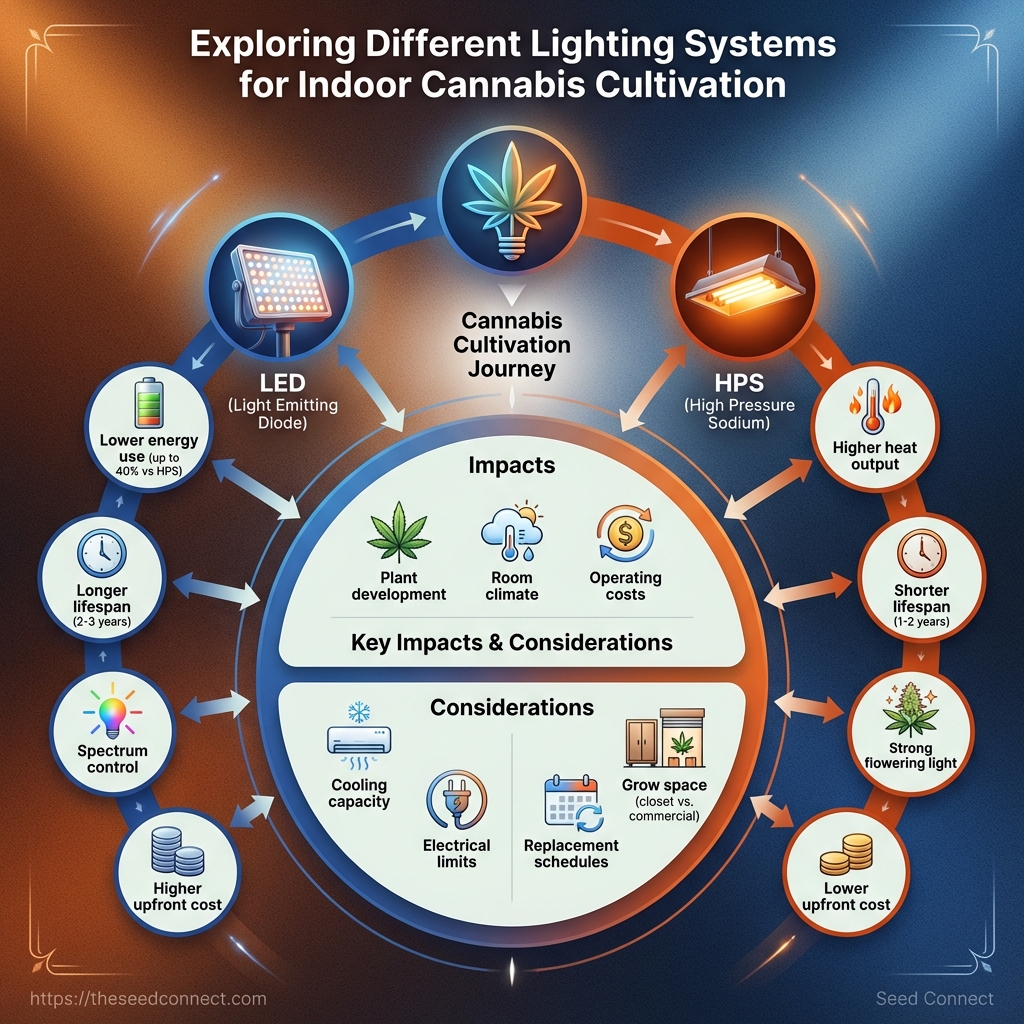
By 2025, LEDs might reduce electrical use by about 40% compared to HPS lights.
Typically, LEDs last around 2–3 years, while HPS lasts 1–2 years.
These estimates are likely higher now.
Manufacturers like Hydrofarm, Sun System’s LEC series, and California LightWorks are pushing different trade-offs between efficiency, spectrum control, and upfront cost.
Real choices come down to space, budget, and how hands-on the grower wants to be.
When weighing LED vs HPS cannabis setups, consider cooling capacity, electrical limits, and replacement schedules.
That small list often decides which system makes sense for a closet grow versus a commercial tent.
Let’s explore a relatable grower scenario.
Picture this: a hobbyist with a 4′ x 4′ tent and a tight budget is choosing between an HPS lamp and a modern LED fixture.
They want dense buds, low bills, and no issues with seed germination.
Their tent sits above a finished basement room.
Temperature spikes under HPS, leaves curl in mid-flower, and a fan runs constantly.
The grower wonders whether switching to LED will cut electrical costs and save plants from heat stress.
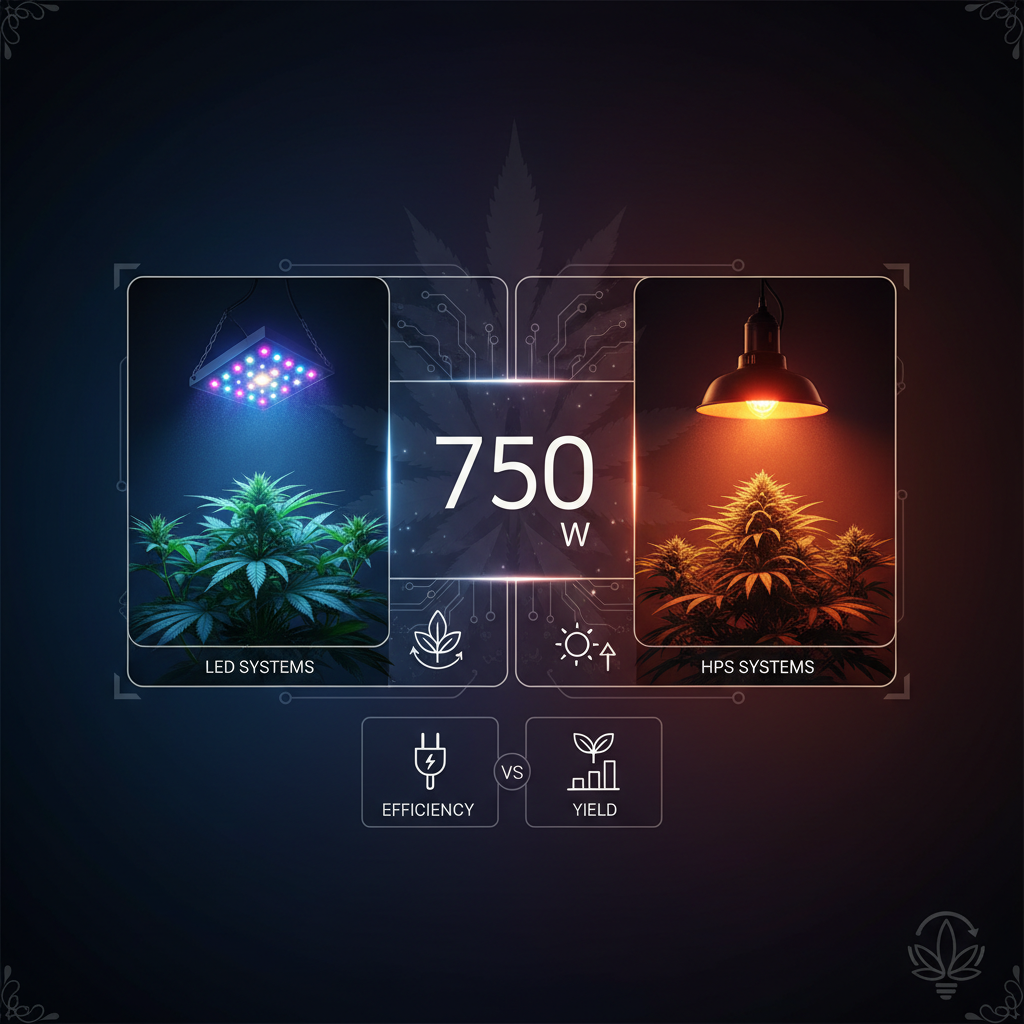
The illustration shows the same 4′ x 4′ canopy under two setups.
One side displays HPS: hot, yellow-orange light, denser heat plume, and a compact canopy beneath a single center hotspot.
The other side shows LED: even light spread, cooler air, truer leaf color, and a wider, flatter canopy.
LED Lights:
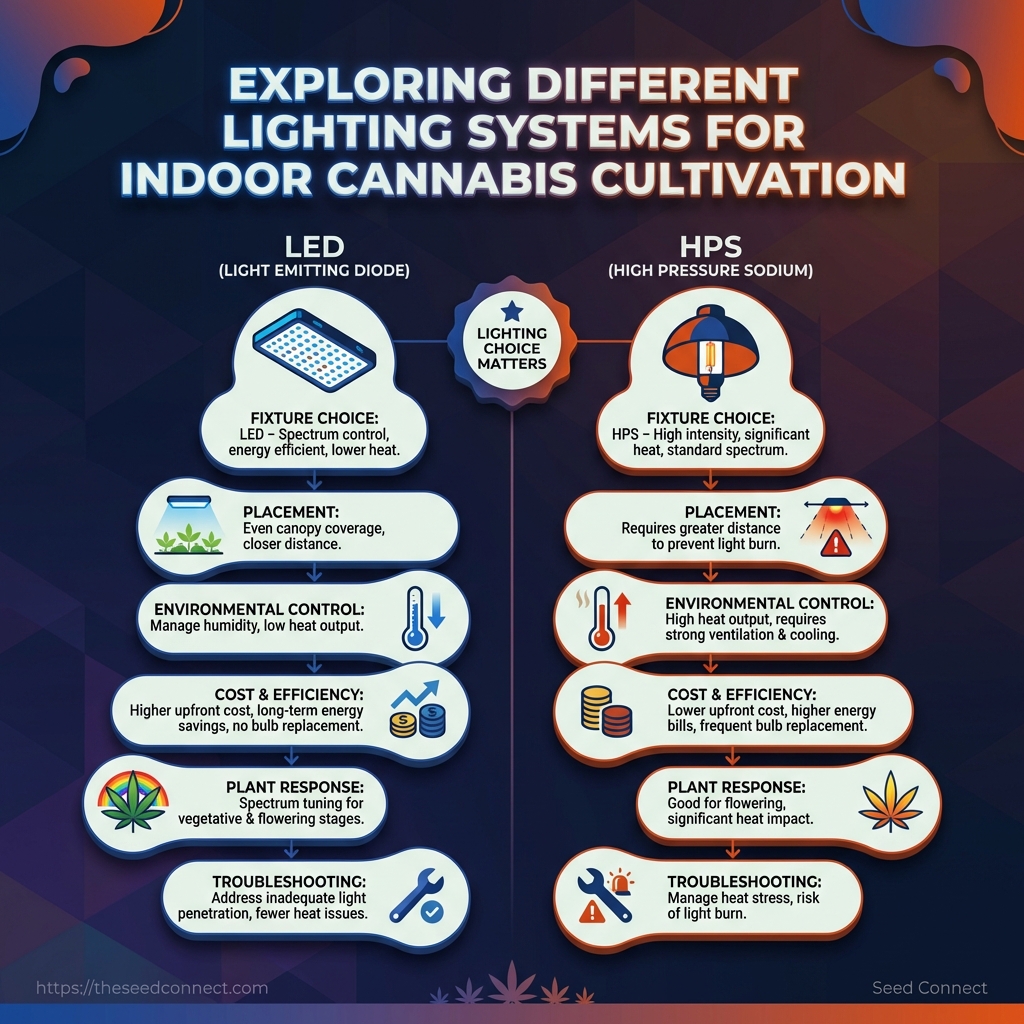
Energy-efficient fixtures that allow spectrum control and often reduce electricity use; long-term savings offset higher upfront cost.
HPS Lights:
High-intensity lamps that produce strong flowering light but generate more heat and frequent bulb replacements.
Germination guarantee:
Seller promise that seeds will sprout under reasonable conditions; outcomes improve when seedlings avoid heat shock and light stress — factors tied to the grow light used.
A few concrete considerations for the small-room grower follow.
Heat profile: LEDs produce far less radiant heat than HPS, which matters in tight tents and affects humidity control.
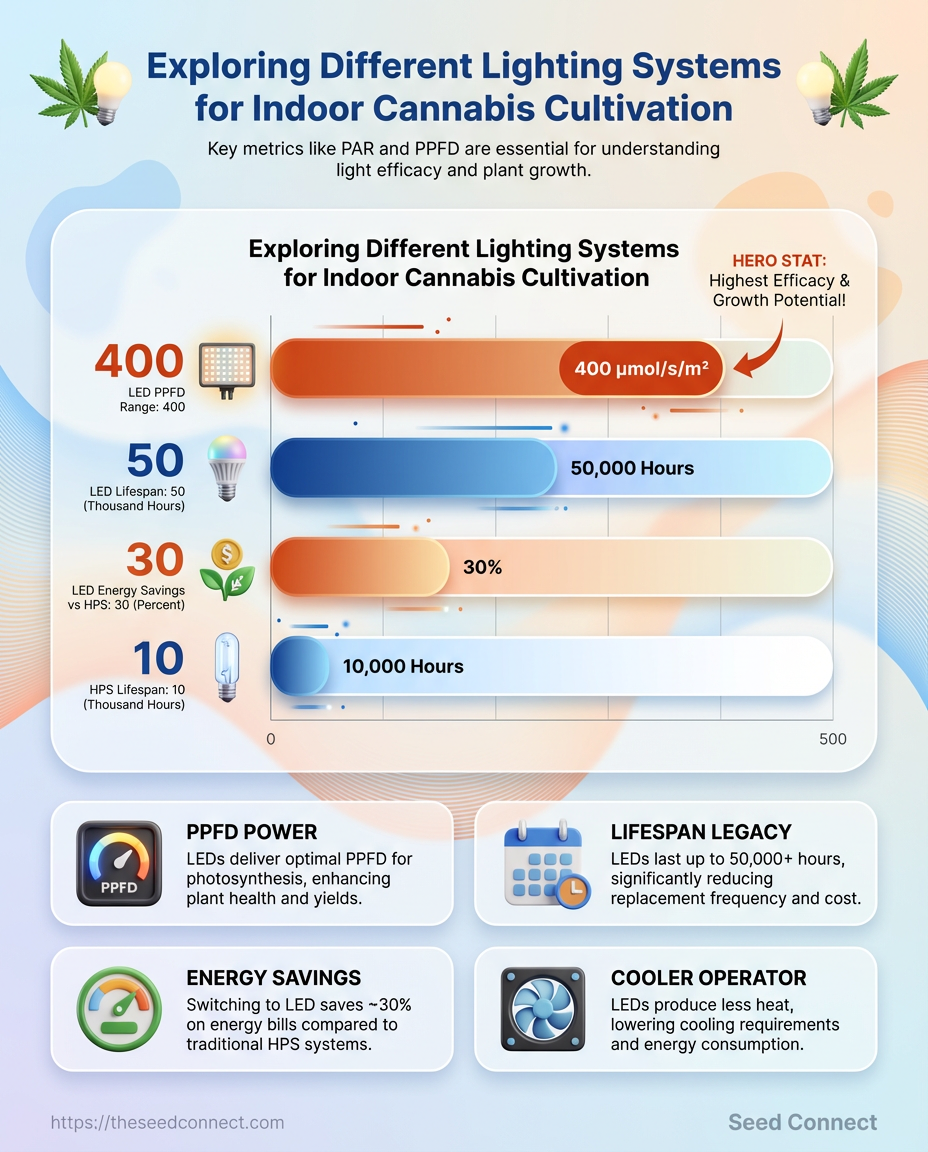
Energy and lifespan: A 2025 Agricultural Lighting Association study found LEDs can cut electrical use by up to 40% versus HPS, and market analysis from 2025 shows LED lifespans around 2–3 years compared with 1–2 years for HPS lamps.
Spectrum and plant response: LEDs let you dial in blue for vegetative growth or red for bloom; Sun System’s LEC series and similar solutions use broader spectrums that change how plants stretch and flower.
Choosing the right light also changes seed selection.
Some seed types—especially delicate autoflowers—tolerate cooler spectrums and lower heat better, which helps honor germination guarantees from platforms like The Seed Connect.
A well-chosen fixture solves room heat, lowers running costs, and protects seedlings during the critical germination-to-transplant window.
Overview of common lighting systems
Curious which lamp actually shapes the plant more than the grower? Lighting is the single biggest environmental input that alters leaf structure, internode spacing, resin production, and even terpene balance.
Picking between technologies means trading heat, spectrum control, lifespan, and power draw.
This section compares the major options you’ll see in modern cannabis grows and explains how each one nudges morphology and cannabinoids.
Expect practical notes on PPFD behaviour, typical lifespans, and the use cases where each light shines.
That context makes the choice less emotional and more tactical when designing a tent, room, or greenhouse with efficient indoor grow lights.
Quick comparison table
| Light type | Typical spectrum | PPFD / PAR notes | Heat output | Lifespan | Typical upfront cost | Best use case |
|—|—:|—|—:|—:|—:|—|
| LED (commercial full‑spectrum fixtures) | Broad, tunable (full 350–750 nm) | High PPF; even canopy coverage, often 400–900 μmol/m²/s depending on fixture | Low-to-moderate (driver heat) | 2–3 years (market 2025) | $400–$2,000 | Whole-cycle in tents/rooms; energy-conscious commercial grows |
| LED (budget “blurple”) | Narrow red/blue peaks | Uneven PAR hotspots; lower usable PPFD | Low at fixture, may heat canopy | 2–3 years | $50–$300 | Small hobby tents, seedlings, cost-limited setups |
| HPS (flower spectrum) | Red/orange heavy (ideal for bloom) | Very high PPF at canopy; excellent flower penetration | High (lamp + ballast) | 1–2 years (market 2025) | $150–$400 (ballast + bulb) | Dense flowering rooms, legacy commercial racks |
| MH (metal halide — veg spectrum) | Blue-rich spectrum | Good vegetative PAR; less penetration than HPS | High | 1–2 years | $150–$350 | Vegetative bays, early-stage growth |
| CMH / LEC (e.g., Sun System LEC series) | Broad, CRI-rich ceramic MH | Strong full-spectrum PAR; even canopy delivery | Moderate | 1.5–2.5 years | $200–$600 | Quality-focused full-cycle grows, flavor-forward runs |
| CFL (compact fluorescent) | Warm/cool bulbs available | Low PPFD; best close-proximity lighting | Low | 1–2 years | $20–$80 | Seedlings, clones, micro grows |
| T5 fluorescent | Cool white / full-spectrum options | Moderate PPFD across shallow canopy | Low | 1–2 years | $50–$200 | Seedlings, mothers, low-height veg racks |
| Natural / greenhouse supplemental | Full solar spectrum | Very high midday PPFD; diurnal fluctuation | Variable (ambient) | N/A | Variable (structure + glazing) | Greenhouse production; season-extended outdoor / supplemental lighting |
What stands out is that modern LEDs trade higher upfront cost for lower energy bills and longer service life, while HPS/ MH still offer straightforward high-intensity output at a lower initial price.
How each system affects plant morphology and cannabinoid development
Different spectra and intensity profiles change plant shape and chemistry.
Blue-rich light tightens internodes and produces compact, resinous growth.
Red-rich, high-intensity bloom light promotes stretch and larger flowers, which can increase overall yield but may alter terpene ratios.
LED (full‑spectrum): Promotes balanced morphology with denser canopies and often higher terpene preservation due to lower heat.
LED (blurple): Can boost early photosynthesis but may encourage looser canopy and inconsistent terpene profiles.
HPS: Drives vigorous flower development and heavier yields; elevated heat can concentrate cannabinoids but may stress volatile terpenes.
MH: Strong blue content produces stocky veg structure and leaf development for later flowering.
CMH/LEC: Broad, high-CRI spectrum supports terpene and flavonoid complexity while keeping morphology balanced.
CFL / T5: Gentle light that reduces stretch in seedlings but lacks PPFD for heavy flowering or cannabinoid maximization.
Natural / greenhouse: Full UV–IR solar mix can increase certain cannabinoid and terpene expressions but introduces seasonal variability.
Choosing a system means balancing desired plant form against energy, heat, and maintenance.
Match spectrum to growth stage and space constraints for the best results.
Spectrum, PAR, PPFD and what they mean for your plants
Plants care about color, quantity, and where light lands.
Spectrum describes which wavelengths hit a leaf.
Intensity measures how much light is available, and distribution describes how evenly that light spreads across the canopy.
Those three pieces together dictate photosynthesis rates, stretch, leaf thickness, and bud production.
Growers who treat spectrum, PAR, and PPFD as separate levers get better results from the same fixture than growers who only watch wattage or brand.
Understanding the differences lets you tune indoor grow lights and cannabis lighting systems to each growth stage for denser, more resinous flowers.
Spectrum: the mix of wavelengths, often shown as blue and red peaks.
Intensity: the number of photosynthetic photons available per second, usually measured as PPFD in µmol·m⁻²·s⁻¹.
Distribution: how PPFD varies across the canopy — hotspots vs shaded patches.
Spectrum: which colors matter and why
Blue light (400–500 nm) promotes compact growth and strong stems.
Red light (620–700 nm) drives flowering and bud development.
Far-red shifts photoperiod signals and can influence stretch and canopy shade responses.
Modern LED fixtures let you dial these bands independently.
That control is the main advantage of many indoor grow lights when compared with legacy HID options.
The diagram shows blue and red bands, a PAR curve, and a heatmap of PPFD across a 4′ x 4′ canopy.
Use it to spot hotspots and see where to adjust fixture height or add diffusion.
Look at the heatmap and ask whether lower canopy spots fall below target PPFD.
If they do, redistribution or supplemental light is required.
PAR vs PPFD: actionable differences
PAR stands for photosynthetically active radiation — the wavelength range plants use.
PPFD (photosynthetic photon flux density) tells you how many usable photons strike a square meter every second.
Think of PAR as the bucket of usable colors, and PPFD as the flow rate through that bucket.
A broad PAR range with low PPFD under the canopy still limits growth.
Practically, aim for PPFD ranges appropriate to stage and canopy density, and use spectrum shifts to control morphology.
Matching spectrum and intensity to growth stage
Seedlings want low intensity and a cooler spectrum to prevent stretch.
Vegetative plants thrive on stronger blue-rich light and higher PPFD for leaf production.
Flowering prefers increased red energy and peak PPFD on top colas.
Seedling: low PPFD (
50–150 µmol·m⁻²·s⁻¹) — gentle blue-rich spectrum.Vegetative: moderate PPFD (
200–450 µmol·m⁻²·s⁻¹) — more blue to density leaves.Early flower: raise PPFD (
400–600 µmol·m⁻²·s⁻¹) — balance red and blue.Late flower: peak PPFD (
600–900 µmol·m⁻²·s⁻¹) — richer red, careful heat management.
Adjust numbers by canopy thickness and cultivar genetics.
LED fixtures reduce electricity use versus HPS — studies in 2025 found LEDs can cut consumption by up to 40% compared with HPS systems — and they often let you tailor spectrum without extra lamps.
Use PPFD maps and a handheld meter to validate distribution across the canopy rather than trusting advertised wattage or fixture type.
Small fixes — moving a light 6–12 inches or adding a reflector — can rescue low-PPFD corners.
A lighting plan that separates spectrum, intensity, and distribution produces predictable plant responses and fewer surprises during crucial flowering weeks.
Practical setup: fixture selection, placement, and environmental impacts
Choosing the right fixture and where to place it can help you avoid problems down the road.
Think of lighting as a system: fixture specs, placement, and the room’s airflow all interact and decide whether a crop thrives or struggles.
Practical choices cut energy, reduce plant stress, and save time on troubleshooting.
This section gives concrete checks for different tent and room sizes, a clear way to calculate coverage and hang height, and pragmatic fixes for heat and humidity swings triggered by lamps.
The guidance draws on industry trends — for example, LEDs have shown up to a 40% electricity reduction versus HPS in a 2025 study — and on product lifespans (LEDs ~2–3 years; HPS ~1–2 years as of 2025).
Use the checklist and steps below to make decisions that match your space and goals.
Fixture selection checklist for different grow sizes
Start every purchase by matching canopy area, desired PPFD, and ventilation capacity.
Fixtures that suit a 2′ x 2′ space will overload a 5′ x 5′ canopy, and too-strong lamps without proper airflow create heat stress.
Small tent (2′ x 2′) — choose a compact full-spectrum LED with even footprint and a PAR map for the center 24″ x 24″.
Medium tent (3′ x 3′ to 4′ x 4′) — pick a multi-bar LED or a single 600–1000W-equivalent LED; confirm manufacturer PPFD maps for a 48″ x 48″ area.
Large tent (5′ x 5’+) — use multiple fixtures spaced to overlap PPFD contours; prefer modular LEDs for redundancy.
Commercial/room crop — plan fixtures in rows, use
PARmaps to create 10–15% overlap between adjacent arrays.HPS option — choose a white- or LEC-based hood (e.g., Sun System LEC) only if the room has cooling and you accept higher heat loads.
This short walkthrough shows mounting a full-spectrum LED and an HPS hood in a 4′ x 4′ tent, plus how to take PAR readings across the canopy to adjust hang height.
Placement, hang height, and calculating coverage for even PPFD
Measure before you hang anything.
Use the fixture’s PPFD map and a PAR meter to create a 3×3 grid over your canopy.
Target the average PPFD you want for the growth stage and adjust height to flatten the map.
Place a
PARmeter at canopy level in the tent’s center and corners.Record readings on a 3×3 grid and calculate average PPFD.
Raise or lower the fixture until the average matches target (seedling ~
100–300 µmol/m²/s; veg300–600 µmol/m²/s; flower600–900 µmol/m²/s).Aim for ≤20% variance across the canopy for even growth.
When using manufacturer maps, match your measured grid to the map’s contours rather than relying on wattage alone.
If a single fixture can’t meet uniformity, add a second fixture with overlapping PPFD to smooth hotspots.
Managing heat, ventilation and light-triggered humidity shifts
Heat and humidity follow the lamp.
Strong HPS setups push more sensible heat into the room, raising A/C needs; LEDs shift some heat lower but can still create hot spots under bars.
Airflow first: Install an exhaust fan sized to exchange the grow space air every 1–3 minutes depending on heat load.
Spot cooling: Add an oscillating fan near the canopy to break boundary layers and even temperature.
Dehumidify during lights-off: Transitions from high daytime humidity to lights-off condensation are common; use a humidistat-controlled dehumidifier for flower stretch.
Monitor at canopy level: Place temperature and RH sensors at canopy height, not at floor level.
If heat spikes when switching to HPS, lower ballast/fixture distance only if PAR maps still fit targets.
Otherwise reduce lamp run time slightly, increase exhaust, or swap to higher-efficiency LEDs.
The right fixture in the right place prevents most environmental headaches.
Small tweaks to hang height and airflow yield big gains in uniformity and energy bills.
Costs, efficiency and environmental considerations
When it comes to indoor cannabis cultivation, understanding the costs, efficiency, and environmental impacts of your lighting options is crucial for maximizing yields while keeping expenses in check.
Each lighting system has different operating costs and possible environmental effects that growers need to think about.
Choosing wisely means balancing initial investments with long-term benefits.
Energy consumption is a major factor in the overall cost of running a grow operation.
While traditional High-Pressure Sodium (HPS) lights have been popular for their high output, their energy requirements can lead to hefty electricity bills.
On the other hand, LEDs continue to gain traction due to their energy-efficient operation, customizable light spectrums, and significantly longer lifespan.
Understanding these dynamics can help growers make informed decisions that not only benefit their wallets but also the environment.
Growers should also be aware of the environmental impact of various lighting systems.
For instance, these systems contribute to overall greenhouse gas emissions through high electricity consumption.
However, advancements in technology—like those seen in products from companies such as California LightWorks and Hydrofarm—are favoring energy-efficient solutions that lessen the ecological footprint of indoor agriculture.
By carefully evaluating all aspects of lighting systems, growers can enhance both their operational efficiency and sustainability.
Operating cost and watt-to-yield considerations (annualized)
To provide clarity on operating costs and efficiency, the following table compares various lighting systems commonly used in cannabis cultivation.
Each entry includes the average wattage for a 4’x4’ canopy, estimated annual electricity costs, and the expected yield per cycle.
Operating cost comparison of common cannabis lighting systems
| Light Type | Average Wattage for 4’x4′ Canopy | Estimated Annual kWh (12-hour light cycle) | Estimated Annual Electricity Cost (by $0.15/kWh) | Lifespan (Hours) | Yield per Cycle (Relative) | Notes | |————————————-|———————————–|———————————————-|————————————————–|——————|————————–|——————————————-| | Commercial LED fixture (600W equiv.)| 300W | 1,095 | $164.25 | 50,000 | High | Energy-efficient; longer lifespan | | HPS 1000W (ballast draw) | 1000W | 3,650 | $547.50 | 24,000 | Medium | High heat output; requires cooling | | CMH / LEC 315W | 315W | 1,148 | $172.20 | 30,000 | Medium to High | Better energy use than HPS; wide spectrum | | CFL bank (equiv. output) | 200W | 730 | $109.50 | 10,000 | Low | Less efficient; shorter lifespan |
The table outlines how the commercial LED fixture stands out by significantly reducing energy consumption while providing yields.
Although the initial costs for LED fixtures can be higher, their longevity and efficiency lead to lower overall expenses over time.
Contrastingly, while HPS systems offer intense light, they burn out faster and generate more heat, leading to increased cooling costs that could offset potential savings.
As you navigate the world of cannabis lighting systems, weighing these costs alongside the environmental implications can help steer your decisions.
Understanding these dynamics not only promotes better business practices but also supports a more sustainable approach to cannabis cultivation.
Common problems and troubleshooting specific to each light type
Ever swapped a lamp and watched leaves go pale or stems stretch overnight? Lighting quirks are often the hidden culprit behind nutrient-looking problems, heat stress, or unexpected growth changes.
Fixes start with correctly diagnosing which light trait is causing the symptom.
Different fixtures create different failure patterns.
LED issues usually show as uneven canopy coverage, spectrum-driven yellowing, or driver failures.
HPS problems often involve heat-related leaf curl and uneven light drop-off.
LEC/CMH systems sit between those two: better spectrum than HPS but with ballast and ceramic lamp aging to watch.
Use this section to link symptoms to likely causes and to follow a clear troubleshooting path.
Practical diagnostics beat guessing.
Start by checking distance, PAR/PPFD, and run schedule before adjusting nutrients.
The 2025 Agricultural Lighting Association study found LED systems can cut electricity use by up to 40% compared with HPS (2025), and market analysis from 2025 reports LEDs lasting roughly 2–3 years versus 1–2 years for HPS.
Those facts matter when a fixture behaves oddly; age and efficiency losses are common root causes.
LED fixtures: yellowing, hotspots, and driver faults
LEDs often create spotty symptoms because of focused diodes and lens optics.
If yellowing appears only in bright zones, that’s likely spectrum stress or light burn rather than a nutrient deficiency.
Symptom: Upper canopy yellow or crispy tips
Likely cause: Fixture too close or high blue/white spectrum intensity
Fix: Raise the fixture 4–12 inches depending on output, or dial spectrum/veg/flower mode down if available
Symptom: Patchy growth under specific diodes
Likely cause: Failing LED chip or driver inconsistency
Fix: Swap channels, test with a different driver, or contact the manufacturer (brands like California LightWorks and Hydrofarm offer support for these issues)
HPS and LEC/CMH: heat, stretch, and lamp aging
HPS produces lots of heat and strong red light that can mask nitrogen issues until stress appears.
LEC/CMH (Sun System LEC series) gives fuller spectrum but still needs ballast checks.
Symptom: Lower leaves yellow while stems elongate
Likely cause: Excessive distance followed by sudden high-intensity exposure (stretch then shock) or inadequate nighttime cooling
Fix: Keep consistent height changes, improve airflow, monitor night/day temps
Symptom: Sudden drop in intensity after months of use
Likely cause: Lamp aging or ballast degradation
Fix: Replace lamp or ballast per manufacturer interval; consider LEDs for longer life if replacement cost is a concern
When switching lights or changing schedules stresses plants
Changing light type or photoperiod can nudge plants into hormonal stress and shift flowering timing.
A shift from high-red HPS to a blue-rich LED can delay flowering signals briefly.
Pause major feeding or pruning for 3–5 days after a switch.
Introduce new schedule in small increments (one hour per day).
Watch trichome/cloudiness for true flowering changes rather than leaf color alone.
The flowchart walks step-by-step: check distance → measure PAR/PPFD → inspect heat → verify schedule → adjust.
Use it as a quick triage tool before changing nutrients or pH.
If a quick fix doesn’t resolve symptoms in 72 hours, log fixture age, spectrum mode, and recent schedule changes before deeper troubleshooting.
Light problems often look like nutrient problems, but fixing the light usually fixes the plant.
Choosing the right light for your seeds and growing goals
Pick lights that match not just square footage, but the genetics and the guarantees behind your seeds.
Different seed types, like autoflowers and feminized photoperiods, respond differently to light schedules and intensity.
Match the plant’s vigor and your germination guarantee so you don’t waste time replacing seedlings under the wrong fixture.
Energy and lifetime matter for budgeting and reliability.
LEDs can cut electricity use by up to 40% compared with HPS systems (Agricultural Lighting Association, 2025), and typical LED fixtures now last 2–3 years on average while HPS bulbs are usually replaced every 1–2 years (2025 market analysis).
That changes how quickly a germination failure becomes expensive to recover from.
Lighting choice also affects how forgiving early-stage plants are.
A stable, appropriately sized LED makes early recovery easier for delicate seedlings, while high-heat HPS/LEC setups demand stricter environmental control and faster response if seeds struggle.
Decision guide: small personal tent, multi-tent hobby, small commercial
| Grow scale | Suggested fixture type | Approx. wattage / fixture | Ventilation recommendation | Budget level | Why it fits |
|—|—:|—:|—|—|—|
| Small personal tent (2’x2′ to 3’x3′) | Compact full-spectrum LED (single-bar or panel) | 150–300W | Passive intake + 4″ inline fan exhaust | Low–Medium | Low heat, low draw, easy to mount for one or two plants |
| Standard tent (4’x4′ to 5’x5′) | High-output LED panel or 600W HPS/LEC alternative | 300–600W | 6″ inline fan, carbon filter recommended | Medium | Balances canopy coverage and control; fits most hobby rigs |
| Multi-tent hobby (two or more tents) | Modular LED fixtures (daisy-chain capable) or mixed LED + LEC | 2×300W or 600–1000W total | Zoned exhaust per tent + ducting | Medium–High | Scales easily; modular LEDs reduce replacement downtime (Hydrofarm models useful here) |
| Small commercial / 100+ sqft | High-output LED fixtures or rows of LED bars | 1000–2000W equivalent per bay | Dedicated HVAC with fresh-air intake and dehumidification | High | Maximizes energy savings and uptime; California LightWorks-style systems scale well |
This matrix focuses on common, real-world fixture types and ventilation needs.
For growers balancing cost and reliability, modular LEDs reduce single-point failures.
Sun System LECs are an option where broader spectrum and higher heat tolerance are desired.
Match your seed type and germination guarantee to light and environment
Autoflowers usually prefer consistent light and less shock during seedling stages, so lean toward low-heat LEDs with gentle ramping.
Feminized photoperiods tolerate staged light increases but need precise cycle control for flowering.
High-THC genetics often produce variable seedlings; if a vendor offers a germination guarantee, confirm how quickly replacements are issued and whether lighting-induced stress is covered.
Platforms like https://theseedconnect.com list germination policies that influence whether you choose a forgiving LED or higher-risk HPS/LEC setup.
Short checklist before you buy
Warranty: Verify fixture warranty length and what it covers (driver, diodes, burn-in).
Returns: Confirm return window and who pays shipping on defective units.
Local shipping & support: Check for domestic shipping, replacement parts availability, and vendor technical support.
Power draw vs. coverage: Compare
Wper square foot and expected lifespan (LEDs:2–3 years, HPS bulbs:1–2 yearsas of 2025).Serviceability: Prefer fixtures with replaceable drivers or modular LEDs to avoid full-unit replacement.
Choose lighting that reduces replacements and matches your seed support policy.
A practical fixture choice saves time and keeps your germination guarantee meaningful.
Conclusion
Make the light do the heavy lifting
One key factor matters more than just wattage: the lighting system you choose and how it’s positioned above your plants influences heat, light distribution, and, ultimately, bud density.
If your grow room runs hot and yields vary plant to plant, the issue almost always sits above the canopy — wrong spectrum, poor PPFD, or fixture placement.
Choosing fixtures with the appropriate spectrum, balanced light distribution, and good placement can help lower your energy bills while improving quality.
When weighing LED vs HPS cannabis options, think in terms of tradeoffs rather than marketing.
LEDs typically deliver higher photosynthetic efficiency and far less heat; HPS still offers strong PAR punch in big rooms, so match your indoor grow lights to ventilation, canopy size, and energy goals.
Start with one measurable step: measure canopy PPFD before finalizing fixtures — take PAR readings at several spots, raise or lower the lights accordingly, then decide whether to invest in new fixtures or change genetics like