

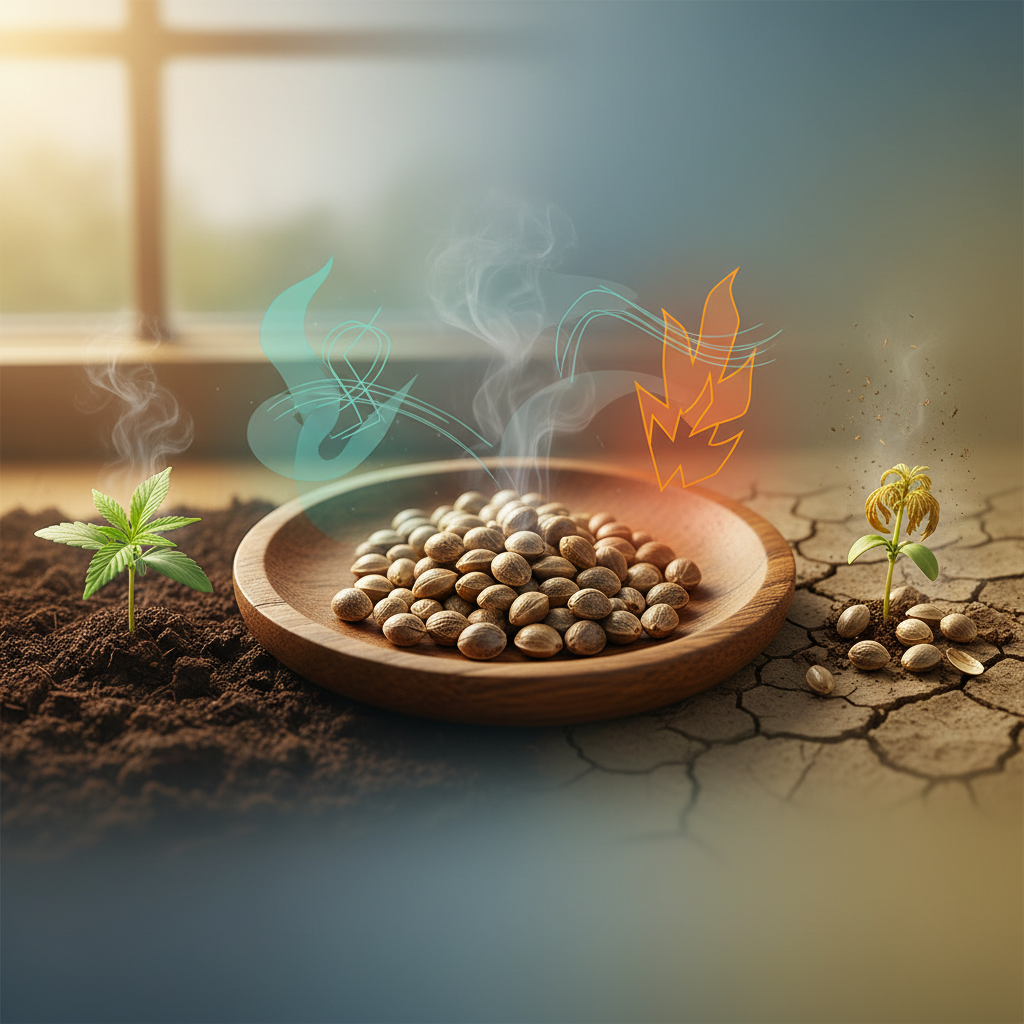
The Impact of Climate on Cannabis Seed Quality can begin long before a seed is planted. Temperature, humidity, light exposure, and storage conditions can all influence how well cannabis seeds retain their viability, vigor, and ability to germinate successfully.
According to seed-storage research, warmer temperatures and excess moisture can accelerate seed deterioration over time. In this guide, The Seed Connect explains how different climate conditions can affect cannabis seed quality and what growers can do to protect seeds during storage, shipping, and before germination.
Quick Answer: Climate directly determines cannabis seed viability by driving seed aging and stress before planting, with temperature, humidity, light, and airflow acting together. Excess humidity speeds breakdown and can shorten shelf life, while heat and repeated temperature swings weaken vigor and lead to poorer, less even germination even if seeds look healthy. To protect seed quality, store seeds in cool, stable conditions in darkness with low moisture and gentle, dry airflow.
Table of Contents
How climate shapes cannabis seed quality from the start
What if the weather was already shaping seed quality before planting even began?
That is exactly how climate and cannabis growth connect.
A seed does not wait for the grow room to tell its story; temperature, moisture, light, and airflow start influencing its condition long before germination.
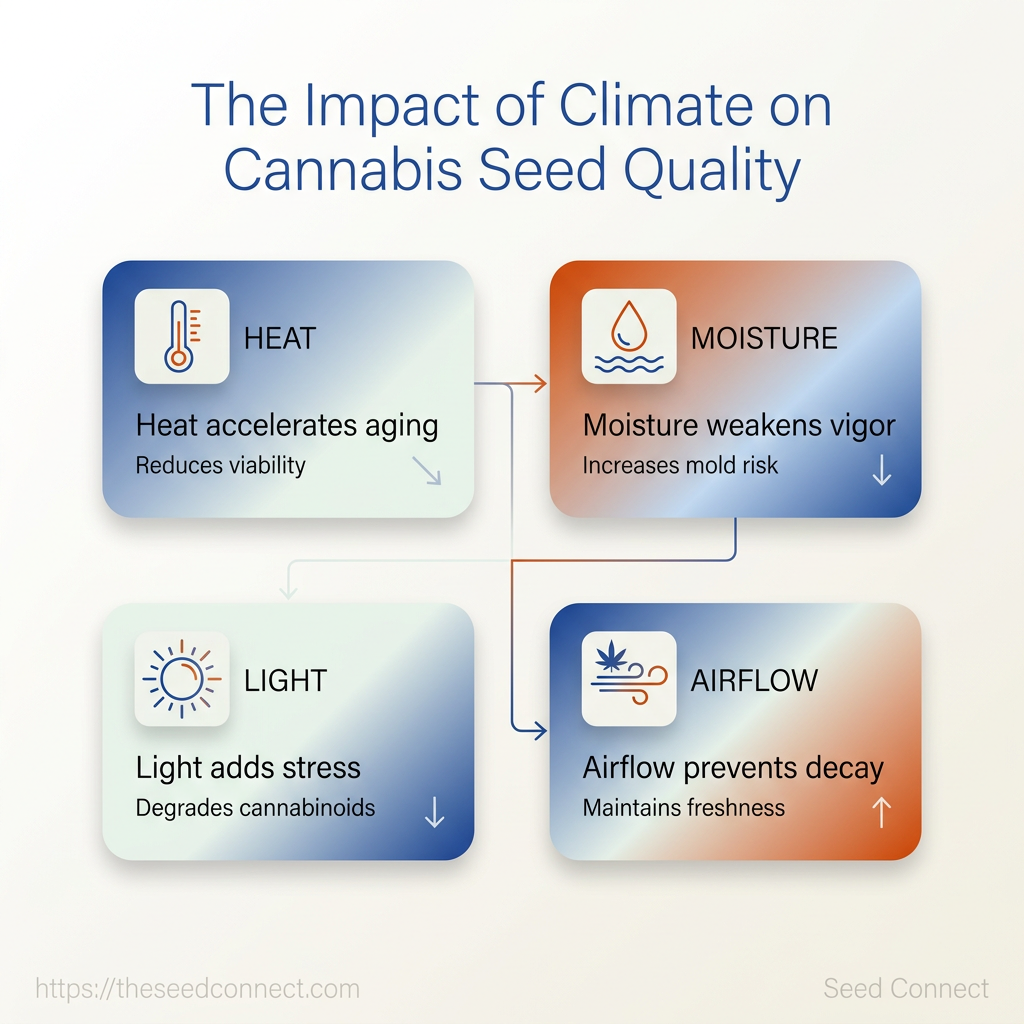
Heat speeds up aging.
Excess humidity invites premature breakdown.
Even brief swings can create stress that shows up later as weaker sprouting, uneven emergence, or poor vigor.
The four factors that matter most are temperature, humidity, light, and airflow.
Each one affects the environmental effects on seeds in a different way, but they work together.
Stable conditions protect viability, which keeps the seed ready to wake up when the grower wants it to.
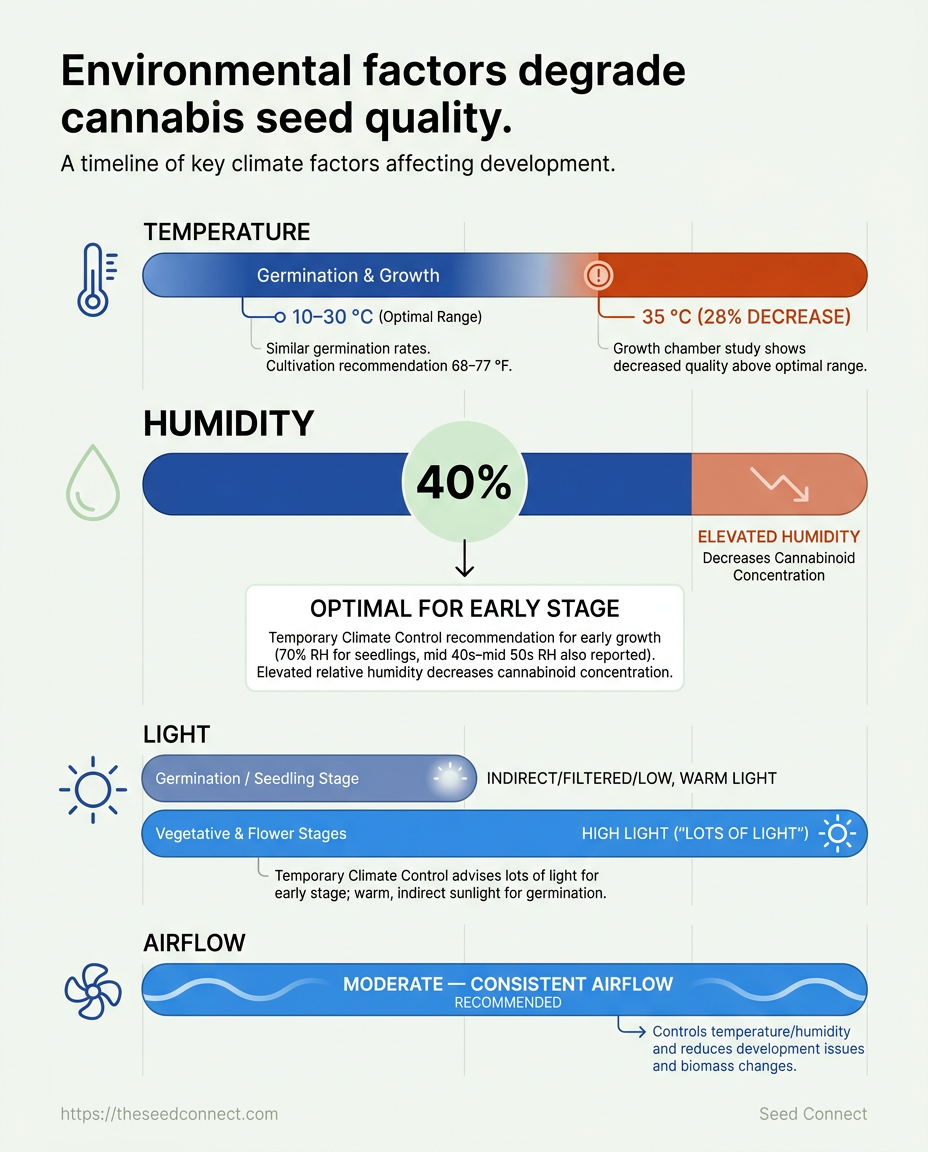
- Temperature: Cool, steady storage slows seed aging and helps preserve germination potential. Wild swings do the opposite, especially when seeds move between warm and cold spaces.
- Humidity: Moisture is the fastest way to damage stored seed. Too much humidity can raise internal seed activity and shorten shelf life.
- Light: Seeds prefer darkness in storage. Repeated light exposure can add unnecessary stress, especially when paired with heat.
- Airflow: Gentle, dry airflow helps prevent trapped moisture. Stale air around stored seeds often means higher humidity and more decay risk.
A recent trial on hemp seed storage found that germination in some lots dropped by 50% after only one year, according to the ACSESS study on seed moisture and temperature.
That is a good reminder that cannabis seed climate impact is not abstract.
It shows up fast when conditions drift.
Picture two growers with the same genetics.
One keeps seeds in a cool, dark, dry place with stable airflow.
The other leaves them near a warm window and opens the container often.
The second grower is gambling with vigor before a single seed hits soil.
Stable storage does more than protect germination rates.
It helps seeds stay uniform, which makes early growth easier to read and manage.
Seed quality starts with the environment around the seed.
Keep the conditions calm, and you give every batch a better shot at strong, even starts.
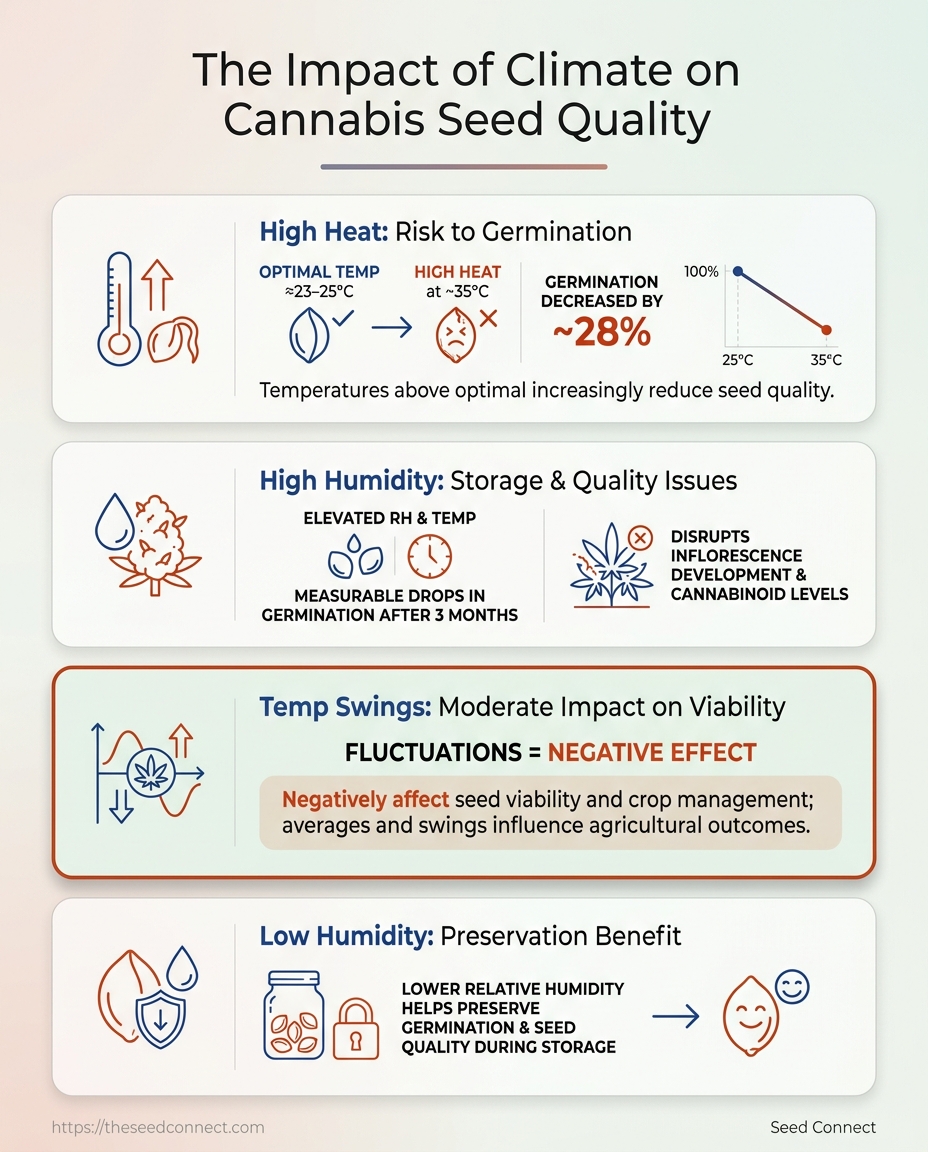
Climate condition versus likely seed impact versus best prevention step
| Climate condition | Likely effect on seeds | Risk level | Best prevention step |
|---|---|---|---|
| High heat | Speeds aging, weakens viability, and shortens storage life | High | Store in a cool, dark place with stable temperatures |
| High humidity | Raises mold risk, rot, and accidental sprouting | High | Keep seeds dry with airtight storage and a desiccant pack |
| Rapid temperature swings | Creates condensation and stress during storage | High | Avoid garages, attics, and fridges opened constantly |
| Low humidity | Can dry seeds too far if exposure is prolonged | Medium | Use sealed containers and monitor storage dryness |
| Direct light exposure | Breaks down storage quality and adds heat stress | Medium | Keep seeds in opaque, light-blocking packaging |
Heat and moisture often matter more during transitions (moving bags/containers, taking seeds out to check them, or storing in inconsistent spaces). A seed can look unchanged while its internal reserves decline.
Why the stage matters
- Dormant (dry storage): Seeds tolerate brief stress better if conditions stay mostly stable.
- Soaking/early germination: Once water enters, any stored micro-damage (or moisture exposure) can show up as mold growth, uneven root timing, or “misses.”
The practical rule
Match your storage and handling to the seed’s weakest point.
- If you’re fighting moisture risk, prioritize sealed + dry.
- If you’re fighting temperature swings, prioritize consistency (same indoor spot, minimal cycling).
Keep the environment boring—and you reduce the chance that climate stress turns into uneven emergence.
How to protect cannabis seed quality in different climates
Think of seed quality like a countdown timer. Climate doesn’t just affect germination in the grow room—it can start shortening that timeline while seeds wait in storage.
Across hot, humid, dry, and variable climates, the same three threats usually drive outcomes: heat, light, and moisture. Your job is to control which threat gets the most influence in your specific environment.
The baseline storage habits (work in every climate)
- Airtight container: Use a sealed jar, tin, or food-safe pouch with a tight closure.
- Cool, stable spot: Avoid places that heat up daily or get direct sun.
- Low light: Opaque containers help reduce exposure.
- Dry environment: In humid regions (or damp homes), include a dry pack/desiccant and keep containers closed.
Climate-specific storage habits that help maintain seed quality
| Climate type | Storage priority | What to do | What to avoid |
|---|---|---|---|
| Hot climate | Heat control | Use an opaque airtight container in the coolest indoor spot you can maintain. | Leaving seeds in cars, sunny rooms, or near electronics that run warm |
| Humid climate | Moisture control | Store in a sealed container with a dry pack; keep it in a dry cabinet/closet. | Bathrooms, basements, and opened breeder bags |
| Dry climate | Stability of dryness | Seal seeds well so they don’t cycle between very dry air and room humidity. | Exposing them to open-air drafts or frequent container opening |
| Variable climate | Temperature stability | Pick one interior location and keep it there; reduce movement. | Shifting between warm days, cold nights, and outdoor storage |
Quick “reality check”
If the location feels uncomfortable for you (too hot, too steamy, too damp, or constantly swinging), it’s likely stressing seeds too.
Stable, dark, cool, and dry usually outperforms clever—but inconsistent—storage.
A seed can look perfect and still be a weak bet.
That is why a fast hands-on check matters before anyone soaks or sows.
At Seed Connect, we see the same pattern again and again: growers trust appearance alone, then wonder why the tray comes up uneven.
A better habit is simple.
Compare, feel, and test a small sample before planting the whole batch.
Start with the eyes and fingertips
Healthy seeds usually look consistent from one seed to the next.
They tend to be firm, dry, and evenly colored, with a surface that looks intact rather than cracked or dull.
A quick inspection can reveal a lot about environmental effects on seeds.
If a batch has many pale shells, soft spots, or irregular shapes, that often points to poor maturation or climate stress during storage.
- Color: Expect a fairly even tone across the batch, not a mix of washed-out and dark seeds.
- Firmness: A healthy seed should feel solid when pressed gently between fingers.
- Surface texture: Look for a smooth, intact shell without splits, dents, or chalky patches.
- Uniformity: Seeds from the same lot should look broadly alike in size and finish.
Use a small germination test before planting the full lot
A simple test answers a bigger question than appearance ever can.
It shows whether the seed is still active, and it can hint at climate damage that is not obvious on the shell.
Research including ACSESS seed storage studies has shown germination can decline substantially when seeds are exposed to unfavorable moisture and temperature conditions over time.
That’s exactly why a 10–20 seed test is worth the time.
Compare two batches, not just two seeds
Imagine two batches that looked similar on delivery day.
One sat in a cool, steady room. The other spent weeks in a hot, humid space.
The first batch may still sprout evenly.
The second can show slower cracks, delayed roots, and a few complete misses.
That gap is a practical example of climate and cannabis growth showing up before planting even begins.
A simple demo works well for first-time growers
A short inspection-and-test video helps new growers learn the process fast, especially when they are judging seed quality for the first time.
- Sort seeds by size and color.
- Press a few gently for firmness.
- Test a small sample on a damp paper towel.
- Compare the sprout rate against the rest of the lot.
That small routine saves a lot of guesswork.
It also gives growers a clearer read on cannabis seed climate impact before a full run starts.
What good is a strong genetic line if the seeds were handled badly before they reached you? The answer usually starts with the supplier, not the packet.
Climate and cannabis growth are linked long before planting, and environmental effects on seeds continue during storage, packing, and shipping.
Seed conservation research (including ACSESS work on seed moisture/temperature) consistently shows that germination can drop sharply when moisture and temperature drift outside stable ranges over time—so freshness and handling history matter just as much as the seed itself.
Tilth Alliance’s seed viability guidance also points to heat and moisture as fast ways to weaken seed performance.
A 2024 MDPI study on temperature effects in cannabis germination found temperature significantly affected germination percentage and rate, which is a good reminder that cannabis seed climate impact starts well before the plant touches soil.
Before buying, ask four plain questions:
- How were the seeds stored? Cool, dry, and dark handling beats vague “proper storage” claims.
- How fresh is the lot? Look for lot dates or recent stock rotation.
- What germination support is included? A real guarantee matters more than marketing copy.
- How are orders packed and shipped? Ask whether the packaging reduces heat and moisture exposure in transit.
Supplier signals that matter most
A supplier can sound confident and still leave out the details that matter.
The best ones are specific about storage, freshness, support, and shipping, because those are the points where climate stress usually shows up first.
That same thinking helps separate a careful seller from one taking shortcuts.
A 2020 Mongabay report on climate-linked germination risk makes the broader point clear: seed performance can become more sensitive when conditions and handling are inconsistent.
| Supplier signal | Why it matters | Good sign | Red flag |
|---|---|---|---|
| Fresh stock turnover | Old inventory loses vigor faster, especially when conditions vary. | Recent lot dates and regular rotation. | No lot info or stale stock sitting unsold. |
| Sealed packaging | Good packaging helps keep out moisture and contamination. | Airtight, tamper-evident packs. | Loose bags or damaged seals. |
| Germination guarantee | Accountability matters when climate stress or transit hurts performance. | Clear guarantee terms, like our own germination-backed policy. | No policy or vague exclusions. |
| Expert customer support | Good guidance helps match seed choice to local conditions. | Grower support that answers storage and climate questions. | Generic replies and no technical help. |
| Transparent shipping policies | Shipping time and packing method affect seed condition on arrival. | Clear transit windows and discreet protective packing. | Hidden delays, unclear carriers, or no packing detail. |
| Storage transparency | You want proof that seeds were kept in stable conditions. | Supplier explains temperature and humidity handling. | No mention of storage at all. |
| Shipment tracking | Fast, visible transit reduces exposure to heat or cold. | Tracking provided quickly after dispatch. | Orders vanish into silence. |
These supplier signals do not guarantee perfection, but they do separate careful handling from guesswork.
If a seller cannot explain storage, freshness, and shipping in simple terms, that is usually the answer.
For growers comparing options, the safest path is a supplier that treats handling as part of seed quality, not an afterthought.
That is where climate-aware buying starts to pay off.
Will cannabis seeds be banned in 2026?
No reliable timeline for a cannabis-seed ban in 2026 is provided here. This material focuses on climate-driven seed viability—how heat, humidity, light, and airflow affect seed aging and germination—rather than laws or future regulatory changes. For any ban or legal status, check current rules with your local regulators.
Is 50 degrees too cold for seeds to germinate?
50 degrees may be cold enough to slow or make germination less even, but the exact threshold isn’t specified here. What is clear is that temperature strongly influences both seed viability and the stress seeds experience; heat accelerates aging, while unstable conditions can weaken vigor. For consistent emergence, use stable, appropriate germination conditions rather than letting temperature swing.
Does hydrogen peroxide help seeds germinate faster?
There is no guidance in the provided information that hydrogen peroxide reliably speeds up cannabis seed germination. The key drivers highlighted are controlling temperature, moisture, light, and airflow, since excess humidity accelerates breakdown and can invite mold or rot. If you want better outcomes, prioritize clean handling and the right moisture and storage conditions instead of relying on additives.
Is 80% germination rate good?
An 80% germination rate is generally a solid outcome, since it indicates most seeds can still emerge rather than being fully compromised. However, the broader risk is that environmental stress can cause uneven sprouting, weaker vigor, or shorter viability even when some seeds look healthy. Use appearance and a small test sample to confirm uniform performance before committing to the full batch.
What is the effect of seed moisture content and storage temperature on seed longevity of hemp cannabis sativa?
Seed moisture and storage temperature are major determinants of hemp cannabis sativa longevity because they drive aging and stress before planting. High humidity raises mold/rot risk and can shorten shelf life, while high heat speeds up aging and weakens viability. Keeping seeds dry with low moisture, using airtight storage, and storing in a cool, dark, stable environment helps; research including ACSESS seed storage studies shows germination can decline markedly over time when moisture and temperature are not kept stable.
Choose Seeds for the Conditions, Not the Catalog
The key idea is simple: climate shapes cannabis seed quality long before planting.
This article focused on five practical checkpoints:
- Mechanisms first (Section 2): heat, moisture, light, and airflow can weaken seeds while they sit.
- Stage risks (Section 4): storage, soaking, and early germination respond differently to climate stress.
- Prevention by climate (Section 5): use airtight + cool + dark + dry—and make it match your environment.
- Pre-plant verification (Section 7): inspect, then run a small germination test so you’re not guessing.
- Supplier evaluation (Section 8): prioritize handling history, freshness signals, and shipping practices.
If you change one habit, make it this: before you sow, confirm the seeds’ storage and handling story—and whether it fits your local realities.
When quality genetics and climate-aware planning align, you get the strongest chance of uniform emergence.