



Shipping cannabis seeds across borders can be a tricky journey — not because the seeds themselves are complicated, but because every country treats them differently.
From customs rules and legal classifications to packaging requirements and documentation, international seed shipping requires careful planning and clear knowledge of the risks involved. Whether you’re a home grower looking to access unique genetics or a seller wanting to reach global customers, understanding how to move seeds safely and legally can save time, money, and headaches.
This guide breaks down the key considerations you need to navigate complex international regulations and get your seeds where they need to go with confidence.
Executive Summary
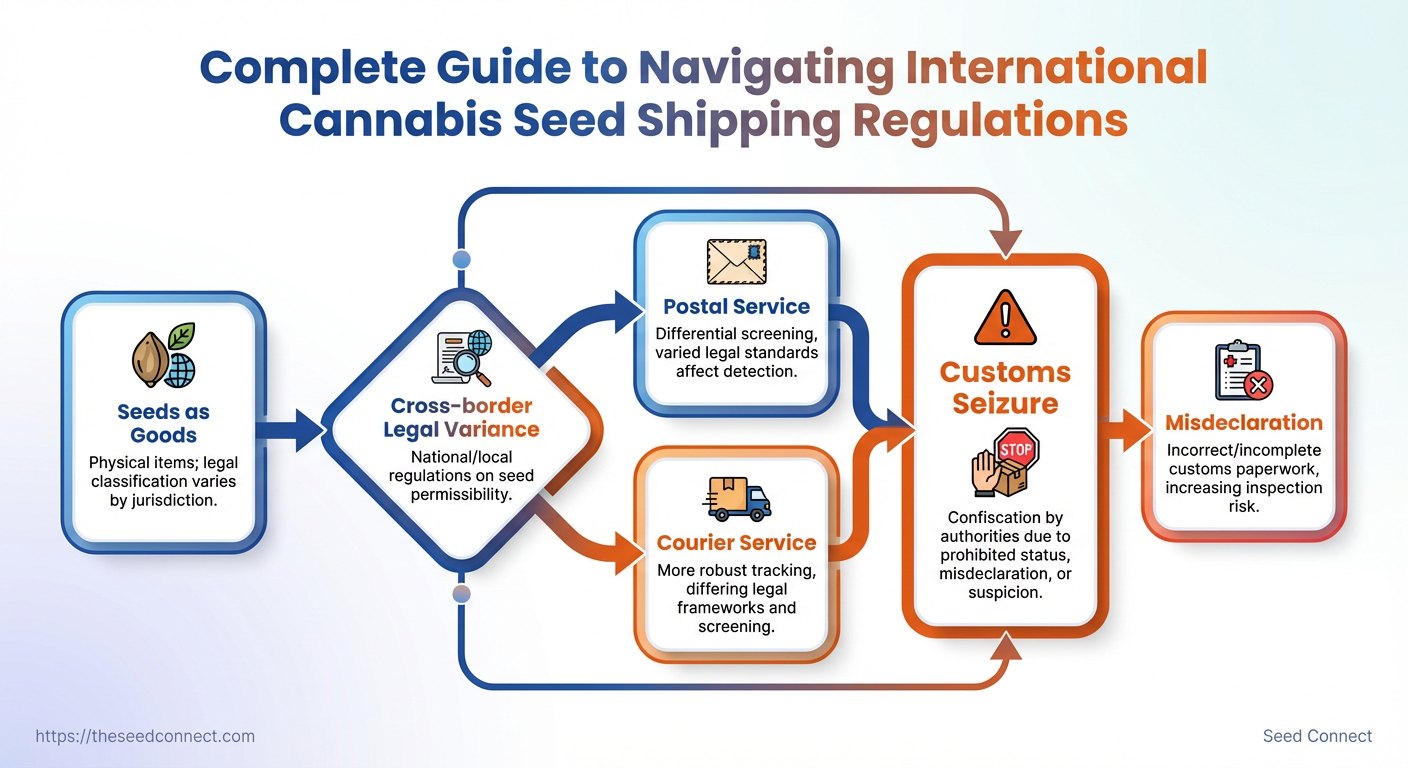
This section frames the operational and legal risks of shipping cannabis seeds internationally, and lays out immediate, practical defenses to protect supply chains and customers. Cannabis seeds are treated differently across jurisdictions: some classify them as agricultural goods, others as controlled substances, and enforcement can vary widely between countries and even between postal operators. Primary risk vectors include customs seizure, incorrect product declarations, and differing screening practices between postal services and private couriers.
- Scope: seeds as physical goods that carry regulatory status and agricultural/import considerations.
- Operational exposure: variability in carrier screening, documentation accuracy, and origin/destination laws.
- Commercial impact: lost inventory, fines, longer delivery times, and reputational damage.
Seeds as goods: Physical items intended for planting or collection; legal classification varies by jurisdiction.
Cross-border legal variance: Differences in national and local regulations that determine whether seeds are permitted, restricted, or prohibited.
Customs seizure: Confiscation by border authorities due to prohibited status, misdeclaration, or suspicion of illegal intent.
Misdeclaration: Incorrect or incomplete customs paperwork that increases inspection and seizure risk.
Postal vs courier risk: Postal networks often use centralized screening and face different legal standards than private couriers, affecting detection and redirection likelihood.
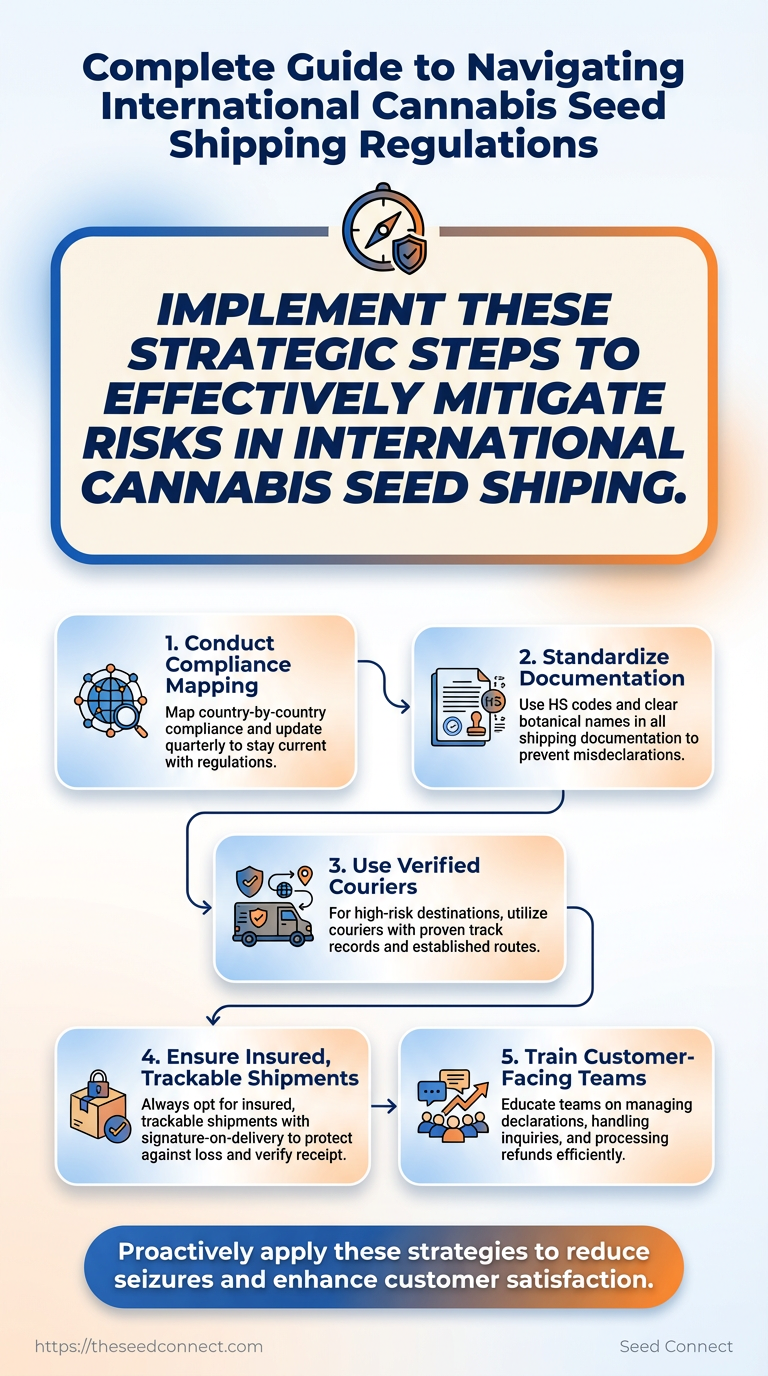
- Conduct a country-by-country compliance map and update quarterly.
- Standardize shipping documentation with
HScodes and clear botanical names. - Use verified courier routes for high-risk destinations.
- Implement insured, trackable shipments with signature-on-delivery.
- Train customer-facing teams to manage declarations and refunds.
Following these steps reduces seizures and customer friction while keeping operations auditable and defensible. When handled deliberately, cross-border seed shipping becomes a manageable, low-friction part of a global supply strategy.
1. Global Legal Frameworks Affecting Seed Shipping
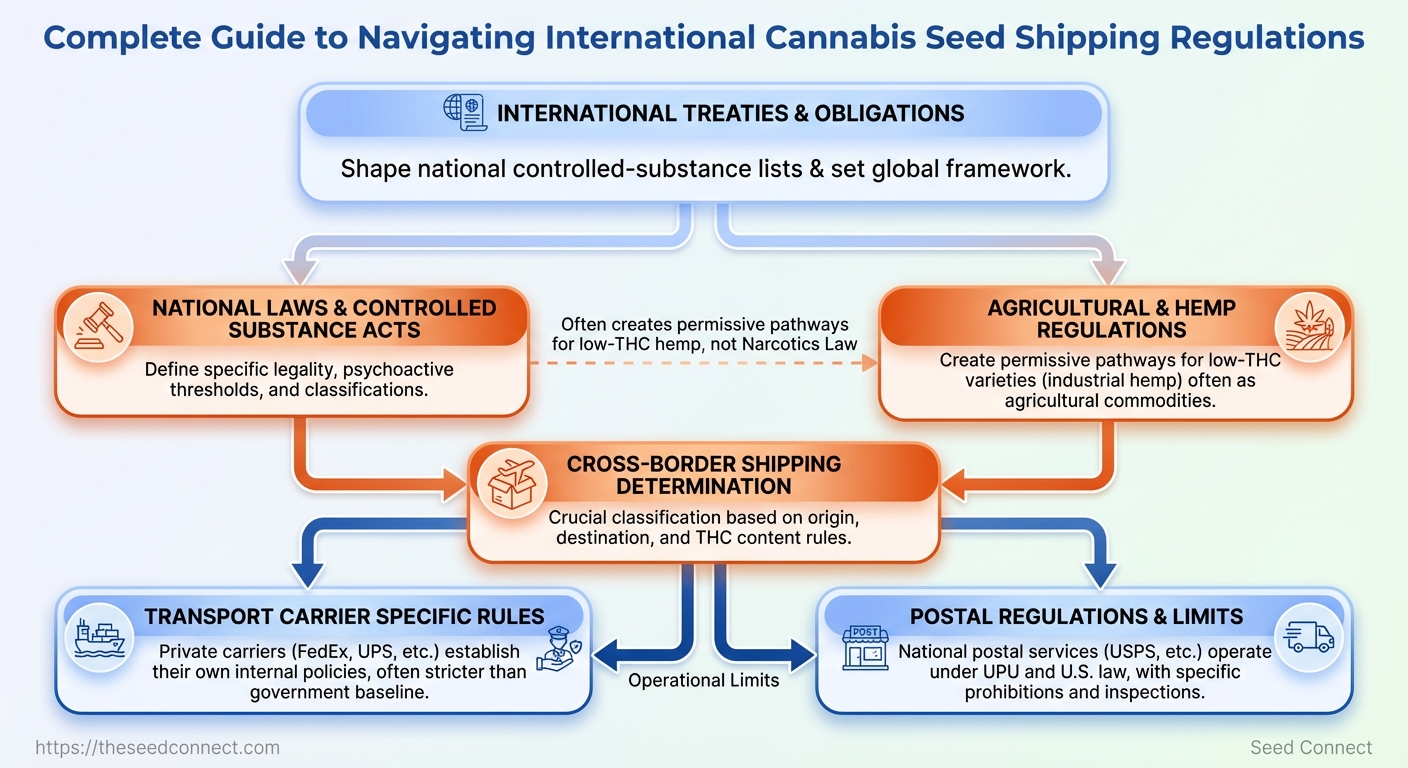
International treaties set floor-level obligations, but national law defines what can actually move across borders. At treaty level, the UN-controlled-substances framework historically distinguished between cannabis as a psychoactive drug and industrial hemp largely by cannabinoid content. That distinction matters because many countries treat hemp under agricultural or trade rules, while they treat psychoactive cannabis under controlled-substance regimes. Practical shipping outcomes depend on how a country transposes treaty text into domestic statutes, postal rules, and customs enforcement priorities.
The interaction plays out across three practical layers: Treaty obligations shape national lists. Countries sign treaties that require control of certain substances, which then appear in national controlled-substances acts. Agricultural regulations create permissive pathways. When a jurisdiction classifies low-THC hemp as an agricultural commodity, seeds can move under seed/plant-health rules, not narcotics law. * Transport and postal rules add operational limits. Postal operators and courier terms of service often forbid shipping of controlled botanical material regardless of treaty status.
Common friction points include: 1. Divergent THC thresholds (for example, 0.2% vs 0.3%) that create cross-border ambiguity. 2. Conflicting classification: a seed legal for cultivation domestically may be illegal to import elsewhere. 3. Postal detection and seizure policies that operate on risk profiles rather than strict legal text.
Controlled substance vs agricultural distinction: Many legal systems place psychoactive cannabis under a controlled-substances act, while hemp falls under seed or agricultural statutes. This determines licensing, permitted paperwork, and penalties.
Agricultural regulation: Plant-health inspections, phytosanitary certificates, and seed-import permits are commonly required when seeds travel under agricultural rules.
Postal/courier rules: Even if national law allows import, carriers may refuse carriage; commercial platforms may delist sellers to reduce compliance risk.
Treaty-level frameworks vs national implementations
| Legal instrument | Scope | Typical national effect | Example countries |
|---|---|---|---|
| UN Single Convention | Global drug-control obligations | Requires control of scheduled psychoactive substances; countries list cannabis derivatives in drug statutes | Many signatories worldwide |
| Bilateral trade agreements | Trade facilitation between two states | Can create exemptions or standards for agricultural goods including seeds | EU trade partners, Canada bilateral deals |
| National controlled substances acts | Domestic criminal/regulatory control | Criminalization, licensing, penalties for psychoactive cannabis | United States (Controlled Substances Act), Japan |
| Agricultural/horticultural seed regulations | Plant health, varietal registration | Permits, phytosanitary certificates, seed quality rules for hemp | Netherlands, Germany, Canada |
| Postal/courier service rules | Operational carriage policies | Carriers may refuse or screen consignments; lead to seizure even if legal | USPS/EMS/couriers with restricted item lists |
Key insight: The same seed can be legal under agricultural law in one state and illegal under controlled-substance rules in another, so operational compliance requires reading both treaty-derived national statutes and carrier policies.
Understanding these overlapping layers helps teams design shipping processes that respect both legal classification and carrier rules. When implemented correctly, this reduces seizure risk and speeds reliable deliveries.
2. Key Risk Factors for International Seed Shipments
Exporting seeds internationally is high-friction because customs, carrier rules, and paperwork intersect with strict plant-health and narcotics frameworks. The immediate risks are seizure at the border, long delays from inspections, and carrier refusal due to prohibited-content policies. These risks arise not from a single failure but from predictable friction points: classification ambiguity, incomplete phytosanitary documentation, and choosing a carrier whose service rules or customs relationship increases scrutiny.
Customs classification and declarations
HS Code: Use of the Harmonized System code is the first control point. Industry practice places many seeds under HS 1209 (seeds, fruit and spores of a kind used for sowing), but classifications can vary by seed type and destination.
Phytosanitary certificate: Many countries require an official phytosanitary certificate issued by the exporter’s national plant protection organization. Missing or incorrect certificates are the most common cause of holds and destructions.
Mislabeling risk: Declaring a parcel as agricultural seeds without specifying species, origin, and phytosanitary status often triggers secondary inspection. Generic labels invite targeted checks by customs and quarantine officers.
Carrier rules and differences
- National postal services: Often lower-cost and broader reach, but subject to stricter customs integration and slower response times. Postal channels typically pass through national customs with routine inspections.
- Express couriers (DHL, UPS, FedEx): Faster transit and more direct customs brokerage, but carriers have strict internal prohibitions; some will refuse parcels flagged as seeds or restricted biological material.
- Specialized seed couriers: Tailored paperwork support and discreet handling; usually more knowledgeable about phytosanitary certificates, but cost is higher.
- Freight forwarders: Useful for bulk shipments and complex routing; require advanced customs clearance planning and can store goods pending inspection.
- Hand-carry/consignments: Highest control and fastest clearance in some cases, but legally complex and risky for larger volumes.
Practical, avoidable mistakes occur repeatedly:
- Failing to use the precise HS code and Latin species name on customs forms.
- Leaving out the issuing authority and reference number for phytosanitary certificates.
- Selecting a carrier that explicitly disallows seeds in the fine print.
Pros and cons of different carriers for seed shipments
| Carrier type | Customs oversight level | Typical transit time | Likelihood of inspection |
|---|---|---|---|
| National postal service | High — integrated with national customs | 7–21 days international | Medium–High |
| Express couriers (DHL/UPS/FedEx) | Medium — dedicated brokerage teams | 2–7 days | Medium |
| Specialized seed couriers | Medium — experienced with phytosanitary docs | 3–10 days | Low–Medium |
| Freight forwarders | High — commercial import channels | 7–30 days (depends on consolidation) | Medium |
| Hand-carry/consignments | Variable — requires customs pre-clearance | 1–3 days (air) | Low–Variable |
Key insight: choosing the wrong carrier compounds paperwork errors — low-cost postal routes increase inspection likelihood, while express and specialized services reduce administrative friction but cost more.
Precise classification, complete phytosanitary documentation, and matching carrier capability to risk appetite remove most execution risk. Understanding these trade-offs lets operations teams optimize cost, speed, and seizure risk without guessing at customs outcomes.
3. Country-by-Country Considerations & Quick Flags
Regulatory posture for cannabis seeds varies sharply by country — some permit seeds freely, others treat them as controlled goods, and many fall in ambiguous grey areas. Focus first on legal classification (recreational, medical, hemp, illegal), then on import controls (permits, testing, phytosanitary requirements) and finally on practical enforcement (postal interceptions, courier refusals). These three vectors determine whether a shipment clears customs or becomes evidence in an investigation.
Practical checks before sending or ordering seeds: Legal class: Confirm if seeds are explicitly allowed, considered paraphernalia, or treated as controlled narcotics. Import documentation: Check if a phytosanitary certificate, import permit, or medical license is required. Carrier policy: Verify whether major couriers service the destination for such items and their seizure record. Enforcement intensity: Expect more scrutiny in countries with strict drug laws or recent anti-smuggling crackdowns. * Local penalties: Be aware that possession post-delivery can trigger penalties for the recipient.
How to evaluate risk quickly 1. Identify the country’s legal classification for cannabis and seeds. 2. Search customs guidance for seeds or plant reproductive material and note required certificates. 3. Contact your chosen courier and confirm their stance; document responses.
Common postal/courier anecdotes UK: Community reports show Royal Mail often returns or destroys packages labelled as seeds; private couriers sometimes request documentation. Netherlands: Domestic availability reduces seizures, but imports can be inspected and held for phytosanitary checks. * Spain: Local regulations are lax for personal possession, but imported seeds may be subject to customs checks during holidays or festivals.
Summarize country-level shipping posture for quick scanning
| Country | Cannabis seed import status | Required documentation | Enforcement intensity (low/med/high) |
|---|---|---|---|
| United States | Varies by state; federally seeds often treated as agricultural material | State permit (varies), phytosanitary for some shipments |
high |
| Canada | Legal nationwide for recreational; imports still monitored | Import permit for commercial shipments; personal imports rare | med |
| United Kingdom | Seeds legal but considered paraphernalia; imports scrutinized | No standard permit; customs may inspect | high |
| Netherlands | Domestic sales permitted; imports can be routine but inspected | Phytosanitary certificates advised for large shipments |
med |
| Spain | Personal possession tolerated; import enforcement uneven | No consistent documentation; customs inspection possible | med |
Key insight: Countries with nationwide legalization (Canada) still operate import controls, while nations with tolerant domestic markets (Netherlands, Spain) apply customs scrutiny inconsistently. High enforcement countries (United States at federal intersections, UK) present the greatest shipment risk and demand careful documentation and courier selection.
Understanding these country-level flags lets teams make informed choices about routing, documentation, and whether to pursue alternative supply channels. When handled correctly, risk is reduced and compliance becomes a predictable part of the supply process.
4. Documentation, Declarations, and Packaging Best Practices
Clear, accurate documentation and disciplined packaging choices prevent delays, preserve germination rates, and reduce legal exposure. Use precise botanical language on internal paperwork, keep outward-facing descriptions legally neutral, and control moisture and odor inside the parcel. Well-crafted declaration templates paired with a reproducible packaging checklist make operations predictable and defensible across markets.
Botanical description: Use the full botanical name and cultivar identifier; avoid colloquial or slang terms. Phytosanitary certificate: Official health document issued by plant-health authority confirming absence of regulated pests. Discrete outer packaging: Non-transparent, neutral external package without imagery or wording that implies seed contents.
Ready-to-use declaration templates (copy-paste and adapt)
- Internal invoice line (detailed):
Item: Cannabis sativa L. seeds — cultivar: [Cultivar Name]; quantity: [X] seeds; origin: [Country/Producer]; batch ID: [####]; germination guarantee: [X% for X days] - Export declaration (neutral outward-facing):
Item: Botanical seeds (non-edible) — scientific name: Cannabis sativa L.; HS code: 1209.99; quantity: [X]; commercial value: $[XX.XX] - Phytosanitary transmit line:
Phytosanitary certificate attached: Yes. Issuing authority: [Name]; certificate no.: [####]; health remarks: None.
Packaging checklist — practical essentials
- Bold label: Include batch ID and cultivar on an inner document only.
- Bold label: Use silica packets and humidity indicator cards to keep RH < 15%.
- Bold label: Odor-barrier inner bag (mylar with heat-sealed seam).
- Bold label: Tamper-evident tape or seal on the inner packet.
- Bold label: Discrete outer box, plain courier label, no promotional material.
- Bold label: Attach commercial invoice and phytosanitary copy in a sealed pouch inside the box.
- Bold label: Retain digital photos of packaging and weight for 180 days.
- Prepare internal invoice and attach a copy inside the package.
- Place seeds in breathable coin envelopes or glassine, then into a sealed mylar pouch with desiccant and humidity card.
- Insert sealed pouch plus paperwork into a plain outer box; apply tamper-evidence and courier label.
- Photograph the sealed box, record tracking and batch ID in shipment log.
Checklist matrix showing required vs recommended items for shipments
| Item | Required/Recommended | Why it matters | How to implement |
|---|---|---|---|
| Botanical description | Recommended | Ensures accurate customs classification and internal traceability | Use Cannabis sativa L. + cultivar; include batch ID on internal docs |
| Invoice | Required | Establishes commercial value and HS code for customs | Include HS code 1209.99, unit price, and full seller details |
| Phytosanitary certificate | Recommended/Required (destination-dependent) | Prevents quarantine delays and seizures | Obtain from national plant-health authority when required by importer |
| Discrete outer packaging | Recommended | Reduces detection risk and secondary inspections | Plain box, no logos, minimal labeling, plain packing slip inside |
| Silica packet/moisture control | Recommended | Preserves viability during transit | Use food-grade silica + humidity indicator; target <15% RH |
Key insight: Treat documentation and packaging as one integrated control—precise internal records support legal compliance while discreet, moisture-controlled packaging protects seed viability. Implementing repeatable templates and a checklist reduces human error and speeds throughput across jurisdictions. Understanding these practices helps operations move faster without compromising quality or compliance.
5. Risk Mitigation Strategies for Sellers and Buyers
Present guarantees and shipping policies transparently while acknowledging variables outside your control. Sellers that state clear, conditional guarantees and multiple dispatch options reduce disputes and protect revenue. Buyers who verify legality, insist on traceable shipping, and document every interaction preserve their ability to escalate effectively. Below are pragmatic seller practices and a buyer checklist with escalation steps that work in real-world seed commerce.
Seller best practices: framing guarantees and fulfillment
Clear conditional guarantees: State germination or replacement guarantees with explicit caveats about customs seizure, jurisdictional restrictions, and carrier liability.
Policy window: Offer a 30–90 day claim window tied to tracking and proof-of-delivery. Documentation required: Require photos of packaging, tracking logs, and a signed delivery receipt for claims. Conditional language: Use phrases like “guarantee valid where shipping is lawful and not impeded by customs”* to reduce ambiguity.
Dispatch options that minimize loss
- Tracked small‑packet: Use tracked small‑packet services where available to reduce losses and provide proof.
- Insured courier: Offer insured courier for higher-value orders; insurance covers loss but often not customs seizure.
- Split shipping: For bulk orders, split into multiple consignments to limit total loss if one package is seized.
Suggested refund/replace wording
- Refund: “Refund issued if carrier confirms lost/delivered-to-wrong-address and buyer provides requested documentation.”
- Replace: “Replacement shipped once original is confirmed lost and customer returns proof of seizure or loss.”
- Store credit: “Store credit issued at seller discretion for packages seized by customs when replacement is impractical.”
Seller policy options (refund, replace, store-credit) under different seizure scenarios
Seller policy options (refund, replace, store-credit) under different seizure scenarios
| Scenario | Refund | Replace | Store credit |
|---|---|---|---|
| Seized by customs | ✗ Typically denied; possible partial credit depending on proof | ✗ Generally not possible | ✓ Offered when replacement impossible; amount varies |
| Lost in transit | ✓ Full refund when carrier confirms loss | ✓ Replace after claim period and proof | ✓ Option if buyer prefers |
| Delivered but damaged | ✓ Refund or partial refund on inspection | ✓ Replace after return/disposal proof | ✓ Possible if buyer accepts |
| Delivered to wrong address | ✓ Refund after carrier investigation | ✓ Replace upon failed recovery | ✓ Offered as goodwill |
| Buyer refuses shipment | ✗ No refund if refusal violates policy | ✗ Replace not applicable | ✓ Partial credit after inspection fees |
Key insight: Policies should be granular—different scenarios require different remedies; store credit is the most flexible option sellers can use to preserve revenue while satisfying buyers.
Buyer checklist and escalation steps
- Verify legality: Confirm local laws permit possession and import of seeds before ordering.
- Request seller documentation: Ask for proof of dispatch, tracking number, and clear return/claim terms prior to purchase.
- Monitor shipment: Track daily; capture screenshots of tracking updates and save emails.
- On seizure detection, document: Photograph any customs notices, retain carrier emails, and note timestamps.
- Escalate to seller: Provide documentation, request claim initiation, and ask for a case reference number.
- If seller unresponsive, escalate to payment provider: File a dispute with evidence and timeline.
- Regulatory step: If applicable, contact local customs office to request disposition information.
Understanding and applying these practices reduces friction and preserves claims. When both parties operate with clear documentation and realistic policies, disputes resolve faster and relationships remain intact.
6. Handling Seizures, Delays, and Legal Encounters
When seeds are seized or shipments delayed by customs, the first priority is containment: document everything and act inside narrow time windows. The practical response is a coordinated, time-sensitive playbook that preserves evidence for appeals, limits financial exposure, and clarifies responsibilities between buyer, seller, and carrier.
Seizure response playbook: immediate actions and documentation
Chain-of-custody record: Photograph packaging, labels, tracking scans, and any customs seizure notices as soon as possible.
Communication log: Record dates, times, names, and transcripts of phone or email interactions with the carrier, customs office, and seller.
Proof of purchase: Keep invoices, order confirmations, payment receipts, and product descriptions showing seeds were ordered.
Legal contact: Engage counsel familiar with import/export or agricultural restrictions if the shipment has prosecuted value above local thresholds.
Practical step-by-step process for the first 72 hours
- Contact the carrier and retrieve the formal seizure or hold notice.
- Notify the seller immediately and request any sales documentation or export paperwork they can provide.
- Photograph all physical evidence: packaging, label, seal numbers, and container condition.
- Request a written statement from customs describing the specific violation or reason for seizure.
- Preserve communications and set calendar reminders for appeal windows (often within 48–72 hours).
Costs and realistic expectations
- Short-term costs: Administrative time, shipping/query fees, and possible storage fees.
- Legal costs: Retaining counsel typically ranges widely; expect a baseline retainer for export/import matters.
- Recovery odds: Recovery depends on jurisdiction, species, and paperwork; administrative releases are common when documentation is complete, while prosecutions are rare but possible.
When the seller can help
- Seller assistance: Reputable seed suppliers will provide invoices, declarations, and, in some cases, coordinate with carriers for appeals.
- TheSeedConnect value: A germination guarantee and responsive support can simplify documentation and improve the chance of administrative release.
Outline a 30-day action timeline after seizure with recommended actions by day range
| Day range | Action | Owner (buyer/seller/carrier) | Expected outcome |
|---|---|---|---|
| 0–2 days | Secure seizure notice, photograph packaging, collect invoices | Buyer/Seller | Documented evidence, initial claim filed |
| 3–7 days | Submit administrative appeal or information request | Buyer/Seller | Customs reviews paperwork for release |
| 8–14 days | Engage legal counsel if no response; escalate to carrier claims | Buyer/Buyer & Seller | Formal dispute opened, potential release negotiation |
| 15–30 days | File formal customs appeal or small-claims action; arrange return/destruction | Buyer/Seller/Carrier | Resolution pathway defined; cost estimate solidified |
| 30+ days | Execute legal remedy or accept loss; recover insurance/chargeback if applicable | Buyer/Seller | Final disposition (release, forfeiture, or settlement) |
Key insight: Acting fast and preserving complete documentation dramatically increases the chance of administrative release and lowers legal exposure. Understanding the parties’ responsibilities and the timelines for appeals removes guesswork and reduces avoidable costs.
Understanding these procedures makes it far easier to manage disruptions without losing control of the case or budget. When sellers proactively supply documentation and communication, recovery becomes a procedural exercise rather than a legal scramble.
7. Technology, Trackability, and Insurance Options
High-quality tracking and the right insurance mix are the most effective levers for reducing loss on international seed shipments. Combining robust parcel tracking, documented chain-of-custody data, and layered financial protections — carrier liability, specialized insurance, and escrow/payment safeguards — converts disputes from subjective claims into verifiable events that insurers and marketplaces accept.
Tracking and verification technologies
- Real-time GPS-enabled scans: Use carrier scans and third-party trackers to capture location stamps and transit photos.
- Tamper-evident packaging: Add serialized seals with scan records to prove package integrity on arrival.
- Chain-of-custody logs: Maintain timestamped handoffs (origin pack, carrier pickup, customs release, delivery) to support claims.
- Digital evidence storage: Keep
PDFreceipts, photos, and export declarations in a single indexed folder for fast retrieval.
How tracking supports claims
- Collect all digital artifacts immediately after shipment.
- Attach photos of the seeds, packaging, and seal to the tracking record.
- Match carrier timestamps to your internal order timeline and export declarations.
Insurance — what typically covers and excludes
Standard parcel insurance: Covers loss and physical damage during transit up to a declared limit; typically excludes loss from regulatory seizure, mislabeled contents, and loss due to prohibited-item restrictions.
Specialized high-value goods insurance: Covers inventory shortages, higher declared values, and some customs-related losses; often requires proof of value and stricter packaging standards.
Carrier liability: Carrier contracts often cap liability (e.g., ~$100 per package for international parcels) and exclude illegal or restricted contents.
Escrow/marketplace protection: Escrow holds funds until buyer confirms receipt; marketplace protection may offer complementary dispute resolution and partial reimbursements.
Custom legal defense funds: Provides coverage for legal costs if a shipment is detained or seized due to regulatory issues; generally excludes willful misconduct and fraudulent paperwork.
Practical escrow and payment methods
- Third-party escrow: Hold funds until delivery confirmation, reducing chargebacks.
- Payment hold-release: Release payments after verified tracking + buyer photo proof.
- Multi-sig payouts: For high-value transactions, use multi-signature crypto escrow or bank escrow for added oversight.
Typical insurance/coverage options and their limits for international parcels
| Product/type | Typical coverage limit | Cost estimate | Exclusions |
|---|---|---|---|
| Standard parcel insurance | $50–$2,500 per parcel | 1–3% of declared value or flat $2–$15 | Seizure, prohibited items, mislabeling |
| Specialized high-value goods insurance | $5,000–$250,000+ | 0.5–2% of declared value annually | Fraudulent documentation, regulatory non-compliance |
| Carrier liability | ~$100–$200 standard cap | Included in shipping fee | Illegal contents, insufficient packaging |
| Escrow/marketplace protection | Depends on platform policy | 0.5–5% per transaction | Seller fraud, lack of tracking proof |
| Custom legal defense funds | $10,000–$500,000 limits | Retainer or premium-based | Intentional regulatory violations |
Key insight: Layer protections — use strong tracking and packaging, declare accurate values for insurance, and route payments through escrow when buyer/seller trust is partial. These steps turn subjective disputes into evidence-driven claims, shrinking financial risk and speeding recoveries. Understanding and applying these principles reduces friction and preserves margins on international shipments.
8. Quick Reference & Cheat Sheet
This section distills the most actionable items for getting seeds from packet to healthy plant in short order: printable checklists, rapid troubleshooting cues, and top tips to prevent wasted cycles. Use these items as a pocket guide during germination, veg and early flower so decisions happen quickly and consistently.
Printable checklists (one-line items for easy printing) Seed selection: Verify genetics, type (feminized, autoflower) and THC level preference. Germination method: Confirm chosen method (paper towel/jiffy pellet/direct soil). Media & pH: pH-adjust growing medium to 6.0–6.5 for soil, 5.5–6.0 for hydro. Temp & humidity: Maintain 20–25°C with 70–80% RH during germination. Lighting schedule: Set lights to 18/6 for vegetative stage (photoperiod strains). Nutrient plan: Start at 25% recommended strength, ramp over two weeks. * Record keeping: Log seed batch, date planted, germination time, and anomalies.
Quick seizure checklist — rapid actions when a young plant shows acute stress 1. Move plant to stable environment with known temperature and humidity.
- Check runoff pH and EC/ppm; adjust irrigation and withhold nutrients if EC is high.
- Reverse recent changes (nutrients, light intensity, transplant) immediately.
- Flush lightly if nutrient burn suspected, then allow medium to dry to recommended moisture level.
- Isolate from pests; inspect undersides and base for signs of infestation.
Top tips for consistent success Start slow: Begin nutrients at low strength to avoid burn. Observe daily: Small visual checks catch issues before they escalate. Use a seedling dome: Maintain humidity and temperature control in the first 7–10 days. Map a timeline: Record expected milestones (taproot, cotyledons, true leaves) for each strain. * Keep backups: Germinate extra seeds from the same batch to hedge against losses.
Common quick-reference definitions
Germination time: Typical window is 24–120 hours depending on strain and method.
Damping-off: Fungal collapse of seedlings caused by overwatering and poor airflow.
Topping: Cutting the top growth to encourage two main colas during veg.
Where to find the full details For step-by-step germination protocols, see the germination and seed handling chapter. For nutrient schedules and feed charts, consult the feeding guide and strain-specific notes. * For troubleshooting, reference the pest & disease diagnostic flowchart.
These checklists and rapid-response cues let growers act decisively and keep more seeds turning into healthy plants. When used alongside full protocols, they reduce guesswork and speed up reliable outcomes.
📥 Download: International Cannabis Seed Shipping Compliance Checklist (PDF)
FAQ
These eight questions cover the practical decisions growers ask most often about buying and using cannabis seeds, legal checks to run in your country, and when to get legal help. Answers are concise and include immediate next steps to act on.
1. What should I consider when choosing seeds? Choose genetics based on desired effect, growth difficulty, and flowering time. Next steps: List three priorities (yield, potency, speed), match them to strain profiles, and order a small test pack.
2. What’s the difference between feminized, autoflower, and regular seeds? Feminized: bred to produce only female plants. Autoflower: switch to flowering by age, not light cycle. Regular: can produce male or female offspring. Next steps: Pick feminized for simplicity, autoflower for quick turnarounds, regular for breeding.
3. How reliable are germination guarantees? A germination guarantee reduces financial risk but varies by vendor terms. Next steps: Read the guarantee fine print, note replacement timelines, and document germination attempts with photos.
4. How should seeds be stored? Store seeds in a cool, dark, low-humidity place; a sealed container in a refrigerator is common. Next steps: Place seeds in airtight packaging with a desiccant and record storage date.
5. Are there country-specific legal checks I must run? Yes—laws differ widely for possession, cultivation, and seed sales. Next steps: Check your national health or agriculture authority rules, consult local cannabis advocacy groups, and verify import/export restrictions before ordering.
6. When do I need a permit or license? Permits are often required for commercial cultivation or larger plant counts. Next steps: Contact your municipal licensing office and review agricultural licensing documents for thresholds and fees.
7. When should I involve a lawyer? Engage legal counsel when navigating licenses, commercial distribution, land-use zoning, or cross-border seed shipments. Next steps: Prepare your questions, gather documents (site plans, business model), and book a consultation.
8. How do I choose a reputable seed supplier? Look for clear genetics descriptions, germination guarantees, transparent shipping policies, and customer reviews. Next steps: Compare three suppliers by policy, price, and available support; request cultivation guidance with purchase.
Industry analysis shows regulations and best practices evolve rapidly; verify local rules before acting. Good planning and the right legal checks make cultivation straightforward and reduce risk.
Resources & Further Reading
Practical, authoritative resources reduce risk when shipping cannabis genetics across borders. Below are curated categories and specific entry points that reliably answer customs questions, clarify phytosanitary requirements, explain major carriers’ stances on seeds, and connect you with legal help for cross-border trade disputes. Use these resources to build a compliance checklist, draft shipping SOPs, or vet partner carriers before booking lanes.
- Government customs pages — national customs authority portals for import/export rules and prohibited items.
- Phytosanitary guidance — official plant health rules and certificate procedures required by many destination countries.
- Carrier policy pages — up-to-date prohibited items and hazmat classifications from parcel carriers.
- Legal and trade directories — directories and bar associations that list trade law and customs attorneys experienced in agricultural shipments.
- Seed bank and merchant policies — example shipping policies and T&Cs to model customer-facing agreements.
These resources serve three practical uses: build an origin/destination compliance matrix, select carriers and services that match regulatory constraints, and identify legal counsel for contested seizures or complex multijurisdictional cases.
Curated resource list for cannabis seed shipping resources
| Resource | Category | Why it’s useful | Suggested use case |
|---|---|---|---|
| National customs authority (US CBP) | Government customs | Official import/export rules, prohibited items list | Confirm U.S. export clearance and seizure guidance |
| HM Revenue & Customs (UK) | Government customs | Tariff codes, plant import controls | Verify UK entry requirements and duties |
| European Commission – Phytosanitary rules | Phytosanitary guidance | EU plant-health certification framework | Determine EU SPS document needs for seeds |
| APHIS (USDA) Plant Health | Phytosanitary guidance | Phytosanitary certificate process and import permits | Prepare export certificates for controlled shipments |
| FedEx Prohibited Items | Carrier policy | Carrier-level prohibitions and package handling rules | Screen carriers before booking seed shipments |
| UPS Dangerous Goods & Prohibited Items | Carrier policy | Service-specific restrictions and liability limits | Match service level to package contents |
| International Trade Law Directories | Legal aid | Lists trade/customs attorneys by jurisdiction | Find counsel for customs disputes and claims |
| Seed bank shipping T&Cs (example: established seed bank) | Seed bank policies | Example terms, returns, germination guarantees | Model customer-facing shipping and refund policies |
Key insight: this list combines regulatory sources, carrier rules, legal help, and commercial policy examples so teams can triage risk, select compliant carriers, and draft customer policies that align with real-world enforcement.
Understanding these references lets operations teams reduce shipment delays and legal exposure while preserving customer experience. Use the table as the backbone of a living compliance playbook that gets updated before new routes or markets are opened.
Conclusion
After working through legal frameworks, risk factors, documentation, and real-world handling of seizures and delays, the practical picture is simple: preparation reduces surprises. Tight documentation, country-specific checks, and a clear insurance or appeals plan turn a vulnerable shipment into a manageable project. Recall the examples earlier where proactive declarations sped release in Canada and where incomplete paperwork triggered a German customs hold—those contrasts show how small operational changes produce big, measurable differences. Ask yourself: have I validated the destination’s legal status, properly labeled and documented every parcel, and lined up a contingency contact for customs? If not, prioritize those steps now.
Move forward with three concrete actions: run a destination compliance check, standardize a documentation checklist for every shipment, and purchase trackable, insured shipping. For templates, step-by-step procedures, and germination-guarantee specifics, see the Seed shipping resources at The Seed Connect. If a seizure or delay occurs, escalate with the courier, compile photos and paperwork, and consult counsel experienced in plant material transit. These moves protect revenue, reduce disruption, and preserve relationships with buyers. Implementing them will make cross-border seed shipping predictable rather than risky.