



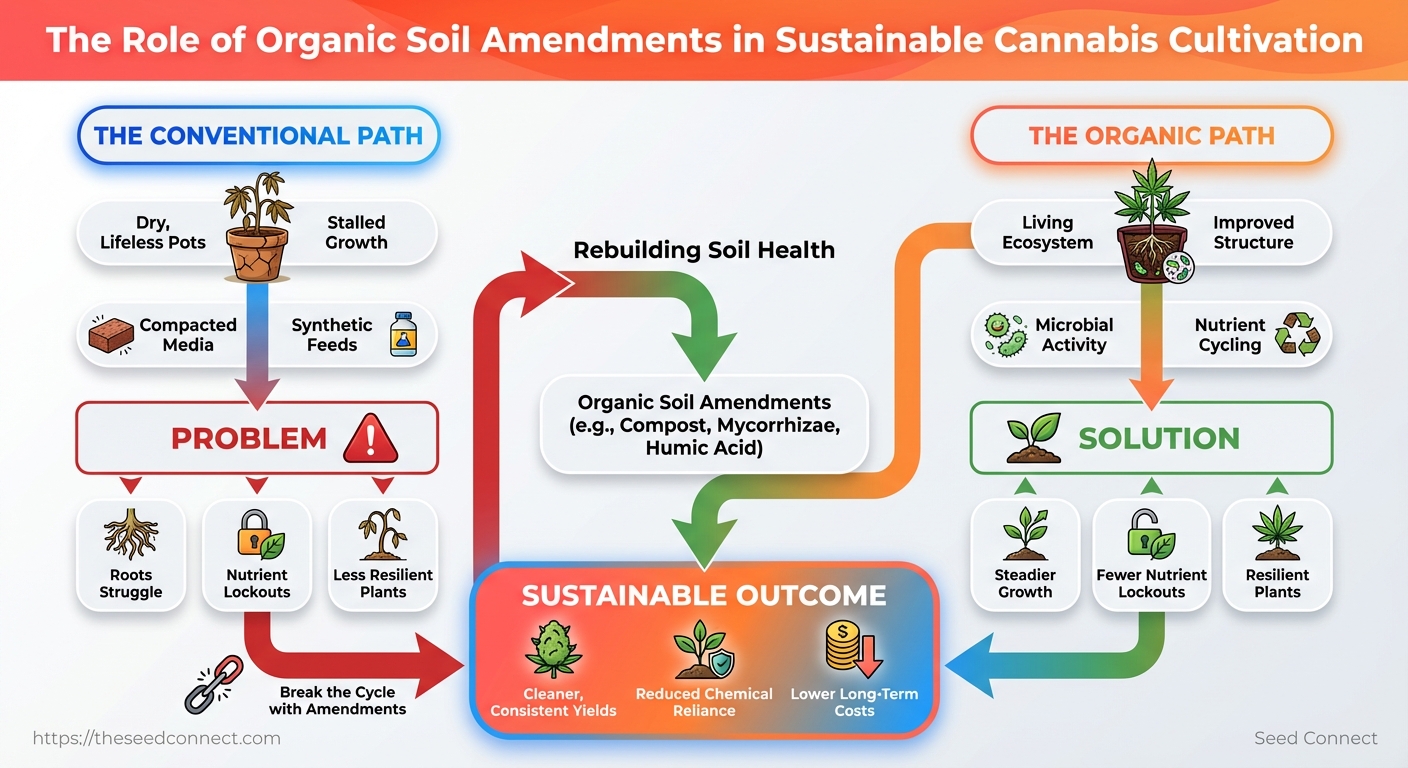
Dry, lifeless pots and plants that stall halfway to flowering are a far more common problem than nutrient calculators admit. When roots struggle in compacted media, the solution rarely starts with synthetic feeds; it starts with rebuilding soil health from the ground up. Growers who treat soil like a living ecosystem see steadier growth, fewer nutrient lockouts, and more resilient plants through humidity swings and pest pressure.
Working with organic soil amendments transforms that ecosystem by improving structure, microbial activity, and nutrient cycling rather than masking deficiencies. For cultivators aiming for sustainable cannabis, these changes reduce reliance on chemical inputs, lower long-term costs, and produce cleaner, more consistent yields. Practical choices—what to add, when to incorporate it, and how to monitor results—make the difference between a hobby patch and a reliably productive canopy. []
What Is an Organic Soil Amendment?
An organic soil amendment is a material added to soil to improve its structure, biological activity, water-holding capacity, and long-term fertility rather than delivering immediate soluble nutrients. Think of amendments as the soil’s foundation—they change the physical and biological environment so plants access nutrients more efficiently over weeks to months. This contrasts with fertilizers, which provide readily available nutrients that act quickly but don’t appreciably change soil structure or microbial life.
Amendments vs fertilizers: Amendment: Improves soil physical/biological properties over time; nutrient release is slow. Fertilizer: Supplies soluble nutrients for immediate plant uptake; often water‑soluble or mineral-based.
Common categories and how they’re used:
Organic matter: Adds humus, improves aggregation, increases water retention. Examples: compost, well-rotted manure. Microbially rich inputs: Seed and feed soil biology for nutrient cycling. Examples: worm castings, compost tea. Mineral amendments: Supply trace elements and change soil chemistry slowly. Examples: rock phosphate, gypsum, lime. Carbon stabilizers: Increase long-term carbon and porosity. Example: biochar. Specialty organics: High-nutrient concentrates for targeted use. Examples: bat guano, bone meal, kelp meal.
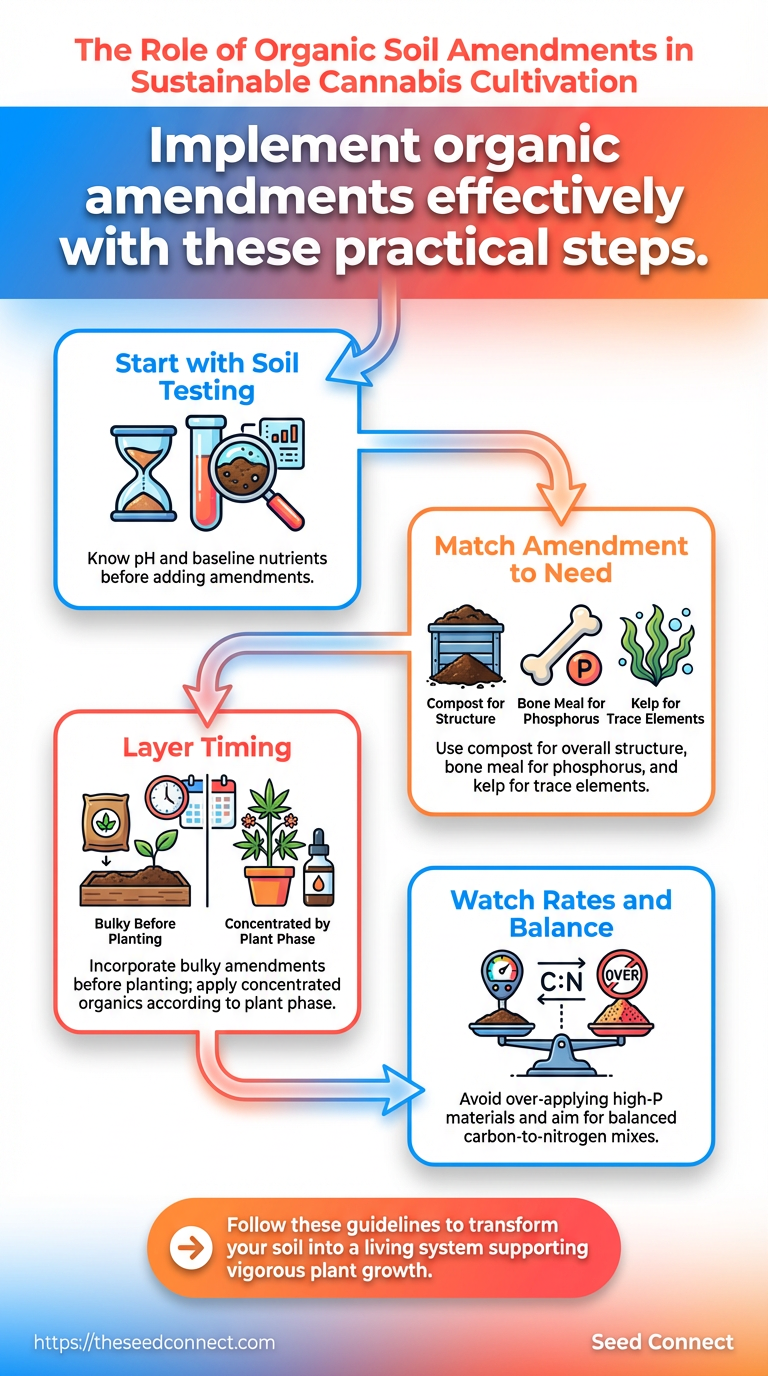
Practical guidance for growers: Start with soil testing: Know pH and baseline nutrients before adding amendments. Match amendment to need: Use compost for overall structure, bone meal for phosphorus in early flower, and kelp for trace elements and growth regulators. Layer timing: Incorporate bulky amendments (compost, biochar) before planting; apply concentrated organics (bone meal, bat guano) according to plant phase. Watch rates and balance: Over-applying high-P materials can lock out other nutrients; aim for balanced carbon-to-nitrogen (C:N) mixes.
### Common organic soil amendments by primary benefit, typical N-P-K (qualitative), best use phase, and application rate
| Amendment | Primary benefit | Typical N-P-K (qualitative) | Best use phase | Typical application rate |
|---|---|---|---|---|
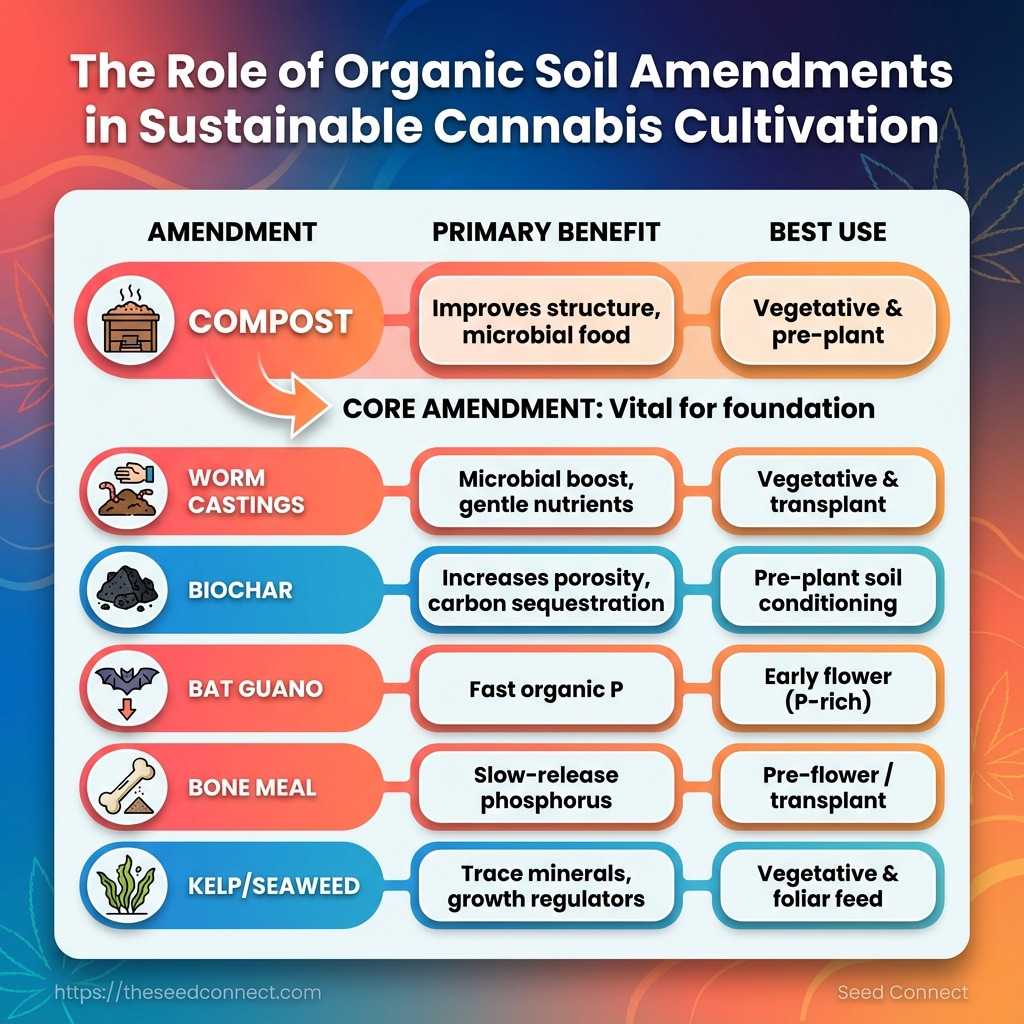
| Compost | Improves structure, microbial food | Low | Vegetative & pre-plant | 20–40% by volume in pot mixes; ½–2 in/acre topdress |
| Worm castings | Microbial boost, gentle nutrients | Low–Med | Vegetative & transplant | 5–20% by mix volume; ¼–1 cup/plant topdress |
| Biochar | Increases porosity, carbon sequestration | Negligible | Pre-plant soil conditioning | 2–10% by volume, often charged with compost |
| Bat guano | Fast organic P (and sometimes N) | Med–High (P or N depending) | Early flower (P-rich) | ½–2 tbsp/plant in pots; follow product label |
| Bone meal | Slow-release phosphorus | Low–Med (high P) | Pre-flower / transplant | 1–4 tbsp/plant; 2–5 lbs/100 sq ft incorporated |
| Kelp/seaweed | Trace minerals, growth regulators | Low | Vegetative & foliar feed | 1–2 tbsp/gal for tea; 5–20 lbs/acre granular |
Key insight: Compost and worm castings provide broad-spectrum benefits for soil health, while bone meal and bat guano supply targeted P for flowering. Biochar acts as a long-term structural soil asset but requires charging with organics to be fully effective.
Understanding organic amendments empowers more resilient, sustainable cannabis cultivation and reduces reliance on quick‑fix fertilizers while enhancing long-term soil health. When chosen and applied with intent, amendments transform soil into a living system that supports vigorous plants and consistent yields.
How Do Organic Soil Amendments Work?
Organic soil amendments change three things at once: the physical structure of the medium, the availability of nutrients, and the living biology that processes those nutrients. Start with that simple frame and it becomes easy to predict how an amendment will affect watering, feeding schedules, and cannabis vigor at each lifecycle stage.
Structure — amendments like compost, coco coir, or worm castings alter porosity and water retention. Improved structure means more consistent moisture around roots, fewer wet–dry swings, and better oxygenation for root growth. Practically, soils with higher organic matter can be watered less often but require monitoring to avoid anaerobic pockets.
Nutrients — organic amendments supply minerals directly and release them slowly as microbes break down organic matter. Unlike synthetic salts, these sources buffer nutrient availability; plants get a steadier feed that’s less likely to cause nutrient burn. For cannabis, that smoothing of N-P-K release reduces the need for abrupt nutrient schedule changes when transitioning from veg to flower.
Biology — the living component is the multiplier. Beneficial microbes, fungi, and protozoa mineralize nutrients, suppress pathogens, and stimulate root exudation. Mycorrhizal fungi extend root reach, increasing phosphorus uptake during bloom when P demand spikes.
Practical implications for watering, feeding, and vigor: Watering frequency: Soils high in organic matter retain moisture longer; test with finger depth or a moisture meter rather than strict schedules. Nutrient schedule: Expect a gentler feeding ramp—start with 25–50% of synthetic chart values and supplement with slow-release organics. * Plant vigor: Robust root networks form faster in microbe-rich mixes, reducing transplant shock and improving resilience to heat or drought stress.
Linking mechanisms to cannabis lifecycle stages: 1. Veg stage: Focus on structure and microbial establishment—add compost and mild N-rich organics to support leaf and root expansion. 2. Early flower: Shift to amendments that enhance biology and supply phosphorus—mycorrhizae and bone meal help bud set. 3. Late flower: Use low-N, P/K–rich organics and bolstering microbial teas to maintain sugar production without promoting excess foliage.
Concrete example — a practical amendment sequence: 1. Mix 10–20% worm castings into potting media. 2. In first two weeks, water with a mild compost tea twice. 3. At transition to flower, add a tablespoon per gallon of bone meal and re-inoculate mycorrhizal product.
Consider building a simple checklist or amendment calendar to track what goes in at each stage; that makes the benefits repeatable across grows. Understanding these mechanisms clarifies why organic amendments change how a grower waters and feeds plants, and how they improve plant health across the cannabis lifecycle.
Why Organic Amendments Matter for Sustainable Cannabis Cultivation
Organic amendments deliver tangible environmental wins and practical advantages for cultivators by rebuilding soil biology, improving nutrient cycling, and reducing reliance on synthetic inputs. Using compost, biochar, worm castings, and mineral rock powders shifts a grow from pumping soluble salts into plants toward creating a living medium that feeds roots on demand. For sustainable cannabis, that means lower runoff, better drought resilience, steadier cannabinoid expression, and fewer corrective interventions during flower — outcomes that are measurable and repeatable across grows.
How amendments translate to environmental benefits and grower ROI
- Soil biology improvement: Healthy microbiomes mineralize nutrients slowly, reducing the need for frequent synthetic fertilizer applications and cutting nutrient runoff.
- Water efficiency gains: Increased organic matter raises water-holding capacity, lowering irrigation frequency and smoothing EC spikes that stress plants.
- Carbon storage: Stable amendments like biochar and compost build soil organic carbon, sequestering CO2 and improving long-term soil structure.
- Plant resilience: Plants in biologically active soils demonstrate lower incidence of root pathogens and recover faster from heat or drought stress.
Measurable indicators growers should track
- Soil organic matter (SOM): Test baseline SOM and retest seasonally to quantify amendment impact.
- Water holding capacity: Measure volumetric water content or observe irrigation intervals.
- Fertilizer input: Track mass or volume of synthetic fertilizer applied per crop cycle.
- Plant health metrics: Monitor disease incidence rates, leaf tissue nutrient analyses, and yield consistency (g/plant).
- Runoff nutrient concentration: If runoff is collected, test for nitrate and phosphate as environmental indicators.
Practical examples: integrating 3–5% compost into potting mixes commonly reduces soluble fertilizer needs by 20–40% within a season; adding 1–2% biochar by volume can increase cation exchange capacity and buffer nutrients through longer cropping cycles. Start small, measure frequently, and adjust blends rather than assuming one amendment fixes every problem.
Soil organic matter: The fraction of soil composed of decomposed plant and microbial material that holds nutrients and water.
Biochar: A stable, carbon-rich amendment that increases soil porosity and long-term carbon storage.
Worm castings: Microbially active fertilizer that improves nutrient availability and soil structure.
### Summarize measurable benefits of amendments with suggested metrics and expected ranges (sustainable cannabis soil health, organic amendments benefits)
| Benefit | Metric to track | Typical short-term improvement (6-12 months) | Long-term improvement (1-3 years) |
|---|---|---|---|
| Soil organic matter | SOM % (loss-on-ignition) | +0.2–1.0 percentage points | +0.5–2.0 percentage points |
| Water retention | Volumetric water content (%) | +5–15% relative improvement | +10–30% relative improvement |
| Fertilizer usage | kg synthetic N-P-K per crop | −15–40% reduction | −30–60% reduction |
| Plant resilience / disease incidence | % plants affected per cycle | −10–30% fewer disease events | −25–60% fewer disease events |
| Carbon sequestration potential | Tons CO2e stored per ha-equivalent | 0.1–0.5 t CO2e | 0.5–2.0 t CO2e |
Key insight: These ranges are typical outcomes observed when growers adopt consistent amendment strategies and measure progress. Tracking the listed metrics turns abstract sustainability goals into actionable targets that reduce input costs while improving crop stability and environmental outcomes.
Understanding these principles helps operational teams prioritize amendments that fit their workflow, measure what matters, and scale practices that improve both farm profitability and environmental performance.
Common Misconceptions About Organic Soil Amendments
Many growers assume organic amendments are a one-and-done magic bullet. Reality is different: amendments are tools that interact with existing soil biology, crop genetics, and environmental conditions. Expecting immediate, uniform results without testing or blending leads to inconsistent crops and wasted inputs. This section corrects common myths and provides practical fixes grounded in soil ecology and grow-room practice.
Myth vs reality — practical corrections Myth: Amendments work instantly. Reality: Most organic inputs change nutrient availability over weeks to months as microbes break them down; C:N dynamics and temperature control the pace. Myth: One amendment fits all soils. Reality: Soils vary by texture, organic matter, pH and microbial communities — a kelp meal addition that helps sandy loam can create salt stress in already nutrient-rich, clay-heavy mixes. Myth: More is better. Reality:* Over-application of compost or rock dust can cause nutrient imbalances, poor aeration, or excessive microbial oxygen demand, especially in container grows.
Definitions that clarify terms Active amendment: Material that supplies readily available nutrients or stimulates microbes (e.g., fish hydrolysate).
Passive amendment: Material that slowly releases nutrients or changes structure (e.g., biochar, compost).
Testing and blending: a short workflow 1. Collect a representative soil sample from multiple pots or locations and measure pH, EC, and texture. 2. Compare results to plant targets and identify deficiencies or excesses. 3. Choose amendments to correct specific issues (e.g., gypsum for sodium, worm castings for trace nutrients). 4. Mix small test batches at recommended rates, monitor for 2–4 weeks, then scale if results show improved structure or seedling vigor.
Practical examples and common fixes Sandy soil lacking water retention: Add compost and biochar to increase organic matter and water-holding capacity. High EC in containers: Reduce concentrated manures, leach with clean water, then recondition with dilute kelp and microbial inoculants. * Low microbial activity: Apply diverse carbon sources (leaf compost, molasses in very low doses) and maintain warm, moist conditions to encourage decomposition.
Avoid one-size-fits-all thinking by testing, patching mistakes on small scales, and tracking changes over time. When applied thoughtfully, organic amendments become predictable levers for healthier soil and more consistent cannabis production. Understanding these principles helps growers make informed adjustments that improve harvest reliability.
Real-World Examples and Case Studies
Three short, practical case studies show how choices in amendments, scale, and timing change outcomes for cannabis growers. Each example focuses on realistic, replicable practices you can adapt: a home grow (4–8 plants) that prioritizes organic soil amendments for potency and flavor; a commercial greenhouse optimizing throughput with targeted nutrient regimens and integrated pest control; and a regenerative outdoor farm rebuilding soil over seasons to increase yield per acre. The following vignettes include concrete timelines, measurable outcomes, and experiment-level actions a grower can try in their next cycle.
### Home grower — small-scale, high-quality flower Setup: 4–8 plants in 10–20 L pots using a living soil mix. Primary amendments: compost (25% by volume), worm castings, rock phosphate, kelp meal. Timeline: visible soil biology improvement in 4–6 weeks; harvest-ready plants in 10–14 weeks from flip. Measured outcomes: denser buds, smoother smoke, and more consistent terpene expression reported by growers using compost-rich mixes. Actionable experiment: 1. Replace 20% of potting mix with well-aged compost before transplant.
- Top-dress with 1–2 cups worm castings at week 3 post-transplant.
- Measure plant vigor visually and note aroma at harvest for comparison.
### Commercial greenhouse — throughput and consistency Setup: hundreds of plants under supplemental LED lighting with ebb-and-flow irrigation. Primary amendments: tailored soluble feeds, microbial inoculants, calcium-magnesium supplements. Timeline: two-week flush cycles for soluble feeds; stable harvest windows within 8–10 weeks. Measured outcomes: tighter canopy uniformity, faster turnaround, and reduced nutrient variability between benches. Actionable experiment: 1. Implement EC and pH logging at irrigation points.
- Trial a microbial inoculant on one bench for a single crop cycle and track yield/kg per light.
### Regenerative outdoor farm — soil rebuilding at scale Setup: multi-acre rotation with cover cropping, heavy compost inputs, and minimal tillage. Primary amendments: bulk compost, biochar additions, diverse cover crop seed mixes. Timeline: soil organic matter gains measurable in 1–3 seasons; yield increases typically seen in season two. Measured outcomes: improved water retention, stronger pest resilience, higher yield per acre after 12–24 months. Actionable experiment: 1. Plant a legume-rich cover crop over winter and incorporate as green manure in spring.
- Apply a 1–2% biochar-by-volume amendment mixed into topsoil in a test plot and monitor moisture retention.
### Side-by-side summary of the mini case studies showing scale, amendments used, timeline, measurable outcomes, and recommended next step for readers
| Scale (home/commercial/farm) | Primary amendments used | Timeline to results | Measured outcomes | Recommended reader experiment |
|---|---|---|---|---|
| Home (4–8 plants) | Compost 20–25%, worm castings, kelp meal | 4–6 weeks soil activity; 10–14 weeks to harvest | Denser buds, improved aroma, steadier germ rates | Top-dress worm castings week 3; compare two plants |
| Commercial greenhouse (hundreds) | Soluble feeds, microbial inoculants, Ca-Mg | Immediate nutrient response; 8–10 week cycles | Uniform canopy, consistent yields, reduced nutrient drift | Log EC/pH; trial inoculant on one bench |
| Regenerative outdoor farm (acres) | Bulk compost, biochar, cover crops | 1–3 seasons for SOM gains; 2nd season yield lift | Better water retention, pest resilience, +yield/acre | Plant legume cover crop; test 1–2% biochar plot |
Key insight: the same organic soil amendment principles scale from pots to acres, but timelines and measurable wins differ—the home grower sees aroma and texture changes within a single cycle, the commercial operator gains consistency immediately with monitoring, and the regenerative farm realizes systemic gains over multiple seasons.
Understanding these examples helps prioritize experiments that fit a grower’s timeframe and resources. Small, controlled trials—the kind described above—deliver actionable comparisons without risking an entire crop. When high-quality starting genetics and a germination guarantee are part of the program, those experiments become more predictive and useful.
How to Start Using Organic Amendments: Practical Guide
Start by testing the soil, choose amendments to match deficiencies and goals, then apply in small, repeatable increments while monitoring plant response. Begin with a baseline soil test (pH, texture, organic matter, and basic nutrient levels). Use that data to pick targeted organic inputs—think compost for general fertility, kelp or fish emulsion for soluble trace elements, alfalfa or soybean meal for nitrogen, and biochar or coco for water retention. Apply conservatively, observe for two weeks, then adjust rates rather than doubling initial doses. This approach reduces shock, builds a living soil, and keeps nutrient availability aligned with plant growth stages.
How to implement it day-to-day: 1. Perform a soil test and record pH, texture, organic matter, and basic N-P-K.
- Choose a starter recipe tailored to results; prepare enough to treat one bed or pot to validate.
- Apply amendments
2–4 weeksbefore planting in outdoor beds, or top-dress during veg for containers.
- Monitor plants weekly for leaf color, growth rate, and soil moisture; run follow-up tests at mid-veg and pre-flower.
- Adjust by ±25% of application rates based on observed deficiency or excess; document every change.
Practical recipes that are testable and repeatable: Increase water retention: Mix 5–10% by volume biochar + 10–20% compost into top 6 inches. Boost vegetative nitrogen: Apply 1–2 lb/yd³ alfalfa meal or 0.5–1 lb/yd³ soybean meal incorporated into soil. Improve bloom and terpene expression: Side-dress with 0.5–1 lb/plant bat guano (low N, high P) at pre-flower; foliar kelp spray for trace elements. Build soil microbiome: Incorporate 1–2 cups/ft³ of finished compost and apply a microbial inoculant at label rate.
Monitoring indicators and simple adjustment rules: Leaf color: Pale green → add slow-release nitrogen; dark, burnt tips → flush or reduce amendments. Growth rate: Slow despite good light → check pH and microbial activity; consider a pH 6.0–6.8 adjustment. * Soil moisture: Waterlogged → increase drainage and reduce water-retentive amendments; too dry → raise organic matter and mulching.
### Provide a quick reference matrix of amendment choice by grower goal (increase water retention, boost nitrogen, increase bloom nutrients, build microbiome)
| Grower goal | Recommended amendments | When to apply | Quick application note |
|---|---|---|---|
| Increase water retention | Biochar, compost, coconut coir | At bed prep or pot mix | Mix into top 6″ at 5–15% volume; improves porosity and moisture holding |
| Boost early vegetative nitrogen | Alfalfa meal, soybean meal, blood meal (lower rate) | Incorporate before planting or top-dress early veg | Use slow-release rates: 1–2 lb/yd³; avoid over-application |
| Improve bloom and terpene expression | Bat guano (low-N, high-P), bone meal, kelp | Side-dress at pre-flower (first 2–3 weeks) | Apply conservatively: 0.5–1 lb/plant; combine with kelp foliar for micronutrients |
| Build soil microbiome | Finished compost, mycorrhizal inoculant, compost tea | At planting and monthly teas during season | Add 1–2 cups/ft³ compost; use teas to boost active microbes |
Key insight: The table ties specific grower goals to practical amendments and timing; start small, measure plant response, and iterate. This methodical approach minimizes mistakes and builds resilient, nutrient-rich soil for consistent harvests.
Understanding and following these steps greatly reduces guesswork and accelerates learning on the next grow cycle. When applied thoughtfully, organic amendments simplify nutrient management and reward patient, observant growers.
📥 Download: Organic Soil Amendments Checklist for Sustainable Cannabis Cultivation (PDF)
Risks, Regulations, and Sourcing Best Practices
Start by treating genetics and provenance as safety-critical choices: poor sourcing exposes a crop to contamination, legal risk, and wasted time. Focus on lab-verified seed lots, transparent chain-of-custody, and vendors who document testing. For home and commercial growers alike, cultivating with attention to regulatory compliance and soil health prevents lost harvests and legal headaches.
Contamination risks and what to watch for Fungal contamination: spores in seed lots and media can cause damping-off and bud rot; ask for germination and pathogen screens. Bacterial contaminants: seed-borne bacteria can stunt seedlings and confound nutrient uptake. Pesticide residues: non-organic seed production can carry residues that persist in plants and soils. Genetic mislabeling: mislabeled strains create compliance and product-consistency problems. * Adulterants and heavy metals: poor-quality inputs or growing in contaminated soils transfers toxins into biomass and concentrates.
Sourcing checklist — concrete items to request from any seed vendor Lab test reports: recent germination and pathogen/aflatoxin/pesticide screens for the specific seed lot. Lot/batch traceability: unique lot number and production date. Genetic lineage: breeder information and phenotype stability notes. Germination guarantee: terms for replacement or refund if germination fails. * Shipping and storage conditions: temperature controls and humidity measures used during transit.
Vendor vetting: step-by-step process to follow 1. Request the lot-specific lab report and verify the lab name and test date.
- Ask for references or grower case studies showing consistent phenotype expression.
- Confirm commercial or bank licensing relevant to your jurisdiction and request proof.
- Test a small starter sample under controlled conditions before scaling purchases.
- Retain documentation — invoices, certificates, and communications — to demonstrate due diligence.
Practical examples and templates Use this email template when verifying a new supplier: `text Please provide lot #, lab test report (pathogens/pesticides/heavy metals), germination rate, and storage/shipping conditions for the specified seed lot. Also include breeder lineage and any warranty terms.
Definitions for clarity Germination guarantee: A vendor commitment to replace or refund seeds that fail to meet an agreed germination rate.
Chain-of-custody: Documentation that traces seeds from breeder to buyer, useful for legal compliance and recalls.
Pathogen screen: Laboratory testing for seed-borne fungi, bacteria, and viruses that can impair crops.
When sourcing, prioritize suppliers who combine transparent testing with clear guarantees—these practices reduce biological risk and protect investments while supporting sustainable cannabis cultivation and soil health through informed input choices. Understanding and documenting these steps makes regulatory compliance manageable and keeps operations resilient.
Roots are where many crop problems begin, and the practical lessons in this article converge on one point: rebuilding soil biology and structure pays dividends that calculators can’t predict. Integrating well-chosen organic soil amendments—compost, worm castings, biochar and on-site compost teas—transforms compacted media into an actively feeding root zone, improves water retention, and reduces reliance on synthetic fixes. Real-world growers in mixed-light greenhouses and small craft operations reported steadier veg growth and fewer late-stage nutrient lockouts after switching to staged amendment programs and routine microbial inoculation. Start small: test one amendment in one bench, monitor soil health and run a simple EC/pH and root-visual check every two weeks.
For anyone ready to act, three practical next steps move the needle quickly: 1) perform a baseline soil health check, 2) build a simple amendment schedule tied to life stage, and 3) source high-quality inputs from reputable suppliers. For professional seed and germination support that pairs well with soil-driven cultivation, review the seed sourcing and germination guide and align variety choice with your amended media. If questions remain about timing, rates, or microbial blends, replicate the trial approach used by the case studies here: low-risk, measurable changes that protect crop value while restoring long-term soil health for more sustainable cannabis production.