


Understanding the Essential Elements for Optimizing Cannabis Growth helps growers support stronger roots, healthy foliage, and consistent plant development throughout the growing cycle. Cannabis plants rely on a balanced supply of macronutrients such as nitrogen, phosphorus, and potassium, along with secondary nutrients and micronutrients that support key biological processes.
According to the University of Massachusetts Amherst, proper nutrient management depends on maintaining the right balance of essential elements rather than simply applying more fertilizer. In this guide, The Seed Connect explains the most important nutrients cannabis plants need, what each one does, and how they contribute to healthy growth.
Quick Answer: Healthy cannabis growth depends on a balanced nutrient plan.
This plan mainly includes nitrogen, phosphorus, and potassium (N-P-K) and must match each stage of growth.
Studies suggest that nutrient yield may depend significantly on these macronutrient ratios, and optimizing them could potentially increase yields by approximately 20%.
Excess feeding or imbalanced nutrients can harm plants, highlighting the need for careful monitoring and adjustment.
What Do Cannabis Plants Actually Need to Grow Well?
What makes one cannabis plant thrive while another stays pale, weak, or stunted? The answer usually comes down to balance: the right nutrients, water, light, air, temperature, and root conditions at each stage of growth.
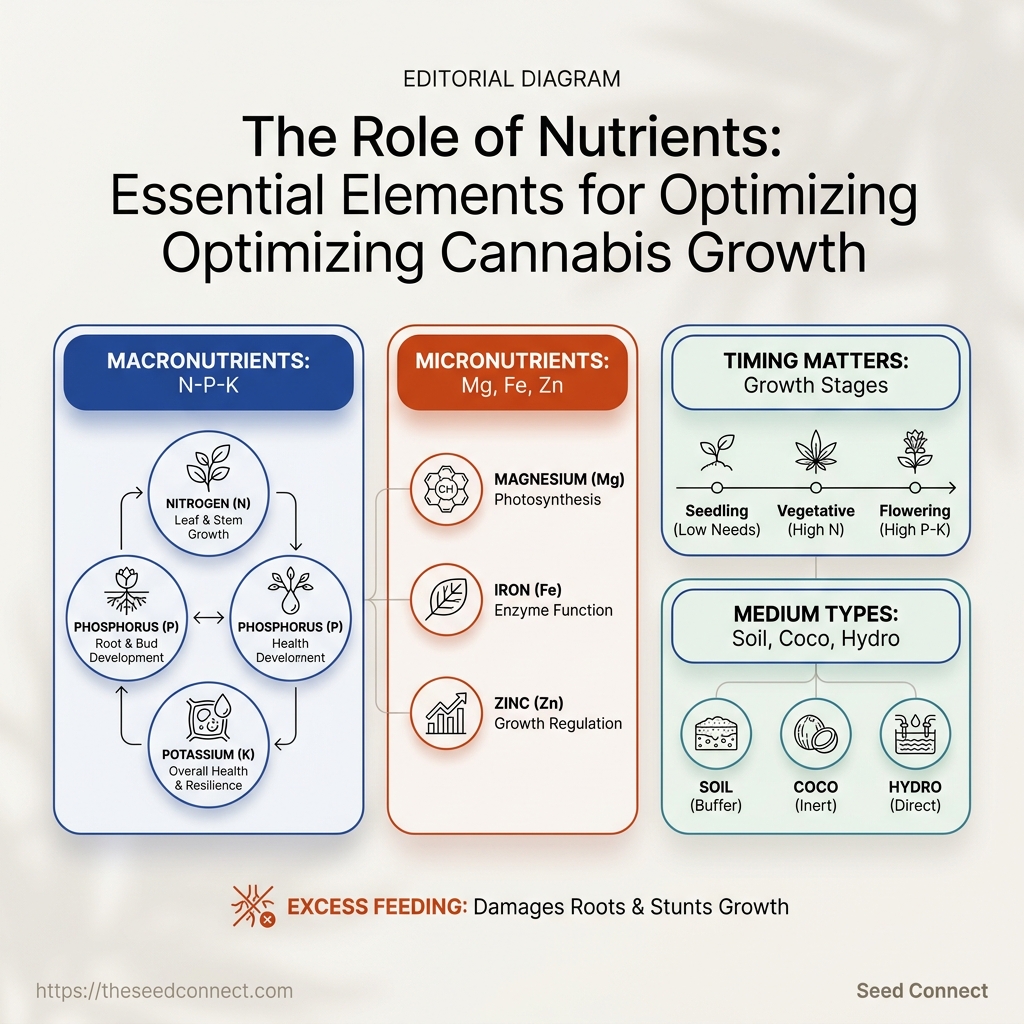
Nitrogen, phosphorus, and potassium form the primary nutrient group, often written as N-P-K on fertilizer labels.
Nitrogen supports stems and leafy growth, phosphorus helps roots and flower development, while potassium supports water movement, enzyme activity, and overall plant function.
The right balance matters more than simply adding more fertilizer.
Best cannabis nutrients for 2026 comparisons also distinguish between complete nutrient lines and single-purpose additives.
A complete base feed usually provides a more reliable foundation than stacking several products without checking their combined contents.
The supporting nutrients matter, too
Healthy cannabis growth depends on more than the three headline nutrients.
Secondary nutrients and micronutrients help plants build tissue, produce chlorophyll, transport sugars, and carry out essential chemical processes.
- Calcium: Supports cell walls, new growth, and root development.
- Magnesium: Forms part of chlorophyll and helps leaves capture light.
- Sulfur: Supports amino acids, enzymes, and natural plant compounds.
- Iron: Helps plants produce chlorophyll and maintain healthy new leaves.
- Zinc and manganese: Support enzyme activity and normal growth processes.
A deficiency is not always caused by a lack of fertilizer.
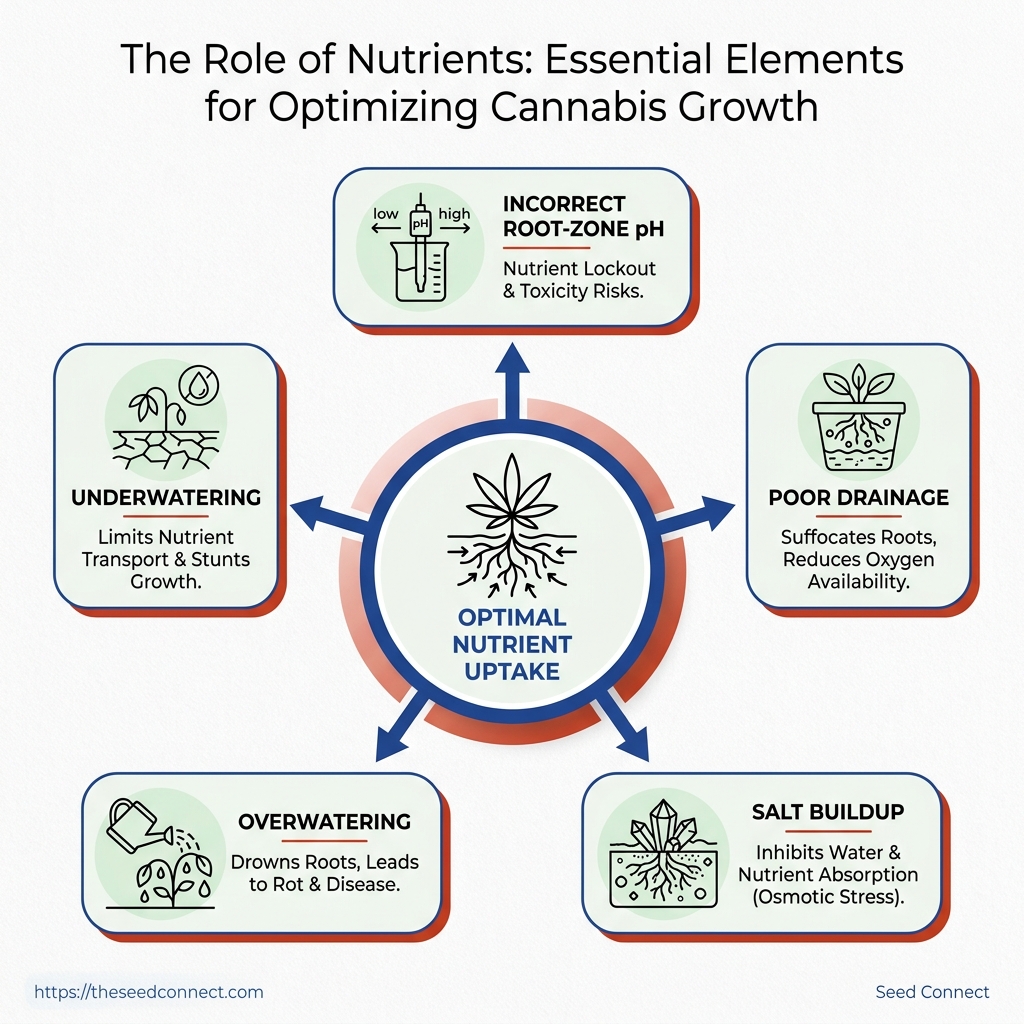
Incorrect root-zone pH, poor drainage, or salt buildup can prevent roots from absorbing nutrients that are already present.
Yellowing leaves, curling tips, slow growth, or unusually dark foliage should prompt a review of watering, pH, and feeding habits before adding more nutrients.
Nutrient needs change from seedling to harvest
Seedlings need very little nutrition because their first leaves and roots contain stored energy.
Strong light, gentle watering, and an airy growing medium usually matter more than heavy feeding during this stage.
During vegetative growth, plants typically need greater nitrogen support as they build leaves, stems, and roots.
As flowering begins, nutrient needs shift toward balanced phosphorus and potassium support, while nitrogen generally becomes less dominant.
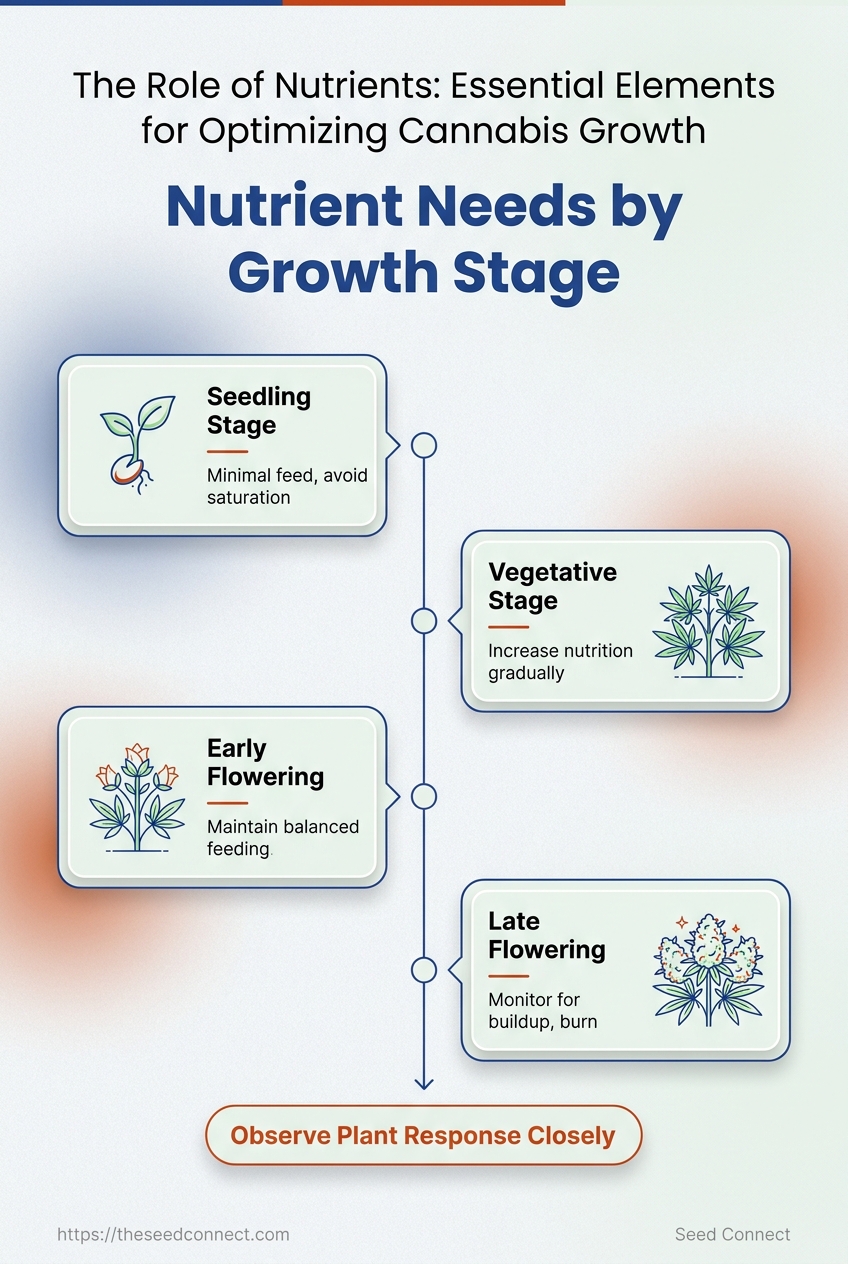
- Seedling stage: Use minimal feed and avoid saturating young roots.
- Vegetative stage: Increase nutrition gradually as healthy leaves and roots develop.
- Early flowering: Maintain balanced feeding while the plant transitions into flower production.
- Late flowering: Follow the nutrient line’s guidance and watch closely for buildup or leaf-tip burn.
Good cannabis growth optimization starts with observation, not guesswork.
Feed gradually, monitor plant response, and treat healthy roots as the foundation for every later stage.
Healthy Growth Depends on Balance, Not Simply More Nutrients
Have you ever increased feeding because a plant looked slow, only to see the leaves curl, darken, or develop burnt edges? Excess nutrition can damage roots quickly, while a mild deficiency often gives growers time to adjust.
High levels of nutrients can pull water away from the roots through osmosis.
That stress can reduce water uptake, weaken new growth, and create symptoms that resemble several deficiencies at once.
A plant may then receive even more nutrients, worsening the original problem.
The goal is not maximum feeding.
It is a root zone where concentration, acidity, moisture, and oxygen work together.
General feeding guidance also varies by product and growing method, so manufacturer instructions should support—not replace—regular plant observations.
Best Cannabis Nutrients 2026 compares nutrient lines that differ in formulas and feeding approaches.
How the Root Zone Controls Nutrient Uptake
The same cannabis nutrients can behave differently in soil, coco coir, and hydroponic systems.
Root-zone pH affects whether elements remain available, while the growing medium controls how quickly moisture and salts move around the roots.
The table below gives broad guidance, not universal targets.
Always account for the cultivar, plant stage, water source, and product label.
Table: Healthy Growth Depends on Balance, Not Simply More Nutrients — Growing factor, Why it matters, Common warning sign & more
| Growing factor | Why it matters | Common warning sign | Practical adjustment |
|---|---|---|---|
| Root-zone pH | Controls nutrient availability at the roots | Interveinal yellowing or stalled growth despite feeding | Check runoff or root-zone readings; adjust gradually within the medium’s usual range |
| Nutrient concentration | Determines how much dissolved feed reaches the roots | Brown tips, very dark leaves, curling, or slowed growth | Follow the label; reduce strength when symptoms suggest excess salts |
| Growing medium | Changes nutrient retention, drainage, and feeding frequency | Dry pockets, persistent wetness, or uneven growth | Match the feeding schedule to the medium rather than the calendar |
| Water quality | Minerals and alkalinity can alter pH and add dissolved salts | Rising readings, residue, or unstable pH | Test source water periodically and account for its mineral content |
| Drainage and aeration | Roots need oxygen as well as water and nutrients | Wilting in wet media or weak root development | Improve drainage, avoid compacted media, and allow appropriate drying |
A measured routine creates better information.
Record the product, dilution, water volume, pH reading, and plant response after each feeding.
This makes small corrections possible before stress spreads.
Do Versus Do Not
- Do begin cautiously: Use the product’s recommended starting rate, especially after transplanting or when changing nutrient lines.
- Do observe new growth: Recent leaves reveal whether the current routine is working better than older, damaged foliage.
- Do change one variable: Alter feeding strength, pH, or watering frequency separately whenever possible.
- Do not chase every symptom: Similar signs can come from excess salts, poor drainage, pH drift, or root stress.
- Do not feed on a fixed schedule blindly: The medium’s moisture level and the plant’s stage should guide timing.
- Do not flush automatically: A flush may remove accumulated salts, but unnecessary flushing can disrupt a stable root zone.
Healthy cannabis growth comes from steady conditions, not aggressive feeding.
A calm, recorded approach supports better nutrient uptake and more reliable cannabis growth optimization.
A Small Grower’s Nutrient Decisions Often Start with the Plant’s Signals
What should you do when the lower leaves turn pale during early vegetative growth? Do not reach for a stronger feed immediately.
First, see the plant as a set of clues instead of just one problem.
Lower leaves often change color because they are older and less active.
A gradual fade may reflect normal aging, especially when new growth remains green and the plant continues producing leaves.
Rapid paling, slow growth, or spreading discoloration deserves closer attention.
A useful diagnosis combines three signals: leaf color, growth rate, and root-zone conditions.
Looking at only one can lead you toward the wrong fix.
Read the Whole Pattern
Start with the newest growth.
Healthy new leaves provide a useful reference point because they show how the plant is developing now, not what happened several days ago.
Then check whether the plant is gaining height, producing new nodes, and holding its leaves upright.
A pale lower leaf on a fast-growing plant means something different from pale leaves on a plant that has stopped developing.
The root zone adds the missing context.
Check whether the growing medium feels wet, dry, compacted, or poorly drained.
Roots need access to both water and oxygen, so a constantly wet medium can create symptoms that resemble a lack of plant nutrients.
A simple observation routine can prevent unnecessary changes:
- Check new growth: Healthy color and steady development reduce the chance of an urgent nutrient problem.
- Track growth rate: Record new leaves, node spacing, and overall posture every few days.
- Inspect moisture: Note how quickly the medium dries after watering, rather than watering by calendar alone.
- Review recent changes: Include repotting, light adjustments, temperature shifts, and feeding changes.
One symptom can have several causes.
Pale lower leaves may reflect limited nitrogen, restricted roots, excess moisture, poor nutrient availability, or ordinary leaf turnover.
The pattern matters more than the color alone.
For example, pale leaves plus slow growth and wet soil point toward a root-zone issue before a stronger feed makes sense.
Pale leaves with active new growth and evenly drying soil may call for closer observation instead.
Nutrient products also differ in their intended growing mediums and feeding systems, as shown in this 2026 comparison of cannabis nutrients.
That makes the plant’s response, the label directions, and the medium equally important.
Good cannabis growth decisions begin with patient observation.
Read several signals together, then make one measured change and watch how the plant responds.
Some Nutrient Problems Are Not Nutrient Shortages at All
Have you ever added more feed to a pale plant, only to see the problem spread? The plant may have enough nutrients in its growing medium.
Its roots simply cannot access them.
A true deficiency means the plant lacks an available element.
Nutrient lockout is different: the element may be present, but an unsuitable root-zone pH, excess salts, poor moisture control, or damaged roots prevents uptake.
This distinction matters because adding more cannabis nutrients during lockout can increase stress rather than correct it.
Start by checking the root environment before changing the feed.
Test the input solution and, where appropriate, the runoff.
Compare those readings with the needs of the growing medium.
Coco, soil, and hydroponic systems do not manage plant nutrients in exactly the same way; medium-specific guidance is discussed in this cannabis nutrient reference from GrowWeedEasy.
Read the Whole Growing Environment
Leaves show symptoms, but roots experience the cause.
Check these factors before diagnosing a shortage:
- Watering pattern: Constantly wet media can reduce oxygen around roots, while repeated severe drying can interrupt uptake. Aim for a consistent moisture cycle suited to the medium.
- Light intensity: Strong light increases demand for water and nutrients. If light rises sharply while roots, moisture, or feed remain unchanged, leaf stress can resemble a deficiency.
- Temperature: Cold roots absorb slowly. Excessive heat can increase water loss and place more pressure on the root system, even when the nutrient mix is unchanged.
- Root condition: Brown, damaged, compacted, or foul-smelling roots point toward a root-zone problem rather than a simple shortage.
The same leaf symptom can therefore have several causes.
Iron may be present but unavailable at an unsuitable pH.
Magnesium uptake may slow when roots stay cold or saturated.
Excess fertilizer can also raise salt levels and make water movement more difficult.
Change One Variable at a Time
When several conditions look wrong, resist the urge to change everything together.
Record the current feed strength, watering pattern, light setting, temperature, and pH.
Then correct the most likely cause first.
For example, if the medium remains wet and the roots appear stressed, address watering and drainage before increasing feed.
If the root zone looks healthy but pH is outside the medium’s suitable range, correct that issue and watch new growth before adding supplements.
This method makes cause and effect easier to track.
It also supports better cannabis growth optimization because each adjustment teaches you something about the plant’s actual needs.
Research published in a peer-reviewed study on cannabis nutrient management also underscores how nutrient balance influences plant performance, not merely the total amount supplied.
A plant that looks hungry may be asking for better access, not more food.
Diagnose the root zone first, then make one measured correction and give the plant time to respond.
Contrary to Popular Advice, a Complete Feeding Chart Cannot Replace Observation
A feeding chart is a starting point, not a command.
Product labels often describe a general schedule, yet plants can respond differently because of cultivar, medium, container size, light intensity, water quality, and root health.
Even two plants from the same seed pack may not drink or feed at the same rate.
Manufacturer guidance remains useful for understanding product strength and timing.
Advanced Nutrients, for example, provides product-specific feeding information alongside its nutrient systems, while Grow Weed Easy’s nutrient guidance stresses that growing medium and plant response affect feeding decisions.
A simple log turns observation into evidence.
Record what happened, then compare the plant’s response over the next few days instead of changing several inputs at once.
A Practical Nutrient Log for Each Plant
Table: Contrary to Popular Advice, a Complete Feeding Chart Cannot Replace Observation — Date and growth stage, Water amount, Nutrient product and dose & more
| Date and growth stage | Water amount | Nutrient product and dose | pH or water notes | Plant response | Next observation |
|---|---|---|---|---|---|
| Seedling | 100–250 ml around the root zone | Plain water or label-recommended starter dose | Record source water and measured pH | Note leaf color, posture, and new growth | Check moisture and new leaves within 24–48 hours |
| Early vegetative growth | 250–750 ml, adjusted for container dryness | Begin below the label maximum; record exact amount | Record pH and whether runoff appears | Note growth speed, leaf angle, and stem strength | Recheck before increasing the dose |
| Late vegetative growth | 750 ml–1.5 L, based on plant size and medium | Follow the product schedule, not a higher personal estimate | Record pH, runoff, and water temperature | Note canopy color, tips, and spacing between nodes | Compare response after two feeding events |
| Early flowering | 1–2 L, adjusted for container demand | Use the bloom-stage label rate as a reference | Record pH and any change in runoff readings | Note stretch, flower formation, and leaf condition | Review trends before adding supplements |
| Mid to late flowering | Amount required to evenly wet the medium | Reduce or stop products only according to label timing and plant response | Record pH, runoff, and days since last feed | Note fading, swelling flowers, and damaged tips | Confirm whether change is expected maturity or stress |
The table works because it separates what we applied from what the plant did next.
Keep one record for each plant when possible; a single group-wide note can hide meaningful differences.
Reduce feeding when fresh growth shows stress soon after application, the medium remains wet unusually long, or the plant’s condition worsens after repeated doses.
Flushing may be appropriate when confirmed salt buildup affects the root zone, but it is not a routine cure for every pale leaf.
Follow the product instructions and medium requirements before making a large correction.
Persistent symptoms, uncertain runoff readings, or suspected root damage justify advice from an experienced grower or qualified horticultural professional.
A feeding schedule supports good decisions; careful observation makes those decisions fit the plant in front of you.
Picture Two Plants with the Same Nutrient Program but Different Results
The same nutrient program can lead to different results because plants have different biological potentials.
Genetics influence root development, feeding speed, stretch, flowering behavior, and tolerance for environmental stress.
Seed quality matters just as much.
A weak seedling may emerge slowly, develop an uneven root system, or struggle to recover from early stress.
Increasing plant nutrients in response can create a second problem instead of correcting the first.
Imagine two plants receiving identical cannabis nutrients in the same room.
One develops a strong root ball and drinks steadily.
The other stays small because its roots remain cool, wet, or poorly established.
Their nutrient response will differ even though the feed is identical.
Genetics Set the Starting Point
Different cultivars can show very different nutrient preferences.
Some grow quickly and use more water during vegetative growth.
Others remain compact, mature slowly, or react poorly when the root zone stays heavily fed.
The growing medium adds another layer.
Coco coir, soil, and hydroponic systems hold and release nutrients differently.
Canna, for example, focuses on coco-specific growing, while General Hydroponics offers a flexible three-part approach for multiple media, as described in this cannabis nutrient guide from GrowWeedEasy.
Before changing a feeding program, compare the plant’s development with its growing conditions:
- Seedling vigor: Check emergence speed, stem strength, leaf shape, and early root growth.
- Root-zone conditions: Record moisture, drainage, temperature, and the time between waterings.
- Plant uniformity: Compare several plants from the same batch rather than judging one plant alone.
- Environmental consistency: Note light intensity, airflow, humidity, and container size near each plant.
Choose Dependable Genetics First
A dependable seed gives us a clearer starting point for diagnosing growth issues.
When seed quality and genetics are consistent, differences in leaves or growth rate are more likely to reflect the environment or feeding approach.
That does not mean every plant must look identical.
Natural variation still occurs.
It means the grower has fewer unknowns to manage.
Our cannabis seeds include a germination guarantee, and our team provides grower support when early development raises questions.
That fits best within a careful plan: begin with reliable genetics, record conditions, introduce feed gradually, and judge the response over several days.
Nutrient brands also differ in how much guidance and adjustment they expect.
Advanced Nutrients, for instance, highlights pH-focused technology and a broad range of additives on its official nutrient information page.
The label can guide the program, but the plant’s history supplies the context.
Strong genetics do not remove the need for observation.
They make observation more useful because the starting conditions are easier to trust.
What nutrients should you consider using like professional cannabis growers?
Professional cannabis growers primarily use macronutrients, specifically nitrogen, phosphorus, and potassium (N-P-K).
These nutrients are essential for supporting vigorous growth, healthy leaves, and flower production.
What fertilizer makes buds bigger?
Fertilizers with a higher phosphorus content are recommended for increasing bud size.
Phosphorus plays a crucial role in flower development, contributing to larger and more buds.
What is the best NPK ratio for cannabis?
The best NPK ratio for cannabis during vegetative growth is usually about 3-1-1 and about 1-3-2 during flowering.
Careful monitoring and adjustment of these ratios can significantly boost yields.
How do I know if my cannabis plants are nutrient deficient?
Signs of nutrient deficiency include pale lower leaves, slow growth, and spreading discoloration.
It’s essential to consider leaf color, growth rate, and root-zone conditions together to accurately diagnose the issue.
What is the role of micronutrients in cannabis growth?
Micronutrients like magnesium, iron, and zinc support vital processes within the plant, though they are needed in smaller amounts compared to macronutrients.
These elements play a critical role in overall plant health and nutrient metabolism.
Let the Plant Set the Pace
Successful cannabis growth relies more on understanding what the plant needs than on overfeeding.
The right balance of water, light, root conditions, and plant nutrients creates steady development; adding more fertilizer cannot correct poor drainage, an unsuitable pH, or stressed roots.
Healthy leaves and consistent new growth usually matter more than following a feeding schedule perfectly.
That is why two plants can receive the same cannabis nutrients yet produce different results.
One may have strong roots and ideal light, while the other struggles with compacted media or a damaged root zone.
Treating both plants with extra feed could worsen the weaker plant instead of supporting cannabis growth optimization.
Before changing your nutrient mix today, inspect the leaves, check the growing medium, and review your watering pattern.
Write down one observation and make only one measured adjustment, then watch the plant for several days before changing anything else.
This simple habit turns feeding from guesswork into a clear conversation with the plant—and gives you a much better chance of correcting the real problem.