


The Role of pH Levels in Cannabis Seed Germination Success is especially important once the seed begins developing roots and interacting with its growing medium. While moisture, oxygen, and temperature trigger germination, pH can influence the root-zone environment and how effectively young seedlings access nutrients after emergence.
According to research on cannabis cultivation, substrate pH can affect nutrient availability and plant development. In this guide, The Seed Connect explains how pH influences early growth, which ranges are commonly used for different media, and how growers can test and adjust pH without creating unnecessary fluctuations
Table of Contents
Why do healthy cannabis seeds still fail to sprout?
A seed can look perfect and still stall—often because the root zone pH drifts before you notice.
During germination, pH affects water movement around the seed and emerging root tip, and it influences how readily early nutrients stay available once the root begins to grow. Because sprouts have very little buffering capacity, the seedling has limited “wiggle room” to recover from a bad start.
The tricky part is timing: pH stress often shows up after the seed has already spent its stored energy. By then, the problem can look like weak genetics instead of an environment issue.
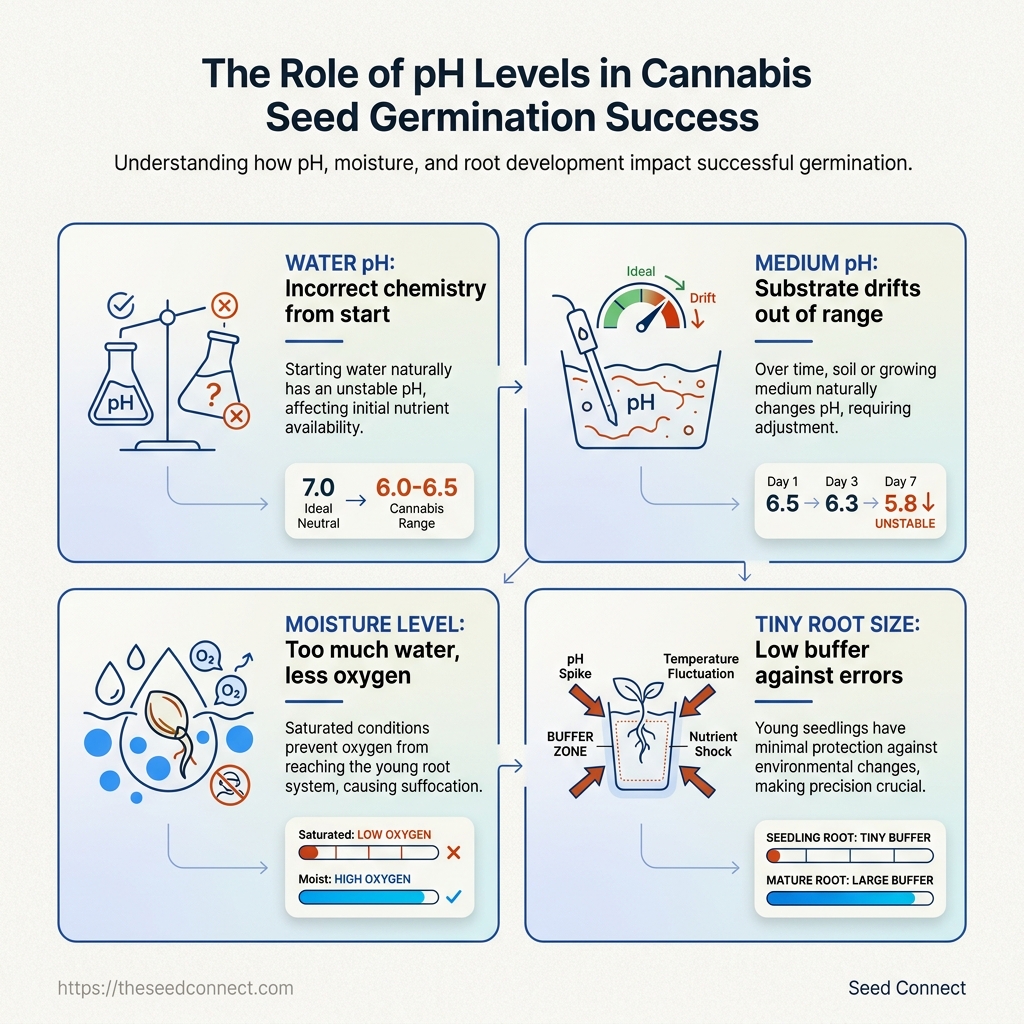
What makes pH trouble easy to miss:
- Water pH: If the water starts outside the right band for germination, the seed soaks in the wrong chemistry from minute one.
- Medium pH: Rockwool, soil, or coco can shift away from the intended target even when the surface looks fine.
- Moisture level: Overly wet media cuts oxygen, and the symptoms overlap with pH issues—so the wrong cause gets blamed.
- Tiny root size: Early roots can’t buffer swings the way larger plants can.
The practical move: check the water and the medium before germination stalls. For the medium-specific germination targets, use the table and guidance in Section 4. For the step-by-step testing approach, follow the checklist in Section 7.
What pH range helps cannabis seeds germinate best?
Why do some seeds crack open fast while others sit there for days? In most cases, the difference is not just heat or moisture. Seed germination pH is a quiet variable that can make the first stage feel smooth or stubborn.
For most starts, slightly acidic water and root-zone conditions work best.
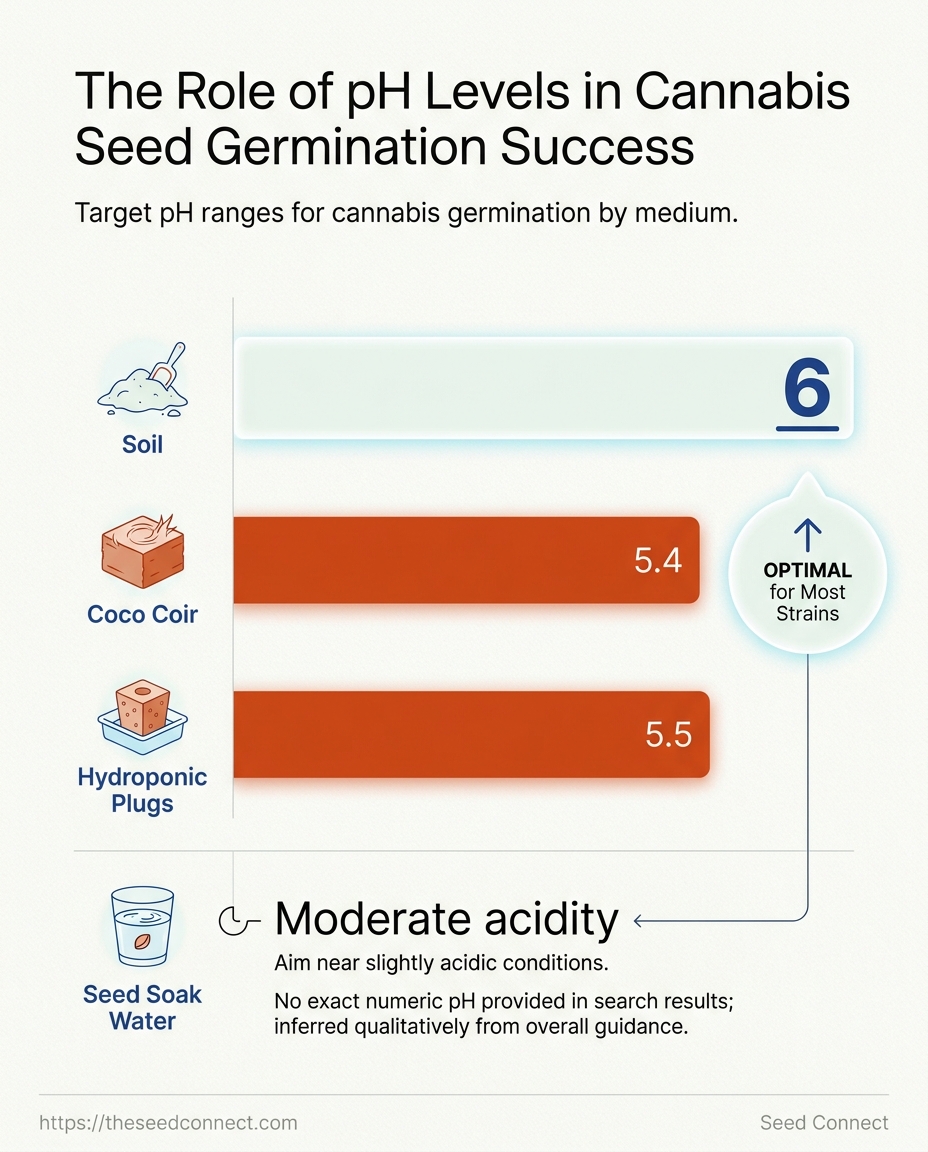
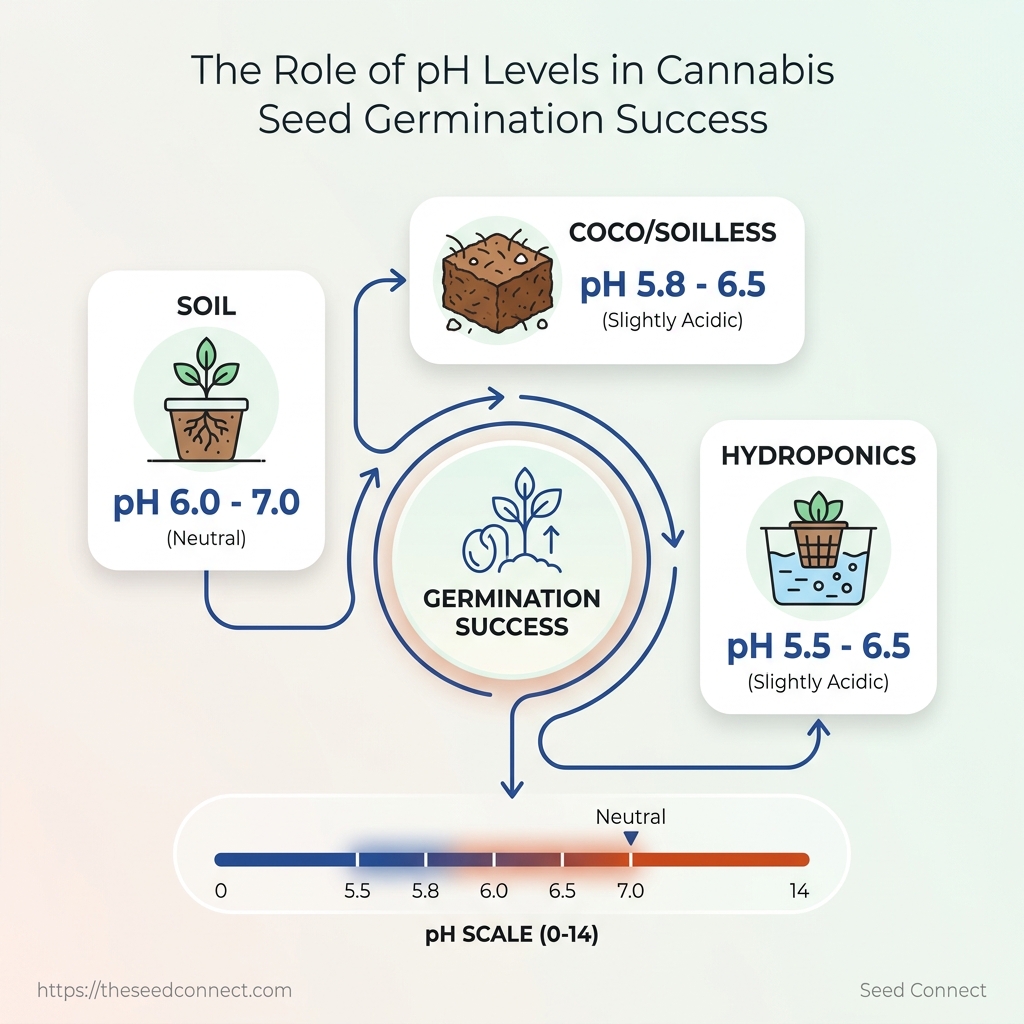
A practical target is 5.5–6.5 for soilless and hydro-style setups, while soil usually sits a little higher at 6.0–7.0.
Seedlings are not looking for the same numbers used later in veg or flower; they need a stable zone that keeps early nutrients available without pushing the medium too far in either direction.
That matters because the optimal pH cannabis growers talk about is really medium-specific.
A seed in coco, a plug, or soil all “see” pH differently once water moves through the root zone.
Practical pH targets by medium
| Growing medium | Target pH range | Best use case | Common risk if pH is off |
|---|---|---|---|
| Soil | 6.0–7.0 |
Direct sowing in a living or buffered soil mix | Micronutrients can become harder to access if the mix drifts too high |
| Coco coir | 5.8–6.5 |
Starter cups, buffered coco, and early transplant cups | Calcium, magnesium, and iron issues show up fast in unstable coco |
| Hydroponic starter plugs | 5.5–6.5 |
Rockwool, peat plugs, and other inert germination media | Roots can stall if the solution swings outside the narrow band |
| Seed soak water | 5.5–6.0 |
Pre-soaking plugs or moistening cubes before sowing | Water that is too alkaline can slow early uptake and delay cracking |
A useful practical detail shows up in starter-media guides: rockwool is often soaked in water around pH 5.5 before planting, which matches the mild-acid zone many seedlings prefer.
That lines up with Seed Connect’s medium-based guidance for early growth and with a 2025 hydroponic starting practice guide from Seeds’ cannabis germination guide.
Why the seedling range is narrower
Veg and flower plants can handle more buffering because their root systems are larger and more resilient.
Fresh sprouts do not have that cushion, so they feel pH swings sooner.
Seed Connect’s early-stage guidance places soil at 6.0–7.0, coco or soilless at 5.8–6.5, and hydroponics at 5.5–6.5 in the root zone.
That is a good reminder that germination is not the same as flowering, and pushing far outside those bands can backfire; as a 2025 hemp study on substrate pH reported, very acidic conditions such as pH 3.0 and 4.0 reduced growth and should be avoided.
For the first few days, aim for a stable middle ground rather than chasing perfection.
If the medium stays in range, the seed has a much easier path from crack to sprout.
What happens when pH is off during germination?
A seed can split open and still struggle.
When pH levels cannabis growers set drift too far, the first thing that usually suffers is water movement around the seed coat and emerging root tip.
That matters because germination is a tiny, high-pressure window.
If the water around the seed is too acidic or too alkaline, the seed may absorb moisture unevenly, and the new root can emerge weak, twisted, or slow to branch.
Picture a seed that looks exhausted on day three.
The shell may seem fine, but the real problem can be the medium around it, not the seed itself.
In that kind of seed germination pH mismatch, the seed often stays damp without making real progress, which is why growers sometimes blame genetics when the medium is the real issue.
A good comparison is severe acidity in early media.
A 2024 hemp study published by Wiley found that substrate pH 3.0 and 4.0 reduced growth, which lines up with the way very poor optimal pH cannabis conditions can suppress early development before a plant ever reaches the seedling stage.
- Water uptake slows: The seed can sit in moisture without building enough pressure to push the root out cleanly.
- Roots stay shallow: Early root hairs form more slowly, so the seedling anchors poorly and drinks less efficiently.
- Tissue looks tired fast: Pale cotyledons, stalled growth, or a thin root tip often show up before true leaves do.
- The medium sends mixed signals: Wet, but not active. Alive, but not moving. That is the kind of pattern pH trouble creates.
Do this instead: watch for consistent swelling, a clean white taproot, and steady progress over a few days.
Do not assume a darkened shell, slow crack, or limp sprout means the seed is dead.
Those are often early warning signs that the root zone chemistry needs attention, not a reason to give up on the seed.
That small correction can save an otherwise healthy start.
How do we check and correct pH without making germination harder?
A tray can look spotless and still be off by a meaningful amount. That’s enough to make seed starting more finicky than it should be.
The safest approach is simple: test each medium on its own, then make tiny corrections before seeds go in.
Water, soil, and starter plugs behave differently—so one fix doesn’t fit all.
For germination pH, gentleness matters more than chasing perfect precision. Big swings create more trouble than a slightly imperfect reading, especially in small starter systems with limited buffering.
- Water: Test the water in a clean cup before it touches anything else. If it’s already off, correct it first and retest.
- Soil: Make a small slurry with distilled water and the planting mix, then measure the liquid after it settles. Dry-soil readings can mislead.
- Starter plugs: Check the soak water, not the plug itself. Rockwool/peat/coco plugs should be moist (not dripping) before seeds are placed.
- Meter care: Calibrate the meter before the first test. A drifting meter causes false fixes—the fastest way to chase the wrong problem.
- Record the number: Write down the starting pH for each medium so you don’t overcorrect the same batch twice.
Raising pH: use a small dose of standard pH-up solution, wait, mix if needed, and retest.
Lowering pH: use the same approach in reverse—tiny change, mix well, wait, test again.
For soil, mild amendments (like calcitic/dolomitic lime) are generally safer than strong last-minute liquid corrections.
For plugs and germination water, pre-adjust the soak solution instead of applying concentrated acid/base near the seed.
Keep adjustments small and stop as soon as you’re in the target zone. Stable pH gives seeds a calmer start—and calmer starts usually sprout cleaner.
Which germination mistakes are really pH mistakes in disguise?
A stalled sprout does not automatically mean a weak seed.
In many grows, the real problem is hidden in the medium, the water, or the room conditions.
Consider the grower who kept blaming every new pack of seeds. Tray after tray looked “bad,” but the real issue was a wet, cold peat mix that never settled into a stable root-zone condition. Once the medium was corrected, the same seed stock performed normally.
That pattern shows up often because pH problems rarely announce themselves first. They tend to arrive wearing a different mask—overwatering, slow heat, or poor seed storage before planting.
A stalled seed can also be a “mixed-symptom” situation: chilled, oxygen-poor conditions can slow water movement and growth in a way that looks a lot like pH failure.
What to watch for:
- Overwatering: Constant saturation crowds out oxygen, so the seed swells but doesn’t progress into healthy root growth.
- Cold media: A cool plug or pot delays sprouting long enough to mimic a pH-related stall.
- Poor storage: Old or badly stored seeds lose vigor first, making it easy to blame pH you never tested.
- Medium drift: Coco, peat, and starter plugs can shift faster than expected, especially when the water you use trends consistently one direction.
The smarter test is simple: check the medium and water conditions before changing the seed lot. If the same tray fails across different seeds, the environment is the likely culprit.
For the medium-specific pH targets you should aim for during germination, refer to Section 4—then use the checks in Section 7 when symptoms show up.
How can better seed quality support pH-sensitive germination?
Why do two seeds in the same tray behave so differently? Often, the medium is not the whole story.
A strong seed gives the young root more room to handle small swings in seed germination pH, while a weaker one can stall at the same setting.
That matters because early cannabis roots are tiny and unforgiving.
A recent cannabis germination protocol published by the National Library of Medicine still treats early-stage moisture and handling as critical variables, which is a good reminder that first growth is fragile Development and Standardization of Rapid and Efficient Seed Germination protocol for Cannabis sativa.
Our own germination guidance also places optimal starts in the 70% to 90% range under controlled conditions, with sprouts usually appearing in 2 to 7 days Cannabis Seed Germination Techniques and Success Benchmarks.
Good seed quality does not cancel out pH levels cannabis growers need to manage.
It simply gives the seed more resilience when the root zone is close, but not perfect.
Fresh, stable genetics tend to sprout more evenly, which makes pH-related stress easier to spot and less likely to snowball.
Seed qualities that make pH-sensitive starts easier
| Seed quality factor | Why it matters | What to ask before buying | How Seed Connect supports it |
|---|---|---|---|
| Freshness | Fresher seeds usually hold more energy for early root push, so minor pH drift is less punishing. | When were these harvested and packed? | We ship from the U.S. with fast, secure delivery to help protect seed condition in transit. |
| Genetic stability | Stable genetics tend to sprout and grow more uniformly, which makes early pH issues easier to read. | Is the line known for even germination and predictable early vigor? | We focus on quality genetics across feminized, autoflower, and high-THC seed lines. |
| Storage and handling | Poor storage can weaken viability before germination even starts, leaving less margin for pH error. | How were the seeds stored before sale and shipping? | We use careful handling and fast shipping to reduce avoidable stress on arrival. |
| Expert support | Even good seeds need the right start, and practical guidance prevents small pH mistakes from turning into lost sprouts. | Is support available if germination slows or looks uneven? | Our germination guarantee and expert grower support give buyers a clearer path through early issues. |
The pattern is simple.
Better seed quality does not replace the right optimal pH cannabis range, but it does make that range easier to work with.
That is especially useful when a grower wants a smoother start without babysitting every tray.
For buyers, the smartest move is to look past the packet art and ask how the seeds were handled, how consistent the line is, and whether support exists if the first attempt needs backup.
Strong genetics plus careful handling make pH-sensitive germination a lot less fragile.
What is the best pH for germinating cannabis seeds?
The best germination pH is medium-specific and slightly acidic. Use the exact ranges in the table in Section 5: “What pH range helps cannabis seeds germinate best?” and aim for stability rather than perfection.
Will cannabis seeds become illegal in 2026?
Cannabis seed legality in 2026 is not universal—it depends on your country, state, and local regulations. Rules can change over time, so check your local cannabis laws for the most accurate guidance.
Does hydrogen peroxide help seeds germinate faster?
Hydrogen peroxide isn’t the main germination lever emphasized here. Root-zone pH stability is more directly tied to how well the seed can take up water and how readily early nutrients stay available. For reliable results, focus on testing and adjusting to the correct medium-specific pH range (see Section 5).
What is the best pH balance for cannabis seeds?
Aim for a stable, slightly acidic root-zone environment appropriate to your medium. See Section 5 for soil vs. coco/soilless vs. hydroponic germination targets.
What pH should water be for germinating cannabis seeds?
Use water pH that matches your germination target so the seed isn’t soaked in the wrong chemistry from minute one. Test your starting water, adjust if needed, and retest after changes—then verify the medium using the approach in Sections 7.
pH Is the First Test, Not the Last
A seed that fails to sprout is not always a bad seed.
More often, the problem starts with the environment around it, and pH can quietly decide whether water and nutrients are available at the right moment.
That is why seed germination pH deserves attention before anything else.
A healthy-looking seed in damp paper towels can still stall if pH levels cannabis growers are working with drift too far from the optimal pH cannabis plants prefer at the start.
The fastest way to avoid that trap is to check the water and medium before the next soak. Test the pH, adjust slowly, and start with one small batch so you can see the response without risking every seed at once.
If seed quality still feels uncertain, our cannabis seeds come with support that helps make the first stage easier to trust.