

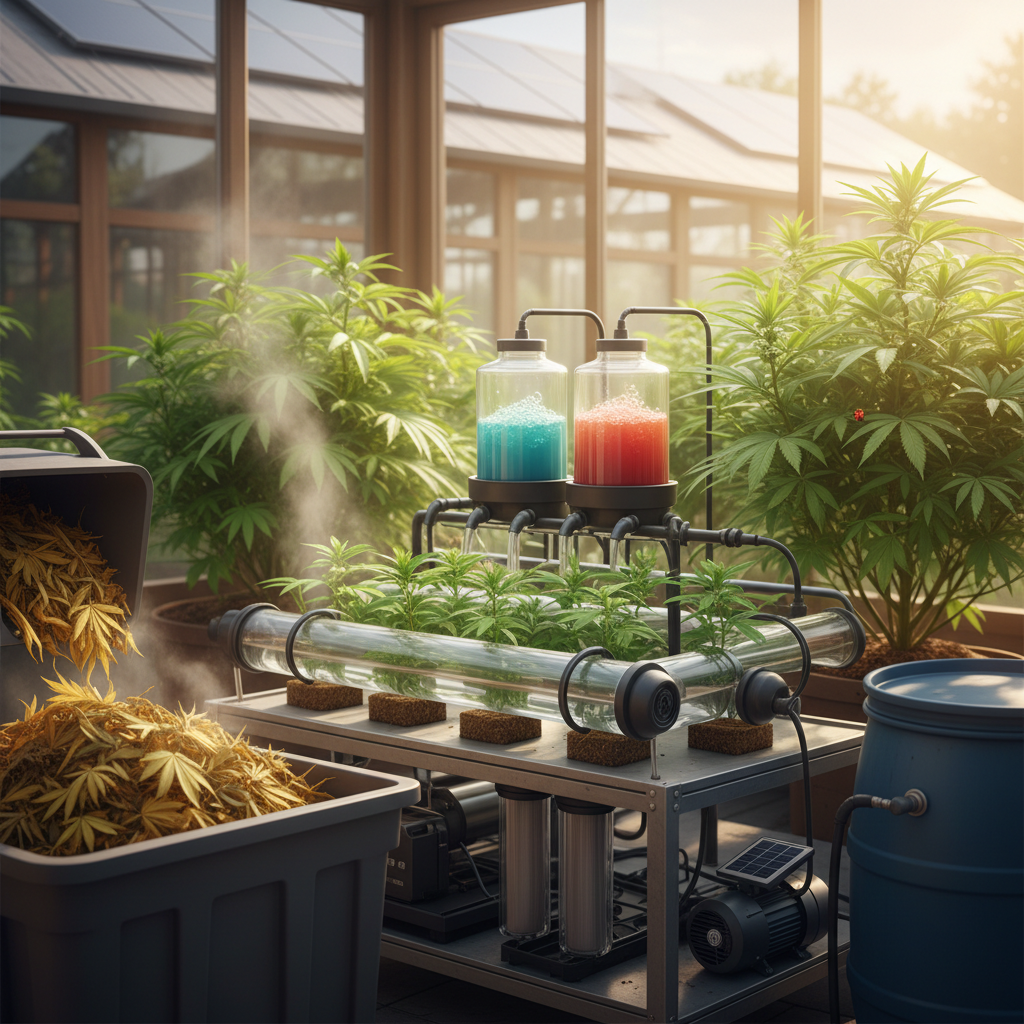
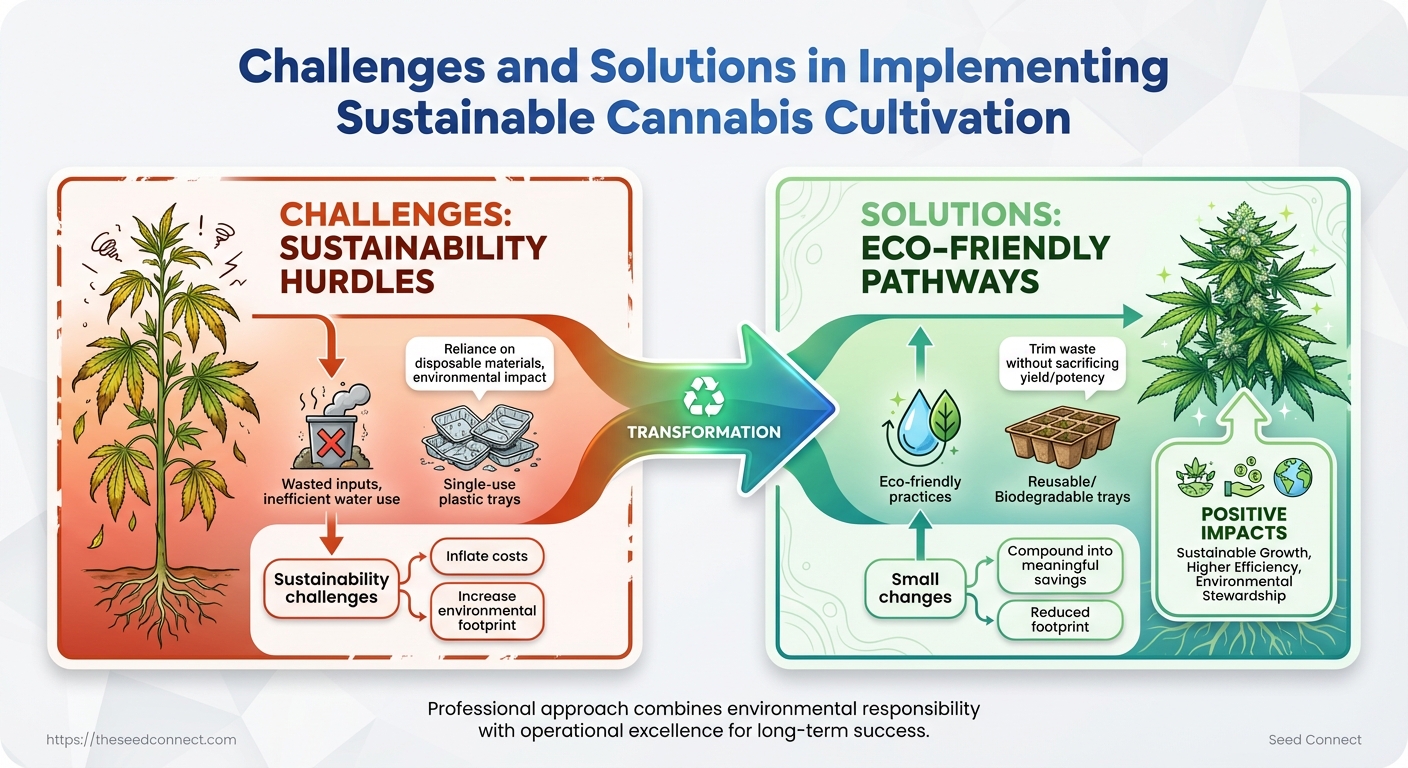
If you’ve ever caught a whiff of nutrient burn in your grow tent or noticed leaves slowly turning yellow, you’re not alone. These symptoms show that there are deeper sustainability challenges. These problems include wasted resources, inefficient water use, and reliance on disposable materials. Together, they silently increase costs and harm the environment.
Identifying the specific operational choices that create these issues is the first step to correcting them.
Practical, measurable cannabis cultivation solutions exist that trim waste without sacrificing yield or potency, from water-reuse workflows to low-waste propagation and integrated pest strategies. Adopting eco-friendly practices means redesigning routines, not accepting trade-offs between sustainability and productivity. Small changes—timing nutrient feeds to plant demand, swapping to compostable media, or optimizing run-times for lights and HVAC—compound quickly into meaningful savings and reduced footprint.
Understanding the Sustainability Challenges in Cannabis Cultivation
Cannabis cultivation faces…
Understanding the Sustainability Challenges in Cannabis Cultivation
Cannabis cultivation faces several environmental and operational challenges. These make sustainability both urgent and technically difficult. Energy use for lighting, heating, ventilation, and air conditioning (HVAC), as well as dehumidification, is a major part of operational costs and carbon footprints in indoor growing. Managing water—both the amount needed and the risk of nutrient-rich runoff—poses regulatory and environmental challenges.
Reliance on chemical pesticides and single-use plastics may compound waste streams, and the learning curve and capital intensity of sustainable technologies can impede adoption at scale.
Root causes explained
- Energy intensity: Indoor lighting (HPS/LED), climate control, and dehumidifiers run continuously and increase as your canopy grows.
- Water and runoff risks: High-frequency irrigation plus nutrient solutions increase the chance of leaching into local waterways.
- Chemical dependence: Pesticide and fungicide use often results from tight production schedules and limited integrated pest management (IPM) expertise.
- Waste streams: Trimmings, spent soil/media, and packaging plastics accumulate rapidly without diversion programs.
- Operational barriers: Sustainable tech needs upfront capital, and growing teams frequently lack the expertise to systems for efficiency.
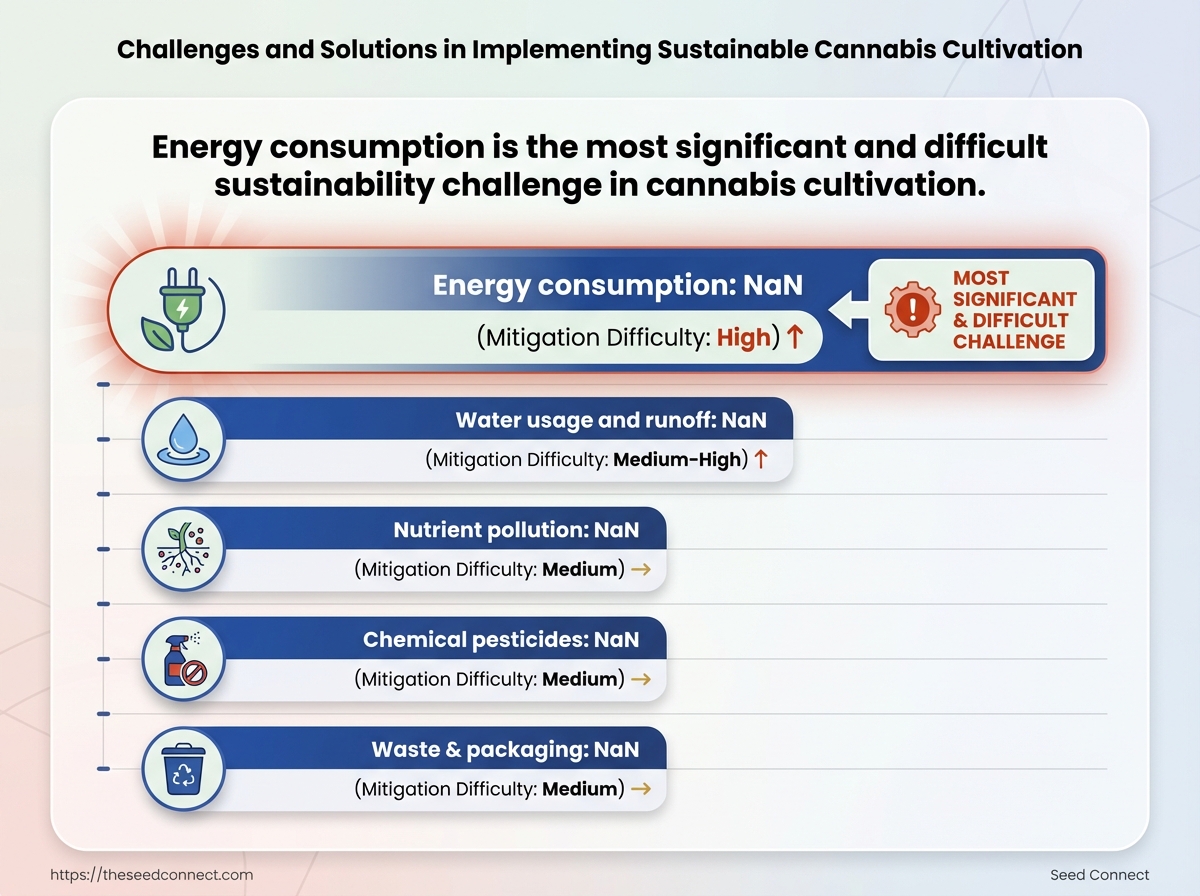
Energy intensity: Energy consumption from grow lighting and HVAC is the single largest operational sustainability challenge, driven by long photoperiods and indoor climate control.
Water usage and runoff: Heavy irrigation and fertigation practices increase total water use and raise the risk of nutrient-rich runoff entering stormwater systems.
Nutrient pollution: Over-application and improper disposal of nutrient solutions create eutrophication risks for nearby water bodies.
Chemical pesticides: Routine chemical treatments can harm beneficial insects, degrade local biodiversity, and complicate market access in regions with strict residue rules.
Waste & packaging: Single-use plastics, non-compostable packaging, and large volumes of plant waste create disposal and reputational issues.
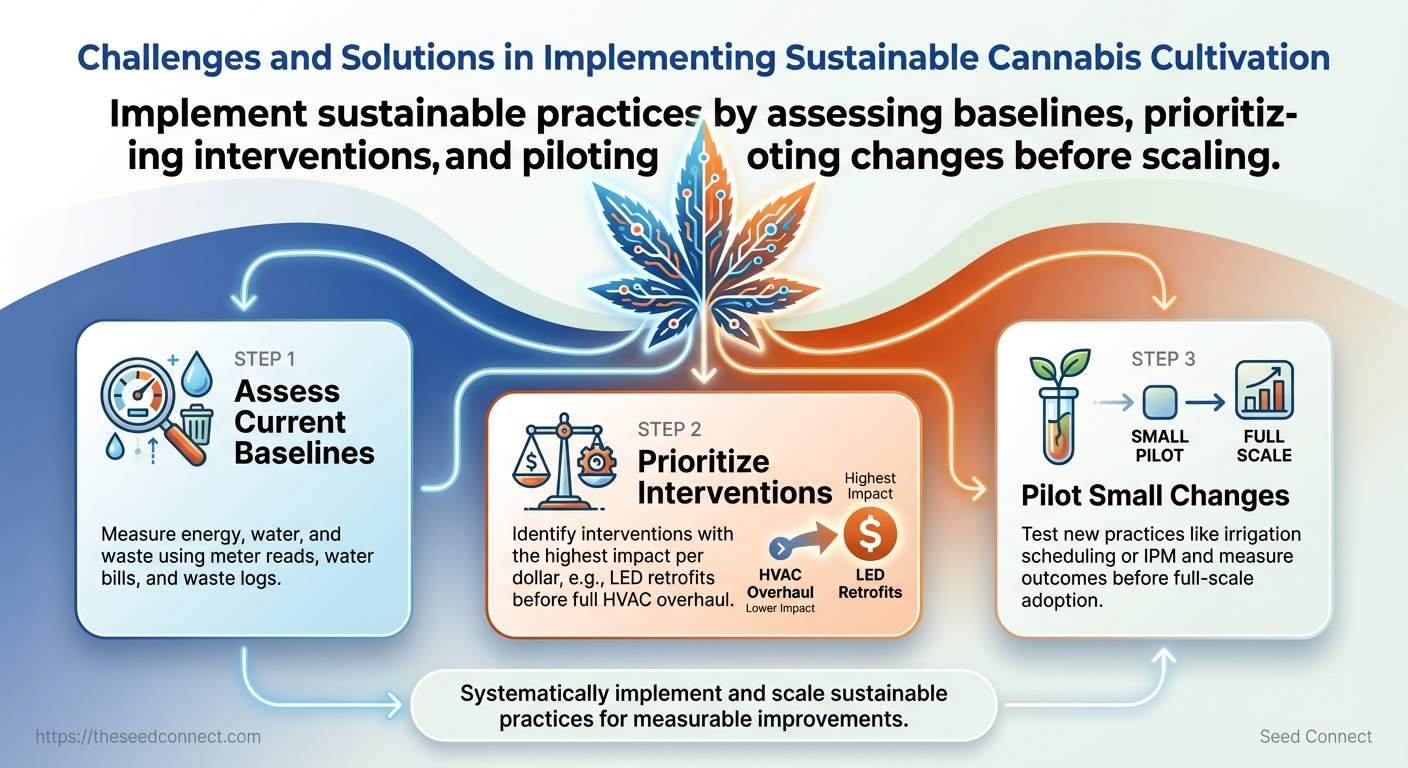
- Assess current baselines for energy, water, and waste (meter reads, water bills, and waste logs).
- Prioritize interventions by impact per dollar (e.g., LED retrofit before full HVAC overhaul).
- Pilot small changes (irrigation scheduling, IPM practices) and measure outcomes before scaling.
Side-by-side comparison of major sustainability challenges with impacts and typical mitigation difficulty
Table: Understanding the Sustainability Challenges in Cannabis Cultivation — Challenge, Typical Impact, Primary Cause & more
| Challenge | Typical Impact | Primary Cause | Mitigation Difficulty |
|---|---|---|---|
| Energy consumption | High operating costs, large carbon footprint | Continuous lighting and HVAC loads | High |
| Water usage and runoff | Local water stress, regulatory risk | Frequent irrigation, fertigation systems | Medium-High |
| Nutrient pollution | Eutrophication, fines | Over-application, poor runoff control | Medium |
| Chemical pesticides | Biodiversity harm, market limitations | Conventional pest protocols | Medium |
| Waste & packaging | Disposal costs, landfill pressure | Single-use plastics, plant waste | Medium |
Understanding these constraints clarifies where investment and training deliver the fastest returns, and highlights practical levers growers can use to reduce environmental impact without sacrificing yield or quality. When teams focus on measurable, incremental changes, operational resilience improves and sustainability becomes a competitive advantage.
Essential Equipment and Skills for Success
Successful, sustainable cannabis cultivation starts by matching the right equipment, materials, and basic skills to the scale and regulatory environment of the grow. For small medicinal grows, reliable environmental control and clean inputs are crucial. In larger commercial operations, redundancy, compliance systems, and waste management are essential. Below are the concrete items and capabilities that shorten the learning curve and reduce costly mistakes. LED grow lights: High-efficiency photosynthetic lighting with spectral control for veg and flower stages. Drip irrigation system: Automated water delivery that reduces human error and conserves water. Soil testing kit: Handheld meters and reagent tests to measure Composting setup: Aerobic bin or tumbler sized for your organic waste and amendment needs. HEPA ventilation/filtration: Inline filtration for particulate and odor control to meet local codes. Table: Essential Equipment and Skills for Success — Item, Purpose, Estimated Cost Range & moreEssential Equipment and Skills for Success
Tools & materials to acquire first
Practical skills to develop
PPFD, temperature, and RH.pH and electrical conductivity.pH, EC, and key nutrients.Compliance & operational prerequisites
Checklist mapping prerequisites to purpose, estimated cost, and difficulty
Prerequisites: Tools, Materials, and Skills
| Item | Purpose | Estimated Cost Range | Skill Level Required |
|---|---|---|---|
| LED grow lights | Provide full-spectrum photosynthetic light | $200–$2,000 per fixture | Intermediate |
| Drip irrigation system | Precise, automated watering and fertigation | $150–$800 (small to med) | Intermediate |
| Soil testing kit | Measure pH, EC/TDS, nutrient levels |
$20–$200 | Beginner |
| Composting setup | Convert organic waste into amendments | $50–$500 | Beginner |
| HEPA ventilation/filtration | Control particulates and odors for compliance | $300–$2,500 | Advanced |
Understanding and assembling these prerequisites reduces variability and regulatory friction, letting growers focus on genetics and operational refinement. When equipment, materials, and basic skills are in place, problems are easier to diagnose and wins scale predictably.
Step-by-Step Implementation: Convert a Conventional Grow to Sustainable Practices
Start treating…
Step-by-Step Implementation: Convert a Conventional Grow to Sustainable Practices
Begin to view sustainability as a project with clear, achievable goals. Your aims should be to reduce energy and water use, cut waste, and maintain or improve yield quality. Begin with a rapid audit, set measurable targets, run a small pilot, then scale changes only after validating results. This approach limits disruption to crop cycles while delivering quantifiable wins.
Prerequisites
Operational baseline: Recent electricity, water, and consumables bills plus a log of current yields and runtimes.
Staff alignment: One project lead and a cross-functional grow tech to own tests and documentation.
Budget envelope: A defined capital and operational budget with a 6–18 month ROI horizon.
Tools & materials
- Energy monitoring: Inline meters or smart breakers to track kW in real time.
- Water meters & flow sensors for per-room usage tracking.
- Environmental controllers capable of scheduling setpoints and data logging.
- High-efficiency lighting for pilots (e.g., modern LED arrays).
- Seed selection options such as feminized or autoflower genetics to shorten cycles or increase uniformity.
- Audit existing operations and set targets.
Conduct a room-by-room energy and water audit over 2–4 weeks. Record baseline PPFD, run-hours, HVAC loads, and nutrient usage. According to research from the Cannabis Industry Energy & Environmental Sustainability, set measurable targets like 20% energy reduction, 30% water savings, or maintained yield per square metre within 12 months.
- Prioritize interventions by ROI and risk.
Rank actions: lighting retrofit, HVAC optimization, irrigation upgrades, waste reduction, and genetics changes. Prioritize low-disruption, high-ROI items first (often lighting and irrigation).
- Design a small-scale pilot.
Choose one room or 10–20% of canopy. Define control and test groups, schedule, and metrics: kWh/m², water L/kg, crop uniformity, and THC/CBD if testing genetics.
- Execute the pilot and document everything.
Run the pilot for a full growth cycle. Log environmental setpoints, energy graphs, nutrient recipes, and harvest weights. Use photos and time-stamped notes for anomalies.
- Analyze results and iterate.
Compare pilot vs control on the defined metrics. Adjust variables—PPFD, DLI, root zone temps—based on outcomes. Repeat one more cycle if results are mixed.
- Scale and monitor long-term.
Deploy successful changes across rooms in phases, monitor via dashboards, and lock protocols into SOPs. Set quarterly review cadence with clear KPIs.
Practical examples: switching to optimized LED schedules often cuts lighting kWh by 30% without yield loss; swapping to drip reclaim systems can reduce runoff by 40–60%.
Understanding these steps lets teams convert a conventional grow into a resilient, efficient operation while preserving product quality and operational continuity. When implemented thoughtfully, sustainable changes become the new baseline for predictable performance.
Key Takeaway: Effective energy and climate control reduces operating costs while stabilizing plant environments—start by targeting the largest energy draws (lighting, HVAC) and then layer controls and renewables to shave emissions without risking yield. LEDs…
Energy and Climate Control Solutions
Effective energy and climate control reduces operating costs while stabilizing plant environments—start by targeting the largest energy draws (lighting, HVAC) and then layer controls and renewables to shave emissions without risking yield. LEDs typically cut lighting energy by 30–60% versus older HID systems, while HVAC optimization delivers recurring savings by reducing load through better sequencing, setpoints, and heat recovery. For growers with capital constraints, staged renewable integration (start with solar PV, add batteries later) balances cashflow with long-term emissions reductions.
Core components and benefits
- LED lighting: Lower heat output, dimmable spectrum control, and lower wattage per μmol. HVAC optimization: Variable-speed drives and zone control cut runtime and peak demand. Heat recovery ventilation: Recovers waste heat from exhaust air to precondition incoming air.
- Solar PV panels: Reduces grid consumption and demand charges during daylight operations. Battery backup: Enables peak shaving and resilience during outages.
Planning steps for implementation
- Run an energy audit to profile loads, demand charges, and runtime patterns.
- Prioritize low-cost/high-impact retrofits: install LED retrofit fixtures and tune lighting schedules.
- Implement HVAC controls: add variable-frequency drives, set sensible temp/humidity bands, and establish night setbacks.
- Evaluate staged renewables: size solar to daytime load first; design battery capacity for critical systems.
- Monitor and iterate using interval data from submeters and BMS dashboards.
LED retrofit: Replace HID fixtures with LED fixtures rated for canopy PPFD and efficacy ≥2.5 μmol/J.
HVAC sequencing: Use deadband settings to avoid short-cycling and enable economizer mode when outdoor conditions permit.
> Industry tests show lighting is often the single largest electrical load in indoor grows, making LEDs the fastest payback for many operations.
Practical examples and tips
- Small grows: Start with LED retrofits and basic thermostats.
- Medium grows: Add VFDs and zoned ventilation to reduce runtime.
- Large grows: Combine heat recovery, advanced controls, and on-site solar with energy storage.
Energy-saving options by upfront cost, typical payback, maintenance needs, and suitability for small/medium/large grows
Table: Energy and Climate Control Solutions — Solution, Upfront Cost, Estimated Payback & more
| Solution | Upfront Cost | Estimated Payback | Suitability (size) |
|---|---|---|---|
| LED retrofit | $60–$250 per fixture | 1–3 years | Small/Medium/Large |
| HVAC efficiency upgrade | $5,000–$50,000 | 2–5 years | Medium/Large |
| Heat recovery ventilation | $3,000–$25,000 | 3–6 years | Medium/Large |
| Solar PV panels | $1.50–$3.00 per W installed | 5–10 years | Small/Medium/Large |
| Battery backup | $400–$1,000 per kWh | 6–12 years | Medium/Large |
Understanding these options allows teams to sequence investments so operational funds cover immediate wins while capital projects (solar, batteries) are phased in for durable emission cuts. When implemented correctly, this approach reduces energy spend and stabilizes growing conditions without disrupting production.
Key Takeaway: Effective water and nutrient management starts with aligning the delivery method to the plant’s growth stage and the medium’s ability. This means using recirculating irrigation whenever possible, monitoring
ECand pH with each run, and increasing…
Water and Nutrient Management
Effective water and nutrient management starts with aligning the delivery method to the plant’s growth stage and the medium’s ability. This means using recirculating irrigation whenever possible, monitoring EC and pH with each run, and increasing soil organic matter to help retain moisture and nutrients between waterings. These three actions cut waste, stabilize root-zone chemistry, and reduce the need for corrective measures.
Why recirculating systems matter
Recirculating systems recover run-off nutrients and return them to the reservoir, dramatically cutting both water and fertilizer consumption for medium-to-large grows. They work best when paired with reliable filtration and scheduled reservoir turnovers to prevent salt buildup and microbial issues.> Industry analysis suggests that recirculating systems can significantly reduce water use and nutrient waste in controlled environments.
Practical monitoring and controls
- Regular EC checks: Measure
ECbefore and after feed to track uptake and detect salt accumulation. - Frequent pH checks: Keep pH in the target band for your medium to ensure nutrient availability.
- Reservoir management: Swap or partially drain reservoirs on a schedule tied to growth stage and EC drift.
- Calibrate meters weekly.
- Record
ECand pH for each reservoir and each irrigation cycle.
- Adjust fertilizer concentration only after confirming pH is in range.
Soil health levers
- Increase organic matter: Compost, biochar, and well-composted amendments increase water-holding capacity and microbial stability.
- Use mycorrhizae when appropriate: They improve nutrient uptake efficiency and reduce required feed levels.
- Avoid compaction: Looser soils promote even wetting and reduce anaerobic zones that cause root disease.
EC (electrical conductivity): The measure of dissolved salts in solution; used as a proxy for nutrient concentration.
pH: The acidity/alkalinity of the root zone; controls nutrient solubility and uptake.
Soil organic matter: Decomposed plant and microbial material that improves water retention and nutrient buffering.
Provide target EC and pH ranges across veg/flower stages and corresponding irrigation frequency guidelines
Table: Water and Nutrient Management — Growth Stage, Target EC (mS/cm), Target pH & more
| Growth Stage | Target EC (mS/cm) | Target pH | Irrigation Cadence |
|---|---|---|---|
| Seedling | 0.2–0.5 | 5.8–6.2 | Light misting or small feeds every 2–3 days |
| Vegetative | 0.8–1.2 | 5.8–6.5 | Daily to alternate-day full irrigations |
| Early Flower | 1.2–1.6 | 6.0–6.3 | Daily feeds; monitor runoff EC weekly |
| Peak Flower | 1.6–2.0 | 6.0–6.3 | Daily feeds; flush or partial reservoir change weekly |
| Flush/Finish | 0.5–0.8 | 6.0–6.5 | Reduce frequency; allow mild dry-back 2–3 days before harvest |
EC within stage bands and manage pH first; irrigation cadence then follows substrate retention and plant demand.
Understanding and applying these principles reduces run-off, stabilizes nutrient delivery, and gives predictable plant responses. When soil biology and irrigation systems are tuned together, labor and inputs drop while crop consistency improves.
Key Takeaway: Integrated Pest Management (IPM) focuses on prevention and monitoring. It uses specific actions only when pest levels exceed certain limits.
Integrated Pest Management and Reduced-Chemical Strategies
Integrated Pest Management (IPM) focuses on prevention and monitoring. It uses specific actions only when pest levels exceed certain limits. For cannabis cultivation, that means designing a system where cultural practices, biological controls, and documentation reduce reliance on synthetic pesticides while protecting yield and quality. Practical decision rules are simple: prevent first, detect early, respond proportionally, and document everything so responses improve over time.
Practical IPM Steps and Decision Rules
- Establish baseline monitoring: map the facility, record normal pest/beneficial presence, and set action thresholds for each pest species.
- Prioritize exclusion and sanitation: seal entry points, use sticky traps, clean tools between rooms, and manage incoming plant material.
- environmental controls: use humidity and temperature setpoints that favor plant health and discourage pests; rotate airflows and maintain filtration.
- Deploy biologicals and cultural controls as first-line interventions when thresholds are reached.
- Escalate to low-toxicity products only when biological and cultural measures fail, and always follow re-entry and residue guidelines.
- Document outbreak, actions taken, and outcomes in a centralized log for continuous improvement.
Biologicals, Cultural Controls and Decision Logic
- Biologicals: introduce predatory mites, beneficial nematodes, or microbial inoculants to suppress targets without collateral damage.
- Cultural controls: crop rotation in substrate beds, pruning to improve airflow, and targeted fertilization to reduce plant stress.
- Selective chemistry: choose pheromone disruptors or narrow-spectrum miticides as last-resort options.
Decision rules to apply:
- Threshold rule: treat only when pest counts exceed the economic or quality threshold established in the baseline.
- Proportionality rule: use the least disruptive measure likely to solve the problem.
- Rotation rule: alternate control modes to prevent resistance — biologicals → cultural tweaks → targeted chemistry.
Documentation and Continuous Improvement
Outbreak Log: Record date, affected strain, pest ID, counts, interventions, and outcome.
Post-action Review: Within 7–14 days, evaluate efficacy and adjust thresholds or cultural practices.
Practical example: When spider mite counts on a single flowering room cross threshold, isolate HVAC, release predatory mites, increase humidity slightly, and postpone chemical treatment pending 7-day reassessment.
Implementing these steps reduces chemical inputs while preserving crop quality and compliance, and creates a knowledge base that improves response speed and accuracy over time. Understanding and documenting IPM decisions makes it possible to reduce overhead and maintain consistent, marketable harvests.
Waste Reduction, Circularity and Packaging
Cutting waste and using circular packaging are great ways to reduce costs, increase brand trust, and make compliance easier for cannabis businesses. Start by treating plant waste as a resource: compost biomass to return nutrients to the soil, redirect trims into value streams like extracts or nutrient products, and standardize packaging choices to align with regulatory needs while minimizing environmental footprint. Practical action at the operational level—measurement, segregation, and iterative improvement—yields measurable diversion from landfill and recurring savings.
Practical waste-handling strategies
- Segregate at source: Separate organic waste, recyclables, and regulated waste at daily collection points.
- Compost on-site or partner: Composting returns carbon and nutrients; partner with local composters when space or permits are limited.
- Reuse trims strategically: Convert trim into
hash,solventless extracts, or nutrient-rich compost feedstock. - Switch packaging types: Prioritize recyclable or certified compostable formats compatible with local waste streams.
- Measure and report: Track
waste diversion rateand disposal costs monthly to identify high-impact improvements.
Step-by-step composting & reuse process
- Assess local regulations and permitting for
on-site composting.
- Set up dedicated collection bins labeled for organics, recyclables, and hazardous material.
- Shred plant material and mix with carbon sources (wood chips, shredded paper) at ~30:1 carbon:nitrogen.
- Monitor moisture and temperature; turn piles weekly until stable compost is achieved.
- Test finished compost for contaminants before using as soil amendment or selling.
Each step reduces disposal fees and captures value from previously wasted biomass.
Operational metrics and monitoring
- Waste diversion rate: Percentage of total waste diverted from landfill or incineration.
- Cost per pound disposed: Direct disposal costs drive prioritization.
- Packaging reclaim rate: Percentage of packaging returned or recycled by customers.
Packaging options (plastic, recycled plastic, compostable, glass) by environmental impact, cost, and regulatory suitability
Packaging options (plastic, recycled plastic, compostable, glass) by environmental impact, cost, and regulatory suitability
Table: Waste Reduction, Circularity and Packaging — Packaging Type, Environmental Impact, Cost Relative & more
| Packaging Type | Environmental Impact | Cost Relative | Regulatory/Storage Notes |
|---|---|---|---|
| Single-use plastic | Low recycling value, persistent pollution | Low | Often compliant; watch terpene permeability |
| Recycled plastic | Reduced virgin plastic use, still petroleum-based | Medium | More acceptable to regulators; verify food-grade source |
| Compostable bioplastic | Breaks down in industrial composting, limited home composting | Medium–High | Must match local composting capabilities; label accordingly |
| Glass jars | Highly recyclable, long lifecycle | High | Excellent inert storage for terpenes; heavier for shipping |
| Paper-based | Renewable, recyclable or compostable depending on coatings | Low–Medium | Avoid wax/foil coatings to remain compostable and compliant |
Understanding these practical steps and matching packaging to available waste systems makes sustainability achievable without disrupting operations. When teams measure impact and reuse resources thoughtfully, sustainability becomes a continuous improvement that also protects margins.
Monitoring, Reporting, and Scaling Sustainable Practices
Start by defining clear, measurable indicators and a straightforward rollout plan. According to revcanna.com, track a small group of high-value KPIs continuously, pair them with low-cost sensing and logging, validate improvements in a pilot, then update SOPs and train teams before scaling. This method makes data useful and avoids collecting irrelevant information without taking action.
KPIs to track (focus on quality, resource use, and yield)
- Water use per gram: Liters used divided by dried grams produced; reveals irrigation efficiency.
- Energy per gram: kWh consumed divided by dried grams; includes HVAC and lighting.
- Germination success rate: Percentage of seeds that reach transplant stage; critical for seed suppliers.
- Pest incidence rate: Number of pest outbreaks per production cycle; drives IPM cost decisions.
- Yield per square meter: Dried grams per m²; outcome metric tying inputs to revenue.
- Nutrient use efficiency: Ratio of applied nutrients to plant uptake; track with
ppmandEC. - Cycle time: Average days seed-to-harvest; shorter cycles reduce overhead.
Tools that make monitoring practical
- Basic sensors: Affordable
soil moistureandCO2probes for real-time data. - Power submeters: Per-circuit
kWhlogging to attribute energy to rooms/equipment. - Environmental controllers: Systems that log
RH, temperature, andPARfor crop modeling. - Cloud logging platforms: Low-cost telemetry with CSV export for analysis.
- Plant-tracking software: Batch records and traceability for germination and pest events.
- Mobile inspection apps: Quick photo-based reporting for scouters and IPM teams.
Scaling checklist: pilot → SOPs → rollout
Table: Monitoring, Reporting, and Scaling Sustainable Practices — Phase, Duration, Key Activities & more
| Phase | Duration | Key Activities | Success Criteria |
|---|---|---|---|
| Pilot | 4–8 weeks | Install sensors in one room, run parallel control crop, collect baseline | >10% data coverage, reliable sensor uptime |
| Evaluation | 2–4 weeks | Analyze KPI changes, flag anomalies, calculate ROI per metric | Statistically relevant improvement in 1–2 KPIs |
| SOP Development | 1–2 weeks | Document procedures, thresholds, escalation paths, training materials | SOPs written, reviewed, and approved by operations |
| Full Rollout | 4–12 weeks | Deploy sensors and workflows across facilities, run weekly audits | Facility-wide KPI alignment within target ranges |
| Continuous Improvement | Ongoing | Monthly KPI review, quarterly technology reassessment | Sustained KPI trends and documented optimizations |
- Install monitoring in a limited area and collect 4–8 weeks of continuous data.
- Compare pilot KPIs against a control and calculate practical ROI for each intervention.
- Convert validated actions into step-by-step SOPs and train frontline staff.
- Roll out incrementally, auditing adherence and revising SOPs after each wave.
- Maintain a continuous improvement cadence with monthly KPI reviews.
A practical habit: keep the KPI set lean, automate data capture where possible, and tie any dashboard metric to a concrete operational action. Implementing this flow reduces guesswork and accelerates sustainable improvements while preserving crop quality.
Troubleshooting Common Issues
Start by diagnosing the symptom clearly: note what went wrong, when it began, and what changed in the environment or process immediately beforehand. Rapid, disciplined triage prevents chasing phantom causes and restores consistent results faster.
Diagnose systematically
- Observe and record the symptom precisely (leaf curl, slow germination, yellowing).
- Check recent changes: seed batch, nutrient mix, light schedule, substrate, or watering frequency.
- Measure objectively:
pH,EC/ppm, temperature, and relative humidity.
- Compare readings to your target ranges and flag anything outside tolerance.
- Rule one: change only one variable at a time. This isolates cause and shows whether the correction worked.
- Rule two: document every corrective action and outcome in a simple log.
Common problems and targeted fixes
Stunted or slow growth: Often caused by compacted medium or root-bound pots. Repot to a lighter medium or a larger pot, loosen the root ball, and flush with water at target pH (typically 5.8–6.5 for soil-less mixes).
Seed germination failures: Confirm seed age and storage. Use gentle warmth (20–25°C) and steady humidity; consider a germination medium like moist paper towel or rapid-propagation cubes. For guaranteed seed quality, supplier germination policies and expert support can save weeks of troubleshooting.
Yellow leaves (nutrient deficiency vs. overwatering): Measure EC first. Low EC with interveinal yellowing points to nutrient deficiency; raise feed gradually.
High EC or soggy medium points to overwatering or salt build-up; flush and reduce feed strength by 25%.
Pests and molds: Isolate affected plants immediately. For low-level infestations, use targeted biological controls and improve air movement. For systemic outbreaks, remove severely affected material and consider expert intervention.
When to escalate
Threshold for expert intervention: if corrective steps fail after two documented iterations, if multiple plants show identical rapid decline, or if pathogens (root rot, pervasive mold) appear despite standard controls. Call for lab testing or professional diagnostics when cause is ambiguous and losses exceed acceptable limits.
Understanding and documenting a methodical troubleshooting workflow reduces repeat problems and shortens recovery time. When the steps above are followed, teams resolve most common issues without guesswork and preserve productive runs.
Tips for Success and Pro Tips
Start with small, measurable changes that produce immediate returns and build from there. Research from Best Practices for Eco-Friendly Cultivation shows that low-cost interventions—better seed selection, tighter germination practices, and clearer SOPs—deliver outsized gains in yield consistency and quality. Combine those with staff incentives and targeted capital de-risking (rebates, grants, tax credits) to scale performance without exposing the operation to excessive risk.
SOP: Standardize routine tasks so variability is predictable and fixable.
Germination guarantee: A supplier commitment that reduces seed risk and protects early-stage crop economics.
High-impact, low-cost measures to implement now
- Buy proven genetics: Use feminized or autoflower seeds with documented stability to reduce rework and male weeding. Validate germination: Run simple paper-towel or tray germ tests and log rates for each batch. Tighten environmental setpoints: Small adjustments—±2°C, ±5% RH—often stop stress-related hermaphroditism and slow growth.
- light scheduling: For veg, use
18/6; for autos, maintain consistent daily PAR levels rather than strict day-count. * Active pest scouting: Weekly checks catch issues before they need chemical interventions.
Step-by-step SOP rollout for a grow room
- Draft one-page SOP for a single routine (watering, nutrient mix, or pruning).
- Pilot the SOP with one team for two crop cycles and collect time and error metrics.
- Revise instructions, add photos or short
30–60svideo clips, and secure sign-off.
- Roll out across rooms with a small incentive (productivity bonus or time-off) tied to adherence and outcomes.
Engage staff with incentives and clear metrics
- Clear KPIs: Track germination rate, transplant survival, and week-over-week growth uniformity.
- Small, frequent rewards: Weekly recognition or micro-bonuses keep teams focused.
- Training minutes: Short, scheduled skill sessions beat long, infrequent workshops.
incentives and grants to de-risk upgrades
- Rebate-first approach: Prioritize LED or HVAC upgrades where rebates cover a meaningful percent of capital.
- Phased capital: Replace one zone, measure ROI, then scale.
- Document performance: Use utility-grade meters and simple before/after yield logs to qualify for programs.
Adopt these practices iteratively: a single variable, measure the result, then lock it into an SOP. When executed consistently, these steps reduce surprises and free resources for strategic upgrades and higher-value genetics.
Conclusion
After converting a conventional grow to sustainable practices, the visible wins come quickly: lower energy bills from climate-control upgrades, steadier yields once nutrient regimens are dialed in, and far less waste heading to the compost bin. That practical path—audit first, swap inefficient lighting and HVAC, stabilize water and nutrient delivery, and adopt integrated pest management—was illustrated earlier by According to cannabisbusinesstimes.com, a mid-size indoor operation that cut energy use by roughly 30% after an LED retrofit and by a greenhouse that reduced runoff through closed-loop irrigation. These changes preserve crop quality while addressing According to cannabis.ny.gov, the sustainability challenges that most cultivators face.
Take these immediate next steps:
- Perform an energy and water audit to find the biggest wins.
- Prioritize LED and HVAC upgrades for rapid cost and emissions reductions.
- Implement a simple closed-loop nutrient plan and start integrated pest monitoring.
For hands-on support with seed selection or to align cultivar choices with lower-input systems, explore resources like The Seed Connect’s growing guides and germination guarantee at https://theseedconnect.com. Adopting these measures will reduce operating risk, improve product consistency, and make scaling sustainable practices feasible—start with the audit this week and schedule incremental upgrades so improvements compound without disrupting the crop cycle.