

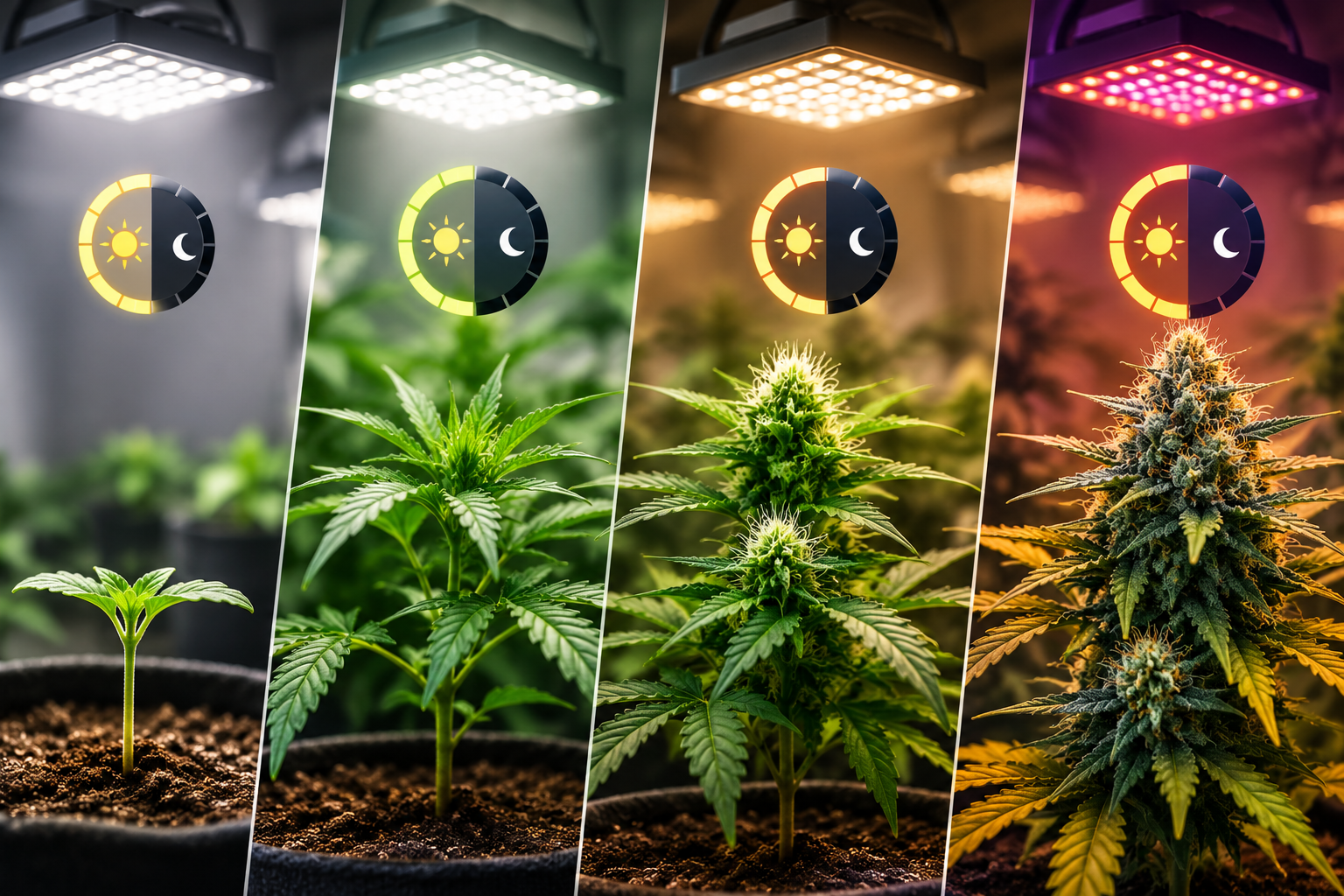
The best light cycle for cannabis depends on the plant’s growth stage and whether you’re growing a photoperiod or autoflowering variety.
For most growers, the schedule is pretty simple:
| Growth Stage | Recommended Light Cycle |
|---|---|
| Seedling | 18 hours light / 6 hours dark |
| Vegetative | 18/6 |
| Flowering, photoperiod | 12/12 |
| Autoflower | 18/6 or 20/4 |
If you remember just one thing, make it this: photoperiod cannabis usually stays under longer days during vegetative growth, then switches to 12 hours of light and 12 hours of darkness to trigger flowering.
Table of Contents
Why Light Cycles Matter
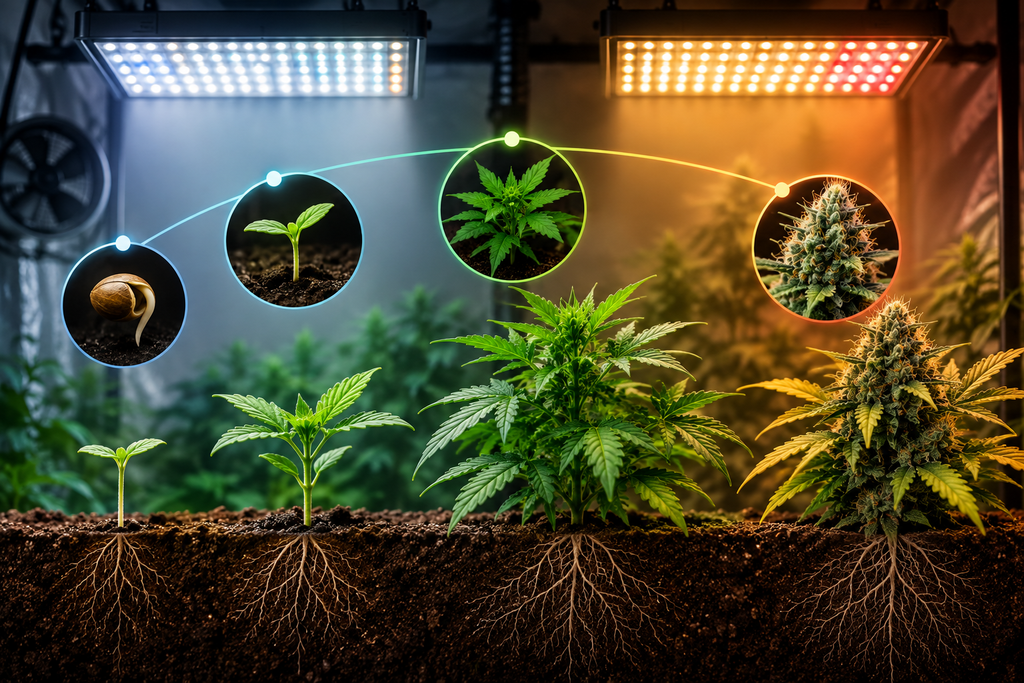
Cannabis does not only respond to how bright the light is. It also responds to how long the light stays on and how long the plant remains in darkness.
For photoperiod cannabis, longer days support vegetative growth. When the dark period becomes long enough, the plant receives the signal to move into reproductive growth.
That is why the classic indoor schedule looks like this:
18/6 in veg → 12/12 in flower
This is not just grower tradition. Controlled cannabis studies commonly use an 18-hour light period during vegetative growth and then switch plants to a 12/12 schedule for flowering.
If you want a broader explanation of indoor lighting beyond just the schedule, The Seed Connect’s grow lights for weed guide covers fixture types, PPFD, hanging height, and light intensity.
Best Light Cycle for Cannabis Seedlings
For seedlings, 18/6 is a reliable place to start.
Young plants need enough light to avoid stretching, but they do not need the same intensity as mature flowering plants.
At this stage, consistency matters more than trying to squeeze out extra hours of light.
Focus on:
- a stable 18/6 schedule
- moderate light intensity
- stable temperature
- avoiding heat stress
- keeping the light close enough to prevent stretching without bleaching the leaves
The Seed Connect’s indoor cannabis growing guide also uses 18/6 as the standard vegetative schedule and gives broader guidance on lighting, ventilation, and climate.
Best Light Cycle for Vegetative Cannabis
For most photoperiod plants, 18 hours of light and 6 hours of darkness is the easiest schedule to work with.
It gives plants a long period for photosynthesis while still leaving a predictable dark period.
That balance is one reason 18/6 remains so common in indoor cannabis cultivation.
Why growers like 18/6
It is:
- simple
- widely tested
- easy to automate
- easier on electricity than 20/4 or 24/0
- easier to manage for heat
- compatible with a wide range of photoperiod cultivars
During vegetative growth, the goal is not to trigger flowering. It is to build roots, stems, branches, and enough canopy to support the flowering stage later.
18/6 vs. 20/4 vs. 24/0
This is where growers often overthink things.
18/6
This is the best default for most photoperiod plants.
It gives you plenty of daily light without running the fixture constantly.
20/4
This schedule adds two extra hours of light each day.
It is more commonly used with autoflowers, especially when growers want to increase total daily light exposure without going all the way to continuous lighting.
The downside is straightforward: more electricity and more heat.
24/0
A 24/0 schedule keeps the lights on continuously.
Some cannabis genetics can tolerate continuous light, and some autoflowering material can even flower under continuous illumination. Research mapping the autoflower trait confirms that photoperiod-insensitive cannabis can flower under long-day and even continuous-light conditions.
But that does not mean 24/0 is automatically better.
For most home growers, the extra electricity and heat are difficult to justify when 18/6 already works well.
When Should You Switch Cannabis to 12/12?
Switch photoperiod plants to 12/12 when they have reached the size and structure you want before flowering.
There is no perfect week number.
A small tent might need an earlier switch, while a larger room can allow plants to stay in veg longer.
Before switching, consider:
- available vertical space
- cultivar stretch
- canopy width
- training method
- plant health
- how much room remains between the canopy and the lights
Remember that many cannabis plants stretch after flowering begins.
If your plants are already close to the light fixture, waiting longer can make the flowering stretch difficult to control.
You can switch directly from 18/6 to 12/12. There is no strong evidence that you need to slowly reduce the light period over several days.
Best Light Cycle for Flowering Cannabis
For most photoperiod plants, use:
12 hours light / 12 hours dark
This remains the standard because it works reliably across many cultivars.
Research comparing cannabis photoperiods also confirms that 12/12 is a common baseline used to initiate flowering, even though some cultivars can flower under longer day lengths.
The practical lesson is simple:
If you want predictable flowering, 12/12 is still the safest starting point.
Why the Dark Period Matters
The dark period is not just “lights off.”
For photoperiod cannabis, uninterrupted darkness is part of the flowering signal.
That means your flowering room should stay reliably dark during the 12-hour night period.
Check for:
- light leaks around doors
- bright equipment displays
- tent vents letting in room light
- faulty timers
- lights turning back on after a power cut
You do not need to become paranoid about every tiny LED in the room, but repeated or strong night interruptions can interfere with a photoperiod-sensitive plant’s flowering response.
Is 12/12 Always the Most Productive Schedule?
Not necessarily.
This is where things get more interesting.
A controlled study comparing nine flowering photoperiod treatments found that some cannabis lines produced more flower biomass under a 14-hour light / 10-hour dark schedule than under standard 12/12. But cannabinoid responses varied by cultivar, so longer days did not improve every outcome equally.
That does not mean everyone should abandon 12/12.
It means the “perfect” flowering schedule can depend on genetics.
For most growers, especially beginners, 12/12 remains the more dependable choice because it reliably induces flowering.
Advanced growers working with known cultivars may experiment with longer flowering photoperiods once the rest of the environment is already dialed in.
Best Light Cycle for Autoflowers
Autoflowers play by different rules.
Their flowering is largely photoperiod-insensitive, meaning they do not depend on a shorter day to start producing flowers. Genetics and maturity play a much bigger role.
That is why common autoflower schedules are:
18/6
or
20/4
and growers often use the same schedule from seedling through harvest.
18/6 for autoflowers
This is the easier option if you want:
- lower electricity use
- easier heat management
- a regular dark period
- simple scheduling
20/4 for autoflowers
This gives plants two more hours of light each day.
It can be useful if your light intensity is moderate and your environment can handle the extra heat.
If you are specifically growing autoflower genetics, The Seed Connect’s autoflower growing guide goes deeper into the full seed-to-harvest process.
Light Cycle and Light Intensity Are Not the Same Thing
A correct schedule will not fix poor lighting.
This is one of the most important distinctions in indoor growing.
A plant can be under 18 hours of light every day and still stretch badly if the fixture is too weak or too far away.
Likewise, a flowering plant can be under a perfect 12/12 schedule and still develop stress if the light intensity is excessive.
Research on indoor cannabis shows that increasing light intensity can significantly influence photosynthesis and flower yield, which is why timing and intensity should be managed together.
A simple way to remember it:
Light cycle = how long the light is on
Light intensity = how much usable light reaches the plant
If you are struggling with fixture strength or hanging distance, use the grow lights for weed guide rather than trying to solve everything by extending the light schedule.
Common Cannabis Light-Cycle Mistakes
Changing the schedule too often
Cannabis responds better to predictable timing.
Use a timer and leave the schedule alone unless you have a clear reason to change it.
Switching to flower too late
If plants already fill the available vertical space, flowering stretch can push them dangerously close to the lights.
Plan for stretch before the switch.
Putting autoflowers on 12/12
Autoflowers do not need a 12-hour night to trigger flowering.
Running them at 12/12 usually means giving them fewer hours of usable light than necessary.
Ignoring light leaks
Photoperiod plants need a consistent dark period during flowering.
A timer is only useful if the room actually stays dark.
Assuming more hours always mean better growth
Twenty-four hours of light does not automatically outperform 18/6.
How much light the canopy actually receives matters more than simply keeping the fixture on for as long as possible.
Use a Reliable Timer
A timer is one of the simplest tools in an indoor grow, but it prevents a lot of problems.
Check that:
- the clock is correct
- the ON/OFF times are correct
- AM and PM are not reversed
- the timer restarts properly after a power outage
- flowering lights completely switch off during the dark period
Set it once, verify it, and let the plants follow a predictable rhythm.
Final Thoughts
The best light cycle for cannabis does not need to be complicated.
For most photoperiod plants:
- Seedlings: 18/6
- Vegetative: 18/6
- Flowering: 12/12
For most autoflowers:
- 18/6 or 20/4 from seed to harvest
Those schedules give you a reliable foundation.
From there, pay attention to the plant itself. Genetics can influence flowering response, and research shows that some cultivars may perform differently under longer flowering photoperiods.
But there is little reason to chase advanced schedules before getting the basics right.
Keep your timer consistent, protect the flowering dark period, and remember that the schedule is only one part of lighting. Fixture intensity, canopy coverage, temperature, and overall plant health matter just as much.
good helpful
Hello Bryan
Thank you for taking the time to leave your thoughts! We’re really pleased that you found the content helpful. It’s comments like yours that motivate us to keep striving for excellence. If there’s anything specific you’d like to see more of or if you have any suggestions, we are here to help
Really enjoyed this article keep up the good work I am still fairly new to this still learning all the time
Hello Gary,
Thank you so much for your kind words! We’re thrilled to hear that you enjoyed the article. Don’t worry about being new to this – we’re all constantly learning and growing. If you ever have any questions or topics you’d like to see covered, feel free to let us know.