


Even plants from the same seed packet can surprise you; one might burst with flowers while its neighbor barely reaches for the light.
This unpredictability starts with DNA.
It leads to differences in strength, resin, and harvest timing.
Knowing cannabis genetics clarifies these differences.
It turns guesswork into reliable outcomes.
Genetic diversity isn’t just academic—it protects crops from pests and expands the range of cannabinoid and terpene profiles growers can produce.
The Biodiversity in Cannabis Project catalogs that variation to help breeders conserve and improve lines.
Trusted outlets such as Leafly and The Cannabist report on those trends so growers can translate genetic signals into practical choices.
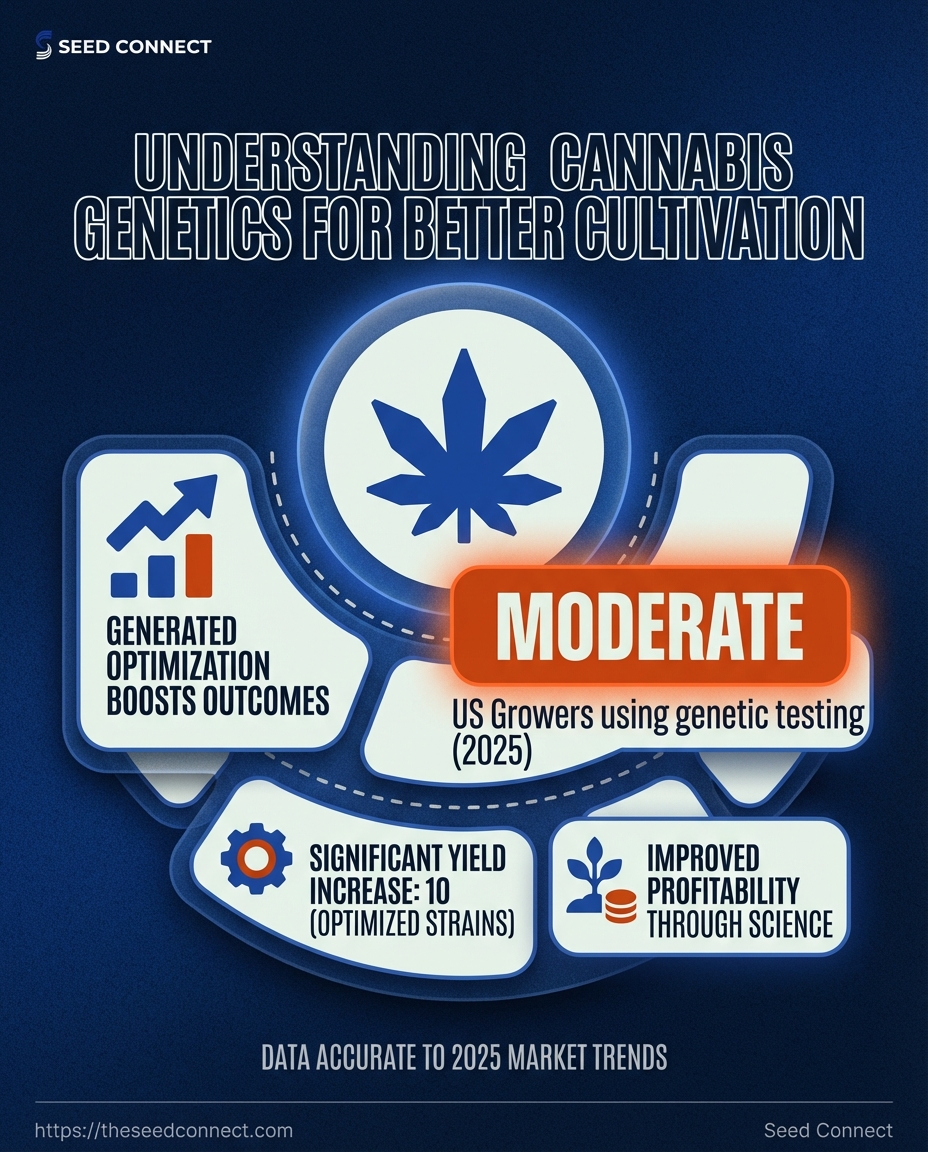
As of 2025, approximately 64% of US growers reported using genetic testing to sharpen cultivation strategies.
As of 2025, growers who adopted genetically optimized strains reported approximately a 40% yield increase in trials.
Those figures make genetics a practical lever for real-world cultivation gains.
Knowing which alleles control flowering, height, and terpene expression lets growers match plants to climate, space, and market demand.
Approached this way, cultivation genetics informs smarter strain selection cannabis and delivers more predictable harvests.
What if genetics were the first tool in your grow room?
Think about the common pitfalls in cultivation.
Focusing on genetics instead of tools can transform your approach.
Genetics lay the foundation for critical factors like yield and pest resistance, making it a primary consideration for successful cultivation.
By selecting optimally bred strains, growers can their processes and potentially eliminate many downstream issues.
Genetics basics every grower should know
Plant genetics decide more than buzzwords; they shape how a crop responds to light, pests, and feeding.
By reading the genetic code, you can predict flowering time, cannabinoid traits, and how well a plant handles stress.
Here, we’ll break down these concepts into easy steps that you can use to improve your growing experience.
Expect clear definitions, a short diagram, and practical rules you can apply when choosing seeds or breeding.
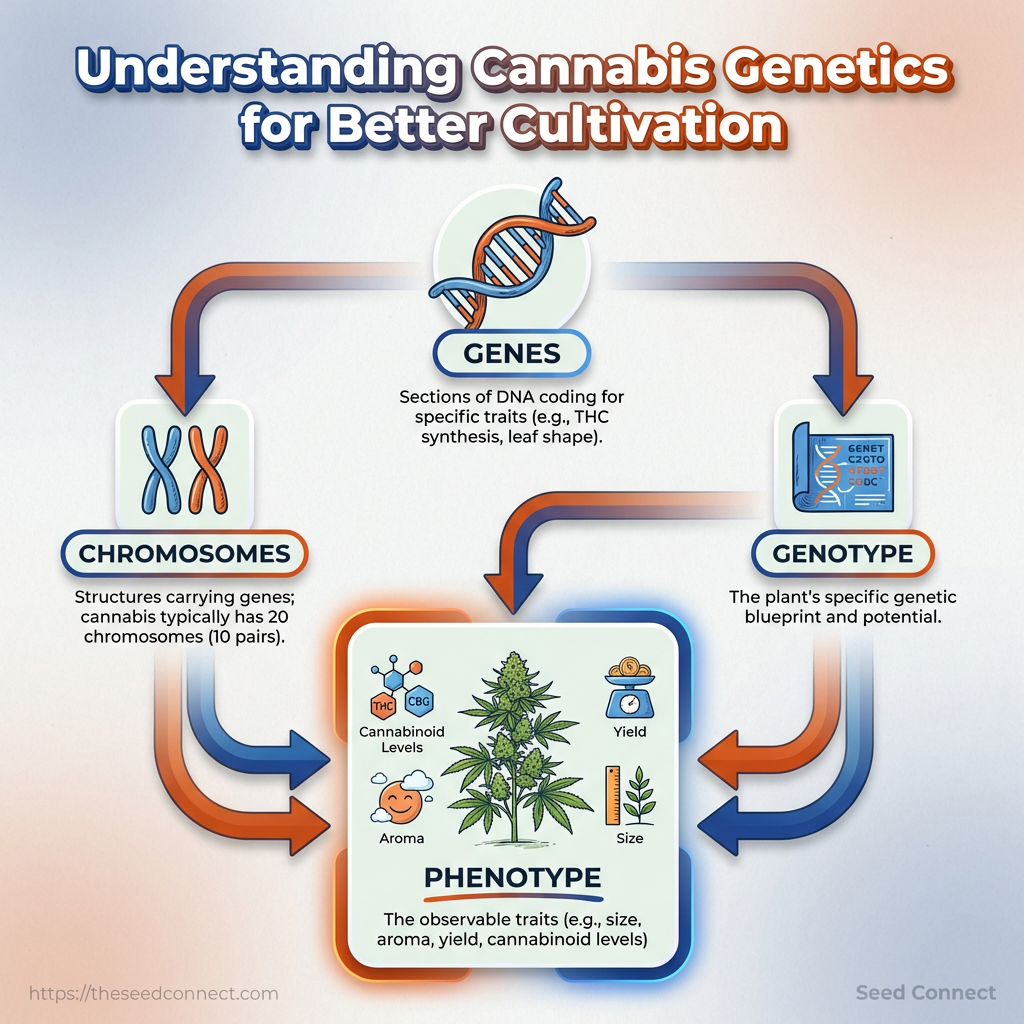
Genes: Sections of DNA that code for traits like THC synthesis or leaf shape.
Chromosomes: Structures that carry many genes; cannabis typically has 20 chromosomes (10 pairs).
Genotype: The plant’s genetic blueprint—its specific alleles across genes.
Phenotype: The observable outcome—the plant’s size, aroma, yield, and cannabinoid levels.
The diagram maps scale from chromosome to gene to trait and labels common targets such as THCAS (THC production), flowering-time loci, and terpene-related genes.
Use it to visualize why a single gene matters less than the whole network of genes.
Genes are parts of chromosomes; multiple genes together produce measurable traits like flowering speed or THC potential.
Seeing that chain makes it easier to choose strains for a given room or market.
How inheritance works: dominant, recessive, and polygenic traits
Dominant and recessive are simple rules for single-gene traits, but most useful cannabis characteristics are polygenic—they depend on many genes adding up.
Dominant alleles express when present; recessive alleles need two copies to show.
Practical patterns to watch for:
- Bold early-flower trait: a dominant gene causes rapid flowering in one parent and usually appears in offspring.
- Bold low-THC requirement: a recessive allele may hide in parents and reappear only if both parents carry it.
- Bold yield and terpene profiles: polygenic traits that respond to selection over several generations rather than a single cross.
Breeders and growers using modern cultivation genetics report measurable benefits.
By 2025, about 64% of US growers reported using genetic testing to shape their strategy, and growers using genetically optimized strains saw up to a 40% yield increase (2025).
Phenotype vs. genotype: why identical seeds behave differently
Two seeds from the same strain may carry the same genotype but express different phenotypes because of environmental interaction and genetic variability within the seed lot.
Mild differences in humidity, light angle, or micro-nutrients push expression down different paths.
Clonal runs remove that variability, but seeds offer diversity—useful for finding elite phenotypes.
Leafly’s strain database and initiatives like the Biodiversity in Cannabis Project show why maintaining diversity helps resilience against pests and shifting consumer tastes.
Choose genetics intentionally.
Matching genotype expectations to your environment is the fastest way to a consistent crop and higher yields.
Key genetic terms and how to read breeding descriptions
Have you ever looked at a seed listing and felt overwhelmed by the shorthand used? Those short codes and promises carry real clues about predictability, risk, and what to expect in the grow room.
Learning to read breeding descriptions quickly saves time and prevents surprises at harvest.
It also helps pick genetics that match your environmental conditions and goals.
Start by treating descriptions as data, not marketing.
Ask which generation, how many parent plants were used, and whether breeders show population statistics or photos.
Glossary: breeders’ shorthand decoded (quick-reference)
| Term | Meaning in plain language | What it means for growers | When to prefer / avoid |
|---|---|---|---|
| F1 | First-generation cross between two distinct parent lines. | Predictable vigor and uniformity; strong hybrid effects. | Prefer for consistent crops; avoid if you want unique phenos. |
| F2 | Offspring from crossing two F1 plants. | More variation in traits; useful for selecting new stable traits. | Prefer for breeding programs; avoid for single-crop uniformity. |
| Backcross (BX) | Crossing offspring back to one parent line to reinforce traits. | Speeds fixation of a desired trait, often reduces variability. | Prefer to reinforce a trait (e.g., pest resistance); avoid if it narrows diversity too much. |
| Stable line | Line that’s bred over generations to breed true. | High predictability in phenotype and performance. | Prefer for commercial runs; avoid if you want novel genetics. |
| Landrace | Traditional, locally adapted population from a specific region. | High genetic diversity and environmental resilience. | Prefer for breeding diversity and resilience; avoid if you need uniformity. |
| Phenotype | Observable traits like height, bud structure, color. | What you actually get in the tent or field. | Prefer when selecting for appearance or structure; avoid equating phenotype with chemical profile. |
| Chemotype | Chemical profile — cannabinoid and terpene makeup. | Predicts effect, aroma, and potential market value. | Prefer if targeting specific cannabinoid ratios; avoid relying on vague scent claims. |
| Hybrid | Cross between two distinct strains (often modern cultivars). | Can combine parent strengths but may vary by generation. | Prefer for balancing traits; avoid if parents are poorly described. |
| Inbred line | Line bred through repeated selfing or sibling crosses to uniformity. | Very consistent genetics; useful as a parent in breeding. | Prefer when stability matters; avoid for genetic diversity. |
| Sibling cross (S1) | Crossing plants from the same parent generation (siblings). | Maintains many parent traits but may expose recessive issues. | Prefer for fixing desirable traits quickly; avoid without phenotypic screening. |
Analyzing breeder shorthand turns listings into decisions.
The table above helps decode whether a listing targets predictability, diversity, or breeding work.
Breeders who document generation, population size, and test results give growers actionable information.
That level of transparency reduces guesswork and aligns expectations.
How to evaluate breeder claims: ‘stable’, ‘true-to-type’, and guarantees
Not all claims are equal; words like stable and true-to-type mean different things depending on context.
Read the supporting details before trusting a label.
Look for proof: multiple harvest photos, grow logs, population sizes, and notes on how many generations the line was selected over.
That context turns a claim into evidence.
- Check generation data: Look for F1/F2/BX details and how many generations were used to stabilize traits.
- Demand population size: Larger selection pools reduce chance of hidden defects.
- Request trial results: Yield, flowering time, and common phenotypes should be listed.
- Verify guarantee terms: Read whether a germination or replacement guarantee requires photos or lab tests.
- Compare multiple listings: Cross-check descriptions on platforms like Cannabis Seeds to see consistent claims.
Grower adoption of genetic testing rose — 64% of U.S. growers used it to guide cultivation strategy in 2025 — and many reported higher yields.
In fact, growers using genetically optimized strains reported about a 40% yield increase in 2025 compared with traditional strains.
Trust the data over the adjectives.
That habit will make strain selection more predictable and reduce costly surprises at harvest.
How genetics shape cultivation traits
Imagine genetics as a roadmap that guides how your plant reacts when things get tough.
Strong genetics determine the maximum yield, chemical profile, and how a plant deals with pests and stress.
That makes strain selection a frontline cultivation decision, not an afterthought.
Growers who read the genetic signals can plan environment, feeding, and harvest windows more accurately.
As of 2025, industry reporting indicated approximately 64% of U.S. growers used genetic testing to refine their approach, and some reported yield gains of around 40% when switching to genetically matched strains.
Those are the kinds of margins that change a crop plan.
Comparing genetic families: Indica, Sativa, and Hybrid — what to expect
| Genetic family | Typical flowering time | Typical plant structure | Common cultivation challenges | Best environment/strategy |
|---|---|---|---|---|
| Indica-dominant | 6–9 weeks | Short, bushy, dense internodes | Susceptible to rot in poor airflow; can be light-sensitive | Controlled indoor rooms, shorter veg, strong lateral pruning |
| Sativa-dominant | 10–16 weeks | Tall, open, long internodes | Longer flowering, stretch, canopy management issues | Taller ceilings, extended veg, ScroG or selective topping |
| Balanced Hybrid | 8–11 weeks | Intermediate height, variable branching | Variable vigor; phenotype sorting may be needed | Match phenotype to environment; moderate veg and flexible training |
Breeders and grower forums agree that family labels guide broad expectations but not guarantees.
Use genetic family as a planning tool, then verify with breeder notes and phenotype observations.
How genetics affect yield and plant form
Genetics set potential yield by defining node spacing, flower density, and how plants partition energy.
A plant with dense buds and short internodes is mechanically easier to grow for high per-square-foot yield.
Grow lighting, nutrients, and pruning tune that genetic potential.
But if the base genetics lean toward airy sativa flowers, no amount of feed will turn them into dense indica colas.
Cannabinoid profile and terpene stability
Genetic makeup determines which cannabinoid and terpene biosynthetic pathways are present.
That affects both the dominant cannabinoids and the range of terpenes a plant can express.
Terpene stability across environments is partly genetic.
Some lines keep a consistent aroma across grows; others swing wildly with light, temperature, or drying.
Track a strain over multiple grows before trusting its terpene profile.
Pest resistance and resilience
Genetic diversity improves disease and pest resistance.
Programs like the Biodiversity in Cannabis Project emphasize conserving diverse genetics to strengthen resilience across the industry.
If pest resistance is a priority, choose lines with documented resistance or bred from parents with clean disease histories.
Genetics reduce risk — they don’t eliminate it.
Predictable traits: Genes reliably govern flowering time ranges, average height, and major cannabinoid pathways.
Variable traits: Terpene expression, exact yield numbers, and latent pest tolerance often change with environment and phenotype.
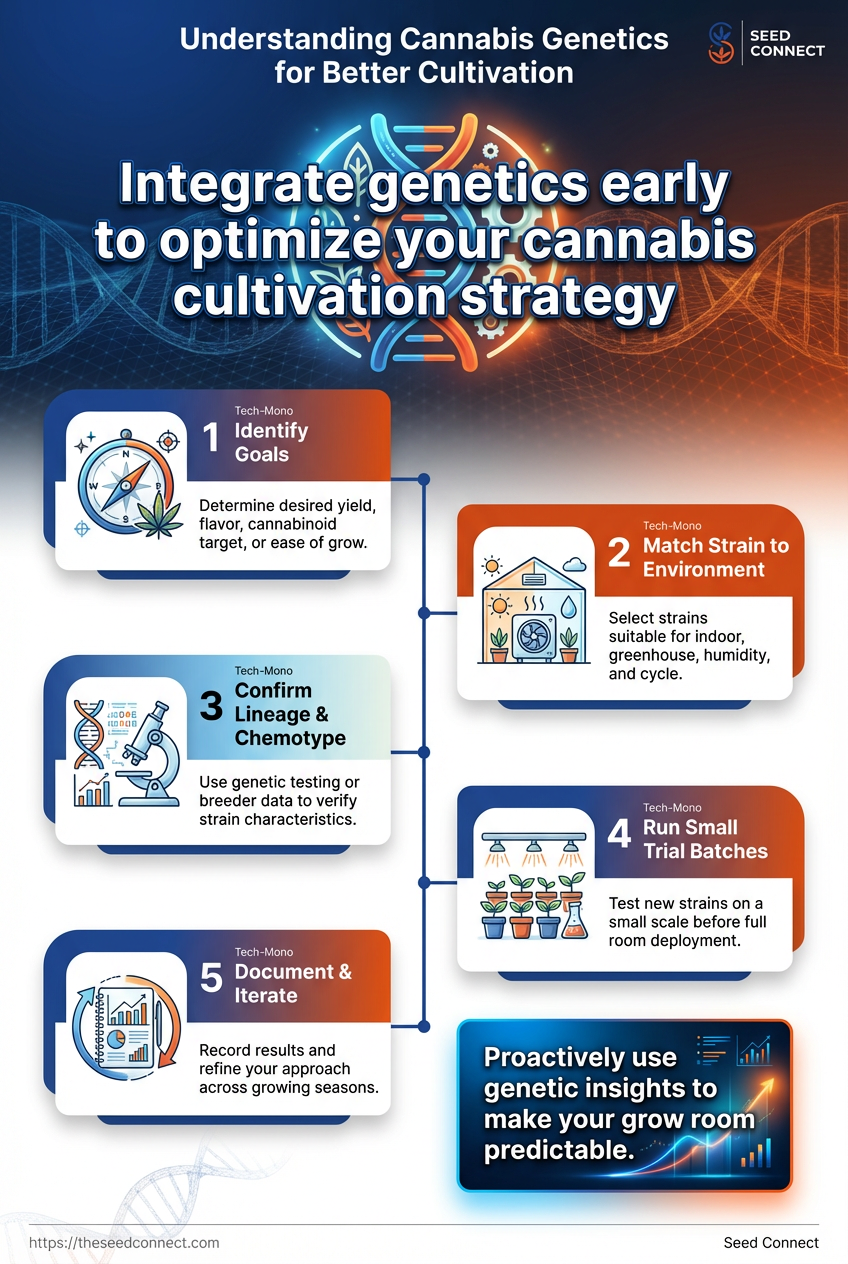
- Practical test: Run a small phenotype trial (4–8 plants) to confirm how a genetic line behaves in your room.
- Record keeping: Track environmental conditions and harvest metrics; genetics reveal their true strengths over repetitions.
- Genetic research: Check resources like Leafly and The Cannabist for breeder notes and community reports before buying.
Genetics set the starting rules.
Grow techniques write the final score.
Choosing the right strain for your grow
Picking the right strain sets the stage for the success of your entire grow.
Match genetics to what you actually want to harvest — not the prettiest photo or a hype score — and the rest of the grow becomes a series of manageable choices.
Start by listing priorities: potency, aroma, yield, climate fit, or legal caps on cannabinoids.
Then cross-check seed-level data like flowering time, expected height, and breeder notes about uniformity.
This step cuts surprises and prevents wasted cycles and inputs.
Two industry facts worth remembering: by 2025, 64% of U.S. growers were using genetic testing to inform strain choices, and growers reporting genetically optimized strains saw average yield gains around 40% (2025).
Those numbers show genetics moves from trivia to a tactical advantage.
Genetic diversity matters too.
Programs such as the Biodiversity in Cannabis Project highlight that broader genetic pools reduce disease risk and expand aroma and cannabinoid options.
Choose strains that balance your goal list with genetic resilience.
Match genetics to your goals: potency, aroma, yield, climate, and legal limits
Genetic choices are practical, not mystical.
Use this matrix to align what you care about with measurable genetic signals from breeders and catalogs.
How to read seed listings and lab reports before you buy
Seed listings hide the useful stuff in short lines of text.
Look for flowering time, expected height, notes on phenotype variability, and any breeder comments about male/female ratios.
Lab reports should show THC%, CBD%, a terpene panel, and contaminant screens.
Pay attention to testing dates and labs; recent, third-party panels are far more reliable than seller estimates.
- Breeder notes: Look for cultivation tips and phenotype ranges.
- Cannabinoid panel: Compare
THC%andCBD%to your legal limits. - Terpene breakdown: Use this to predict aroma and entourage effects.
- Contaminant report: Verify absence of pesticides, heavy metals, and residual solvents.
- Phenotype photos: Confirm the plant form matches your space and training plans.
Practical checklist for first-time buyers
New growers benefit from a short, concrete checklist when selecting seeds.
Keep checks simple and non-negotiable.
- Germination guarantee: Confirm terms and conditions; check processing times and exceptions.
- Return policy: Verify what’s covered if seeds are non-viable or mislabelled.
- Breeder support: Prefer breeders or retailers that offer growing notes or direct support.
- Third-party testing: Demand recent lab reports for cannabinoids and contaminants.
- Shipping & legal compliance: Confirm seeds are allowed in your jurisdiction and shipping window.
- Seller reputation: Look for phenotype photos, grow journals, and community feedback.
- Trusted platform check: Use platforms like https://theseedconnect.com when they clearly display germination guarantees and breeder info.
Choosing the right strain starts with a clear goal list and ends with aligned genetics.
Make buying decisions based on measurable traits and documented tests, and the rest of the grow becomes predictable and rewarding.
Working with seeds, clones, and breeders
Picking between seeds and clones feels simple until a crop goes sideways.
Genetics affect how predictable a plant is.
However, choices about seeds, clones, and breeders determine the risk a grower faces.
Many experienced growers now pair genetic testing and breeder transparency with hands-on decisions.
In fact, 64% of U.S. growers reported using genetic testing to guide their strategy in 2025, and those who pick genetically optimized stock often see big gains — some report around a 40% yield increase compared with older, traditional lines (2025).
That context matters when choosing a starting point.
The sections below break down seed types, when to favor seeds or clones, and the specific questions to raise with a breeder before buying.
Seed types: regular, feminized, and autoflower — pros and cons
Regular seeds are the original form.
They produce both male and female plants and are favored when preserving genetics or making new crosses matters.
- Pros: Greater genetic diversity and breeding flexibility; useful for preserving landrace traits.
- Cons: Up to half the plants can be male; requires screening and space for males.
Feminized: Seeds bred to produce only female plants.
- Pros: Predictable flower-producing plants; reduces time and space wasted on males.
- Cons: Some techniques used to feminize can reduce long-term vigor if overused in small breeding pools.
Autoflower: Flowers by age rather than photoperiod.
- Pros: Faster cycles and simpler lighting schedules; great for multiple harvests per season.
- Cons: Typically smaller plants and less flexibility for major training techniques.
When to choose seeds vs. clones based on genetics and risk tolerance
Choosing seeds gives control; clones give predictability.
Your tolerance for variability and need for uniformity should guide the choice.
- If you need uniform commercial lots, choose clones — they guarantee the same phenotype across plants.
- If you want to develop or preserve traits, use regular seeds and run a stable breeding program.
- If speed and low skill threshold matter, pick autoflower seeds for quick, consistent cycles.
- If risk tolerance is low but you want genetic diversity, start with feminized seeds from a trusted breeder.
Video: questions to ask a breeder before purchasing seeds
Watch this short Q&A to learn the right documentation to request and the precise questions that reveal breeder transparency.
Ask about germination guarantees, full lineage, and third-party lab results for potency and contaminants.
Use the video as a checklist when evaluating sellers.
Request copies of recent germination tests and lab reports before paying.
Link to the site’s cannabis seed catalog when discussing purchasing options.
Choosing the right entry point — seed or clone — changes your workload and crop predictability; be deliberate and ask for proof.
Common genetic problems and how to respond
Genetic issues show up as slow burns in a grow—odd leaves, plants that never bulk, or a few individuals that look completely different from the rest.
These problems are usually genetic first, environmental second, but the two interact.
Identifying which is which can save time and plants.
Most common headaches fall into three buckets: inconsistent phenotypes, hermaphroditism, and unstable breeding lines.
Each has clear diagnostic signs and practical next steps for growers who want predictable harvests and stable seed runs.
> 64% of U.S. growers used genetic testing to guide strain choices in 2025, and many reported measurable improvements.
Growers using genetically optimized strains reported up to a 40% increase in yield compared to traditional strains (2025).
Inconsistent phenotypes: diagnosis and next steps
When a seed pack produces plants that vary wildly in height, smell, or cannabinoid traits, genetics are usually the root cause.
Environmental stress can exaggerate differences, but true phenotype inconsistency traces back to heterozygosity or mixed lineage in the seed stock.
- Check uniformity first: Grow a side-by-side run in identical conditions for a small sample.
- Record differences: Track traits by plant — height, node spacing, flower time, aroma.
- Cull strategically: Remove extreme outliers before they pollinate a run.
- Isolate suspect plants to prevent accidental pollination.
- Run a second small trial under stable conditions to confirm genetics versus environment.
- If variability persists, consider switching to a more stable feminized or inbred line.
Hermaphroditism, triggers, and genetic risk
Hermaphrodites often appear after severe stress, but genetics set the underlying risk.
Some strains carry recessive genes that make male flower development more likely under stress.
- Watch the triggers: light leaks, heat spikes, drought, and chemical stress are common culprits.
- Identify genetic propensity: repeated hermie events in the same line point to heritable risk.
- Prevent early: maintain consistent light cycles and environmental stability during preflower.
Consider a hypothetical: a grower experiences hermies after a late flowering light outage.
If the same cultivar hermies repeatedly across different rooms or seasons, it’s a genetic issue worth discarding.
When to discard a line and when to select for stability
Breeding for stability takes time and patience.
Discard a line when multiple key traits fail repeatedly or hermaphroditism appears across generations.
Keep selecting if variability is limited to a few traits and improvement is likely with 3–5 generations of selection.
- Set objective thresholds: maximum acceptable hermie rate, trait variance, and yield loss.
- If more than one threshold fails after two clean generations, retire the line.
- If thresholds are close, start a controlled selection program and document every cross.
Leafly, the Biodiversity in Cannabis Project, and The Cannabist all emphasize genetic diversity and testing as tools for long-term stability and resilience.
Picking the right genetic path prevents wasted seasons and preserves valuable traits.
Keep records, test when possible, and be ruthless about removing chronic problems.
Put Genetics to Work in Your Grow Room
Think of cannabis genetics as the blueprint that decides how predictable a grow will be.
When growers pay attention to genetics first, everything else—light schedules, nutrient plans, pest control—starts to deliver the results they expect rather than surprises.
That uneven packet where one plant floods the tent with flowers and its neighbor barely stretches is a perfect example of cultivation genetics at play.
Reading breeder descriptions, knowing dominant phenotypes, and choosing between seeds or clones reduces those wild swings and helps match a strain to your space and goals.
Start small and be methodical: start a five-seed pheno run this weekend — germinate, label, photograph, and record each plant’s stretch, flowering time, and vigor.
Use that data to clone or keep seed lines that suit your tent.
If sourcing genetics is the next step, tools like TheSeedConnect can point to verified lines and breeder notes.
Which plant in your next run will change how you think about strain selection for cannabis?