


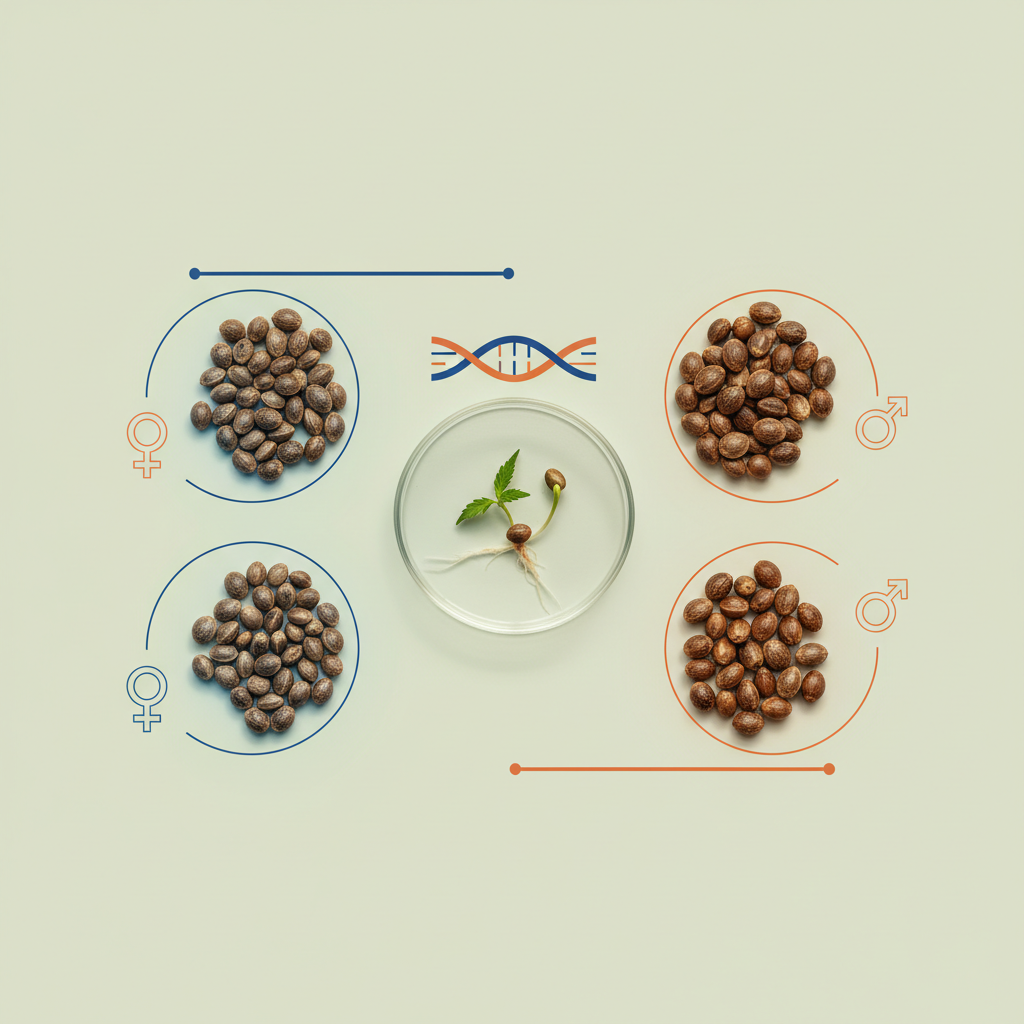
A tray of seedlings can look perfectly ordinary on day ten, yet the seed choice already changes the whole grow.
That is where feminized seeds and regular cannabis seeds start to matter.
You cannot look at a seed or a young seedling and know its sex, so the real difference is genetic, not visual.
With feminized seeds, growers are aiming for female plants and fewer surprises later.
With regular cannabis seeds, the seed can become male or female, which gives breeders room to work and gives some growers a closer look at the original genetics.
That seed gender explanation is simple on paper, but it affects planning, space, and expectations in a real garden.
A grower chasing bud production usually wants fewer male plants to remove, while someone focused on breeding may want the full mix.
The confusion is normal.
These two seed types may look the same in the packet, but they lead to very different decisions once the roots are in the soil.
Quick Answer: Feminized cannabis seeds are engineered to produce mostly female offspring, so growers can avoid the uncertainty of male plants that later form pollen sacs and must be removed. Regular cannabis seeds contain full genetics, meaning each seed can become either male or female after pre-flower formation. A reported feminization method uses ethylene inhibition with a single 3 mM silver thiosulfate (STS) foliar spray during the vegetative stage until runoff.
What are feminized and regular cannabis seeds, really?
Are all cannabis seeds the same once they sprout? Not even close.
Two seedlings can look identical for weeks, then split into different jobs.
One may grow into a pollen-producing male, while the other becomes a bud-bearing female.
A seed’s sex is hidden at the start.
As Grow Weed Easy notes, you cannot look at a cannabis seed or young seedling and tell whether it is male or female.
That is why seed gender explanation matters so much before planting, not after disappointment sets in.
The real difference starts with how the seeds are made. Regular cannabis seeds come from a male plant pollinating a female plant, so each seed can become either sex. Feminized seeds are produced through sex-reversal methods that push a female plant to make pollen, which is then used to create more female-leaning offspring.
Sensi Seeds explains that regular seeds carry the full genetic mix for male or female plants, while feminized seeds are bred to remove the usual male outcome.
> Seed sex is not visible at the sprout stage.
That matters because sex shows up later through pre-flowers.
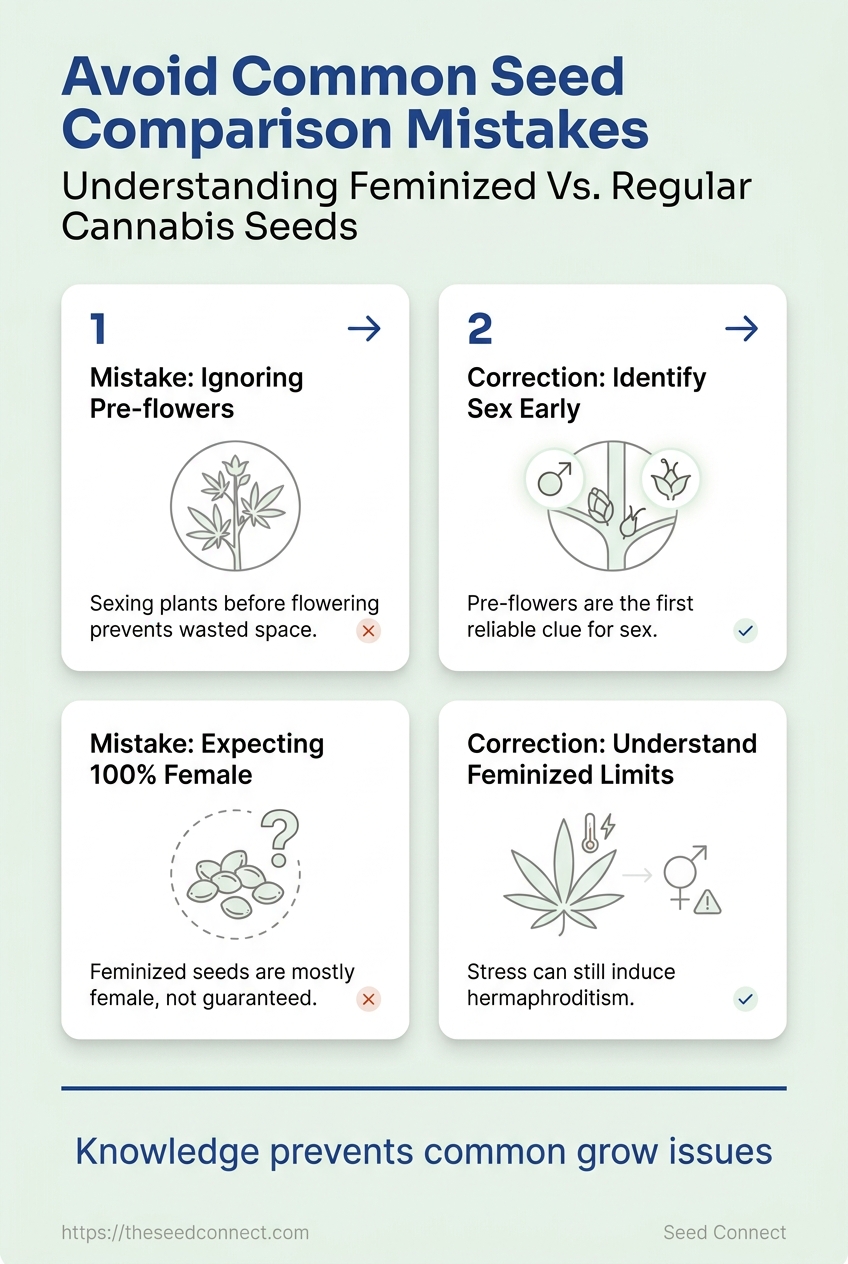
These tiny growths form where branches meet the main stem, and they are the first reliable clue.
- Male plants: They form small pollen sacs that look round or oval.
- Female plants: They form a calyx with two white pistils.
- Hermaphroditic traits: Some plants can show both, usually under stress.
- Feminized lines: They are meant to produce females, but they are not magic.
Why growers care is simple.
Unwanted males can pollinate females, and pollinated females spend energy making seeds instead of dense flowers.
That is why many home growers choose feminized seeds for flower production, while breeders often keep regular cannabis seeds for selecting parents and building new crosses.
A useful rule of thumb: if the goal is a clean harvest, feminized seeds save time later.
If the goal is breeding or studying plant traits, regular seeds keep more options on the table.
That split is the real story.
The seed looks the same on the outside, but the genetics underneath decide everything that follows.
Feminized vs. regular cannabis seeds: the practical differences
The biggest difference is not the packet label.
It is what happens later in the grow, when plant sex starts to affect space, time, and risk.
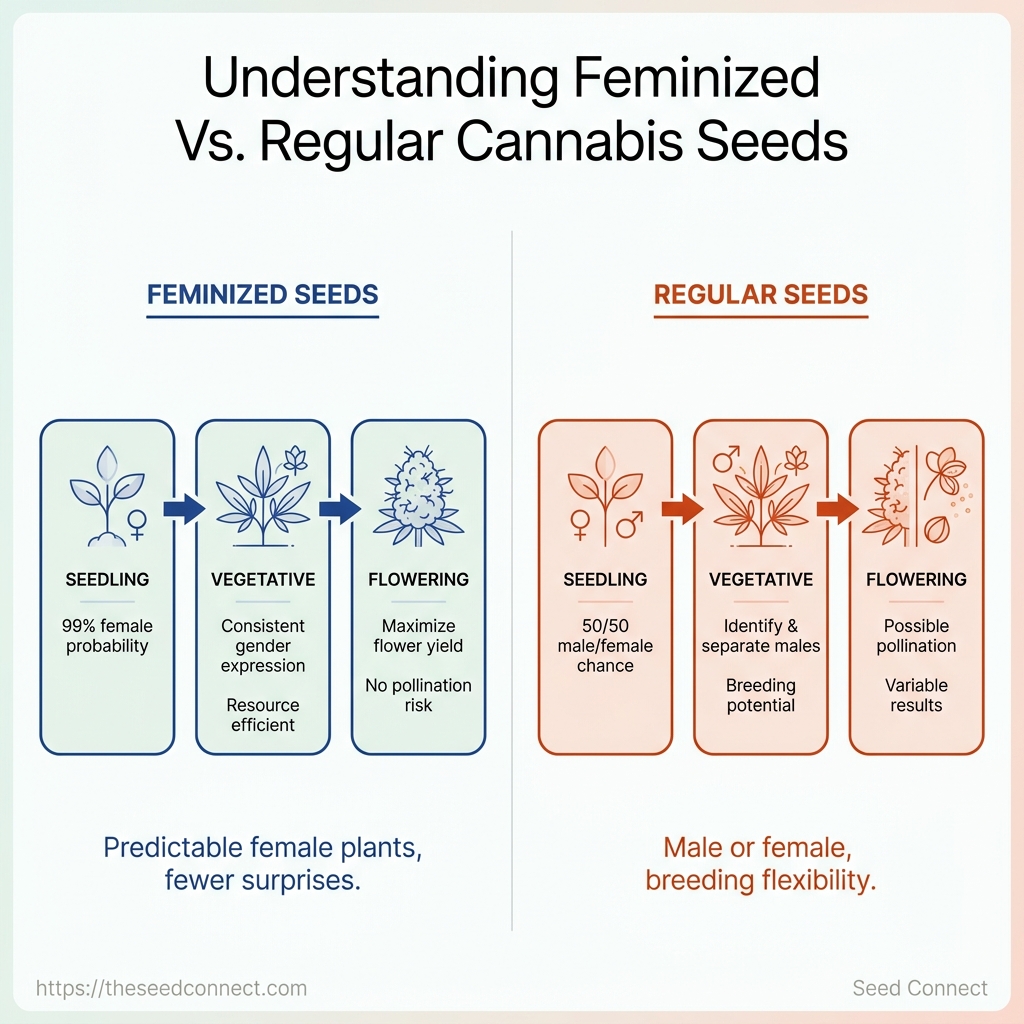
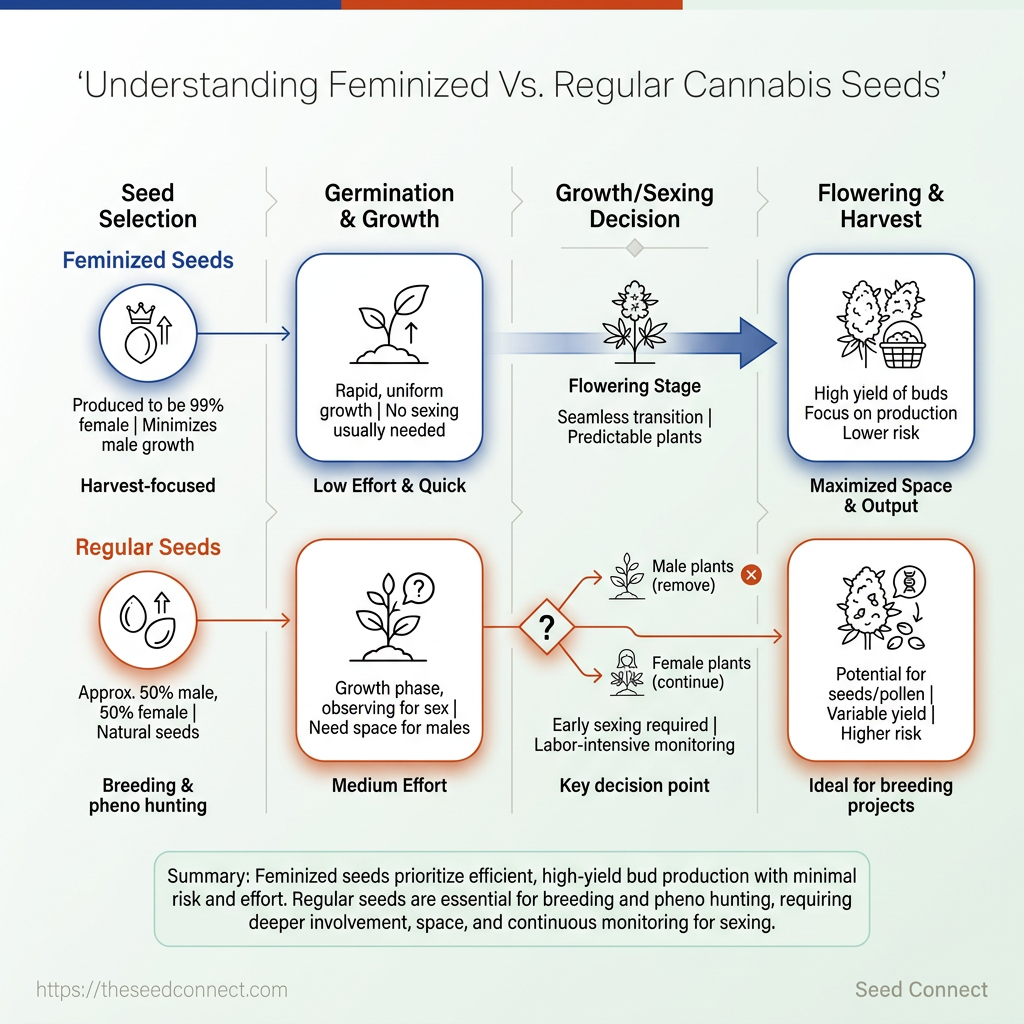
Feminized seeds push the grow toward female plants and fewer moving parts.
Regular cannabis seeds keep both sexes in play, which gives breeders more control but also more work.
Sensi Seeds notes that regular cannabis seeds are still the standard choice for breeding and cloning, while feminized lines are built to remove the male-plant decision from most grows.
That single shift changes how a crop is planned from veg through harvest.
Feminized seeds vs. regular cannabis seeds at a glance
| Feature | Feminized Seeds | Regular Cannabis Seeds | Best For |
|---|---|---|---|
| Plant sex outcome | Mostly female plants | Male or female plants | Harvest-focused grows vs. breeding work |
| Need to sex plants | Usually minimal | Yes, early sexing matters | Busy growers vs. hands-on selectors |
| Seed production | Made through sex reversal on female plants | Made through normal pollination | Controlled production vs. natural breeding |
| Risk of accidental pollination | Lower, but not zero | Higher because males are expected | Small rooms vs. breeding spaces |
| Ideal grower type | Home growers and crop planners | Breeders and pheno hunters | Simple runs vs. genetics projects |
| Typical use case | Bud production with fewer surprises | Parent selection and new crosses | Efficient harvests vs. long-term breeding |
If one of four plants turns out male, a regular-seed grow loses a quarter of its flowering space unless that plant gets removed fast.
That is why feminized seeds often feel easier in day-to-day cultivation.
Regular cannabis seeds make more sense when the goal is selection, not just harvest.
- Choose feminized seeds when space is tight and every plant slot matters.
- Choose regular cannabis seeds when you want to keep male plants for breeding.
- Skip feminized seeds when you need a wider genetics hunt and parent selection.
- Skip regular seeds when you need a simple, flower-first run with less sorting.
As Athena’s guide to feminized cannabis seeds explains, feminized lines are designed to remove males from the equation, while regular seeds preserve the full male-female split.
That difference shapes everything that follows.
Once a grower sees it that way, the choice becomes less about preference and more about the job the crop is supposed to do.
How to choose the right seed type for your grow
A first-time grower once told us they wanted “the fewest surprises possible.” They had one shelf, one light, and no interest in guessing games.
That mindset changes the whole seed choice.
For that grower, the real question was not which label sounded best.
It was which seed type matched the grow space, the timeline, and the level of risk they could live with.
A solid seed gender explanation starts there.
As Sensi Seeds explains in its guide on regular and feminized cannabis seeds, feminized seeds are built to produce female plants, while regular cannabis seeds are the better fit for breeding work and cloning projects.
A simple buying filter
When the goal is a clean, predictable harvest, feminized seeds usually make the most sense.
When the goal includes selection, breeding, or preserving a line, regular cannabis seeds earn their place fast.
The trick is to match the seed to the job before the packet is open.
Once that choice is clear, the rest of the grow gets easier to plan.
Ask these questions before buying any cannabis seeds:
- What is the main goal? Harvesting flower, making seeds, or building a breeding project all call for different genetics.
- How much space do we have? Small tents and tight rooms leave less room for extra plants and extra variables.
- How patient are we? Some growers prefer fewer moving parts, while others enjoy working with a wider genetic spread.
- Do we want repeatable results? If yes, choose the type that best matches consistency over experimentation.
- Are we buying for the first run or the next phase? First grows often reward simplicity; future runs may justify more specialized choices.
- Can we handle a surprise? If an unexpected plant would throw off the plan, lean toward the option that reduces uncertainty.
That same logic is why we keep our own Cannabis Seeds selection organized around grow style, not just strain names.
Choose the seed type that fits the grow, not the other way around.
That simple habit saves time, space, and a lot of second-guessing later.
Common mistakes people make when comparing seed types
Feminized seeds are not automatically the easy path.
That assumption trips up a lot of growers, because seed type answers only one question: what kind of plants are likely to come from the packet.
The bigger mistake is treating feminized seeds or regular cannabis seeds like a measure of strength, yield, or final smoke quality.
Those traits come from genetics, phenotype, and the grow itself, not from the seed label alone.
> A 2024 review in Frontiers in Plant Science describes feminized seed production as a controlled sex-reversal process using an ethylene inhibitor, which shows how technical the category really is: Optimized guidelines for feminized seed production in high-THC Cannabis cultivars
Seed type is not strain quality
A seed is not a promise.
It is a starting point.
One common slip is assuming feminized means “better” and regular means “old-fashioned.” In practice, regular seeds still matter when a grower wants breeding options, while feminized seeds are aimed at reducing the need to sort out males later.
That is a workflow choice, not a quality rating.
Another easy mistake is confusing seed gender explanation with visible plant traits.
You cannot tell by eye whether a seedling is male or female, and the seed itself does not reveal terpene profile, potency, or bud density.
- Do not read potency from the label. THC potential lives in the genetics, not in the word “feminized.”
- Do not treat yield as seed-type dependent. Environment, light, root space, and plant health do more work than the packet name.
- Do not assume regular means weaker. Regular cannabis seeds are often chosen for breeding and selection, not because they lack quality.
Why feminized is not always the simpler choice
A first-time breeder often wants fewer surprises.
A pheno hunter often wants more room to select from both sexes.
Those are very different goals, and feminized seeds only fit one of them cleanly.
The contrarian part is simple: feminized seeds can add pressure when a grower actually needs breeding stock or wants to preserve a male line.
Regular seeds may look harder at first, but they can be the cleaner choice when the end goal is selection rather than a guaranteed female crop.
The best comparison starts with the grow plan, then the seed type.
That keeps the decision grounded in what the plants are meant to do, not in marketing language.
Where this topic fits in the cannabis seed knowledge cluster
Most confusion starts before the first seed is even planted. It starts on the product page—where feminized seeds and regular cannabis seeds can look like simple shopping labels, but they actually signal different grow plans.
Once you understand what the label implies, the rest of your buying decisions get easier: What are you trying to grow, what kind of selection might you want later, and how much uncertainty your setup can absorb?
Here’s how this article connects to the next steps readers usually need:
- Seed gender explanation (foundation): This is the base layer—what the seed-type labels mean for plant sex outcomes and why that affects planning.
- Feminized seeds (branch): Best when you want a crop plan built around female-leaning results and a more predictable workflow.
- Regular cannabis seeds (branch): Best when you want to keep both sexes in play for parent selection, breeding, and genetics projects.
- Product page reading: Next, learn to scan listings for seed type and breeder notes—then translate those details into your space, timeline, and tolerance for extra work.
- Mistake spotting: After comparison, this is where readers avoid treating a label like a guarantee instead of a planning clue.
A quick walkthrough of seed descriptions fits here because it turns abstract terms into a real shopping habit: read the listing, identify the seed type, and match it to the job your grow is trying to do.
This section should bridge the definition work above with the practical comparison and buying-mistake guidance that comes next—so the topic feels like one continuous path rather than separate facts.
Is there a way to tell the difference between male and female cannabis seeds?
No. As explained earlier in this article, cannabis seed sex isn’t visible at the start. The distinction shows up after plants begin forming pre-flowers.What is the downside to feminized seeds?
Feminized seeds aren’t an “easy mode” guarantee. They primarily reduce the chance of male plants, but seed type still doesn’t determine final strength, yield, or smoke quality—those outcomes depend on genetics, phenotype, and the grow itself.What is the difference between feminized and regular cannabis seeds?
Feminized seeds are bred to produce mostly female offspring, aiming to reduce the need to deal with male plants later. Regular cannabis seeds carry full male/female genetics, so each plant can be either sex after pre-flower formation—and they’re typically chosen when you want both sexes for breeding/selection.Are feminised seeds always female?
No. Feminized lines are designed to produce mostly female plants, not a guaranteed 100% female result. Even with feminized genetics, you still need to check plants during pre-flower formation.What fertilizer makes buds bigger?
No single fertilizer makes buds bigger on its own. Final bud size and quality come from genetics, plant health, and correct flowering-stage nutrition. Use appropriate flowering nutrition for your plants’ needs rather than chasing a single “magic” product name.Choose the seed type before the grow chooses you
The most useful seed gender explanation is also the simplest: feminized seeds are bred to produce female plants, while regular cannabis seeds can produce either sex.
That difference matters long before harvest, because it shapes how much space, time, and attention the grow will need.
If your goal is a clean, predictable run, feminized seeds remove one major variable and let you focus on plant health and bud development.
If you want breeding projects, stronger selection options, or a wider genetic pool, regular cannabis seeds still earn their place.
That is why the right choice is not about “better” or “worse”; it is about matching the seed to the job.
The clearest move today is to write down what this grow is really for, then choose from there.
A home grower with four plant slots and limited time will usually value certainty, while a breeder may want the flexibility regular seeds provide.
If a curated starting point helps, our feminized seeds are one practical option to compare against regular packs before you buy.