
We grew two Gorilla Glue #4 plants from the same seed pack.
Same tent, same nutrients, same light schedule.
One finishes near 30% THC, the other tests several points lower.
Most growers blame the breeder.
The label promised a number, the lab report came back short, and strain potency starts feeling like pure marketing.
What’s really going on?
THC percentage isn’t a fixed property of a strain name.
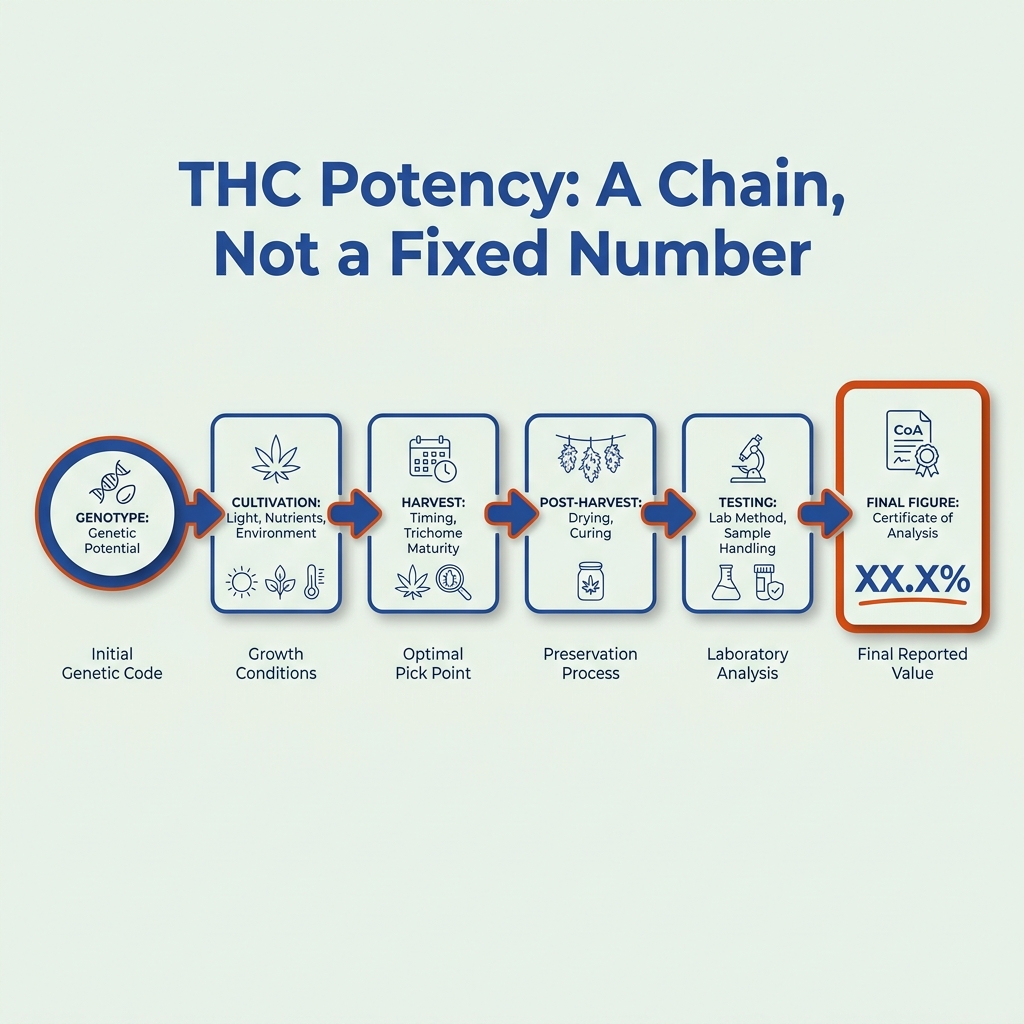
It’s the endpoint of a chain running from genotype to Certificate of Analysis.
Light intensity, harvest timing, trichome maturity, and even how a lab dries its sample all nudge that final figure.
Understanding THC and how it impacts cannabis potency means following that chain one link at a time.
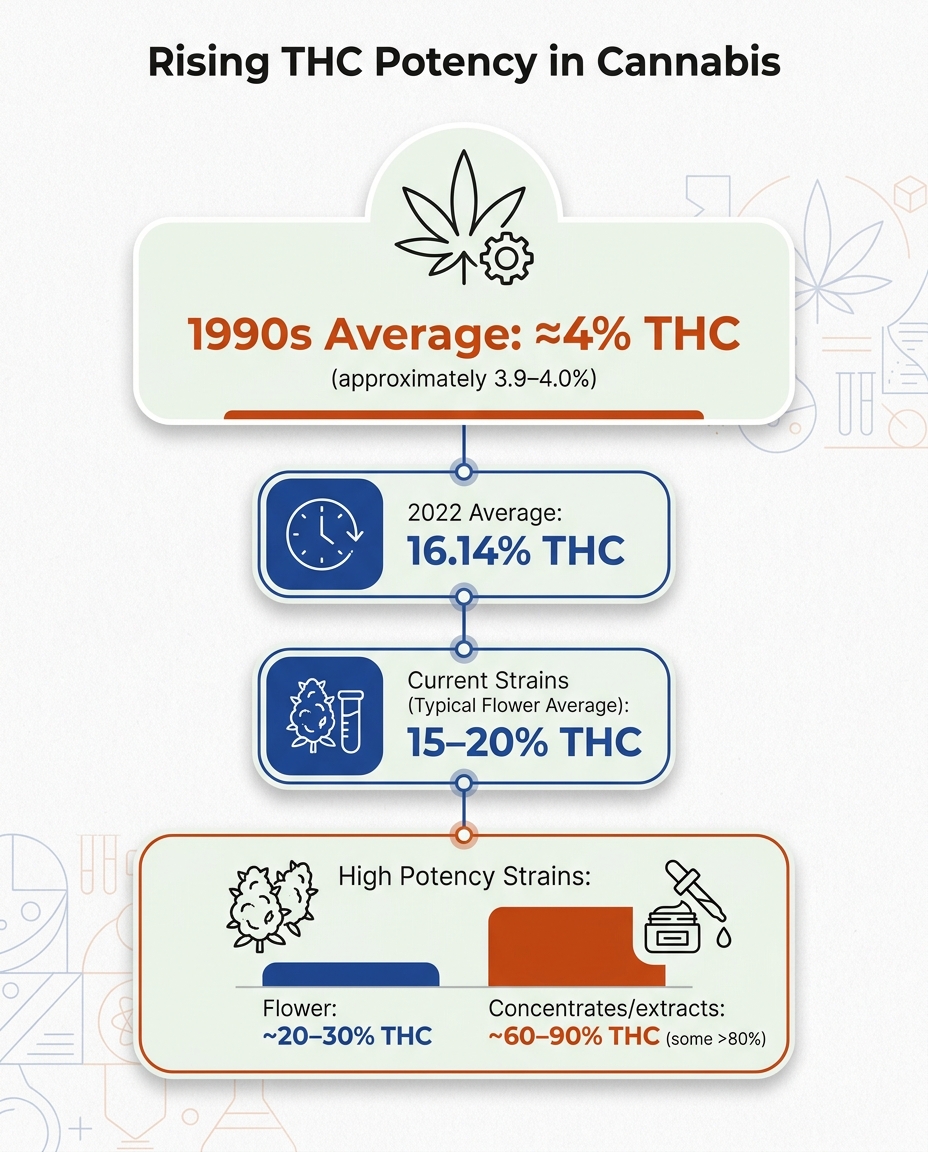
According to the Washington State Liquor and Cannabis Board, flower in Washington State averaged 21% THC in 2022, up from under 5% in the 1990s — a real jump, not a myth.
That average still describes tested samples, not guarantees for your own grow.
Once you see where a seller’s claim ends and your cultivation begins, potency numbers get a lot less mysterious.
Quick Answer: THC potency in cannabis, measured as a percentage of dry weight, is influenced by genetics, cultivation conditions, and post-harvest practices, making it a variable rather than a fixed characteristic. Average THC levels in flower have risen dramatically, from under 5% in the 1990s to approximately 21% in 2022, a figure that may have increased since then. Understanding these factors helps consumers discern that potency claims are not absolute guarantees.
What does understanding THC reveal about cannabis potency?
Ask most growers what makes a strain potent and the answer often comes back as one number: “It’s 26% THC.” This figure feels definitive, but we need to understand it as part of a broader range. Understanding THC — including what it is, how it gets measured, and the implications of the number — reframes cannabis potency as a range of possibilities rather than a fixed promise. THC, or delta-9-tetrahydrocannabinol, is the main psychoactive compound in cannabis. Potency shows how much THC is in a product. This is usually given as a percentage of dry weight in flower or in milligrams per serving in edibles.
A lab report stating 26% THC means that about 26% of the dried plant sample was THC.
But this is just part of the story.
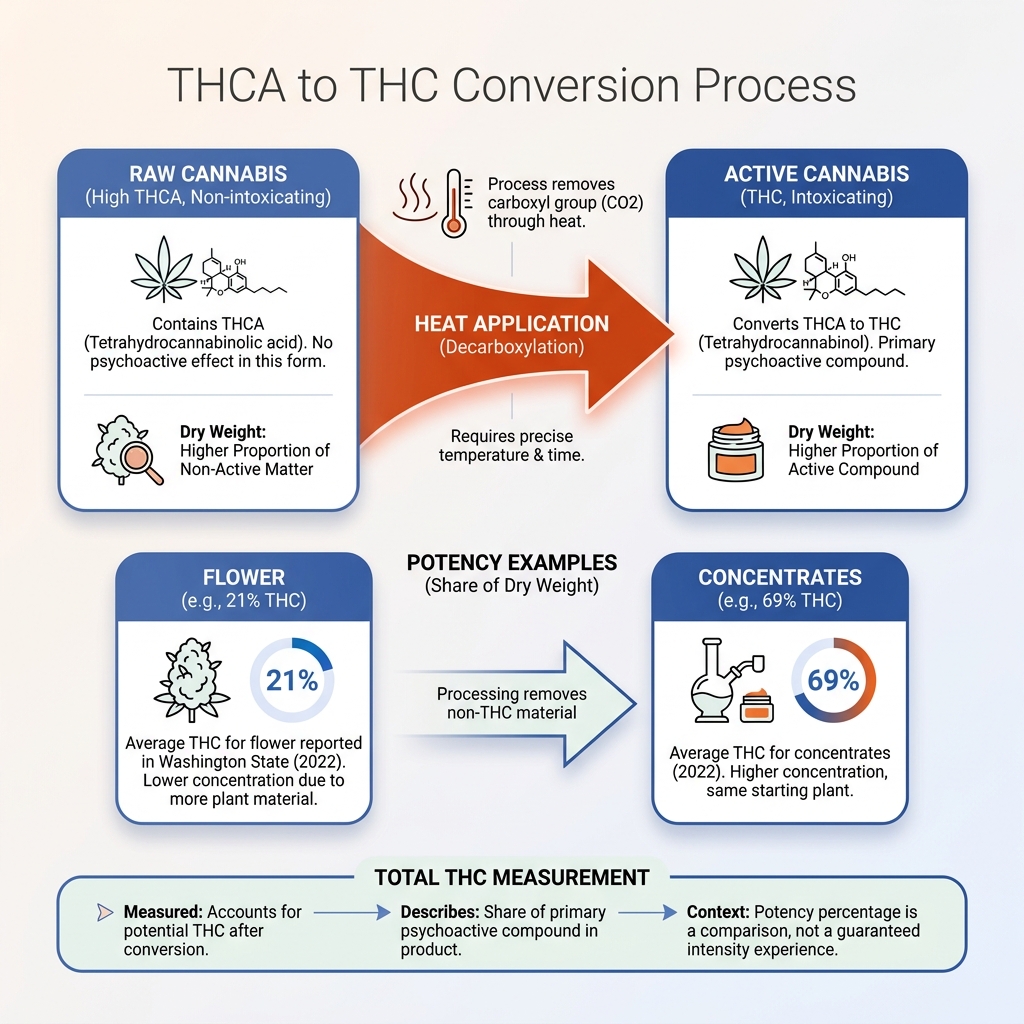
Raw cannabis mainly contains THCA (tetrahydrocannabinolic acid). This is a non-intoxicating form that turns into active THC when heated, in a process called decarboxylation. Methods like smoking, vaping, or baking cause this change.
That’s why labels often show total THC, which adds the THCA that can be activated to the THC already present. It’s important to realize that THC concentration and user experience don’t always match. Two people can use the same 26% flower and have very different experiences.
In the coming sections, we’ll track THC from genetic potential to tested jar, covering how potency is measured, why identical seeds can finish at different percentages, and the critical distinction between what sellers claim and the realities of your growth journey.
It’s important to understand the limits of THC numbers. Always treat advertised percentages as starting points, not guarantees. Actual results depend on many factors, such as genetics, growing conditions, and how the product is handled after harvest.
Why THC potency matters when choosing cannabis seeds
Just because a seed pack says 30% THC doesn’t mean we’ll get a stronger harvest.
Only two things can: the genetics inside the seed, and what you do with them.
That distinction matters because potency is the first filter most growers apply when shopping.
THC is the compound that causes the high. Recent research shows that today’s cannabis flower typically has about 15–20% THC, with some strains going over 30%. This figure might have changed since it was reported. Yale School of Medicine reporting on rising THC concentrations notes that potency has climbed faster than the science tracking its effects.
However, trying to get the highest number can be a mistake.
A 28% strain that needs perfect light and 11 weeks of flowering will underperform a 20% strain you actually finish well.
Higher THC is not automatically the better buy
Potency is just one trait among many, and it can affect others.
Plants bred hard for THC tend to produce very little CBD—the cannabinoid that softens THC’s edge.
One analysis from a Colorado dispensary found that Girl Scout Cookie tested between 17–28% THC and only 0.09–0.2% CBD.
Flavor, resin density, mold resistance, and finish time also help decide if the result is worthwhile.
How seed type changes your potency expectations
The type of seeds you choose affects how much control you have over that potential.
Feminized seeds are predictable photoperiod-driven plants; autoflower seeds are faster and easier but with a fixed lifespan; regular seeds offer the widest genetic pool and the most variability.
| Factor | What it can influence | What it cannot guarantee | What the grower should look for |
|---|---|---|---|
| Genetics | The maximum THC and terpene potential | The THC percentage you actually harvest | Breeder COAs, plants with many trichomes |
| Light and environment | Whether the plant reaches its full genetic potential | Higher potency than the genetics allow | 600–1000 PPFD during flowering, stable temperatures |
| Plant maturity at harvest | THC peaks at the right stage of trichome development | More potency than the plant’s genetics allow | Milky trichomes viewed at 30x magnification |
| Drying and storage | Keeping developed THC intact | Regaining potency lost to heat or light | Slow drying, airtight, dark, and cool storage |
| Laboratory testing | An accurate result for the sample tested | A promise about your particular plant | Third-party COA with a complete cannabinoid panel |
Genetics sets the ceiling; everything else decides whether you reach it.
If you want to start from strong stock, browsing high-yield marijuana seed varieties with documented potency data gives you a clearer baseline than a marketing percentage alone.
Potency is important when it helps you match a strain to your growing setup and skill level.
How THC affects cannabis potency from seed to finished product
Two growers in the same city planted seeds from the same pack on the same weekend. One harvested flowers that tested close to 24% THC. The other, in a warmer tent with a shorter flush, had several points lower.
The seeds were the same; everything else that happened between germination and testing was different.
This difference shows the full story of THC potency. A seed sets the maximum potential, but everything else decides how close you get to it. Genetics define the potential, not the outcome. Breeders choose parent plants for their ability to produce cannabinoids, and that potential is passed down in the seed. But it’s crucial to know that potential is a range, not just one number.
Two plants from the same seed lot can test differently by several percentage points because the same genotype can react differently to light, nutrients, and stress.
As the plant matures, cannabinoid production shifts significantly. Early in flower, trichomes are clear while THC is still building. When they turn milky, it shows peak potency, which is a key stage for harvesting. Amber trichomes mean THC is degrading into CBN, which has different effects. Monitoring trichomes at 30x magnification provides more accurate guidance than relying on calendar dates.
Additionally, post-harvest handling is crucial as it can change the reported THC percentages. THC is characterized as a percentage of dry weight, so a sample with moisture content can weigh more, thus reflecting lower THC levels. Storage conditions play a role too; heat and light can degrade cannabinoids, affecting potency over time.
Finally, testing methods also matter greatly: HPLC separates THCA from THC adeptly without generating heat, while older gas chromatography approaches may not be as reliable, resulting in inflated readings. Remember: when you see a product labeled “20–26% THC,” that range reflects tested samples and not guarantees about what your batch will deliver.
Examples that make THC potency easier to understand
Washington State’s Liquor and Cannabis Board reported an average of 21% THC for flower in 2022—and 69% for concentrates that same year.
Same plant.
The difference came entirely from processing.
Think of it like taking a measured amount of material and removing some of what’s not THC.
The plant still starts the same way, but processing changes the ratio of THC to the rest of the dry matter.
That’s why the percentage jumps so dramatically: the THC amount becomes a larger share of what’s left by the time you’re holding flower versus a concentrate.
THC potency describes how much of the primary psychoactive compound is present as a share of dry weight.
It is not a score for how intense any given session will feel.
A label can tell you “what proportion,” but it can’t guarantee “how strong you’ll experience it.”
Two strains both labeled 22% can land very differently.
Cannabis users don’t just respond to concentration—they respond to how much material ends up delivered to the body, along with factors like your tolerance and the way you consume it.
So the number helps you compare products on paper, but the effect depends on the full context of dosing and use.
How to use THC information when selecting cannabis seeds
A THC percentage should never be the reason you buy a seed. It should be the reason you ask sharper questions about everything else in the listing. That runs against how most seed catalogs get browsed, where the biggest number floats to the top.
But a reported 26% from someone else’s grow room tells you almost nothing about what your setup will produce. As Yale School of Medicine researchers point out in their review of rising cannabis THC concentrations, potency has climbed faster than the science explaining its effects—so shop deliberately rather than chase a headline figure.
Start with your goal, then let THC narrow the list. Growing in a small tent with limited height? An autoflower that finishes on its own timeline usually beats a tall sativa that tests higher. Growing for concentrates?
Genetics with dense trichome coverage matter more than a flower percentage. Chasing maximum effect? Then a documented 25%+ strain belongs on your shortlist—only if you can meet its light and feeding demands.
Before you buy, check whether the seed type fits your space (feminized, autoflower, or regular), whether the potency figure is sourced with breeder COAs or test data rather than asserted, and whether there’s a germination guarantee that covers the one outcome the seller can actually control—whether the seed starts.
What a seed seller can honestly verify is limited: genetics lineage, seed type, germination performance under stated conditions, and shipping details. What no seller can promise is your final THC percentage, your yield, or how the flower will feel. We keep that boundary clear in our cannabis seeds listings and back every order with a germination guarantee and discreet US shipping. Compare listings on genetics, seed type, documentation, and support—then let the THC figure confirm a choice you already made for better reasons.
Does higher THC mean more potency?
Higher THC levels generally indicate more potency, but potency is not solely determined by THC content. Factors such as genetics, cultivation methods, and post-harvest practices also play critical roles in the final potency of the cannabis.
Is 20% THC considered strong?
Yes, a THC level of 20% is considered strong by current cannabis standards. Average THC levels in flower were around 21% in 2022, indicating that 20% likely falls within the high-potency category, though this may have changed since then.
What is THC and how does it affect you?
THC, or delta-9-tetrahydrocannabinol, is the primary psychoactive compound in cannabis. It impacts users by producing effects such as euphoria, altered sensory perceptions, and relaxation, depending on the quantity consumed and individual tolerance.
Is there a way to test THC potency?
Yes, THC potency is typically tested through laboratory analysis, which measures the percentage of THC as a part of a cannabis sample’s dry weight. Growers often use lab reports to validate potency claims before harvest.
Is 30% THCA the same as 30% THC?
No, 30% THCA (tetrahydrocannabinolic acid) is not the same as 30% THC. THCA must be decarboxylated, usually through heat, to convert into THC, which means the actual THC content will be lower than the THCA percentage stated.
Our genetics set the limits, but everything after planting decides how close we get to those limits.
Those two Gorilla Glue #4 plants — same pack, same tent, same feeding schedule — still finished several points apart at harvest.
THC percentage is the end of a long chain: breeder selection, phenotype expression, light intensity, harvest timing, drying, and curing.
It isn’t a number printed on a label.
That changes how you shop.
A strain listing claims potential; your environment determines what that potential becomes.
Chase stable genetics and honest testing data rather than the highest advertised percentage, because potency you cannot reproduce is just marketing.
Start with one concrete step: pick a single strain, run it twice under identical conditions, and test both.
If you want predictable genetics as a baseline, our
Sources