


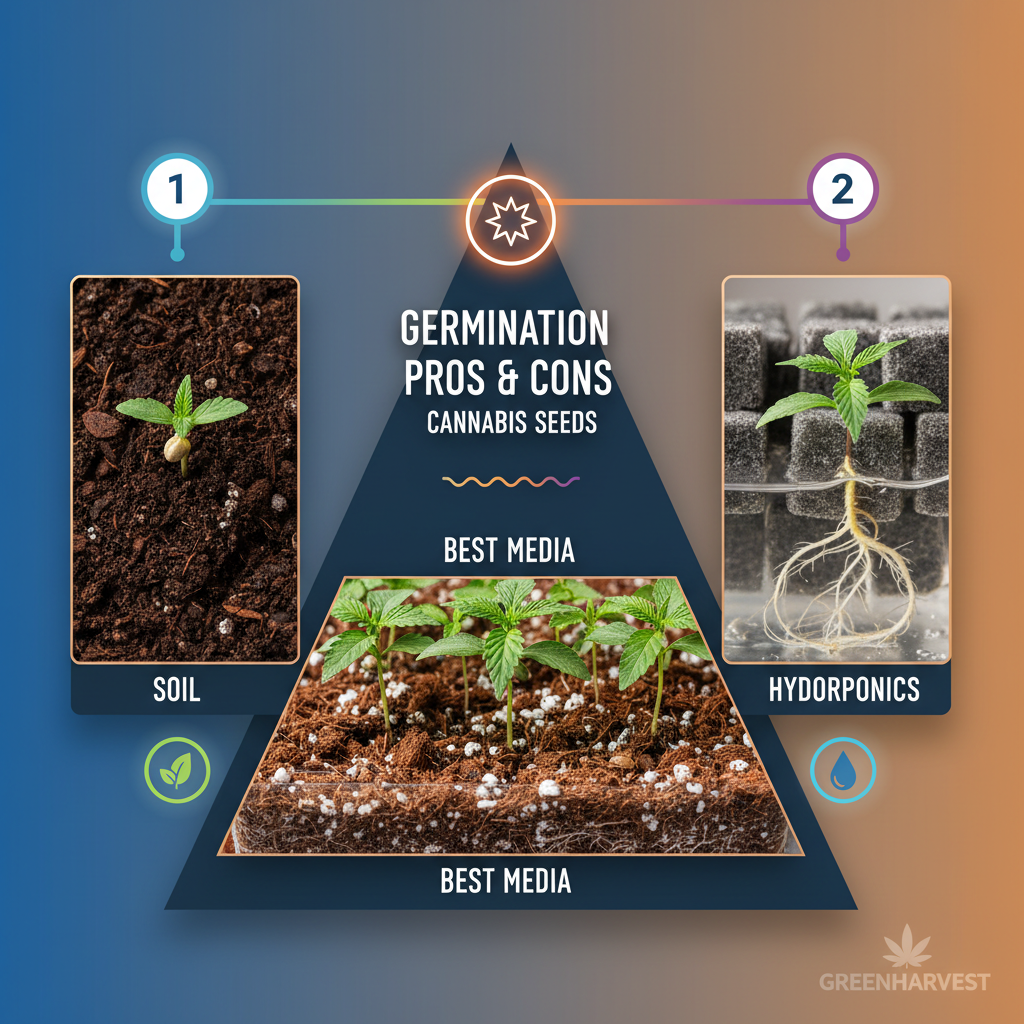
A seed can crack in one setup and stall in another—often for reasons that have less to do with “hype” and more to do with what’s happening in the seed zone during those first days.
In this guide, you’ll compare the most common germination media side by side (paper towel/baggie, soil/seed-starting mix, coco coir, rockwool, and plugs/pellets) and learn what each choice changes in practice—your day-to-day workflow, how easy it is to handle the sprout, and the tradeoffs you’ll notice for different grow setups.
First, we’ll break down what germination media does in the real world so you know what to optimize. Then you’ll pick the best option for your situation using a decision framework based on your environment and how you plan to move from seed to sprout. After that, you’ll follow a clear step-by-step process for starting seeds in the medium you chose.
If your results aren’t consistent, the later sections will help you troubleshoot by stage—so you can identify whether the issue is prep/technique, timing, or how you’re handling the move from seed to sprout. —
Quick Answer: ## Quick Answer Pick the germination medium based on the one tradeoff you can manage best during the seed-zone phase—then use that medium’s readiness cues to decide when to transplant. – Easiest transplant (move as a unit): starter plugs / peat pellets – Most repeatable moisture behavior: rockwool (best with a consistent routine) – Forgiving, steady “buffer” feel: coco coir or seed-starting mix/soil-style (keep the seed pocket damp without pooling) – Fastest visibility (requires closer checking): paper towel / baggie ### Use this cue-based rule Don’t time transplant by the clock—time it by what the medium indicates (the Step-by-Step section covers the exact cue for each medium). ### If results vary For inconsistent runs, see the troubleshooting approach in the Conclusion (the “change one variable at a time” method).
Germination media is more than a container—it’s the environment that shapes what the seed experiences between moisture uptake and a visible sprout.
Rather than just asking “which medium is best,” think about what your medium makes easier (and what it makes harder) in the seed zone:
- How quickly moisture reaches the seed pocket (and whether it does so evenly)
- How much oxygen/air exchange the damp zone can support while it stays moist
- How easy it is to intervene safely (without repeatedly disturbing the seed zone)
When germination stalls, the medium often leaves a recognizable pattern. For example:
- Sluggish or uneven cracking/emergence: the seed pocket may be receiving moisture slowly or inconsistently.
- Stalled growth after activation: the pocket may be staying too wet (low oxygen) or drying out between checks.
- Roots that become hard to manage at move-time: the medium can encourage tangling or make extraction more disruptive.
That’s why medium choice matters: it determines which early warning signs you’re likely to see—so you can respond with the cue-based timing and transfer approach that fits your next step.
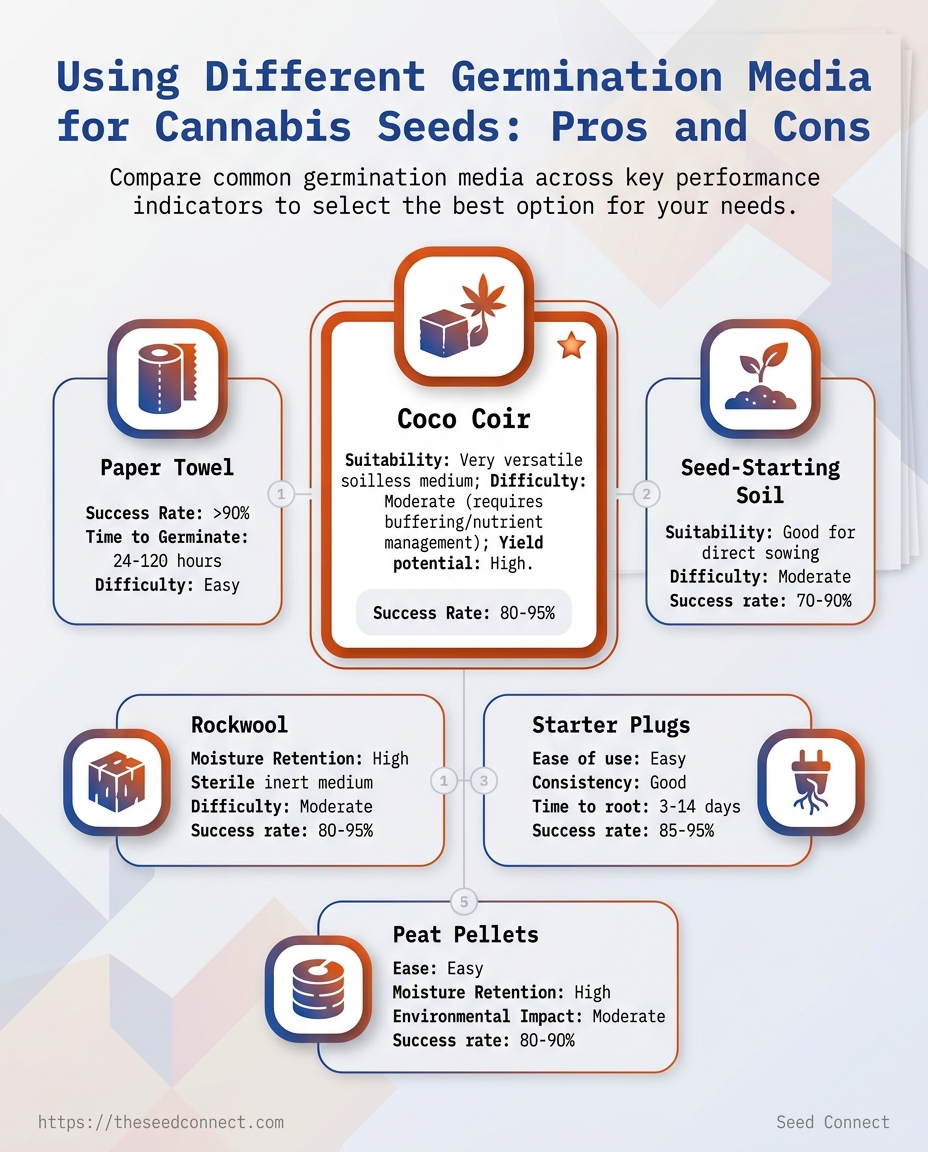
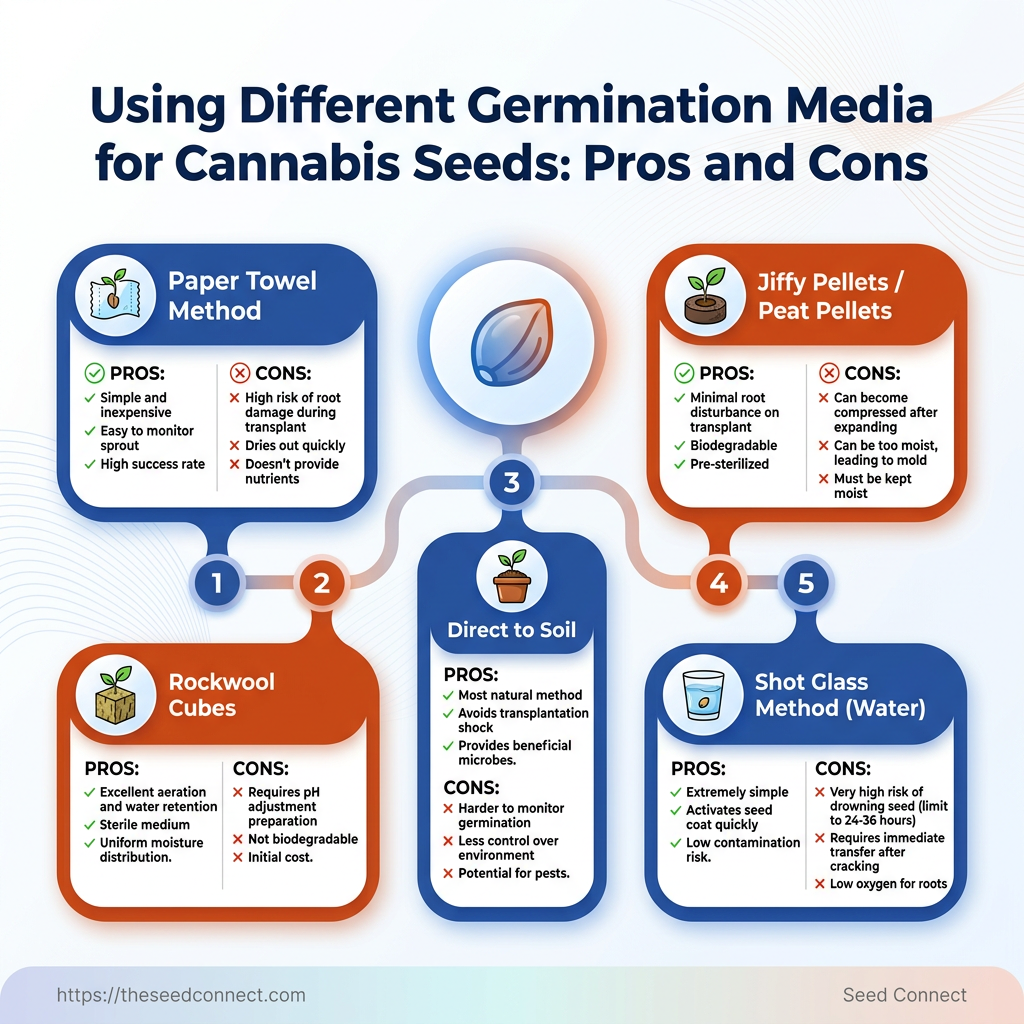
Paper towels / baggies
Best when you want maximum visibility. The main risks are timing and handling time—exposed roots dry out quickly and can tangle if you wait too long.Seed-starting soil
A forgiving “holding zone” in one container. The most common problem is staying overly wet, often from compaction or water pooling near the seed pocket.Coco coir
Great when you want consistent moisture feel and a cleaner, more portable start. Treat it as a buffered medium and plan to manage moisture and feeding promptly once sprouting begins.Rockwool
A predictable choice for controlled, hydro-style workflows. The tradeoff is less forgiveness when conditions drift—especially around hydration consistency and pH management.Starter plugs / peat pellets
Convenient, tidy, and easy to move as units. Watch for edge drying: the seed zone can lag behind outer surfaces.How to use this comparison: pick the medium whose tradeoffs match your process—visibility vs. dryness risk (paper/baggies), buffering vs. compaction risk (soil/coco), or control vs. parameter discipline (rockwool). Then use the medium-specific prep and transplant timing described later in the guide.
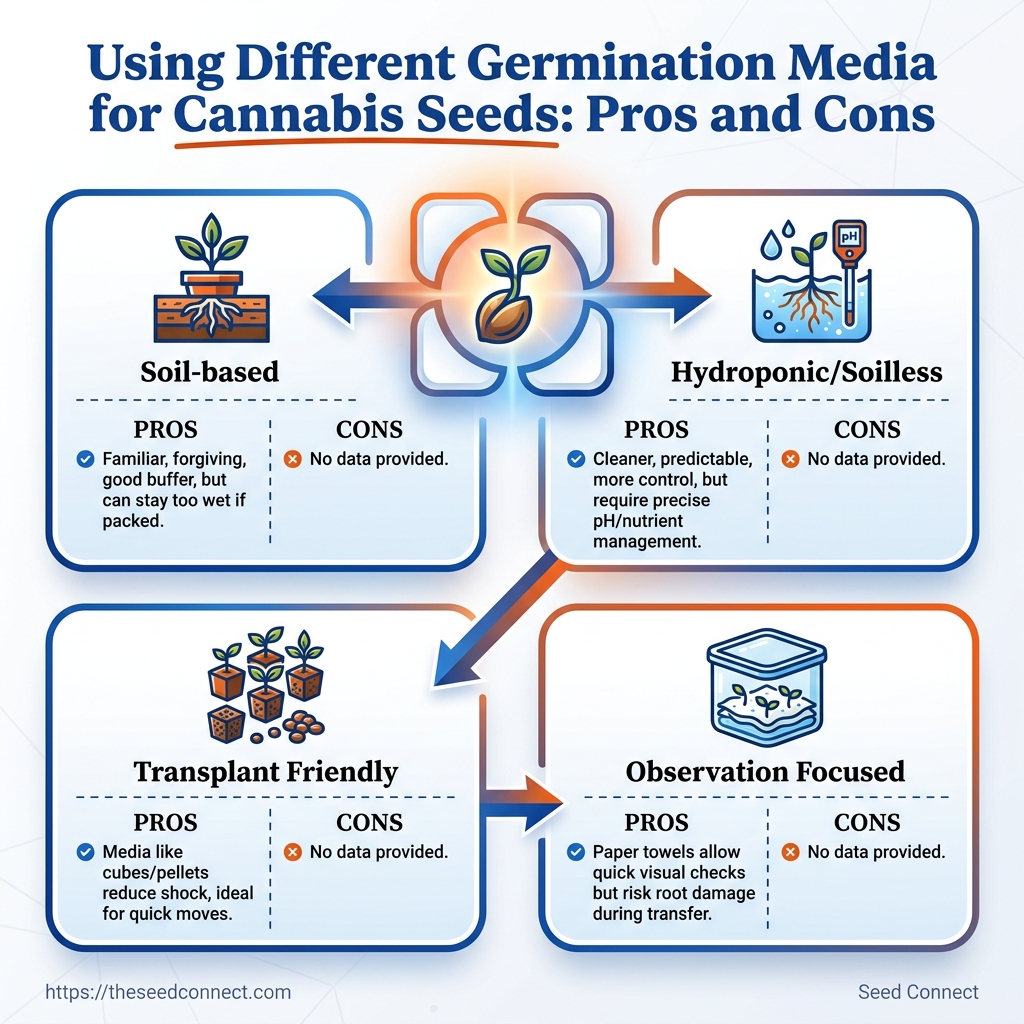
Pros and Cons by Grow Style
What you’re really optimizing with your germination approach isn’t just the medium—it’s how your setup handles two variables during those first days: root-zone stability (how consistently the seed pocket stays in the right moisture/air range) and disturbance tolerance at move-time.
The main tradeoff: stability vs. disturbance tolerance
– Soil-style starts (hand-watered trays/pots):- Typical advantage: the seed sits in a larger buffer of mix, so small timing slips often change the overall moisture feel more gradually.
- Typical drawback: the mix can form micro-zones (compacted or unevenly damp areas) that stall a seed even if the surface looks okay.
- Hydro-style starts (cubes/plugs):
- Typical advantage: the small unit can deliver more consistent behavior when your environment and hydration discipline are steady.
- Typical drawback: because the volume is smaller, deviations show up faster—so you have to stay on top of the routine.
What changes at transplant time
- Soil-style transitions:
- Typical advantage: surrounding medium mass can protect roots from direct exposure.
- Typical drawback: success depends heavily on timing—waiting too long (or encountering a localized wet/dry pocket) can make the move harder.
- Hydro-style transitions:
- Typical advantage: cubes/plugs are designed to be moved as units, which can reduce direct root brushing.
- Typical drawback: separation timing matters—if roots over-develop inside the unit, splitting and seating becomes more disruptive.
Side-by-side summary
| Factor | Soil-based starting | Hydro-based starting | Who it suits best |
|---|---|---|---|
| Root-zone behavior | Changes more gradually; often more forgiving of minor routine shifts | Changes faster; rewards consistent inputs | Soil for steady, low-intervention checks; hydro for precise routines |
| Root “inspection” | Limited until transplant | Often easier to see through/around plugs and cubes | Soil if you prefer fewer checks; hydro if you like visual cues |
| Handling at move-time | Usually gentler if you keep surrounding medium intact | Often cleaner as a unit move, but separation timing is critical | Soil for low-disturbance transitions; hydro for controlled unit transfers |
Quick fit guidance
- Choose soil-style starting if your process is built around a simple routine and you want extra buffer against small variations.
- Choose hydro-style starting** if your workflow supports consistent conditions and you’ll transplant using unit-based handling.
Once you pick a style, narrow down to the specific medium based on how it behaves in your environment—and then follow the medium-specific prep and readiness cues in the Step-by-Step section.
How to Match the Media to the Seed and Environment
Use this section to convert your constraints into a medium pick. Think of it as routing: decide what you need to optimize, then match that to the preparation, placement, and transplant timing that your chosen medium supports.1) Start with your tolerance for handling/time pressure
- If you can check often / seeds are high-vigor: prioritize media that typically show activity quickly (often starter plugs/peat pellets or coco coir).
- If seeds are older, low-vigor, or more delicate: prioritize media that help maintain a steadier seed-zone experience when timing isn’t perfect (often coco coir or a soil/seed-starting mix).
2) Pick based on how stable your seed-zone moisture will be
- If your environment swings (dry/wet cycles): lean toward media with smoother, more consistent moisture behavior (commonly coco coir or seed-starting mix/soil-style).
- If you tend to under-moisten: choose a workflow that keeps the seed pocket damp without constant corrections (often coco coir; soil/mixes only if you reliably prevent pocket drying).
- If you’re at risk of over-wetting/pooling: choose a workflow where excess water is less likely to sit directly in the seed area (often easier with rockwool in disciplined routines).
3) Choose by your transplant plan (not the medium name)
- If you want the gentlest handoff: favor unit-based handling (commonly plugs/cubes/pellets).
- If you want clearer monitoring without disturbing the seed pocket: select a medium that lets you read readiness at the right moment.
- If you can keep parameters tight: hydro-style media can work well when hydration and routine are consistent.
Quick pick shortcuts
- Most forgiving for many homes: coco coir or soil/seed-starting mix (if your seed pocket stays damp)
- Most controllable for unit transfers: rockwool or other cubes/plugs
- Best for tidy, small-space handling: starter plugs / peat pellets
After you choose, apply the matching prep/placement approach for that medium—and transplant when the medium indicates the seed is ready.
Step-by-Step: Start Cannabis Seeds in the Media You Choose
This workflow turns the matching principles from the Quick Answer into exact actions for each medium—so you can keep conditions stable and use the right moment to move.1) Prep: set the medium to match that medium’s behavior
(Goal: even dampness at the seed pocket, with no pooling.)- Paper towels / baggies: Moisten until evenly damp and flexible; squeeze out so there’s no dripping.
- Seed-starting soil: Moisten to a soft clump when gently squeezed. Do not pack hard—keep an airy seed pocket.
- Coco coir / starter plugs / peat pellets: Hydrate to uniform dampness, then confirm the unit drains freely (no standing water at the base).
- Rockwool: Hydrate for your setup, then ensure cubes are well-drained so the base isn’t sitting in excess water.
2) Place: shallow contact so the seed reaches the damp zone
Set the seed shallow enough to maintain contact with the damp area. Avoid deep burial or thick coverage.3) Check rhythm: adjust the surface, not the seed location
- Keep temperature and airflow stable.
- If conditions drift, correct by adjusting the surface/top area (especially for visibility media and plug edges) rather than reopening the seed pocket.
4) Transplant cues: move when the medium signals readiness
- Paper towel / baggie: Transplant when you see the first white root/primary tip and the seed is clearly active (don’t wait until roots tangle).
- Soil / seed-starting mix: Transplant when you can confirm clear emergence/root activity and the seed isn’t stalled by a localized moisture pocket.
- Coco / plugs / peat pellets: Transplant when the root is visible at/through the opening and you can lift the unit without prolonged delay.
- Rockwool: Transplant once the root emerges and the seedling is actively establishing—avoid letting the root system over-develop inside the cube if separation timing matters.
5) Transfer gently (disturbance at move-time matters)
- Plugs/cubes/pellets: Move the unit as a whole.
- Soil: Keep surrounding medium intact where possible; avoid rubbing or compressing the immediate root zone.
Medium-relevant mistakes to watch for (and what they cause)
- Uneven seed-pocket conditions: uneven activation—aim for consistently damp, breathable contact.
- Hard contact/pressing at placement: can slow early expansion, especially in soil/mix.
- Too-early reopening/lifting: interrupts the seed’s environment before it’s ready.
- Letting the transplant window slip: cue-based handoffs become extra root disturbance—follow medium-specific readiness instead of guessing.
Where Seed Quality Fits Into Germination Success
Sometimes the medium isn’t the limiting factor—seed vigor (and how the seeds were stored) determines how reliably your seeds respond to the conditions you set.What to look for when buying online
- Freshness & packaging transparency: recent packaging or harvest/pack dates are a stronger signal than vague claims.
- Clear storage information: prioritize guidance consistent with proper viability preservation (cool, dry storage) rather than marketing language.
- Credible genetics details: enough specificity to match what you’re growing (e.g., feminized vs. autoflower) and what outcomes you can realistically expect.
- Support if germination is uncertain: look for a clear replacement/assurance process, not just broad fine print.
- A timeline that fits the genetics and age: older or less vigorous seed may require more patience and smaller, more consistent check intervals.
How seed quality changes your germination approach
Seed quality mainly changes how predictable the process is—not the underlying germination needs.- Expect more variability with older or lower-vigor seeds. Cracking can be slower and emergence may be less uniform.
- Progress may be harder to read at first. You may see weaker or staggered signs of activity before anything is clearly “ready.”
- Plan for a wider margin of error. With lower vigor, factors like small moisture fluctuations can have a bigger effect on whether a seed progresses.
- Use stability to reduce setbacks. When vigor is uncertain, choosing a medium that keeps the seed-zone conditions consistent (and your checks efficient) helps the process stay on track.
A strong medium supports success—but seed vigor largely determines whether your results stay consistent when conditions drift or timing isn’t perfectly repeatable.
Which germination media is best for easy seedling transplant?
Starter plugs and peat pellets are usually the easiest because you can move them as a unit. The best “when to move” timing is the cue your chosen medium provides (e.g., visible root activity in/through the unit rather than waiting until roots overgrow).What are the key differences between paper towel and soil for germination?
Paper towel/baggies prioritize speed and visibility, so you’ll need tighter monitoring to avoid waiting too long after activation. Seed-starting soil acts more like a buffered holding zone—focus on preventing compaction and keeping the seed pocket from staying waterlogged.How does rockwool compare to coco coir for controlled moisture?
Rockwool tends to work best in disciplined, hydro-style routines where hydration and workflow are consistent. Coco coir can also be very predictable when buffered and managed promptly, but it’s typically more sensitive to how you handle moisture (and subsequent seedling feeding) once growth begins.Which medium is most forgiving if I overdo moisture early?
If extra water turns into pooling/standing water around the seed area, choose approaches that discourage the seed pocket from sitting in excess moisture (often more drainage-disciplined workflows like rockwool). If oversaturation is mild and short-lived, coco can still work—just don’t let the seed pocket remain waterlogged.Do seed quality or storage affect germination success more than media?
Usually, yes—seed vigor and how the seeds were stored strongly affect how uniform and readable early activity is. When vigor is uncertain, choose a medium that helps you keep seed-zone conditions consistent and makes monitoring efficient.Conclusion: Troubleshoot by isolating one change
If your germination results aren’t consistent, treat the next attempt like a controlled update:- Keep everything as steady as possible (especially temperature/airflow and your general handling routine).
- Change one practical factor you can observe—such as:
- how you pre-moistened the medium,
- how you placed the seed depth/contact,
- or when you transplanted based on that medium’s readiness cues.
Then write down what you changed in one sentence. On the next run, build from that note so your process improves predictably instead of guessing.