

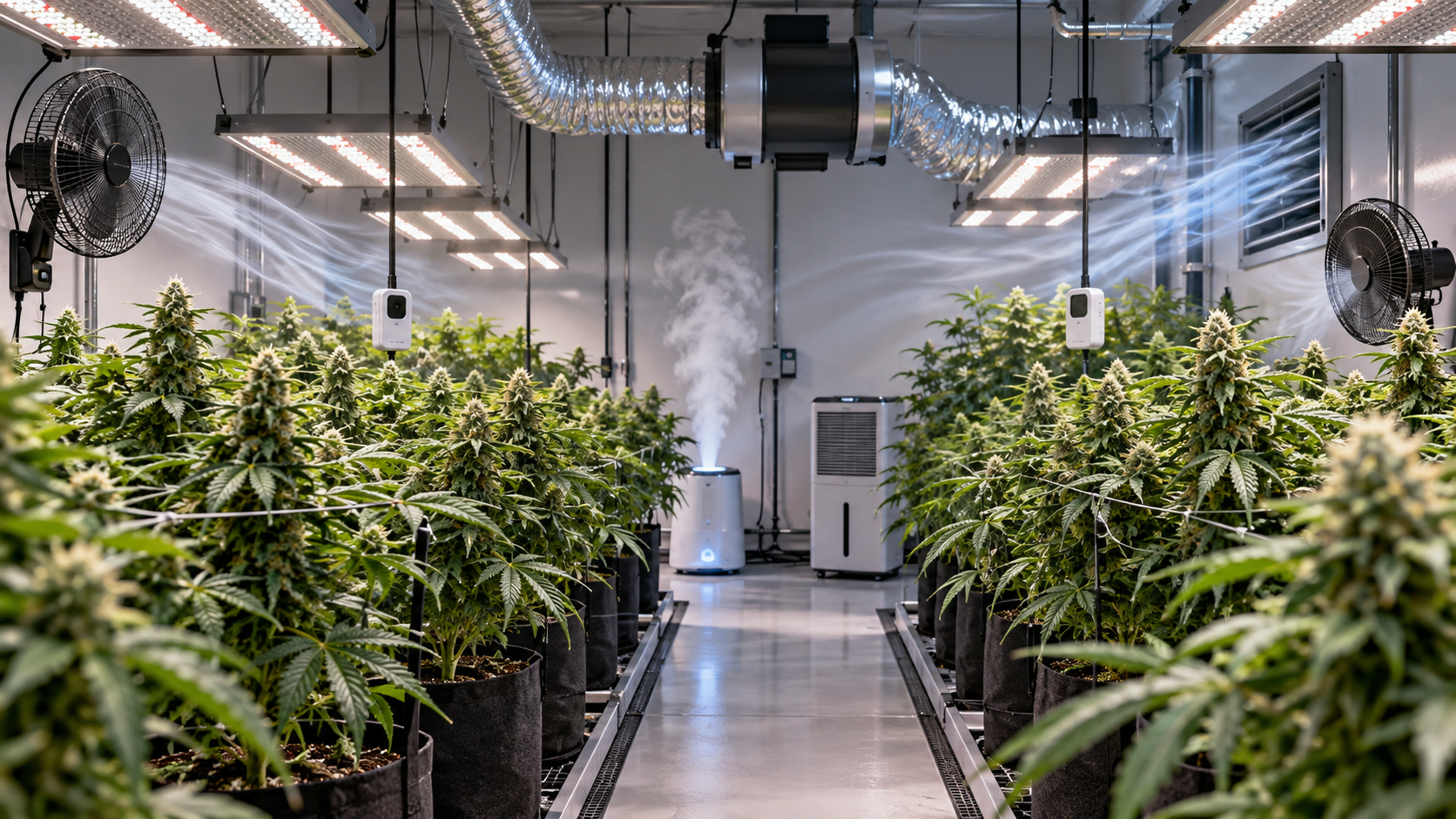
Grow room climate control comes down to managing three things well: temperature, humidity, and airflow.
If one drifts too far, the others usually follow. A hot room often becomes harder to dehumidify. Poor airflow creates humid pockets around leaves and flowers. Weak ventilation traps both heat and moisture.
The good news is that you do not need a complicated commercial HVAC system to build a stable cannabis grow room. Start with accurate sensors, an exhaust fan, steady air movement, and the right humidifier, dehumidifier, or cooling equipment for your space. Then add automation once you understand how the room behaves.
Key Takeaway:
- Control temperature, humidity, and airflow together. Fixing only one often leaves the real problem untouched.
- Start with ventilation and accurate monitoring. A thermometer/hygrometer, exhaust fan, intake, and circulation fans solve many small-room climate problems.
- Automate after the basics work. Controllers are useful, but they cannot compensate for undersized ventilation, poor sensor placement, or a room that is constantly overheating.
Table of Contents
Grow Room Climate Targets by Growth Stage
Use these as practical starting points:
| Growth Stage | Temperature | Relative Humidity |
|---|---|---|
| Seedling | 22–26°C / 72–79°F | 65–70% RH |
| Vegetative | 22–28°C / 72–82°F | 55–65% RH |
| Early Flower | 22–26°C / 72–79°F | 45–55% RH |
| Late Flower | 18–24°C / 64–75°F | 40–45% RH |
The Seed Connect’s indoor cannabis growing guide uses similar stage-based targets and gives broader guidance on ventilation, lighting, and climate.
For a deeper breakdown of temperature specifically, see our best cannabis temperature guide.
Ventilation and Air Circulation Are Not the Same Thing
This is one of the most common setup mistakes.
Ventilation replaces stale room air with fresh air.
Circulation moves air around inside the room.
You need both.
A basic setup usually includes:
- an inline exhaust fan
- passive or powered intake
- one or more oscillating fans
- a carbon filter if odor control is needed
Your exhaust fan removes excess heat and humidity, while circulation fans help prevent hot spots and damp pockets inside the canopy.
The U.S. Department of Energy explains that good ventilation is essential for controlling indoor temperature, moisture, and air quality in enclosed spaces.
Do not point a strong fan directly at one plant all day. Aim for gentle leaf movement across the room instead.
How to Control Grow Room Temperature
Most indoor grow rooms struggle more with excess heat than cold.
Grow lights, dehumidifiers, pumps, and other equipment all add heat.
Start by checking three things.
1. Exhaust capacity
If the room heats up quickly after the lights turn on, your exhaust fan may not be moving enough air.
Increase fan speed or use a larger fan if the system cannot keep up.
2. Light heat
If the grow light is the main heat source, consider:
- raising the fixture
- dimming it slightly
- improving exhaust
- running lights during cooler nighttime hours
- switching to a more efficient fixture
If you need help with fixture choice or hanging height, see our grow lights for weed guide.
3. Cooling equipment
For small tents, ventilation may be enough.
For larger sealed rooms, you may need:
- air conditioning
- mini-split cooling
- dedicated HVAC
Indoor cannabis production can be energy-intensive, and research has identified HVAC and lighting as major contributors to total energy demand. A life-cycle study published in Resources, Conservation and Recycling found that indoor cultivation’s environmental footprint is heavily influenced by climate-control systems and electricity use.
That is why efficient climate control matters both for plant performance and operating cost.
How to Control Grow Room Humidity
Humidity changes throughout the grow because plants release water into the air through transpiration.
A small seedling produces little moisture.
A full flowering canopy can release a surprising amount.
If humidity is too high:
- increase exhaust
- run a dehumidifier
- improve air circulation
- remove standing water
- avoid overcrowding
- water earlier in the light cycle
High humidity becomes especially risky during flowering because dense flowers can trap moisture.
A controlled cannabis study published in Frontiers in Plant Science found that very high canopy humidity during flowering reduced flower biomass and delayed development in the tested plants.
For a more detailed breakdown, see our cannabis humidity control guide.
If humidity is too low:
- use a humidifier
- reduce excessive ventilation
- avoid placing intake air directly on young plants
- check whether your room is being over-cooled
Seedlings generally tolerate and prefer more humidity than mature flowering plants.
Where to Place Temperature and Humidity Sensors
Sensor placement matters more than many growers realize.
Do not place your only hygrometer:
- directly under the light
- next to the humidifier
- beside the exhaust outlet
- on the floor
The most useful location is usually around canopy height.
That tells you what the plants are actually experiencing.
In larger rooms, use multiple sensors:
- front of room
- back of room
- near canopy center
- near intake side
If one side consistently reads warmer or more humid, you probably have a microclimate that needs better airflow.
This is the same principle used in controlled-environment agriculture more broadly: environmental measurements are only useful if they reflect conditions at plant level rather than simply somewhere in the room.
VPD Explained Simply
VPD, or vapor pressure deficit, is a way of looking at temperature and humidity together.
That matters because 60% RH does not mean the same thing at every temperature.
Warm air can hold more moisture than cool air, so a plant can experience very different drying pressure even when the humidity number looks unchanged.
You do not need to obsess over VPD charts as a beginner.
Use them once your room is already stable.
The practical lesson is simple:
Temperature and humidity should be adjusted together, not independently.
Our cannabis humidity control guide goes deeper into VPD if you want to fine-tune the environment.
For background on vapor pressure and plant transpiration, Purdue University Extension provides a useful overview of greenhouse humidity and how it affects plant water loss.
Essential Grow Room Climate Equipment
For most home growers, the essentials are straightforward.
Start with:
- digital thermometer/hygrometer
- inline exhaust fan
- passive intake
- oscillating fan
- humidifier or dehumidifier as needed
Useful upgrades:
- fan speed controller
- thermostat
- humidistat
- smart environmental controller
- data logger
Advanced equipment:
- mini-split AC
- commercial dehumidifier
- sealed-room HVAC
- CO₂ controller
Do not buy advanced equipment before understanding what problem you actually need to solve.
How to Automate Your Grow Room Climate
Automation is useful because grow-room conditions can change quickly when:
- lights turn on
- lights turn off
- plants are watered
- outside weather changes
A basic controller can automatically increase exhaust when temperature rises or activate a dehumidifier when RH crosses a set point.
That reduces the need for constant manual adjustments.
But automation should make a working system more consistent.
It should not be used to hide poor design.
If your fan is too small or your room is badly sealed, a smart controller will not fix the underlying problem.
Grow Room Climate Troubleshooting
| Problem | Likely Cause | First Fix |
|---|---|---|
| Room too hot | Weak exhaust or high light heat | Increase ventilation or cooling |
| RH too high | Heavy transpiration or weak extraction | Add dehumidification and airflow |
| RH too low | Dry intake air or over-ventilation | Add humidity or reduce fan speed |
| Big day/night swings | Lights or HVAC cycling | Stabilize controller settings |
| Humid pockets in canopy | Weak circulation | Reposition oscillating fans |
| Mold risk | High RH + stagnant air | Lower RH and increase circulation |
Try to change one variable at a time.
If you change fan speed, humidity, temperature, and lighting all at once, you will not know which adjustment actually helped.
Common Climate-Control Mistakes
Reacting to every small fluctuation
A room does not need to sit at one exact number every second.
Focus on trends and avoid large swings.
Measuring only room air
The canopy can be warmer or more humid than the area near the wall.
Measure where the plants are.
Using circulation fans instead of ventilation
Moving stale air around is not the same as replacing it.
Letting late-flower humidity stay too high
As flowers become denser, moisture trapped inside the canopy becomes harder to remove.
Buying equipment before calculating the problem
A giant dehumidifier or AC unit may waste energy and create rapid cycling.
Size equipment to the actual room and plant load.
Final Thoughts
Good grow room climate control is not about turning your grow room into a laboratory.
It is about keeping the environment stable enough that the plants are not constantly fighting heat, humidity swings, or stale air.
Start with the basics:
measure accurately → exhaust stale air → circulate room air → control humidity → add cooling if needed.
Then automate once you understand how the room responds throughout the day.
If your temperature, humidity, and airflow are stable, many other cultivation problems become easier to manage.
That is the real goal of climate control: not chasing perfect numbers, but creating a room that stays predictable from seedling through harvest.