

A sudden increase in your electricity bill, the smell of solvent during extraction, and plastic pots collecting in the corner are signs that the choices made in a grow room have long-term effects. Small choices in operations add up to a measurable carbon footprint. Growers who overlook this cost are already facing inefficiency and regulatory risks.
Sustainable practices in cultivation aren’t about sacrifice; they’re about matching technique to reality so profitability and stewardship align. Changes in how water, energy, and waste are managed affect the environmental impact of a crop more than the choice of strain. These changes accumulate over time.
Practical steps—right-sized lighting, smarter ventilation schedules, and reclaimed-water tactics—lower inputs while preserving yield and cannabinoid quality. Expect clear, implementable guidance that targets the biggest waste sources first, with troubleshooting cues for common roadblocks growers face.
Overview: What Is a Carbon Footprint for a Grow Operation?
Your grow operation’s carbon footprint…
Overview: What Is a Carbon Footprint for a Grow Operation?
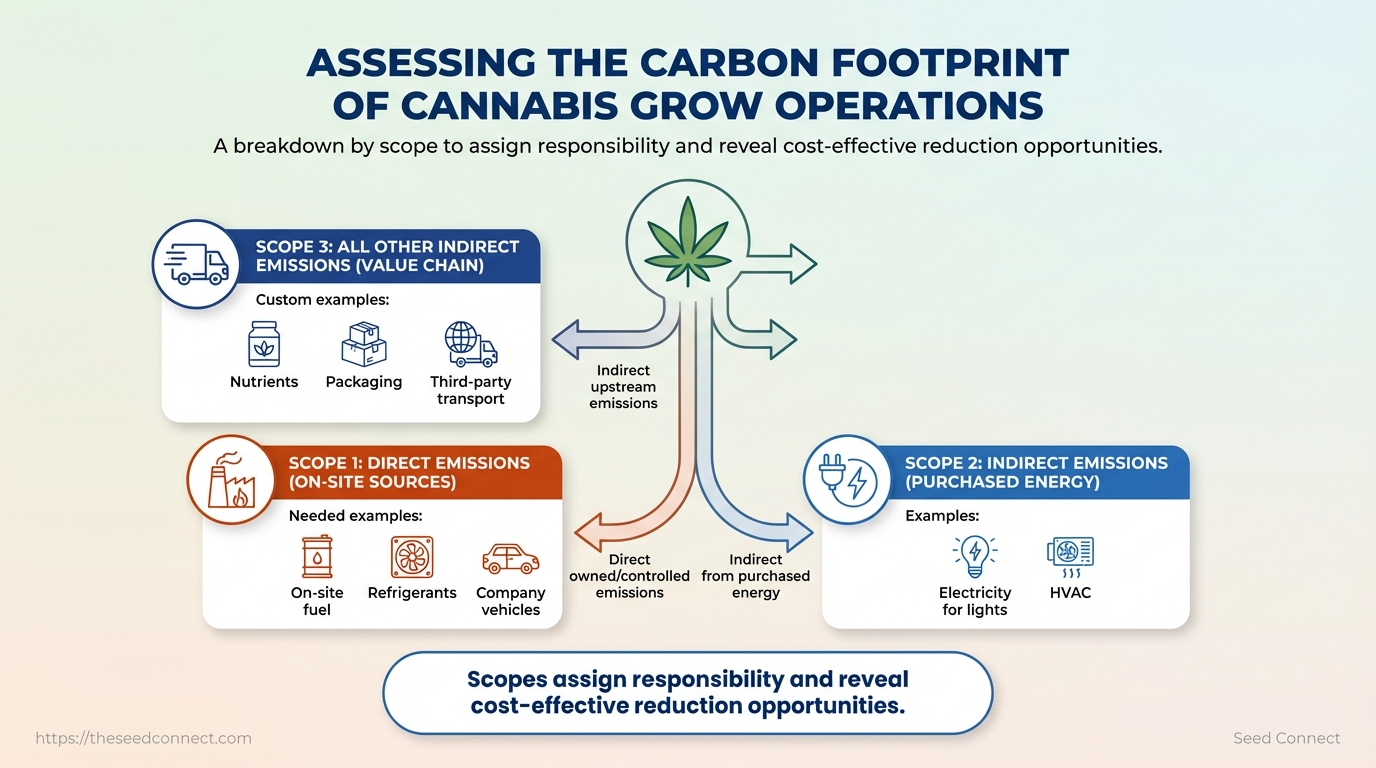
Your grow operation’s carbon footprint shows the total greenhouse gas emissions related to crop production. That means we express it in CO2-equivalent. For cannabis cultivation that means accounting for direct on-site emissions, the electricity and fuel purchased to run lights and HVAC, and the upstream and downstream emissions embedded in inputs and distribution. Breaking emissions into three standard scopes — Scope 1, Scope 2, and Scope 3 — makes a vague concern into a measurable, recordable inventory that encourages practical reductions.
Why the scopes matter: they assign responsibility, reveal where reductions are most cost-effective, and determine which interventions (equipment upgrades, supplier changes, or logistics optimization) will actually move the needle on net emissions.
Definition
Carbon footprint: Total greenhouse gas emissions from an operation, reported as metric tons of CO2-equivalent (tCO2e).
Scope 1: Direct emissions from sources owned or controlled by the grower, such as on-site combustion, refrigerant leaks, and company vehicles.
Scope 2: Indirect emissions from purchased electricity, heat, or steam used to power lighting, HVAC, and environmental controls.
Scope 3: All other indirect emissions in the value chain, like upstream production of nutrients and seeds, packaging, third-party transport, and employee commuting.
How growers typically map a footprint
- Identify
Scope 1sources: generators, boilers, refrigerant servicing, and fuel use for company trucks. - Quantify
Scope 2: electricity consumption by grow rooms, drying, and processing; use utility bills plus local grid emission factors. - Inventory
Scope 3: supplier emissions for nutrients and seeds, packaging material manufacture, third-party transport, and waste processing.
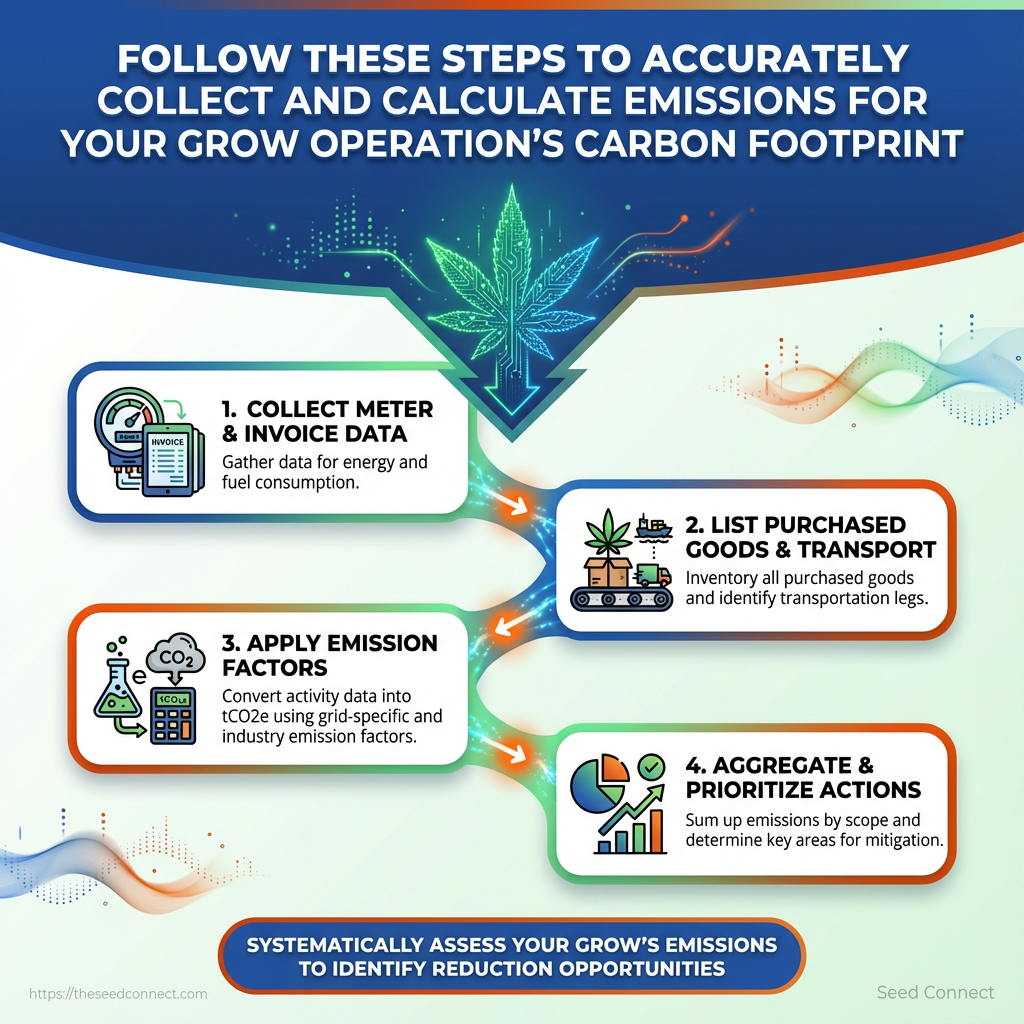
- Collect meter and invoice data for energy and fuel consumption.
- List all purchased goods and transport legs.
- Apply emission factors (grid-specific for electricity) to convert activity into tCO2e.
- Aggregate by scope and prioritize mitigation actions.
Quick side-by-side of Scope 1, 2, 3 with cannabis-specific examples and who typically manages them
Table: Overview: What Is a Carbon Footprint for a Grow Operation? — Emission Scope, Typical Sources in Cannabis Grows, Who Manages/Owns & more
| Emission Scope | Typical Sources in Cannabis Grows | Who Manages/Owns | Measurement Approach |
|---|---|---|---|
| Scope 1 | On-site fuel combustion, refrigerant leaks, company vehicle fuel | Facility owner/operations | Metered fuel use, refrigerant service logs, maintenance records |
| Scope 2 | Purchased electricity for lights, HVAC, dehumidifiers | Facility owner/operations | Utility bills + local grid emission factor |
| Scope 3 | Upstream inputs (nutrients, seeds), third-party transport, packaging, waste | Procurement/management; partly suppliers | Supplier data, spend-based estimates, transport distances |
| Example: Packaging & Transport | Cardboard production, plastic, courier emissions | Procurement/logistics | Supplier LCA data or kg CO2e per package + miles |
| Example: Seed/nutrient production | Fertilizer manufacture, seed production, shipping | Seed suppliers / input manufacturers | Supplier EPDs or industry emission factors per kg product |
Understanding these principles lets teams prioritize interventions that cut real emissions rather than just shifting responsibility. When measurement is aligned with operational ownership, reduction projects become easier to finance and to measure.
Prerequisites: What You’ll Need to Assess a Grow’s Carbon Footprint
Begin by gathering the right…
Prerequisites: What You’ll Need to Assess a Grow’s Carbon Footprint
Start by collecting the necessary data, tools, and skills to make sure your assessment is accurate and easy to repeat. The most important requirement is continuous energy data: at least 12 months of electricity usage (in kWh) connected to the cultivation space. Paired with a verified equipment inventory and operating schedules, that energy baseline lets you translate consumption into emissions using emissions factors.
Without those core inputs, estimates become guesses rather than actionable metrics.
Collect these items and prepare the team before any calculations.
- Documents to request: 12 months of utility bills, equipment spec sheets, purchase invoices, and lease or floor plans.
- Tools to have ready: a spreadsheet template set up for emissions math, an emissions-factor lookup (national grid or country-specific), and optionally an LCA tool for embodied-carbon estimates.
- Skills required on the team: someone who can read meters and convert units, an operations contact who knows runtime schedules, and basic competency in spreadsheet arithmetic and unit conversion.
- Request 12 months of electricity bills and meter numbers from the facility owner or utility account holder.
- Compile an equipment inventory listing wattage, quantity, and estimated hours per day for each device.
- Standardize units in a spreadsheet using
kWh, hours, and count fields so calculations are reproducible.
- Lookup the appropriate emissions factor for the local grid and apply it to the baseline consumption.
- Schedule interviews with operations staff to validate assumed runtimes and atypical loads (drying, cloning, winter supplemental heat).
Practical time estimates: collecting bills and inventories typically takes 2–7 days for a single facility; validating runtime schedules and spot-checking meters adds another 1–3 days. Expect full data consolidation into a working spreadsheet in 1–2 weeks for small operations, longer for multi-site setups. Common pitfalls include missing submeter data and undocumented portable heaters — plan to verify with physical meter reads.
Organize the prerequisite items by category (documents, tools, people, time estimate)
Table: Prerequisites: What You’ll Need to Assess a Grow’s Carbon Footprint — Category, Item, Why it’s needed & more
| Category | Item | Why it’s needed | Estimated time to obtain |
|---|---|---|---|
| Documents | Utility bills (12 months) | Baseline energy consumption in kWh |
2–7 days |
| Documents | Equipment inventory & spec sheets | Convert equipment wattage to load profiles | 1–3 days |
| Tools | Spreadsheet template (emissions workbook) | Reproducible calculations and audit trail | Immediate |
| Tools | Emissions factor lookup (grid or country-specific) | Convert kWh to CO2e |
Immediate (online lookup) |
| People | Operations manager / grow tech | Confirm runtimes, cycles, unusual loads | 1–3 days |
Understanding these prerequisites reduces rework and accelerates meaningful recommendations for sustainable cannabis operations. When teams collect the right documents and hone basic measurement skills up front, the assessment delivers real, implementable insights.
Step-by-Step Assessment: Collecting and Calculating Emissions (Numbered Steps)
Start by mapping…
Step-by-Step Assessment: Collecting and Calculating Emissions (Numbered Steps)
Start by mapping the facility and gathering precise activity data; accurate boundaries and time-series energy records are what make an emissions inventory actionable rather than theoretical. The approach below walks through five concrete steps — from defining what’s in scope to producing normalized emissions outputs you can act on.
- Map the operation and define boundaries.
- Collect energy and fuel data (electricity, gas, diesel).
- Inventory equipment and measure operational hours.
- Calculate emissions using emission factors.
- Aggregate, normalize, and report results.
- Map the operation and define boundaries.
Choose operational boundaries based on management control and reporting goals. Create a site map and list spaces by function (veg room, flower room, drying, packaging). Document assumptions such as excluded leased warehouses or third-party transport and state the reporting period.
Recent research indicates that time expectation is 4–8 hours for a small facility; larger sites scale to days. Difficulty: moderate — requires coordination across facilities and finance.
Prerequisites
Tools & materials
- Floor plan or site map
- Utility bills and fuel invoices
- Access to equipment nameplates or spec sheets
- Collect energy and fuel data (electricity, gas, diesel).
Gather meter-level data where possible: monthly kWh for electricity, therms or m3 for natural gas, liters or gallons for diesel/propane, and generator run-hours. Time-series (monthly) data reveals seasonality and weekly cycles — use it whenever available. 3 kWh`.
Track discrepancies between billed and metered use.
Example conversions and units for common energy sources used in grows
Table: Step-by-Step Assessment: Collecting and Calculating Emissions (Numbered Steps) — Energy Source, Common Units, Conversion Example & more
| Energy Source | Common Units | Conversion Example | Notes |
|---|---|---|---|
| Electricity | kWh | 1,200 kWh (monthly) | Utility bills provide kWh directly |
| Natural gas | therms, m3 | 50 therms ≈ 1,465 kWh | Use local utility conversion tables |
| Diesel | gallons, liters | 100 gal ≈ 378.5 L | Check fuel invoice units |
| Propane (LPG) | gallons, liters | 50 gal ≈ 189.3 L | Cylinder vs bulk pricing affects records |
| Generator run-hours | hours | 20 hours at 15 kW | Record load or fuel used for accuracy |
- Inventory equipment and measure operational hours.
Equipment-level tracking improves allocation precision. Record each item’s rated power and average daily run-hours; where nameplates are missing, use manufacturer specs or measure with a clamp meter or smart plug. Estimate unknown loads by sampling representative devices and scaling by quantity.
Provide a template for equipment inventory: item, wattage, quantity, hours per day, kWh per month
Table: Step-by-Step Assessment: Collecting and Calculating Emissions (Numbered Steps) — Equipment, Wattage (W), Quantity & more
| Equipment | Wattage (W) | Quantity | Avg hours/day | kWh/month (calculated) |
|---|---|---|---|---|
| Lights (LED 600W) | 600 | 40 | 18 | 13,056 |
| Ballasts/Drivers | 50 | 40 | 18 | 1,080 |
| HVAC (split, 10kW) | 10,000 | 4 | 12 | 14,400 |
| Dehumidifiers (1.5kW) | 1,500 | 6 | 24 | 6,480 |
| Circulation fans (200W) | 200 | 20 | 24 | 2,880 |
- Calculate emissions using emission factors.
Apply emission factors to energy totals: Emissions (kg CO2e) = Activity × Emission factor. For electricity use the regional grid factor in kg CO2e/kWh; for fuels use fuel-specific factors in kg CO2e/unit. 4 kg CO2e.
6 kg CO2e. For Scope 3 where supplier data is absent, use industry-average factors or spend-based proxies and flag higher uncertainty.
Worked numeric example: Lighting:13,056 kWh × 0.4 kg CO2e/kWh = 5,222 kg CO2e Diesel backup: 378.5 L × 2.68 kg CO2e/L = 1,016 kg CO2e Total (sample): 6,238 kg CO2e
- Aggregate, normalize, and report results.
Sum by category and create intensity metrics such as kg CO2e per kg product or kg CO2e per m2 cultivated. Visuals help stakeholders: stacked bar charts for category breakdown, time-series for monthly trends, and a hotspot table for top 3 emission sources. Document all assumptions and provide uncertainty ranges (±10–30% where estimates used).
Use the inventory to prioritize mitigation: lighting efficiency, HVAC tuning, or fuel switching usually appear first.
Provide a reporting template comparing total and normalized emissions with example rows
Table: Step-by-Step Assessment: Collecting and Calculating Emissions (Numbered Steps) — Category, Scope, Total kg CO2e & more
| Category | Scope | Total kg CO2e | Intensity (kg CO2e / unit) |
|---|---|---|---|
| Electricity – lighting | Scope 2 | 5,222 | 52.2 kg CO2e/kg |
| HVAC | Scope 2 | 8,640 | 86.4 kg CO2e/kg |
| Onsite fuel (diesel) | Scope 1 | 1,016 | 10.2 kg CO2e/kg |
| Transport (inbound) | Scope 3 | 480 | 4.8 kg CO2e/kg |
| Packaging (Scope 3) | Scope 3 | 320 | 3.2 kg CO2e/kg |
Understanding these steps makes it possible to produce an auditable inventory that feeds strategy — whether the objective is operational efficiency, compliance, or demonstrating sustainable cannabis credentials. When implemented with consistent data collection, this process turns emissions accounting from a one-off exercise into a management tool.
Key Takeaway: Start by focusing on the systems that dominate emissions: lighting and HVAC. Industry data indicates that these two usually account for the most energy use in indoor cannabis growing.
Identifying Hotspots and Prioritizing Reductions
Start by focusing on the systems that dominate emissions: lighting and HVAC. Industry data indicates that these two usually account for the most energy use in indoor cannabis growing. Refrigeration, dehumidification, packaging, and transport also significantly affect Scope 3 emissions. Prioritize interventions that deliver the biggest CO2e reductions per dollar while fitting your timeline and operational constraints.
Prerequisites
Facility baseline: Utility bills (12 months), equipment inventory, and current operating schedules.
Metering access: Sub-metering or interval data for lights, HVAC, and HVAC-related loads.
Stakeholder alignment: Operations, cultivation lead, and finance committed to at least a phased audit.
Quick hotspot identification process
- Gather 12 months of electricity and fuel bills.
- Map major loads (lights, HVAC, dehumidifiers, refrigeration, pumps, fans, packaging line) to monthly consumption.
- Use simple load shares to flag top three contributors (lights, HVAC, dehumidification/refrigeration).
- Run a cost-effectiveness screen: estimate kWh savings, multiply by local CO2e intensity and utility price to get $/ton CO2e avoided.
- Prioritize measures with low implementation difficulty and <5-year payback, then schedule deeper audits for medium/high-complexity projects.
Common hotspots in cannabis grows
- Lights: Often the largest single driver of kWh; switching to high-efficiency LEDs reduces both heat load and energy consumption.
- HVAC & controls: Over-sizing, poor controls, or 24/7 full-capacity conditioning creates persistent waste. Controls tuning and VFDs deliver outsized returns.
- Dehumidification & refrigeration: Frequently undercounted because they run intermittently but at high power; heat reclaim can offset HVAC loads.
- Packaging and transport (Scope 3): Single-use materials and inefficient logistics accumulate emissions downstream. Consider material substitution and route optimization.
- On-site generation and storage: Solar plus battery can cut grid exposure during peak periods and reduce carbon intensity for daytime runs.
Practical prioritization tips
- Quick wins first: LEDs, schedule optimization, and basic controls retuning—low disruption, fast payback.
- Medium projects next: HVAC upgrades, heat recovery from dehumidifiers, and automated controls—requires capital and commissioning.
- Strategic investments later: On-site solar + storage and packaging redesign—higher cost but durable reductions and marketing value.
Table: Common mitigation options by relative carbon savings, typical cost range, and implementation difficulty
Common mitigation options by relative carbon savings, typical cost range, and implementation difficulty
Table: Identifying Hotspots and Prioritizing Reductions — Intervention, Relative CO2e reduction, Estimated cost range & more
| Intervention | Relative CO2e reduction | Estimated cost range | Implementation difficulty |
|---|---|---|---|
| Switch to LED lighting | High (30–60% on lighting load) | $20,000–$200,000 (depends on scale) | Low–Medium |
| HVAC optimization and controls | High (20–50% on HVAC-related load) | $10,000–$150,000 | Medium |
| Install heat recovery | Medium–High (reduces HVAC heating demand 10–30%) | $15,000–$100,000 | Medium–High |
| On-site solar + storage | Medium (reduces grid kWh, varies by design) | $50,000–$500,000+ | High |
| Packaging redesign (scope 3) | Low–Medium (depends on material change & volume) | $5,000–$50,000 | Low–Medium |
Understanding hotspot patterns and using a cost-effectiveness screen lets teams sequence work that actually moves the carbon needle while keeping production stable. When implemented in phases, this approach reduces operational risk and maximizes emissions avoided per dollar.
Key Takeaway: Begin by testing small projects that measure results before expanding. Two important projects you can take action on are retrofitting grow lights to LEDs and fine-tuning HVAC with better controls.
Implementing Changes: Practical Projects with Step-by-Step Guidance
Begin by testing small projects that measure results before expanding. Two important projects you can take action on are retrofitting grow lights to LEDs and fine-tuning HVAC with better controls. Both lower operational cost and reduce environmental impact when executed with measurement-driven steps.
Prerequisites
Site baseline: Current monthly kWh, peak demand, CO2e estimates, and current fixture/ballast inventory.
Measurement kit: Data logger, clamp meter, PAR meter, and access to building management system (BMS) or thermostat logs.
Stakeholder signoff: Facilities, cultivation lead, and safety officer agree on pilot scope and failover plan.
Tools & materials
- LED fixtures: Select horticultural-rated fixtures with published PPF and efficacy.
- Power measurement: Clamp meter and data logger for interval kWh.
- Lighting control: Dimming/phase-cut drivers or 0–10V controllers.
- HVAC access: Secure BMS credentials or local control panels for schedule edits.
Project: LED retrofit for grow lighting — Step-by-step workflow
- Conduct a lighting audit and record
current_watts, PPF, and hours/day.
- Run a 1–2 room pilot replacing 10–20% of fixtures and log PAR and kWh for 2–4 weeks.
- Compare
PPF/Wand canopy uniformity; adjust fixture heights and lensing.
- Install dimming controls and program schedules to match photoperiods.
- Extrapolate savings, include ballast removal and disposal costs, and calculate payback.
Expected energy and CO2e reduction ranges vary with baseline. Recent research from thebreakthrough.org indicates that typical energy savings are 30–60% versus HPS; CO2e reductions follow proportionally depending on your grid emissions. Budgeting should include fixture cost, controls, installation labor, and disposal; expect payback often within 1–3 years for commercial retrofits depending on utility rates and rebates.
Pilot testing is essential to avoid yield or quality regressions.
Project: HVAC tuning and controls optimization — How to proceed
- Map current schedules and setpoints; capture
supply_temp,return_temp, and RH over 7–14 days.
- Adjust setpoints in
0.5–1.0°Cincrements and monitor crop response for 3–7 days.
- Implement setback periods during lights-off windows and ventilation duty cycling.
- Validate with energy meters and humidity control events logged in the BMS.
When to call an HVAC technician: if changes cause compressor short-cycling, abnormal pressures, or alarms, or when system modifications (VFDs, refrigerant work) are required. Monitoring strategy: continuous kWh, zone temperature/RH, and alarm logs for 30–90 days. Typical difficulty is moderate; timeline is 2–6 weeks for tuning and verification.
Understanding these principles helps teams move faster without sacrificing crop quality. When implemented carefully and measured, these projects materially lower operational cost and environmental impact.
Key Takeaway: Issues in energy and emissions accounting typically arise from missing data, unclear assumptions, or mismatched boundaries. Start by isolating the symptom — unexpected high emissions, wildly variable monthly totals, or disagreement between…
Troubleshooting Common Issues
Issues in energy and emissions accounting typically arise from missing data, unclear assumptions, or mismatched boundaries. Start by isolating the symptom — unexpected high emissions, wildly variable monthly totals, or disagreement between stakeholders — then work backward to the simplest data source. Practical fixes focus on reproducible estimates, transparent documentation of uncertainty, and clear escalation triggers for professional audits.
Tools & materials
- Meter readings: monthly utility bills or submeter
kWhdata - Baseline templates: simple spreadsheet with load categories
- Manufacturer specs: wattage and runtime for lighting, HVAC, fans
- Logbook: record assumptions, sources, and confidence levels
Common problems and how to fix them
- Missing utility bills: reconstruct from appliance runtime and rated wattage.
- High seasonal variance: check HVAC setpoints and extraction runtime.
- Unknown equipment loads: use manufacturer nameplate values and spot measurements.
- Disagreement on boundaries: reconcile scope definitions with stakeholders.
- No supplier emission factors: use regional grid averages or published country factors.
- Estimate missing data using a conservative method.
- Identify the missing period and list major loads (lighting, HVAC, dehumidifiers).
- Multiply rated wattage by realistic runtime hours to produce
kWhestimates.
- Apply a grid emission factor (or supplier factor when available) and document the assumption.
When to hire a professional: bring in a certified energy auditor if spot measurements differ from nameplate estimates by >15% or if HVAC/electrical upgrades are being considered.
Documenting uncertainties
Confidence level: Assign High/Medium/Low to each data line and justify briefly.
Assumption log: Record the date, method, and source for each estimate.
Contingency: Note any known omitted loads and estimate their potential percent impact.
Problem / Cause / Quick Fix table to let readers scan solutions quickly
Table: Troubleshooting Common Issues — Problem, Likely Cause, Immediate Fix & more
| Problem | Likely Cause | Immediate Fix | When to escalate |
|---|---|---|---|
| Missing utility bills | Lost or incomplete records | Reconstruct using rated wattage × runtime | If reconstructed totals deviate >20% from expected |
| High seasonal variance | HVAC runtime changes | Compare setpoints and runtime logs | If variance persists after setpoint correction |
| Unknown equipment loads | No nameplate or spec sheet | Spot-measure or use typical wattage tables | When measurements conflict with inventory |
| Disagreement on boundaries | Unclear scope definitions | Re-align on scope (facility vs. process) | If legal/contractual implications exist |
| No supplier emission factors | Supplier data not provided | Use regional grid average factor | When procurement requires supplier-specific reporting |
Understanding and documenting these fixes reduces rework and keeps emissions estimates defensible. Over time, small measurement improvements and better records cut uncertainty and make decisions easier.
Tips for Success and Pro Tips
Start by piloting narrowly, measure everything, then scale what works. Pilots reduce risk, reveal hidden variables (water pressure, microclimate, scheduling), and keep staff engaged by showing quick wins. Metering, simple dashboards, and incentives turn data into repeatable, practical improvements while keeping the environmental impact — including carbon footprint — in view.
Prerequisites
Baseline data: Establish energy, water, and yield baselines before changes. Stakeholder buy‑in: Secure a small cross-functional team (cultivation, ops, finance). Basic metering: At minimum, have submeters for lights and HVAC and a water meter on the main feed.
Tools & materials
- Basic meters: clamp-on energy meters and water flow meters.
- Simple dashboard: spreadsheet or inexpensive SaaS dashboard that updates daily.
- Seed selection: start trials with reliable strains; consider the germination guarantee and expert support available from Theseedconnect for consistent comparators.
- Run a measured pilot with one grow room or bench for 4–8 weeks.
- Meter major loads first: lighting, HVAC, and irrigation.
- Collect yield, potency, and input data weekly and enter into the dashboard.
- Compare pilot results to baseline and iterate control setpoints.
Practical implementation tips
- Meter big loads first: Prioritize lighting and HVAC metering to capture the largest contributors to operational cost and carbon footprint.
- Pilot small, iterate fast: One room gives statistically useful signals while limiting downside.
- Measure results weekly: Use
dailyenergy andweeklyyield snapshots to avoid chasing noise. - Engage staff with simple dashboards: Show two KPIs per team (energy per gram, grams per square meter).
- incentives and grants: Explore local energy-efficiency rebates and agricultural grants to offset upfront costs.
- Include sustainability in procurement: Choose inputs and seeds with lower environmental impact where available.
Example: Swap a 600W HID for an equivalent LED in one room, measure energy and yield for two cycles, then decide on full rollout.
Troubleshooting
If yields dip, revert setpoints and run a controlled A/B trial. If staff ignore dashboards, simplify to a one-line daily alert showing target vs. actual.
Understanding these practices helps teams scale improvements without costly missteps. When implemented consistently, this approach increases predictability and lowers operational and environmental costs.
Case Study Example: Sample Assessment and Results
A 1,000 m2 indoor cultivation can consume energy at commercial scales; A 2023 study found that replacing old HID lights with modern LEDs and improving air handling typically reduces energy use and emissions significantly and pays back within a few years. This worked example shows concrete numbers you can replicate, the decision logic behind each intervention, a simple ROI/payback calculation, and the practical lessons and pitfalls to avoid when reducing a facility’s carbon footprint.
Prerequisites
Site baseline data: Monthly energy bills, peak demand, lighting hours, HVAC load profiles, and current fixture inventory. Decision authority: Capital budget owner and operations lead available for scheduling downtime. Measurement tools: Submetering access and a basic data-logger.
Practical decisions that drive results:
- Lighting choice: Swap HID to high-efficiency LED to cut lighting kW by ~40–60%. HVAC optimization: Add variable-speed drives and improve heat recovery to reduce fan and cooling loads. Controls: Install
VPD-based controllers and occupancy/photoperiod scheduling.
- Metering: Add submeters to validate savings and isolate loads.
- Calculate baseline annual energy using actual bills or
peak_kW × operating_hours.
- Estimate equipment-level savings: apply vendor efficiency delta (e.g., LED saves 45% lighting power).
- Model HVAC interaction: reduce cooling load by expected % after heat reduction and controls.
- Compute annual energy cost savings and simple payback:
project_cost / annual_savings.
Summarize baseline and post-intervention emissions, energy use and simple payback
Table: Case Study Example: Sample Assessment and Results — Metric, Baseline, Post-intervention & more
| Metric | Baseline | Post-intervention | Change |
|---|---|---|---|
| Total kWh/year | 4,500,000 kWh | 2,700,000 kWh | -1,800,000 kWh (-40%) |
| Total kg CO2e/year | 2,025,000 kg CO2e | 1,215,000 kg CO2e | -810,000 kg CO2e (-40%) |
| Energy cost/year | $450,000 (@ $0.10/kWh) | $270,000 (@ $0.10/kWh) | -$180,000/year (-40%) |
| Estimated project cost | n/a | $600,000 | Payback ≈ 3.3 years |
Common pitfalls and tactics: plan retrofits to avoid harvesting disruptions; size LEDs to maintain target PPFD rather than simply matching wattage. Underestimating HVAC interaction leads to optimistic savings—always include a 10–15% contingency in modeled HVAC savings. For carbon accounting, use local grid emission factors; this example uses 0.45 kg CO2e/kWh as a reasonable proxy.
Understanding the numbers allows operations teams to prioritize upgrades that reduce both cost and environmental impact without compromising yield. Implementing these measures carefully frees capital for genetics or facility improvements that drive crop quality and long-term resilience.
Next Steps: Verification, Certification, and Communication
Verification starts with choosing the right level of proof for your goals — basic measurement, third‑party verification, or formal certification — and then aligning communication to your audience. Select verification when buyers, regulators, or partners need confidence; choose certification when legal compliance or market differentiation matters. Communicate transparently and frequently so your footprint claims remain credible and actionable.
Prerequisites
Baseline inventory: Collect energy use, fuel, inputs (fertilizers, pesticides), water, and waste records for at least one full cultivation cycle.
Boundary definition: Decide whether reporting covers scope 1, scope 2, and/or scope 3 emissions and which facilities or product lines are included.
Data quality plan: Assign owners, measurement frequency, and acceptable data tolerances before starting.
Tools & materials
- Measurement tools: utility bills, inline meters, and
CSVexportable cultivation logs. - Calculation frameworks: emissions factors, yield-normalized metrics (e.g., kg CO2e per kg dried flower).
- Communication templates: product labels, sustainability page copy, and stakeholder reports.
Verification options and when to use them
Third‑party verification provides neutral validation of calculations; use it when making public claims or entering regulated markets. Internal audits suffice for iterative improvement or supplier negotiations. For consumer-facing claims, prioritize independent verification to avoid greenwashing risk.
- Hire a verifier with agriculture or cannabis experience and confirm their scope and methods.
- Provide raw data, methodology, and system boundaries for the verifier to review.
- Address any data gaps or adjustments they identify before publishing results.
Certifications to consider and their scope
- Carbon accounting certification: Verifies methodology and numbers for greenhouse gas claims.
- Organic or regenerative labels: Cover agronomic practices and input restrictions.
- Energy or water stewardship badges: Focus on resource-efficiency improvements.
Each certification typically covers defined practices and requires recurring audits; choose the one that best matches customer expectations and regulatory needs.
Communication tactics and transparency best practices
- Bold claim framing: Lead with verified metrics and the verification provider name.
- Clear context: Report per‑unit metrics (e.g., CO2e/kg) and timeframes.
- Accessible detail: Provide a downloadable methodology and raw-data summary for scrutiny.
- Channel strategy: Use product pages, batch certificates, and partner reports for different audiences.
Warnings about overstating reductions are integrated into buyer conversations; when metrics change, explain the methodological reasons clearly.
Reassessment cadence
- Quarterly: Track operational KPIs and catch drift.
- Annually: Recalculate footprint and publish updated figures.
- After major changes: Reassess when scaling, changing energy sources, or altering inputs.
Understanding verification, certification, and clear communication reduces market friction and builds lasting trust with customers and partners. When implemented correctly, a disciplined approach turns sustainability from a compliance checkbox into a competitive asset.
Conclusion
Ready to tackle your grow operation’s carbon footprint? Here’s a practical roadmap to get you started: gather utility and input data, follow the step-by-step emissions calculation, isolate hotspots like lighting and extraction, and test the prioritized retrofit projects from the implementation section. The sample assessment showed how a single lighting and HVAC optimization reduced annual electricity use by nearly 20%—a clear example of how targeted changes deliver measurable environmental and cost benefits. Expect some iteration: initial estimates will refine once meters, logging, and verification are in place, and certification paths will require documented validation of those improvements.
Next steps are concrete. Begin with a basic energy and waste audit within 30 days, then pilot one high-impact project (LED retrofit or CO2 control) within 90 days, and document outcomes for certification and marketing. If you have questions about startup choices or resilient seed stock, handle those along with your operational changes. Check out TheSeedConnect’s seed selection and support services for genetics that enhance sustainable practices.
Tracking these steps reduces environmental impact, supports sustainable cannabis branding, and improves margins—so start the audit, choose one pilot, and measure the results.