


Retailers lower prices on old genetics in late winter. In spring, breeders release new crosses. Shipping delays often raise prices just before the outdoor planting season. Experienced growers learn to recognize these patterns.
Mastering the timing of cannabis seed purchases makes these seasonal trends predictable. This helps avoid costly surprises.
Smart buyers combine calendar awareness with inventory habits to capture real cannabis seed savings and avoid paying premiums during demand peaks. Treat buying seeds smartly as an operational skill: small timing adjustments often yield outsized budget gains without compromising strain selection.
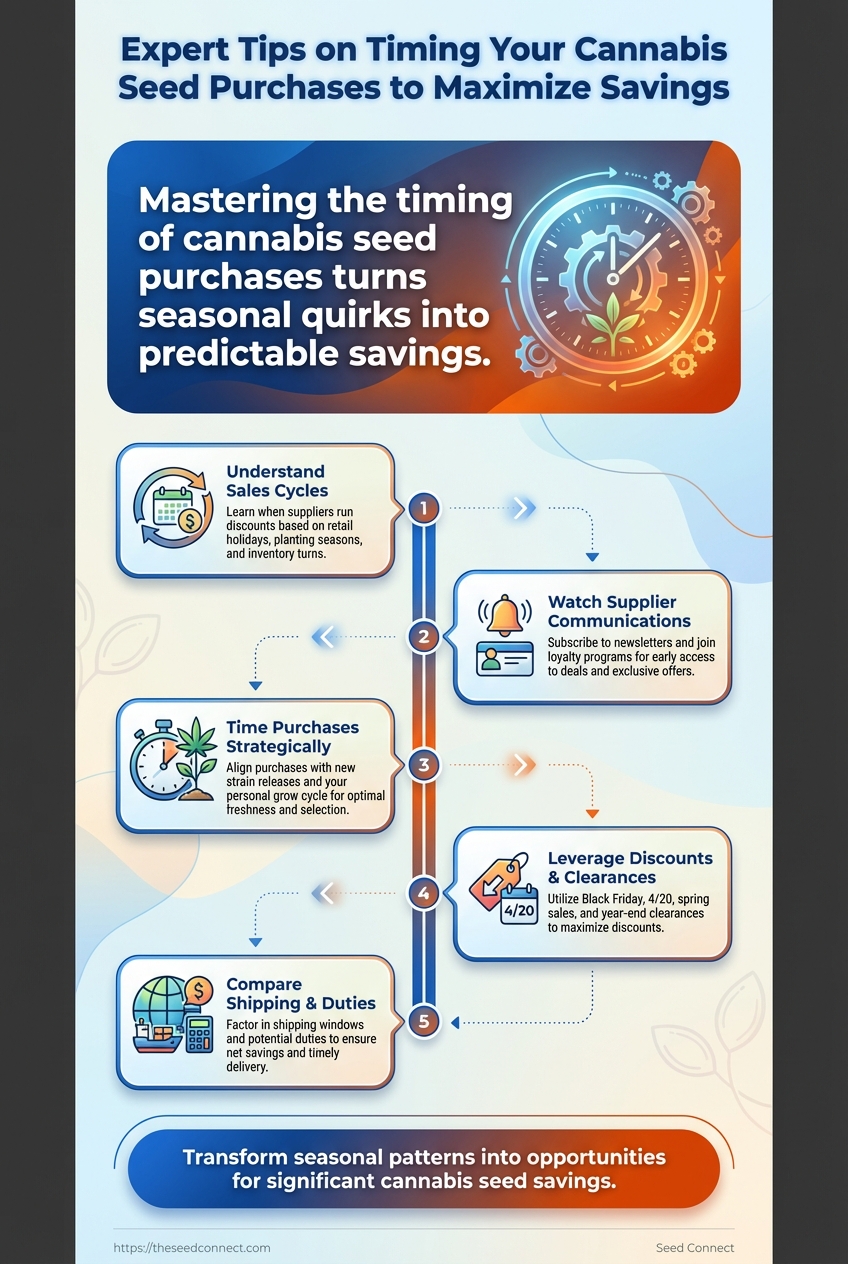
1. Understand the Cannabis Seed Sales Cycle
The cannabis seed market is strongly seasonal and promotion-driven;…
1. Understand the Cannabis Seed Sales Cycle
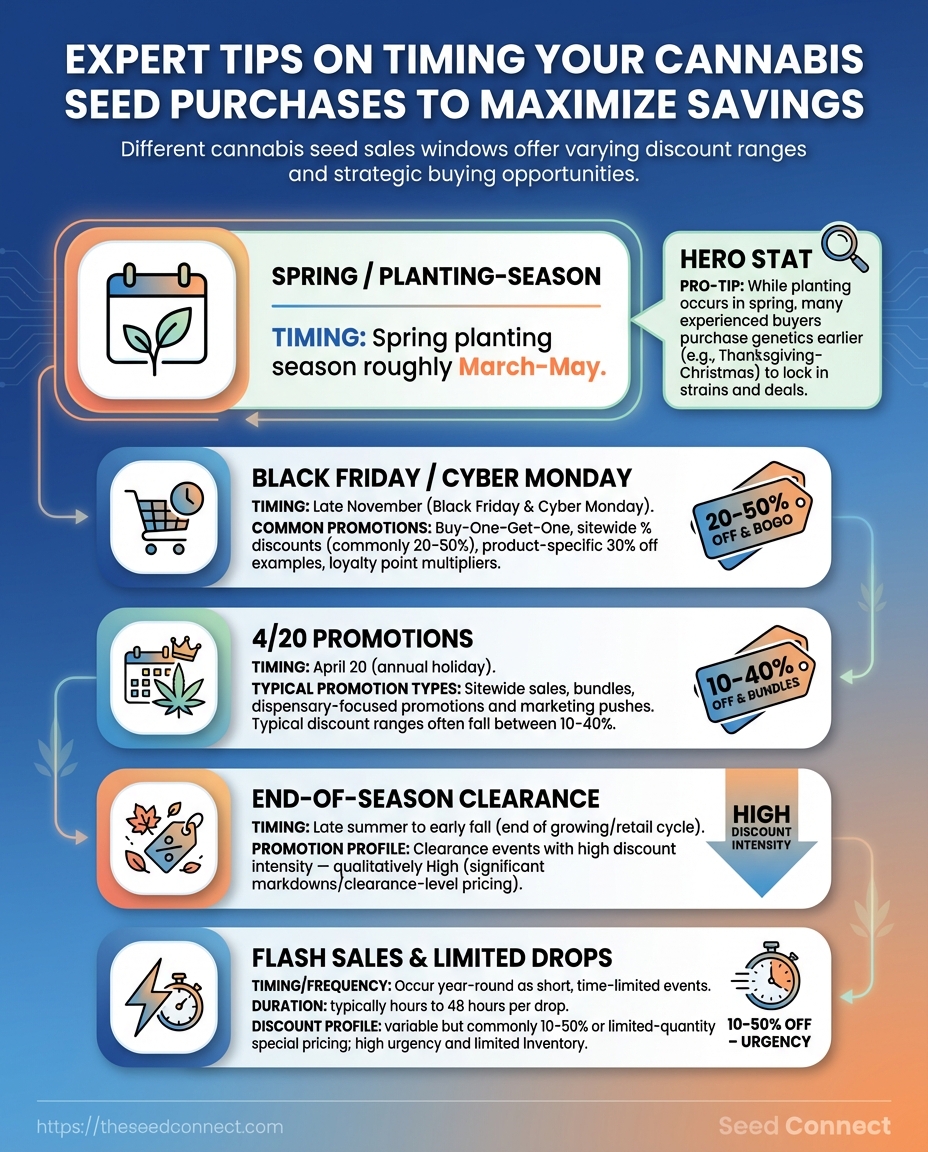
The cannabis seed market follows seasonal trends and promotional strategies. By understanding when suppliers offer discounts and their reasons, buyers can time their purchases for the best value without sacrificing quality. Sales windows concentrate around retail holidays, planting seasons, and inventory turns — each with predictable discount bands and distinct buyer behaviors that capture the savings while managing risk.
- Black Friday / Cyber Monday
Typical discount range: According to industry observations, typical discount range is approximately 20–50%.
Strategic buyer actions: buy high-value, limited genetics; combine with free-shipping thresholds; lock in larger orders for long-term projects. When chasing steep discounts, prioritize strains with proven lineage and confirm return/germination policies.
- 4/20 promotions
Typical discount range: According to industry observations, typical discount range is approximately 15–35%.
Strategic buyer actions: pick mid-to-high THC genetics you plan to trial; use promo stacking (newsletter codes + sitewide sale); expect curated bundles and limited-run crosses. Treat 4/20 as an experimental buying window — good for testing new cultivars.
- Spring / planting-season sales (late Feb–Apr)
Typical discount range: Research from earlier studies shows that the typical discount range is approximately 10–30%, though current trends may vary.
Strategic buyer actions: align purchases with your grow cycle; buy feminized or autoflower batches timed to your climate; order in quantities matching planned grows to avoid long storage. This window is ideal for routine restocking.
- End-of-season clearance (fall)
Typical discount range: Approximately 25–50% based on industry observations.
Strategic buyer actions: use clearance to source common strains at deep discounts; avoid rare genetics unless germination guarantee covers older stock; plan for faster consumption or faster germination tests on arrival.
- Flash sales & limited drops
Typical discount range: 10–40% (variable)
Strategic buyer actions: act quickly but verify seller reputation and shipping timelines; use these for unique crosses you otherwise wouldn’t access. For high-demand drops, have payment and shipping info pre-saved.
Practical buying tips:
- Verify germination guarantees and support options before a sale.
- Compare shipping timelines — heavy discounts don’t help if seeds arrive past planting windows.
- Prioritize reputable breeders for high-discount purchases to reduce risk.
Summarize sales windows, timing, typical discounts, and buyer recommendations to help readers plan purchases
Table: 1. Understand the Cannabis Seed Sales Cycle — Sales window, Typical months, Expected discount range & more
| Sales window | Typical months | Expected discount range | Best for (buyer type) | Notes |
|---|---|---|---|---|
| Black Friday / Cyber Monday | Nov | 20–50% | Value hunters, large-project growers | Best for bulk buys and premium genetics if guarantee applies |
| 4/20 promotions | Apr 20 | 15–35% | Enthusiasts, testers | Good for curated bundles and limited runs |
| Spring / planting-season sales | Feb–Apr | 10–30% | Seasonal growers, planners | Time purchases to local planting schedules |
| End-of-season clearance | Sep–Nov | 25–50% | Budget growers, bulk buyers | Ideal for common strains; check seed age/germination policy |
| Flash sales & limited drops | Year-round (short) | 10–40% | Collectors, rarity seekers | Fast decisions required; verify seller reputation |
2. Watch Supplier Newsletters and Loyalty Programs
Most reputable seed suppliers run newsletters and…
2. Watch Supplier Newsletters and Loyalty Programs
Most reputable seed suppliers run newsletters and loyalty programs that consistently deliver the best timing for cannabis seed purchases. By subscribing, you’ll get early access to limited drops, flash sales, germination guarantees, and exclusive bundles. Used strategically, newsletters become a forecasting feed for price dips and new genetics worth waiting for.
Sign up: quick, practical steps
- Visit the supplier’s homepage and find the newsletter/email signup form.
- Enter a dedicated email address (use a separate inbox or a filterable alias).
- Opt into SMS only if you want instant alerts for flash drops.
- Create an account and enroll in the loyalty program when prompted.
- Save initial welcome codes (
WELCOME10or similar) in your password manager or notes.
How to manage promotional emails without inbox noise
- Filter aggressively: Create an email filter that labels or moves supplier messages to a folder named Seeds & Deals.
- Use a separate alias: Keeps primary inbox clean and makes unsubscribe decisions easier.
- Set digest times: Allow newsletters to accumulate and review them weekly to spot true opportunities.
- Turn on SMS for critical vendors: Reserve SMS for one or two top suppliers to avoid constant pings.
- Unsubscribe selectively: Keep only the suppliers with reliable stock, germination guarantees, or loyalty value.
of loyalty perks and ways to stack discounts
- Points-per-purchase: Points typically convert to store credit; accumulating points before a sale multiplies savings.
- Tiered discounts: Higher tiers unlock % discounts or free shipping—time purchases to hit a tier during a sale.
- Birthday or anniversary credits: Combine these one-off credits with sitewide coupon codes.
- Bundle-only pricing: Bundles often have lower per-seed rates; use loyalty credits on bundles for deeper savings.
- Early access to drops: Purchase limited strains during an early window, then apply a loyalty coupon.
- Referral credits: Share referral links for small credits; stack with first-time-buyer codes.
- Flash-sale SMS codes: SMS-only codes can be combined with loyalty points in many stores.
- Germination guarantees: Prioritize suppliers that include replacements — that reduces effective cost per successful plant.
This approach optimizes both timing and total spend when buying seeds. Watching newsletters and leveraging loyalty programs turns reactive shopping into a predictable savings strategy. Understanding these mechanics puts repeat purchases on a more predictable, lower-cost cadence.
3. Time Purchases Around New Strain Releases
New strain releases create a classic tension: buy early to secure…
3. Time Purchases Around New Strain Releases
New strain releases present a common dilemma: buy early to get rare genetics or wait for feedback from others to lower the risk. Both approaches come with measurable trade-offs. The best choice depends on how much risk you’re willing to take, the size of your grow, and if the strain meets a specific need.
Pre-orders vs. waiting for reviews: risk vs. reward
Pre-order advantage: Secures scarce or limited-run genetics before they sell out. Pre-order risk: Little-to-no real-world performance data; phenotype variability and grower-fit are unknown.
Waiting advantage: Access to community reviews, grow journals, and phenotype trends—fewer surprises. Waiting risk: Popular releases can sell out; prices for remaining stock or secondary-market seeds often rise.
Common features of successful release strategies include:
- Limited-run markers — small batch numbers indicate a likely quick sell-out.
- Stable breeder reputation — established breeders reduce genetic risk.
- Early grower reports — first-hand journals reveal real phenotype ratios and common issues.
When to pre-order
- You require a specific commercial trait (e.g., uniform harvest, high yield) and the release promises that trait.
- The breeder is highly reputable and provides a germination guarantee or clear replacement policy.
- The strain complements a niche lineup (seasonal specials, terpene profiles not in your catalog) where the opportunity cost of missing it is high.
Example — a breeder releases a 500-seed run of a sought-after high-THC hybrid; a commercial grower who needs that specific cannabinoid profile for a limited product line would pre-order to avoid stockout and production delays.
When to wait
- You’re running a low-risk hobby grow and can tolerate missing a limited drop.
- The release lacks independent grow reports, or initial photos and terpene claims feel unverified.
- You need broad phenotype consistency (e.g., for breeding projects) and want to see whether several growers report the same traits.
Waiting often pays off for growers who value predictable outcomes over novelty.
How to assess legitimacy and quality before buying
- Check breeder pedigree and past release track record.
- Review germination and replacement policies — a documented germination guarantee materially reduces financial risk.
- Scan early grower journals, forums, and social channels for photos of multiple phenotypes.
- Verify third-party lab results when available (THC/CBD percentages, terpene panels).
- Look for transparent phenotype ratios and cultivation notes provided by the breeder.
If assessing an unfamiliar seller, prioritize clear return or replacement terms and corroborating grower evidence over marketing claims. com/blog/overview-feminized-cannabis-seeds-benefits/” class=”internal-link”>backs seeds with a germination guarantee, the risk-reward shifts toward pre-ordering. Understanding these decision levers lets teams buy smartly without being driven solely by hype.
This reduces wasted spend while still capturing valuable new genetics when it matters.
Key Takeaway: Buying seeds in bulk or combining orders can reduce the cost per seed. However, the savings depend on factors beyond just the price.
4. Buy in Bulk or Combined Orders Strategically
Buying seeds in bulk or combining orders can reduce the cost per seed. However, the savings depend on factors beyond just the price. Treat bulk purchasing as an optimization problem: lower cost-per-seed versus increased storage risk, possible legal exposure, and cash tied up in inventory.
Cost-per-seed: Calculate true unit price before committing.
- Determine total order cost, including shipping and any handling fees.
- Divide that total by the number of seeds to get the
cost-per-seed.
- Compare with smaller-quantity options after adding the same shipping cost allocation.
This helps show when buying a larger bag actually leads to savings instead of discounts that vanish when shipping costs are included.
Storage and viability: Bulk only pays if seeds remain viable.
- Cold, dry storage: Seeds last longest at
4–8°Cand low humidity; a small refrigerator or dedicated seed box works well. - Longevity trade-off: Many growers see germination decline after 1–3 years if stored improperly.
- Batch rotation: Buy what you can reasonably use within the viable window; rotate older batches forward.
A practical rule: buy roughly what will be used within 12–18 months unless you have lab-grade storage.
Legal & customs cautions for international orders: Bigger orders attract more attention.
- Risk increases with quantity: Larger parcels may trigger additional inspections, seizure, or penalties depending on jurisdiction.
- Know destination laws: Some regions permit seed purchases for collectors but prohibit germination or cultivation.
- Use reliable carriers: Reputable shipping reduces loss but doesn’t change legal liability.
When crossing borders, limit quantities or split shipments across compliant channels to reduce exposure.
When bulk saves money and when it doesn’t
- Saves money: When shipping is fixed or proportionally lower per unit, and you have secure storage and a realistic consumption plan.
- Doesn’t save money: When seeds sit unused beyond viability, when customs risk forces seizures, or when cashflow constraints make large purchases impractical.
Consider combined orders with trusted suppliers to access volume pricing while minimizing risk. For example, ordering multiple feminized or autoflower varieties together from a vendor that offers a germination guarantee provides both cost efficiency and a safety net—TheSeedConnect’s offerings fit naturally here for growers seeking reliable genetics and support.
Buy strategically so savings are real, not just apparent; thoughtful sizing, proper storage, and legal awareness translate discounts into usable value. Understanding these trade-offs speeds up procurement decisions without compromising quality.
Key Takeaway: To time your cannabis seed purchases smartly, automate the process: set target prices, create alerts, and checkout so you can seize great deals quickly. Automation reduces guesswork and captures short, high-value windows — especially important when…
5. Use Price-Tracking Tools and Alerts
To time your cannabis seed purchases smartly, automate the process: set target prices, create alerts, and checkout so you can seize great deals quickly. Automation reduces guesswork and captures short, high-value windows — especially important when desired genetics sell out fast.
Common price-tracking options and why they matter
- Browser extensions and comparison sites: Monitor product pages for price drops and historical low prices. Email/SMS alerts and RSS feeds: Receive immediate notifications when a SKU changes price or stock status. IFTTT/Zapier automations: Route alerts into Slack, SMS, or a spreadsheet for team visibility.
- Retailer wishlists and back-in-stock tools: Some shops trigger native alerts when specific seed batches return.
How to set realistic target prices
- Decide an acceptable discount range based on rarity and baseline MSRP.
- Use recent price history or competitor listings to set that range; For common autoflowers, 20–35% off is often realistic, while rare high-THC genetics may only dip 10–20%, according to industry data.
- If a seed vendor charges high shipping, include that cost in your effective target price to avoid false positives.
- Add a buffer for limited runs: set a slightly higher alert threshold for very limited drops so you aren’t always waiting for deep discounts that rarely occur.
Quick checkout practices to convert alerts into purchases
- Save payment and shipping details in a secure password manager so checkout takes two clicks.
- Maintain a current account with preferred retailers and keep a small balance or payment method authorized.
- Pre-store common coupon codes or loyalty discounts in a note accessible during checkout.
- When a flash sale triggers an alert, act within minutes — inventory for favored genetics can vanish quickly.
Practical example — seed-focused workflow
- Add the desired strain to a tracking extension or the site wishlist. Set an alert at your target price that factors in shipping. Route the alert to your phone via SMS or Slack.
- When triggered, use saved checkout data to complete the order immediately.
Using automated alerts and a fast checkout routine turns timing cannabis seed purchases from luck into a repeatable process. When implemented, this approach saves money and reduces the stress of racing against sellouts.
Key Takeaway: Retailers and breeders routinely discount seeds at the end of the year and during the colder months, creating an opportunity to buy high-quality genetics at lower prices for the next growing cycle. Buying off-season cuts procurement costs and gives…
6. Year-End Clearances and Off-Season Discounts
Retailers and breeders routinely discount seeds at the end of the year and during the colder months, creating an opportunity to buy high-quality genetics at lower prices for the next growing cycle. Buying off-season cuts procurement costs and gives access to strains that might sell out during peak season—if purchases are made with storage and legality in mind.
Reasons off-season discounts happen
- Inventory turnover: Retailers clear last season’s stock to make room for new genetics.
- Cash flow cycles: Smaller seed banks discount to stabilize finances during slow sales months.
- Promotion timing: Holidays and Black Friday create predictable discount windows.
Seed storage best practices
Seed viability: Store seeds at stable, low temperatures and low humidity to preserve germination rates.
Ideal conditions: Keep seeds in an airtight container with a desiccant at 2–6°C (refrigerator), away from light and temperature swings.
Labeling: Mark strain name, purchase date, and breeder; old seeds lose viability gradually—plan to use within 12–36 months depending on conditions.
How to buy for the next season safely
- Verify legality and local regulations before purchasing seeds.
- Buy from reputable sources that publish germination guarantees and clear breeding lineage.
- Check customer reviews and support responsiveness; fast support matters when a batch underperforms.
- Inspect packaging photos and stated storage methods from the seller; prefer vacuum-sealed or foil-pouch packaging.
- Purchase a small test portion first if possible, then scale orders after confirming germination success.
- Keep records of lot numbers and seller contact info in case replacements are needed under guarantee.
Practical tips that reduce risk
- Stagger purchases to avoid large single-batch exposure—spread orders across multiple reputable sellers.
- Secure payment methods protect buyers if disputes arise.
- Reserve a few premium seeds from trusted breeders (including fem/autoflower/high-THC options) even if they cost more; they act as a reliability hedge.
When timing cannabis seed purchases around discounts, balance savings with evidence of quality. Buying smartly during clearances can lower costs without sacrificing genetics, provided seeds are stored correctly and purchased from sellers who stand behind germination. This approach frees budget for essential inputs and experimentation in the upcoming season.
7. Compare Shipping Windows and Duties to Maximize Net Savings
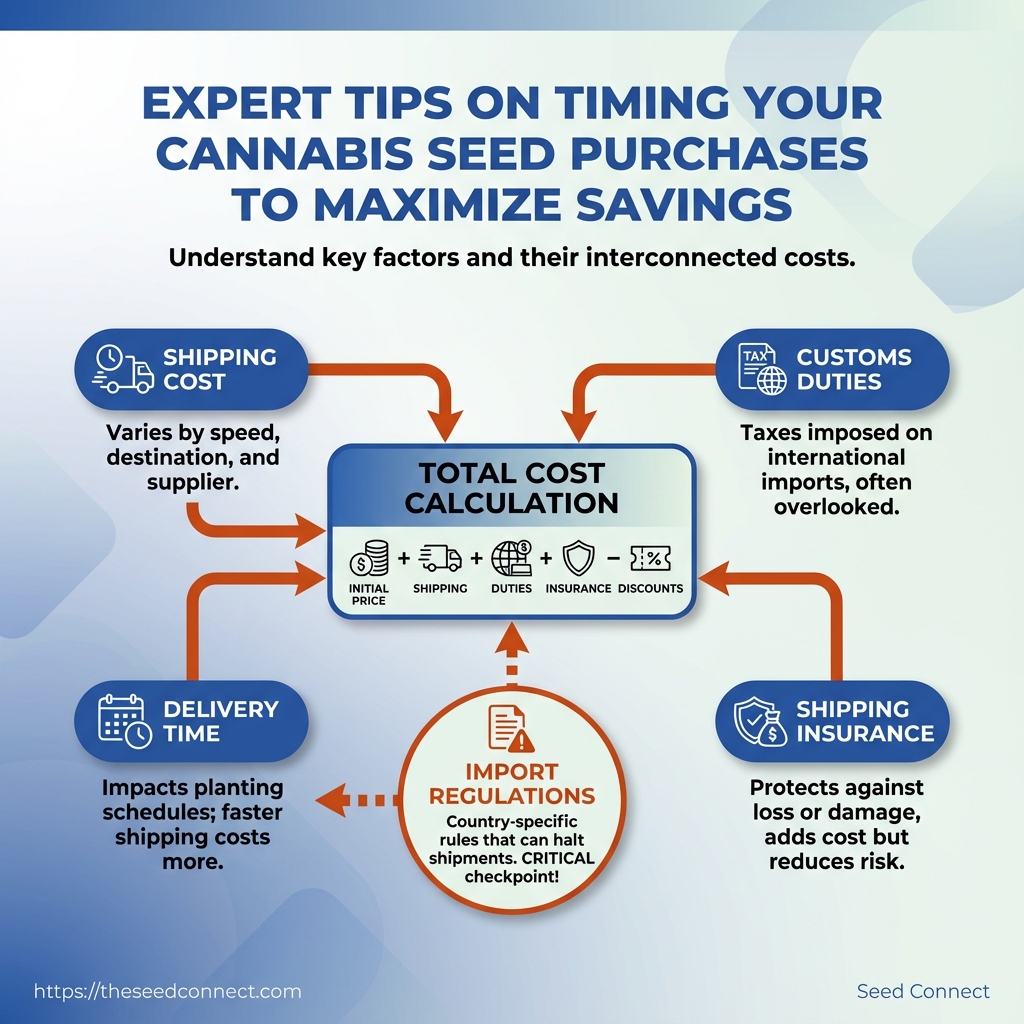
When making buying decisions, calculating your net savings after accounting for shipping and duties is essential, as it can reveal hidden costs beyond just the sticker price. A purchase that appears to be the cheapest can turn out to be the most expensive after considering shipping, customs, and delays. Treat price, shipping window, and expected duties as a single combined cost when evaluating vendors.
Net savings formula: Use this on every quote to compare apples-to-apples.
Net Savings = (Baseline Price + Shipping + Duties + Handling + Expected Losses) - (Promotional Discounts + Bulk/Repeat Buyer Savings + Guarantees Value)
- Compare landed cost step-by-step
- Estimate the seller’s invoice price and any promotional discounts.
- Add shipping — use the seller’s fastest realistic rate, not the cheapest that never arrives on time.
- Add import duties and VAT based on your jurisdiction’s tariff schedule for seeds.
- Add handling, brokerage, and potential return shipping.
- Add expected losses: a conservative percentage for damaged or failed germination if the vendor lacks a guarantee.
Example — domestic vs international
Example 1: Domestic order Baseline Price: According to recent research, costs can vary significantly based on shipping and duties. For a domestic order, the baseline price is approximately $80, shipping is approximately $10 (3–5 business days), duties are $0, and handling is approximately $5, resulting in a net cost of approximately $95.
Example 2: International order (same SKU) Baseline Price: Approximately $60 Shipping: Approximately $35 (10–20 business days) Duties: Approximately $18 (15% import rate) Handling/Brokerage: Approximately $12 Net Cost = Approximately $125.
What the numbers show is how faster domestic shipping and zero duties can outweigh a lower product price. When a vendor like Theseedconnect offers a germination guarantee, factor that value in: reduce the expected losses line by the guarantee’s practical value (fewer replacements, less time lost).
Shipping reduction strategies that boost net savings
- Consolidate orders to lower per-unit freight.
- Select slower economy shipping for non-urgent buys when duties don’t scale with speed.
- Use domestic resellers when duties or brokerage fees are high.
- promotional shipping offers timed with purchase windows.
- Negotiate bundled fees or flat-rate brokerage for frequent imports.
- Buy in-season or during supplier slow periods to access lower prices and waived fees.
- Choose vendors with guarantees to reduce expected loss assumptions.
> Industry analysis shows cross-border duties and brokerage commonly add between 5% and 25% to the invoice, depending on classification and handling.
Running this calculation on every meaningful quote clarifies true savings and prevents surprises. When implemented consistently, this approach makes procurement decisions faster, more accurate, and financially predictable.
8. Smart Timing for Collectors and Small-Scale Growers
Timing your purchases and harvests carefully can transform your hobby collection into a cost-effective, diverse inventory. Staggering purchases lowers financial risk and increases genetic variety for small-scale growers. Simple stop-loss rules help avoid impulse buys on popular strains. Below are eight practical tactics—each compact, actionable, and fitted to collectors and home growers.
1. Stagger purchases across windows
Buy seeds in several batches spaced 4–12 weeks apart to avoid market timing risk and to test germination across different lots. This spreads cash outflow and reveals any batch-specific germination issues before committing to larger orders.2. Define a stop-loss budget
Set a firm monthly or per-order cap—$X or a percentage of your seed budget—and treat it like a trading stop-loss to halt impulse buys. When the cap is reached, pause purchases for the period to force evaluation rather than emotional buying.
3. Prioritize core genetics first
Lock in a small set of reliable strains (feminized or autoflower options if relevant) before chasing rare releases. Core genetics maintain continuity in phenotype testing and reduce dependency on one-off acquisitions.4. Use seasonal timing for germination success
Schedule major germination events for stable environmental periods in your area—spring and early autumn for outdoor-adjacent setups, or evenly spaced for indoor-controlled rooms. Consistent conditions raise first-cycle success rates and reduce wasted seeds.5. Rotate exploratory buys with proven lines
Alternate between a smaller exploratory purchase (1–2 seeds) and a follow-up order of proven favorites. This preserves budget while allowing you to expand genetics deliberately based on observed performance.6. scarcity without overpaying
When a limited release appears, pause to assess long-term value: rarity, reported stability, and grow difficulty. If justified, buy a seed or two; otherwise, wait for restocks or breeder runs.7. Track purchases and outcomes
Maintain a simple log: purchase date, seed lot, germination rate, phenotype notes. Over a season, this data guides future timing and prevents repeat mistakes.8. Align timing with preservation plans
If collecting for genetics, time purchases so seeds feed into a storage and test schedule—germinate a few, store backups properly, and maintain living mother plants only when space justifies it. For small-scale growers, favor autoflower seeds when quick turnover is needed.Understanding these principles helps collect responsibly and grow reliably without unnecessary expense. When implemented, this approach preserves capital, sharpens selection choices, and keeps inventory manageable.
Conclusion
Experienced growers pay attention to seasonal trends. Retail shops often lower prices on older genetics in late winter, while breeders introduce new crossings in spring. Shipping delays typically increase prices just before planting season. Weave those patterns into a purchasing rhythm — monitor newsletters and set price alerts, target late-winter clearances for heritage strains, and time new-cross buys for spring drops to maximize cannabis seed savings and buying seeds smartly.
If questions linger about order size or international duties, test one combined order first and track landed cost; Research indicates that many growers who combined small buys saw per-seed costs fall by 15–30% after factoring shipping. For practical implementation, create a simple calendar with vendor sale seasons, use a price-tracker, and consult resources like the Seed Connect buying guide for germination guarantees and shipping windows. Start by scheduling one strategic purchase this season and compare net costs — that single disciplined step delivers clearer savings and steadier genetics over the long term.