


You buy a packet of seeds, pause over the label, and realise the decision feels bigger than price or strain name. For many growers that moment comes down to a choice between organic cannabis seeds and non-organic seeds — and not just because of soil labels. That choice affects everything from early germination vigor to nutrient needs, pest susceptibility, and the subtle ways a plant expresses its genetics.
Think about the last time a seedling struggled despite perfect light and schedule; often the difference traces back to seed origin and handling rather than grow technique. Understanding what “organic” actually means at the seed level, and where conventional seeds may trade off convenience for resilience, saves time, money, and frustration later. This piece unpacks the practical differences growers notice in seed quality comparison, so decisions on which seeds to plant feel less like a gamble and more like informed selection.
What Is Organic vs. Non-Organic Seeds?
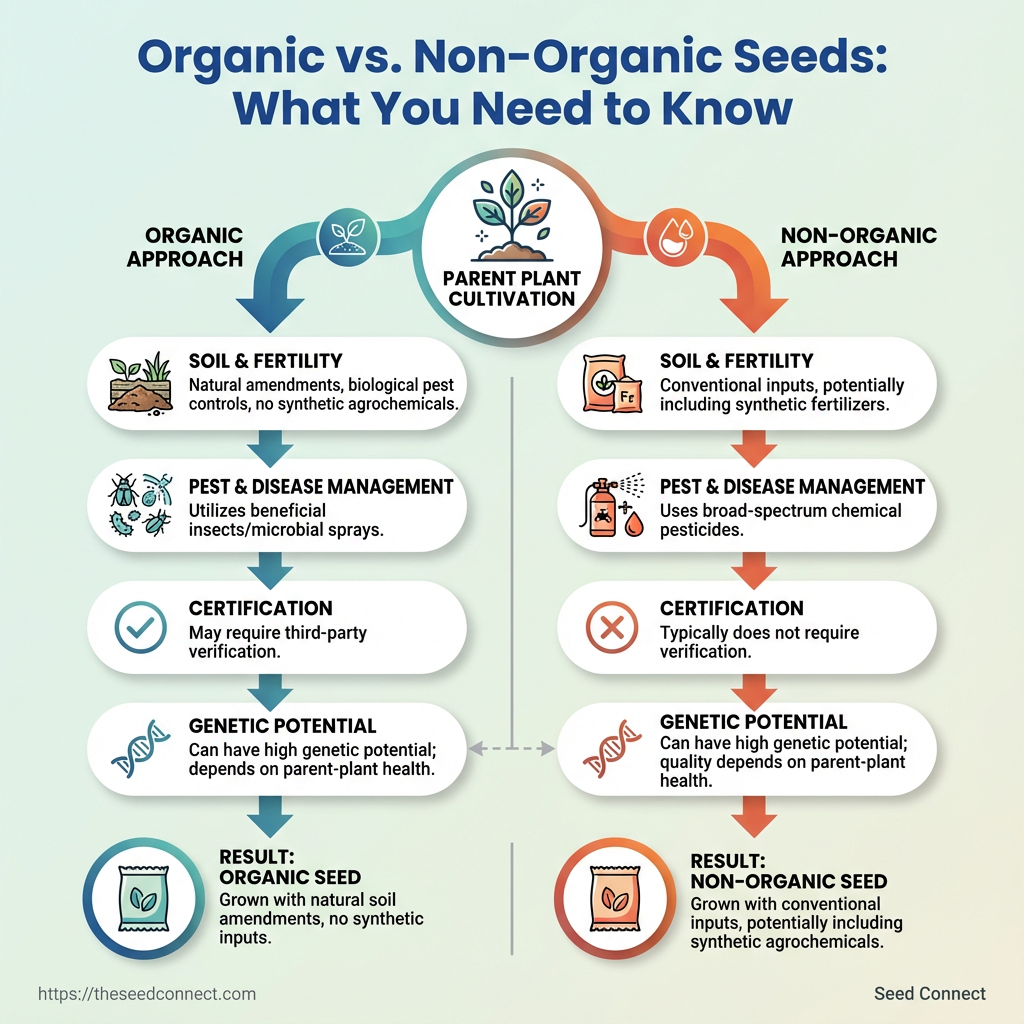
Organic seeds refer to seeds produced from parent plants that were grown using organic practices—no synthetic fertilizers, no conventional pesticides, and soil managed with biological inputs and crop-rotation principles. For cannabis specifically, organic describes how the plant was cultivated and how the seed crop was managed, not a genetic label or an inherent trait of the seed itself.
Organic seed: Seed harvested from parent plants grown under organic production methods, using natural soil amendments, biological pest controls, and processes that avoid synthetic agrochemicals.
Non-organic seed: Seed harvested from parent plants grown with conventional inputs, which may include synthetic fertilizers, herbicides, fungicides, or insecticides during production.
What this looks like in practice: Soil and fertility: Organic production emphasizes compost, cover crops, and microbial teas; non-organic production often relies on mineral fertilizers or synthetic nutrient formulations. Pest and disease management: Organic methods use beneficial insects, microbial sprays, and cultural controls; non-organic producers may use broad-spectrum chemical pesticides. * Record-keeping and certification: Certified organic seed requires documented practices and third-party inspection; many growers will market seeds as “organic” without certification—ask for proof if that matters.
Common confusions cleared up Organic ≠ different genetics. A seed’s genetic potential (vigor, terpene profile, yield) isn’t changed by whether its parents were fed compost or synthetic NPK. Production method affects parental health and seed quality, but not the heredity. Non-organic ≠ poor quality. Conventional production can produce very vigorous, uniform seed lots; the difference is mostly about inputs, residues, and the ecological footprint, not automatic inferiority. * Certification vs. claim. For cannabis the landscape is patchy: some producers pursue organic certification where legally possible, while others use honest-but-uncertified organic methods. Certification raises production costs and can affect price.
When choosing seeds, consider whether you prioritize residue-free growing, ecological practices, or budget. For growers seeking organic-start-to-finish, look for documented practices or suppliers of cannabis seeds for sale that explicitly describe their parent-plant management. Picking the right seed starts with understanding these production differences and aligning them with your grow goals.
How Does It Work? Mechanisms Behind Seed Quality
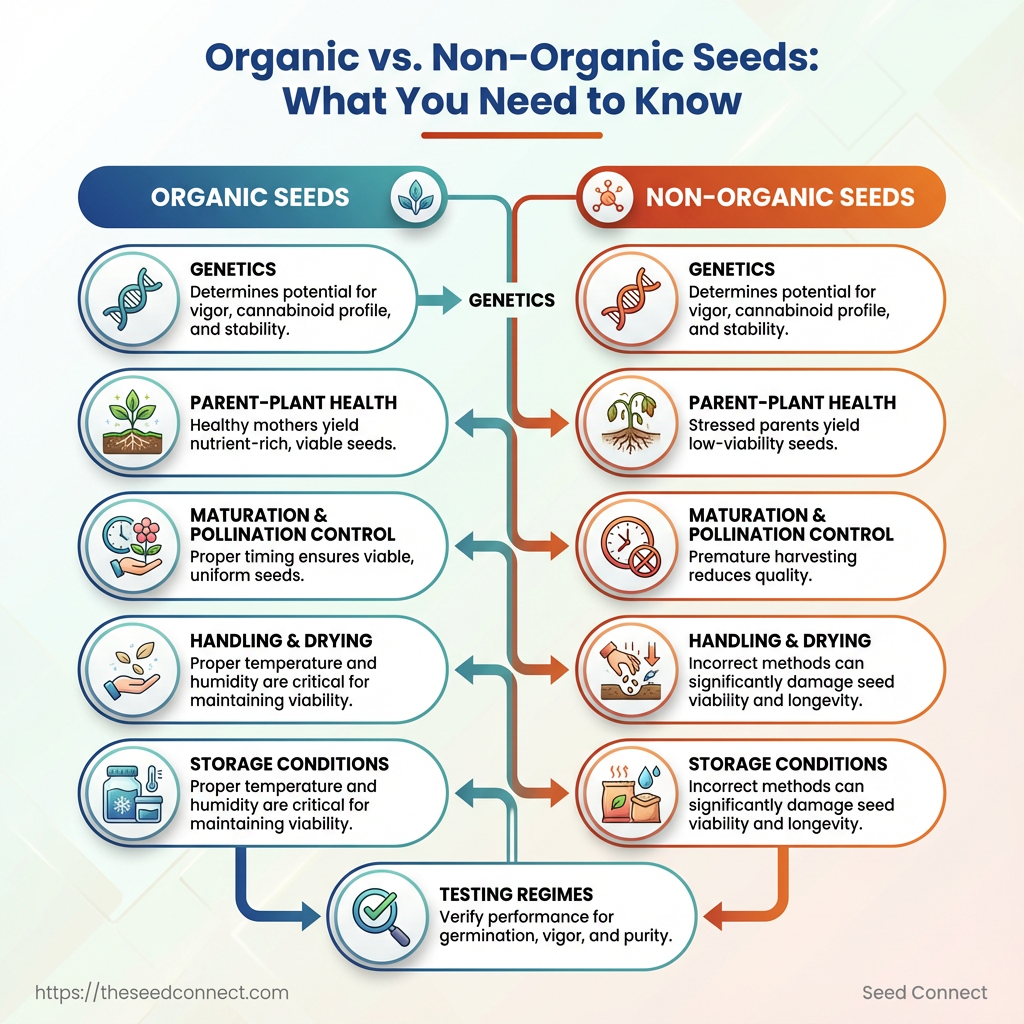
Seed quality comes down to a few concrete, interacting mechanisms: the genetics encoded in the seed, the health and handling of the parent plants, how seeds are dried and stored, and the testing regimes that verify performance. Those mechanisms determine measurable outcomes growers care about: germination percentage, early vigor, uniformity, and susceptibility to disease. Below are the drivers and how they translate to real results.
Genetics: High-quality genetics supply the potential for vigor, cannabinoid profile, and stability. Poor genetics produce uneven crops and weak germination.
Parent-Plant Health: Healthy mothers produce nutrient-rich seeds with full endosperm; stressed or diseased parents yield low-viability seeds and higher disease transmission risk.
Maturation & Pollination Control: Proper, controlled pollination during full seed maturation ensures viable, uniform seeds; premature harvesting reduces germination and vigor.
Handling & Drying: Incorrect drying (too hot, too fast) causes internal damage and reduces shelf life. Gentle, controlled drying preserves viability.
Storage: Seeds are living tissue. Cool, dry, and dark storage preserves germination for years; warm or humid conditions accelerate deterioration.
Testing & QA: Regular germination and purity tests catch batch problems before distribution.
Simple checks growers can run at home
- Visual inspection: Look for uniform size, intact seed coat, and no obvious mold.
- Float test: Briefly described below — useful as a quick screen, not definitive.
- Small germination trial: The most reliable home test for viability.
- Place 10 seeds on a moist paper towel, fold, and seal in a plastic bag.
- Keep at
20–25°Cin indirect light for 5–10 days. - Count germinated seeds to estimate germination percentage.
Residues from foliar sprays or systemic treatments are rare at seed level but possible if parent plants were heavily treated. That can affect early seedling health or leave residues on seed coats; sourcing from reputable producers reduces this risk.
How inputs and handling translate to results
A breeder who prioritizes parental plant nutrition and disease control produces seeds with higher initial germination and lower early mortality. Proper drying and low-humidity storage maintain viability; failures here show up as low germ rates months later. For reliable starts, consider small germination trials before committing large-scale plantings. When buying seeds, whether organic or non-organic, check the seller’s QA claims and run your own 10-seed trial.
How organic vs non-organic production practices affect each seed-quality factor (genetics, parent-plant health, handling, storage, testing)
| Seed-Quality Factor | Organic Production Impact | Non-Organic Production Impact | Practical Outcome for Grower | |—|—|—|—| | Genetics | Emphasis on stable parent lines, selection for resilience | Emphasis on yield/traits sometimes via chemical-assisted vigor | Organic: often more stable in varied environments; Non-organic: may push specific traits | | Parent-Plant Health | Relies on cultural controls, soil health; reduced synthetic inputs | Uses targeted pesticides/fertilizers to maximize health and yield | Organic: lower synthetic residue risk; Non-organic: potentially higher uniformity | | Pollination Control | Manual/isolation techniques emphasized to avoid cross-pollination | Industrial isolation + controlled pollination with chemical supports | Organic: careful isolation; Non-organic: high throughput, consistent seed sets | | Seed Drying & Storage | Low-temperature, passive drying preferred | Quick drying with controlled kilns, desiccants | Organic: gentler drying can preserve compounds; Non-organic: faster, consistent moisture targets | | Testing & Quality Assurance | On-farm or third-party germination/purity checks; slower cycles | Scaled lab testing, faster batch turnover | Organic: strong traceability; Non-organic: often larger QA programs, rapid availability |
Key insight: Organic methods emphasize resilience and low residues, while non-organic methods often prioritize throughput and specific trait performance. For growers, the practical difference shows up as trade-offs between uniformity, residue risk, and environmental adaptability.
For dependable results, run a quick germination trial and inspect storage conditions before planting. If sourcing seeds, consider reputable suppliers—cannabis seeds for sale offers germination guarantees and QA that simplify this process. These checks save time and reduce surprises during the grow.
Why It Matters: Benefits, Risks, and Applications
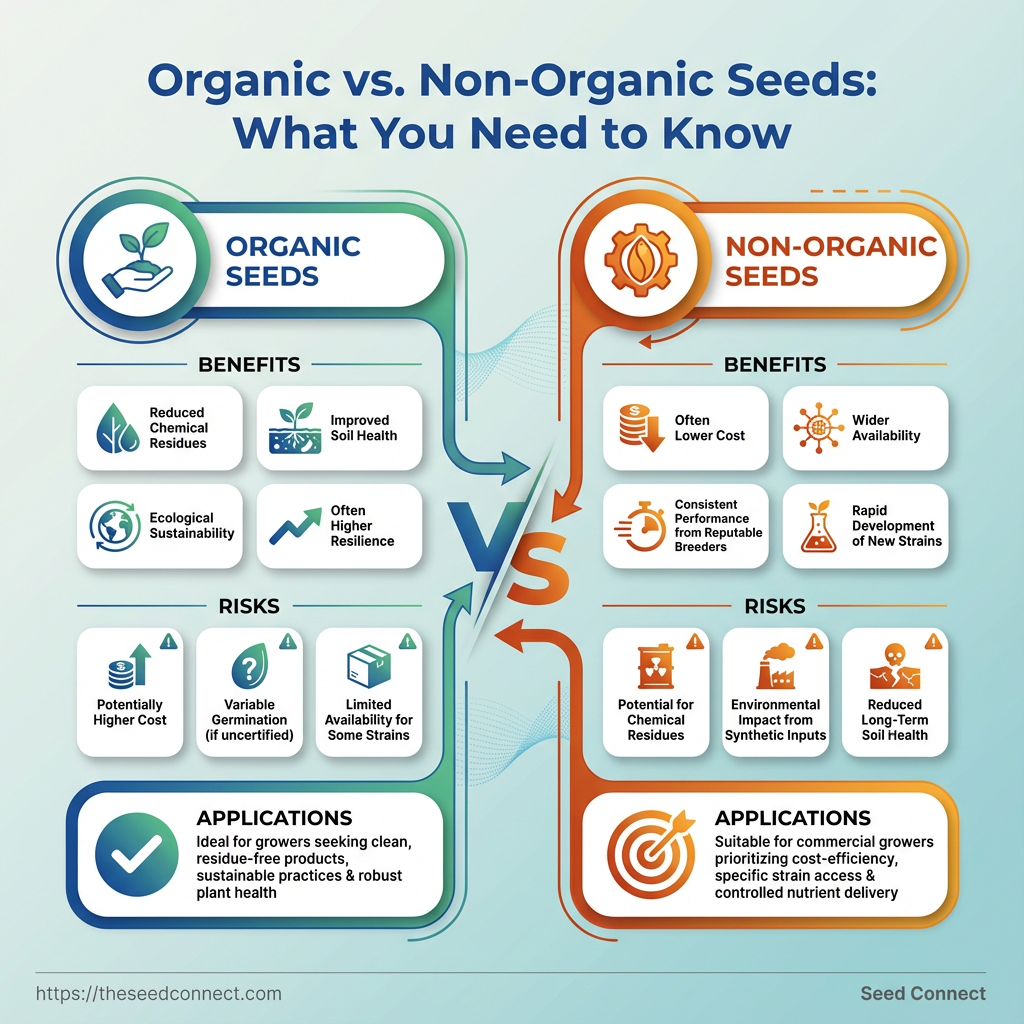
Choosing between organic cannabis seeds and non-organic seeds affects cost, sustainability, market positioning, and practical outcomes in the garden. Organic seeds often tie to an ecosystem-driven approach that can improve soil health and appeal to eco-conscious buyers, while non-organic seeds usually deliver predictable, scale-friendly performance and lower upfront costs. Growers should pick based on their business model, values, and operational constraints rather than myths about one being universally “better.”
Organic seeds: Organic seeds are produced and handled under standards that minimize synthetic chemical inputs and emphasize soil biology.
Non-organic seeds: Non-organic seeds may be produced with conventional practices, including synthetic treatments, focused on uniformity and cost efficiency.
Benefits and risks of organic seeds
- Environmental benefit: Supports biodiversity and reduces reliance on synthetic pesticides and fertilizers.
- Market premium: Can command higher prices from consumers who prioritize organic or sustainable products.
- Plant health potential: Strong soil microbiomes can improve nutrient uptake and resilience over time.
- Higher cost: Production and certification often raise seed prices and limit scale.
- Availability constraints: Fewer varieties and smaller batch sizes can create supply bottlenecks.
- Operational complexity: Requires stricter record-keeping and compatible cultivation practices.
Scenario where organic seeds are better: boutique growers or small-scale brands targeting premium, sustainable markets and willing to invest in regenerative soil practices will see the most ROI from organic genetics.
Benefits and risks of non-organic seeds
- Lower cost: Typically cheaper per seed, helping cost-sensitive operations scale quickly.
- Greater variety and availability: Larger breeders produce more genetics and bulk quantities.
- Predictability: Standardized practices yield consistent
germination rateand phenotype stability. - Perceived sustainability drawbacks: Consumer skepticism around chemical inputs can hurt premium branding.
- Environmental concerns: Conventional production may have higher carbon or pesticide footprints.
- Not inherently low quality: Reputable breeders still deliver excellent genetics regardless of production label.
Reputable non-organic seeds can be an excellent choice for large-scale commercial grows, research trials, or growers prioritizing uniformity and cost control. Sourcing from trusted suppliers reduces most quality concerns — for both organic and non-organic options, consider documented A practical approach is to match seed choice to business goals: prioritize organic when brand integrity and environmental stewardship drive value, or choose high-quality non-organic seeds for cost-effective scale and experimental consistency. Either path works well when the breeder’s practices and documented performance match the grower’s needs. Many growers assume organic seeds are inherently superior and non-organic seeds are inferior. That’s an oversimplification. Seed quality depends first on genetics and breeder practices, not the label on the packet. Organic production can matter for long-term soil health and input choices, but it doesn’t magically guarantee higher germination or vigor. Organic seeds often carry expectations that don’t match reality. Quick, practical checks for seed quality (easy to perform at home) 1. 2. 3. Top myths about non-organic seeds deserve the same honest look. Breeder reputation: Look for documented germination guarantees, clear lineage, and customer feedback. For shopping, consider genetic reliability first, then production methods. When browsing options, including cannabis seeds for sale, prioritize breeders who publish germination rates and describe their seed handling. That approach gets growers to predictable outcomes faster and with less guesswork. Growers make different seed choices because their goals, scale, and risk tolerance differ. The three case studies below show how seed selection — organic vs non-organic, feminized vs autoflowering — affected outcomes for small, commercial, and craft operations. Each example highlights practical decisions, measurable results, and concrete actions a reader can try. A family-run operation in a temperate coastal climate wanted to sell a premium, sustainably grown flower to local craft dispensaries. They prioritized organic inputs and selected organic feminized seeds with stable terpene profiles to support consistent flavor. Seed quality comparison: Organic seed sourcing reduced seedling shock in low-fertilizer runs, improving uniformity during vegetative growth. A 3,000-plant greenhouse operation needed predictable batch-to-batch output and fast turnaround. They chose high-yielding, non-organic feminized seeds optimized for uniformity and greenhouse nutrient programs. Key insight: The commercial grower gained higher per-plant yield and lower seed cost, while the eco-focused grower captured a consistent price premium despite lower yield; germination differences were modest but contributed to overall consistency. A craft grower ran a side-by-side trial comparing an organic line and a non-organic high-yield line across six tents to decide which to scale. Tools & materials Seed batch A: Organic feminized line for terpene and flavor. Seed batch B: Non-organic feminized line for yield and vigor. Observed differences: non-organic line finished sooner and yielded ~40% more per plant; organic line scored higher in aroma panels and achieved higher retail pricing in local channels. Practical checklist for in-home trials: 1. Use at least three plants per genotype. 2. Keep environment identical for the compared groups. 3. Record Real tests like these reveal trade-offs: yield and speed versus flavor and market positioning. For growers choosing seeds, matching genetics to sales channels and production constraints makes the difference between marginal gains and profitable scaling. 📥 Download: Organic vs. Non-Organic Seeds Checklist (PDF) Picking the right seeds comes down to matching biology to goals. Start by deciding whether priority is sustainability, terpene-driven craft quality, or scale and uniformity. That decision narrows seed type (organic-friendly, feminized, autoflower, or high-stability commercial genetics) and how aggressively to test before committing large budgets. Decision Framework: Which Seed Type Suits Your Grow? Key insight: Eco growers prioritize organic compatibility and germination guarantees, craft growers focus on phenotype and terpene fidelity, and commercial operations require genetic stability and cost-efficiency for scale. How to Test Seeds at Home (Quick Protocol) Tools & materials Sample sizes and thresholds and next steps For convenient sourcing that includes a germination guarantee, consider trying cannabis seeds for sale in a small batch before scaling. Choosing the right seed means less stress downstream and a clearer path to the harvest you want. Choosing between organic cannabis seeds and non-organic seeds comes down to priorities: long-term plant health and microbial resilience versus upfront uniformity and sometimes lower cost. Evidence from growers shows organic seeds often produce more robust root systems and better resistance to common pests, while non-organic seeds can offer predictable germination in tightly controlled indoor setups. If you’re asking whether organic seeds are worth the extra care, the pattern suggests they repay attention with healthier plants; if you wonder how to test seed quality, a simple germination trial and a close look at seed integrity will give a quick, practical answer. For next steps, decide what matters most for your grow — soil biology and sustainability, or immediate uniformity — then run a small-scale comparison using both seed types and record germination rate, vigor, and pest resistance. Prioritize a germination test and document results so future purchases are data-driven. For an easy way to explore options and compare seed quality, consider browsing curated sources with guarantees. Browse our cannabis seed catalog with germination guarantee offers a practical starting point for choosing seeds that match your goals and testing approach.germination rate and breeder reputation when buying, for example Side-by-side comparison of practical trade-offs (cost, availability, environmental impact, market positioning) between organic and non-organic seeds to help growers choose
Criterion
Organic Seeds
Non-Organic Seeds
Which Grower Prefers
Cost
Higher per-seed price due to labor/certification
Lower per-seed price; economies of scale
Value-driven or boutique growers vs. scale growers
Availability
Limited varieties; smaller batches
Wide variety; large-scale supply
Small-batch/heritage breeders vs. commercial producers
Sustainability Impact
Lower synthetic input footprint; supports soil health
Often higher inputs; variable practices
Sustainability-focused brands vs. cost/efficiency focused
Market Positioning
Premium, eco-conscious branding
Mass-market, price-competitive branding
Brands targeting premium consumers vs. mainstream markets
Consistency
Good, but can vary with organic inputs
High predictability and uniformity
Experimental/quality-driven growers vs. operations needing uniformity
Common Misconceptions
Visual inspection Look for firm, glossy seeds with clear pigmentation and no cracks.Squeeze test Gently pinch the seed between fingernails; it should resist and not crumble.Germination check Place 5 seeds on a moist paper towel in a warm, dark spot for 3–5 days to estimate expected germination rate.Real-World Examples and Case Studies
Case Study 1: Small Eco-Focused Grower
Case Study 2: Commercial-Scale Producer
Side-by-side outcome metrics from the two case studies (yield per plant, cost per seed, germination rate, pest incidents) to give readers a quick comparative snapshot
Metric
Eco-Focused Grower (Organic)
Commercial Producer (Non-Organic)
Average Germination Rate
92%
96%
Yield per Plant (relative)
1.0x (baseline)
1.6x
Seed Cost (per seed)
$3.50
$1.20
Pest Incidence (relative)
Low (beneficial insects used)
Moderate (higher density stress)
Market Price Achieved
Premium (+20–30%)
Commodity (+5–10%)
Case Study 3: Craft Grower Testing Both
germination date, first true leaves, and harvest dry weight. 4. Note any pest signs and treatment interventions. 5. Run a simple sensory panel with neutral evaluators.
How to Choose: Practical Buying and Testing Guidelines
Checklist matrix showing which seed attributes matter most for different grower types (eco grower, craft, commercial)
Attribute
Eco-Focused Grower
Craft Grower
Commercial Grower
Organic Production
Preferred: seeds known to perform in organic inputs
Important: flavor and terpene expression under organic regime
Optional: may accept conventional inputs for yield
Germination Guarantee
High priority: reduces waste and reorders
High priority: protects small, expensive batches
Critical: lowers failed batches at scale
Batch Testing
Recommended: small pilot plots outdoors
Mandatory: phenotype selection for terpene and structure
Standard: QC runs for uniformity and vigor
Price Sensitivity
Moderate: willing to pay premium for certified organic
Lower sensitivity: pays for exclusive genetics
High sensitivity: cost per seed matters most
Genetic Stability
Important: resilience to organic inputs
Crucial: predictable phenotype and terpene profile
Essential: uniform harvest timing and cannabinoid consistency
10 seeds evenly, fold towel, and slide into a sealed zip bag.21–25°C (70–77°F) in the dark for 24–72 hours, checking daily.Conclusion