


Is the most popular way to start cannabis seeds really the best fit for your setup? A damp paper towel can be effective.
But warmth, moisture, handling, and timing usually matter more than the method.
Alternative germination methods give growers more control when paper towels dry too quickly, seeds need closer monitoring, or transplanting feels risky.
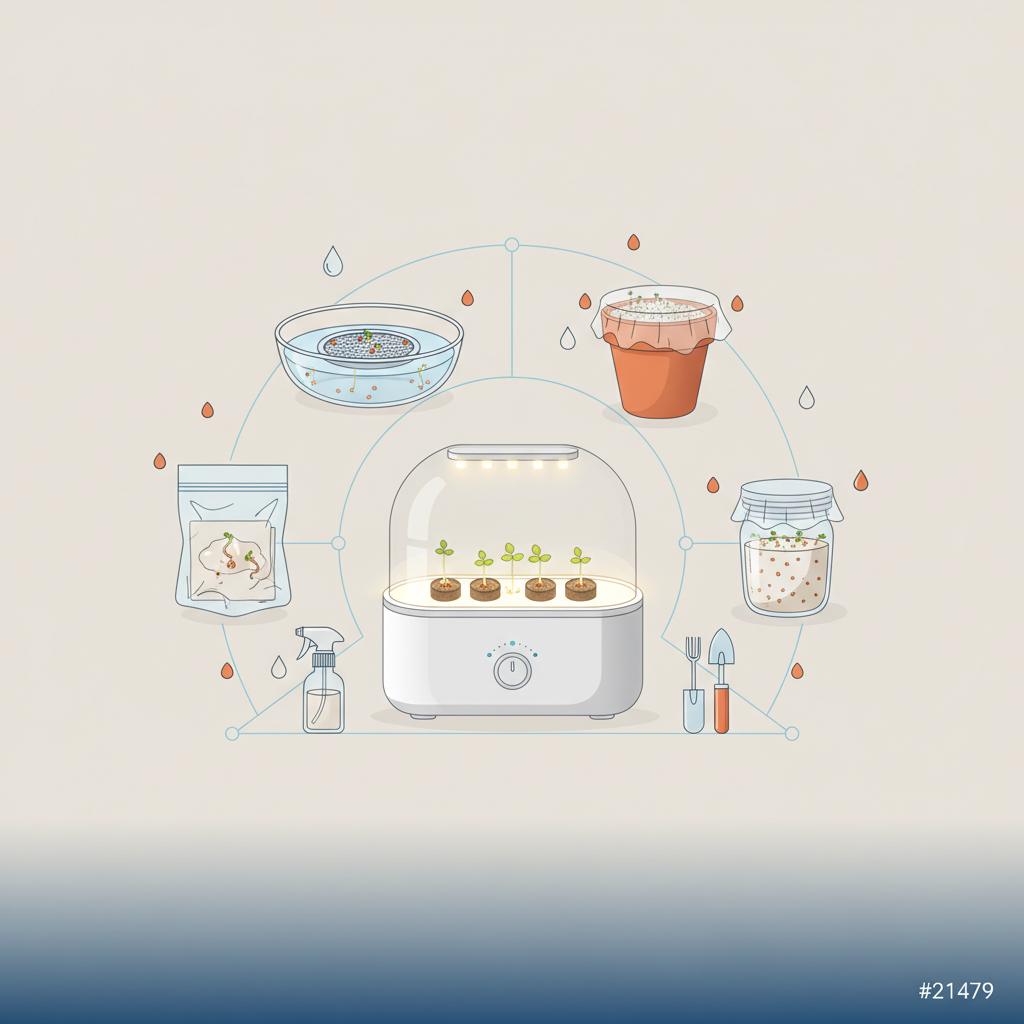
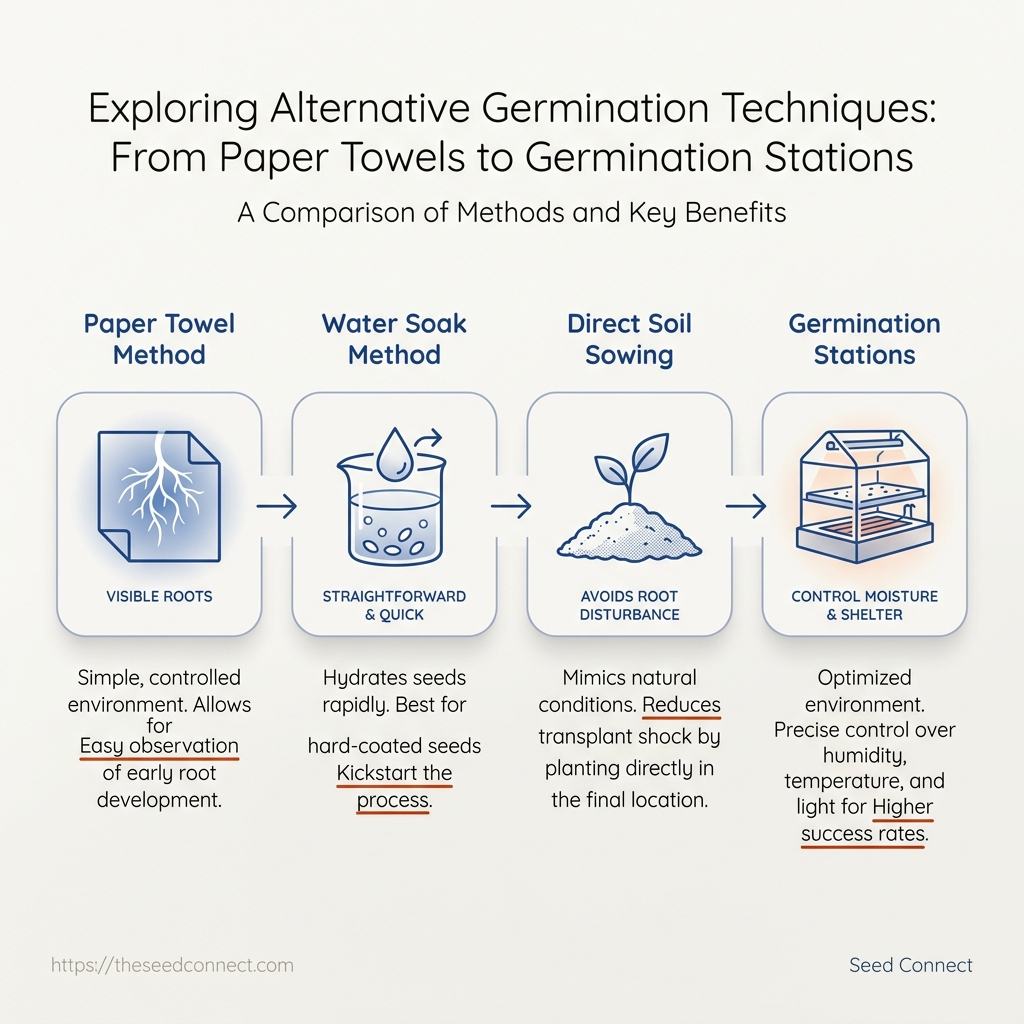
Water soaking, planting directly in soil, using seed-starting trays, and using enclosed germination stations each offer different levels of simplicity and control.
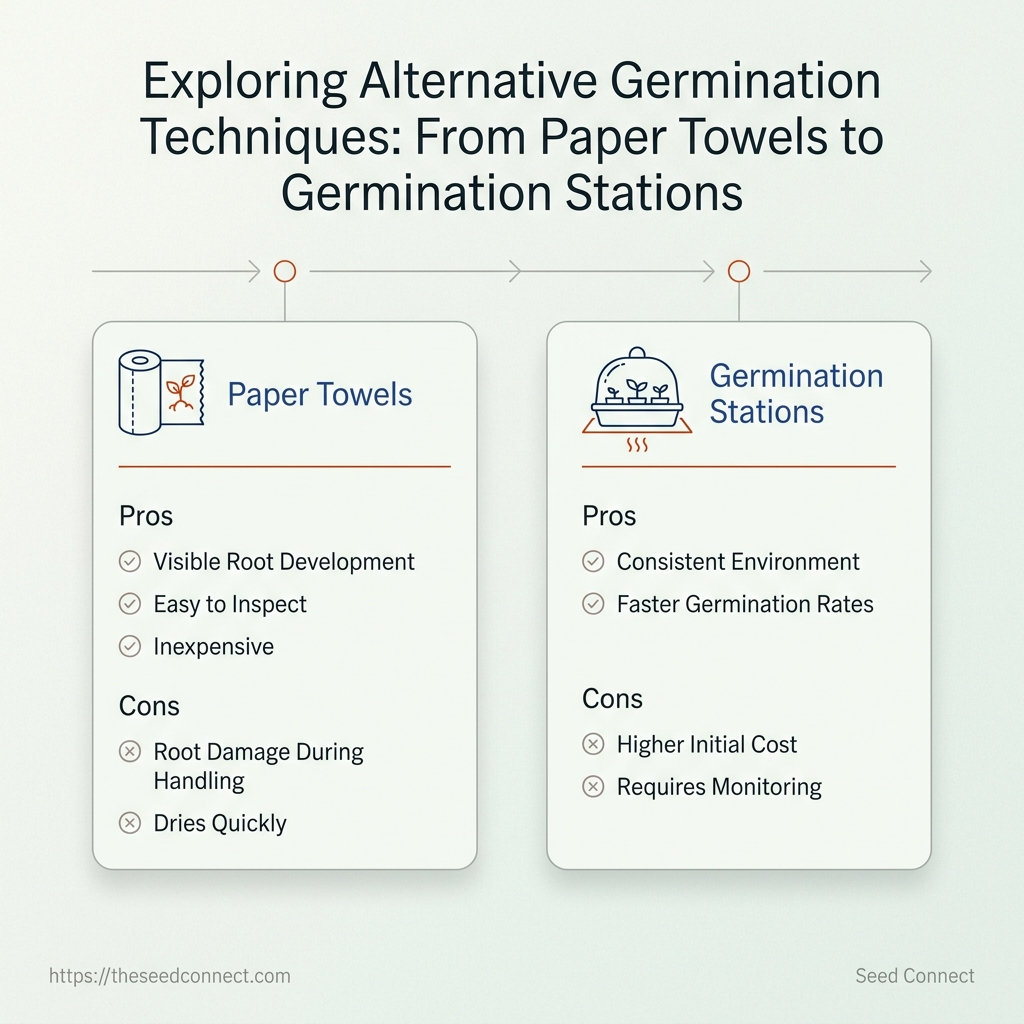
Paper towel germination remains popular because it is inexpensive, easy to inspect, and often produces visible results quickly.
However, handling can damage exposed roots.
This is especially true if growers wait too long to move seedlings into their growing medium.
A glass of water offers a straightforward soak, while direct planting avoids root disturbance altogether.
Germination stations and trays add moisture control and shelter, making them useful when room conditions change throughout the day.
The right choice depends on your seeds, growing space, and daily routine.
Understanding how each approach manages moisture, warmth, airflow, and transplanting will help you choose suitable germination tools without adding unnecessary complexity.
The best germination method for cannabis seeds depends on your growing conditions and preferences.
Other techniques, such as planting directly in soil or using germination stations, can boost success rates.
They can reach around 70% to 90% germination rates when managed well.
Choose based on your space, moisture control, and handling capacity to maximize seed sprouting efficiency.
> Key Takeaway:
> Key Takeaway:
What If the Best Germination Method Depends on Your Setup?
Standard soil-starting works well, but it is not automatically the best choice for…
> Key Takeaway:
What If the Best Germination Method Depends on Your Setup?
Standard soil-starting works well, but it is not automatically the best choice for every grower.
What If the Best Germination Method Depends on Your Setup?
Standard soil-starting works well, but it is not automatically the best choice for every grower.
A cool room, limited space, poor drainage, or a busy schedule can make it difficult to control moisture and temperature.
That’s why you should think about alternative germination methods.
Paper towel germination makes root development easy to monitor, while a seed-starting tray creates separate spaces for moisture control and early growth.
Direct planting remains simple, but it gives you less visibility when conditions are inconsistent.
The method matters less than the environment it creates.
Every successful setup needs four things: steady moisture, fresh airflow, suitable warmth, and careful handling when the root appears.
Match the method to your working conditions
Think about your space and habits before choosing germination tools.
A paper towel setup suits growers who can check moisture often and move sprouted seeds gently.
A tray or small covered container may suit someone who wants more structure and fewer handling steps.
Coir-based seed-starting mix can also provide a light, moisture-retentive medium.
The Seed Starting Essentials guide from Joe Gardener discusses coir as an alternative to peat-based mixes.
Use these practical matches:
- Limited space: Paper towels need little room and make root progress visible.
- Several seeds: A tray keeps seedlings separated and reduces root tangling.
- Infrequent monitoring: A properly prepared medium can hold moisture more evenly than exposed paper.
- Confident transplanting: Paper towel germination works well when you can move each seed without touching the emerging root.
- Low equipment budget: Direct planting needs the fewest materials, provided the medium drains well.
Confirm the rules before starting
Cannabis laws differ by location.
Before ordering or germinating seeds, check your local rules on possession, cultivation, plant counts, age limits, and medical or adult-use status.
Shipping requirements can also vary by destination.
Confirm that seeds may legally enter your area, then review the seller’s shipping terms and delivery restrictions.
Our A reliable setup should feel easy to monitor, not demanding.
Choose the method that fits your space, attention level, seed quantity, and confidence during transplanting.
Paper Towel Germination: A Simple Method for Close Monitoring
Paper towel germination is popular among growers due to its low cost and ease of monitoring.
This method allows for immediate visibility of root development, which is crucial for timely transfers to growing mediums.
While other methods, such as soil planting or using seed-starting trays, may conceal the seed’s progress, they offer their own benefits related to simplicity and reduced handling risks.
Let’s explore how to make the most of using paper towels for germination.
> Key Takeaway:
> Key Takeaway:
Germination Stations: Building a Controlled Starting Area
Picture this: you check your seeds each morning, wondering which container needs…
> Key Takeaway:
Germination Stations: Building a Controlled Starting Area
Picture this: you check your seeds each morning, wondering which container needs watering, which one needs warmth, and how long they’ve been there.
Germination Stations: Building a Controlled Starting Area
Imagine checking several seeds each morning.
You might wonder which container needs water, which one needs warmth, and when each was started.
A small, organized station removes that guesswork.
Every container has a place, every seed has a label, and daily checks become a calm routine rather than a series of decisions.
A germination station does not need to occupy an entire room.
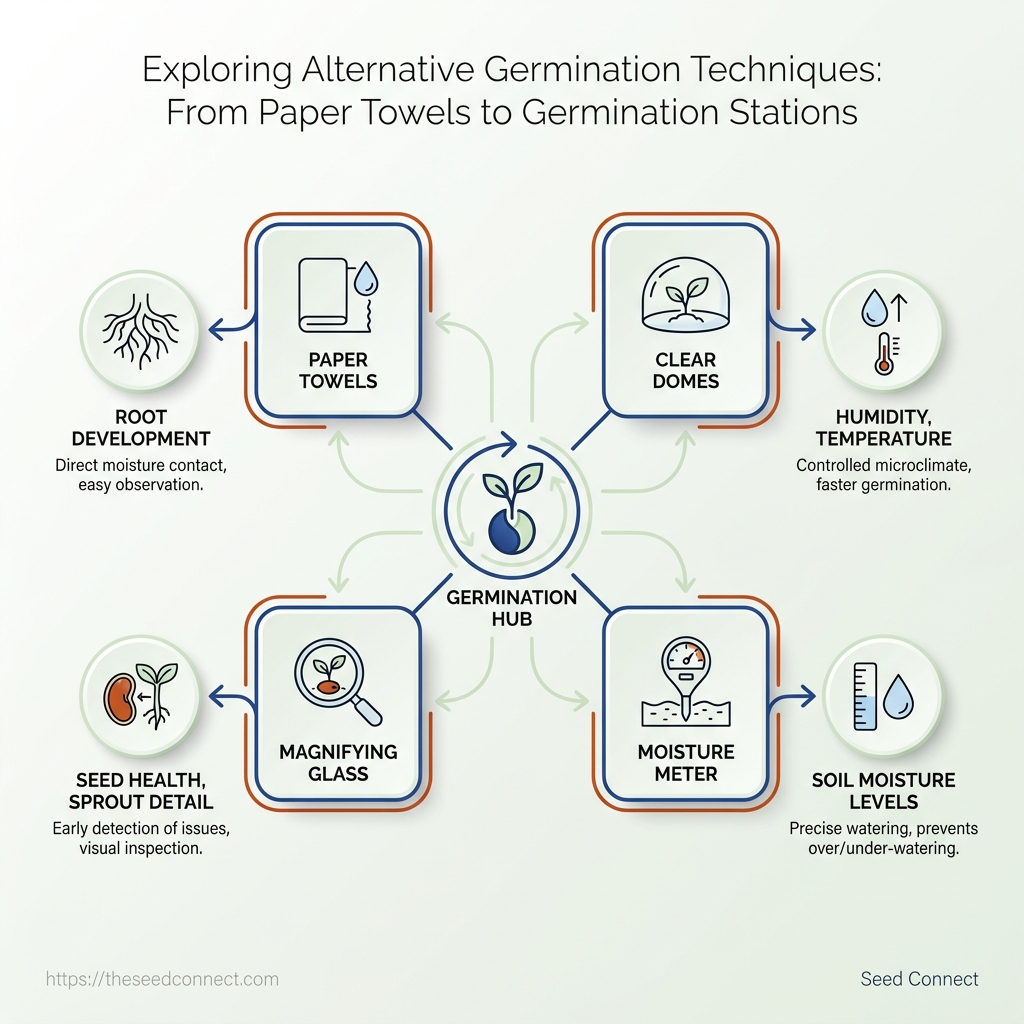
A tray on a stable shelf works well, and a propagation dome can help control humidity for smaller batches.
Growers managing several alternative germination methods may prefer a compact shelf, since it separates containers without making the setup difficult to monitor.
Choose the station format
Match the structure to your batch size and level of control.
- Seed-starting tray: Best for organized batches and consistent container placement. Trays can also reduce transplant shock when seedlings move into their next containers, according to SeedConnect’s guide to seed-starting trays.
- Propagation dome: Useful when the surrounding air is dry or conditions change often. Open the vents gradually as seedlings emerge, rather than leaving the dome sealed indefinitely.
- Compact shelf: A practical choice for multiple containers or different start dates. Leave enough space for air movement and easy inspection.
Set up the essentials
Place clean containers on a level, washable surface.
Add gentle light above the station, but keep it far enough away to avoid warming the containers or drying their surface.
Stable warmth matters more than intense heat.
A thermostat-controlled heat mat can provide steady conditions when the room fluctuates; strategic heat-mat use is also recommended in the 2026 annual seed-starting plan.
Keep airflow moving softly around the station, never directly blasting the containers.
Use labels that record the cultivar, method, and start date.
These details make comparisons possible and prevent accidental mix-ups when several germination tools are in use.
Inspect without disturbing the seeds
Check the station at the same time each day.
Look at the container surface, confirm the temperature, inspect for standing water, and verify that the label remains readable.
Do not lift containers repeatedly or uncover seeds to search for progress.
A stable routine protects the developing root and gives you better information over several days.
A well-arranged station turns germination into a repeatable process.
Clean placement, steady conditions, and quiet observation provide control without unnecessary handling.
> Key Takeaway:
Alternative Germination Methods Compared by Control and Handling
A method can feel more reliable simply because it makes conditions easier to observe.
A method can feel more reliable simply because it makes conditions easier to observe. SeedConnect’s 2026 germination guidance places successful methods in a broad 70%–90% range under optimal conditions, showing why consistency often matters more than the method’s reputation. Seeing progress can sometimes give you too much confidence. Paper towel germination exposes the root, while direct sowing hides progress but avoids handling a delicate sprout. The better choice depends on your schedule, available space, seed type, and comfort with transplanting. Table: Alternative Germination Methods Compared by Control and Handling — Method, Visibility of root growth, Moisture control & more Coir-based mixes are also increasingly used as an alternative to peat-based media, according to Joe Gardener’s seed-starting guidance. Choose based on handling, not habit. Use paper towels when inspection matters, plugs when transplanting confidence matters, direct sowing when simplicity matters, and a covered tray when several seeds need the same routine. A busy grower may prefer direct sowing because it removes one transfer step. Someone with limited space may choose plugs or a tray, since both make it easier to organize several seeds in a compact area. Clean handling matters with every option. Wash containers, use fresh or clean water, label each seed, and touch the seed coat as little as possible. Handle the root only when necessary, and never pull against it. The most controlled method is the one you can repeat calmly. Good germination tools support that routine, but clean conditions and gentle handling still decide how smoothly seedlings get started. More equipment does not automatically produce better germination. A simple setup with accurate readings, clear labels, and clean handling often tells us more than an expensive chamber filled with features we never check. Observation depends on useful information. A thermometer shows whether temperature is drifting, while a hygrometer reveals whether a covered tray is holding excessive humidity. Labels prevent mixed genetics, and a timer helps us record when conditions changed. Our tips for cannabis seed germination place this kind of practical control ahead of unnecessary hardware. A basic kit can support paper towel germination, starter plugs, or other alternative germination methods without turning the process into a laboratory project. Joe Gardener’s seed-starting essentials guidance also emphasizes choosing a suitable starting medium rather than relying on equipment alone. Table: Germination Tools That Support Better Observation — Tool, Primary purpose, Essential or optional & more A thermometer answers “Is the temperature stable?” A hygrometer answers “Is the covered area too damp?” A second heat controller, decorative chamber, or extra sensor may add little when the first readings already guide good decisions. Before starting, write the batch name and date, check that measuring devices work, prepare clean water and tools, and confirm containers drain properly. Current seed-starting plans also emphasize using heat sources strategically rather than running them without purpose, as shown in this 2026 seed-starting plan. Good germination tools reduce guesswork. They do not replace attention, restraint, or clean handling. The root has emerged, but your growing space is still half assembled. This awkward pause is common. Rushing the transfer often creates more risk than waiting briefly in controlled conditions. Keep the germinated seed in its clean, lightly moist setup while you prepare the container. It should stay damp, not soaked, and remain away from direct light and heat. Once the growing medium, container, and planting hole are ready, move the seed without delay. A seed is ready for planting when the white root tip is clearly visible and has begun moving away from the seed shell. Do not wait for a long root or emerging leaves. Longer roots are easier to damage, especially when they catch in paper fibers. Seed-starting trays can help reduce handling and transplant shock because each young plant has its own space, as described in SeedConnect’s guide to seed-starting trays. Give the container stable conditions and inspect it calmly rather than disturbing it repeatedly. Slow emergence can follow a deep planting, cool medium, excess water, or a compacted surface. Uneven results may also reflect differences between seeds, even when the setup appears identical. Check one variable at a time. Confirm moisture below the surface, inspect for a blocked drainage path, and look for a root that has dried or been damaged. Avoid digging up every seedling to compare progress. Dependable genetics also make early decisions less stressful. We pair our cannabis seeds with expert grower support, so questions about unusual emergence or handling have a clear place to go. A prepared container and a light touch protect more seedlings than speed does. Move the sprout when the space is ready, then give it time to establish. The best alternative germination methods include water soaking, direct soil planting, seed-starting trays, and enclosed germination stations. These techniques offer different levels of simplicity and control, achieving about 70% to 90% germination rates when managed properly. The paper towel germination method is simple. It involves placing seeds between damp paper towels in a shallow container. This method allows for easy monitoring of root development, helping to prevent damage during handling before the seeds are transferred to their growing medium. Tools that can enhance seed germination success include thermometers to monitor temperature, hygrometers for humidity levels, and clear labels to avoid mixing seeds. A timer can also be beneficial to track changes in conditions, supporting better observation and monitoring. The time it takes for seeds to germinate varies by method and conditions, typically ranging from a few days to a couple of weeks. Techniques like paper towel germination can produce visible results quickly, while soil planting may take longer depending on moisture and temperature. The best germination method isn’t always the most popular one. It is the one that provides steady warmth, controlled moisture, and requires minimal handling. Paper towel germination remains useful because it makes root development easy to observe, but a small germination station or a direct-to-medium approach may suit your space better. This choice becomes important as soon as a seed starts to crack open. A visible taproot can be reassuring, yet moving it too late or touching it repeatedly can create avoidable stress. Simple germination tools, such as a thermometer, humidity meter, clean tweezers, and a small propagation tray, can make the process more consistent without making it complicated. Before starting today, choose one method and prepare the full setup first. Check the temperature, moisten the growing medium evenly, label each seed, and decide where the seedling will go before the root emerges. Keep a short record of the method, timing, and moisture level; that small habit will show whether your approach is working and make the next round easier. The strongest growers are not loyal to one technique—they pay attention, make careful adjustments, and give each seed the conditions it needs to become a healthy seedling.Comparing Alternative Germination Methods
Starter plugs reduce root disturbance because the developing plant stays inside its original material.
Method
Visibility of root growth
Moisture control
Transplanting effort
Required germination tools
Best suited for
Paper towel method
High; roots remain visible
Moderate; towels can dry or become waterlogged
High; sprouted seeds need careful transfer
Paper towels, container, clean water, tweezers if needed
Growers who want to inspect early progress
Starter plugs
Low to moderate; root growth stays mostly hidden
High when plugs are pre-moistened correctly
Low; the plug moves as one unit
Plugs, tray, label, water, optional humidity cover
Beginners and growers planning an easy transplant
Direct sowing in a growing medium
Low; seed remains covered
Moderate; depends on medium and container drainage
Minimal; no early transfer required
Growing medium, small container, label, water
Growers with limited time or few available tools
Propagation tray with humidity cover
Low to moderate; seedlings are visible above the medium
High; tray retains moisture across multiple cells
Low to moderate; seedlings move after establishment
Tray, cells or plugs, cover, labels, growing medium
Multiple seeds, limited space, or planned batch starts
Match the Method to Your Working Style
Germination Tools That Support Better Observation
Minimal setup checklist before starting a batch
The most useful purchases are the ones that answer a specific question.
Tool
Primary purpose
Essential or optional
What to look for
Common misuse
Seed labels
Track strain and start date
Essential
Waterproof surface and clear writing
Relying on memory
Thermometer
Monitor air or medium temperature
Essential
Easy-to-read digital display
Measuring once, then ignoring changes
Hygrometer
Check humidity inside covered spaces
Helpful
Readable humidity and temperature display
Treating humidity as a substitute for ventilation
Spray bottle
Add small amounts of water
Helpful
Fine, even mist and clean reservoir
Saturating the medium from above
Clean tweezers
Handle seeds or roots carefully
Helpful
Fine tips, washed and dried
Gripping the emerging root
Propagation tray or humidity cover
Keep containers organized and reduce drying
Optional
Drainage, clear cover, adjustable vents
Sealing the tray continuously
Seed-starting medium or starter plugs
Provide a consistent rooting space
Essential
Clean, airy, and evenly moist material
Packing it tightly or leaving it waterlogged
From Sprout to Seedling: Transplanting Without Setbacks
A gentle transfer sequence
What are the best alternative germination methods?
How does the paper towel germination method work?
What tools can enhance seed germination success?
How long does it typically take for seeds to germinate using different methods?
Pick the right method that fits your growing space.