

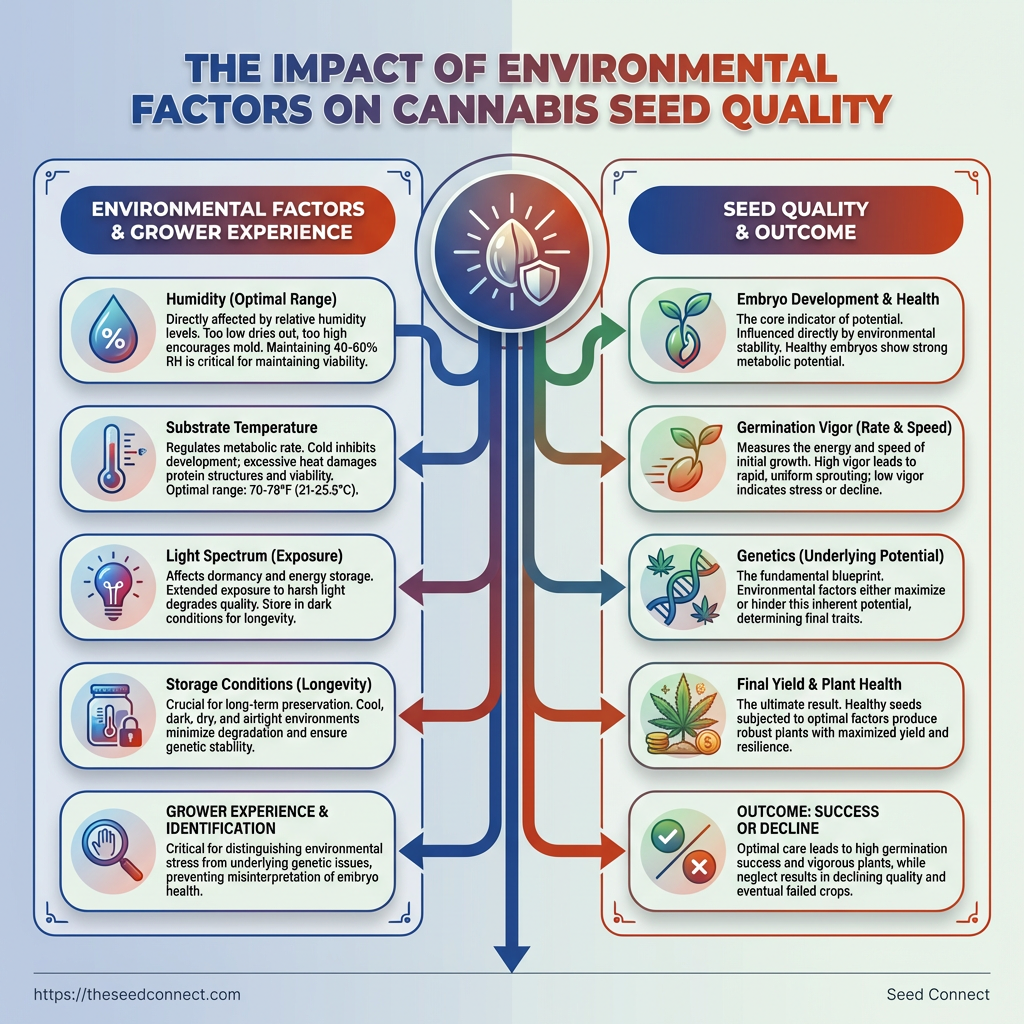
A tray of seeds that should all pop on day three, but half sit inert while a few sprout weak, twisted cotyledons—that moment is how cultivators learn the hard way that environmental factors quietly decide a crop before it truly begins. Humidity, substrate temperature, light spectrum during early growth and even minute fluctuations in storage conditions shape embryo development and germination vigor, turning otherwise healthy genetics into disappointing seedlings. Experienced growers recognize those early signs fast because they know poor conditions masquerade as bad genetics far more often than the reverse.
Spotting the difference requires understanding how the seed quality environment interacts with genetics: moisture levels can trigger mold or pre-germination stress, cold storage preserves viability only within narrow limits, and inconsistent light or nutrient salts during seedling stages stunt roots before they establish. That interplay defines whether cannabis growth conditions favor robust germination or gradual decline, making the first phase of a grow the most decisive for final yield and plant health.
What Is Seed Quality? Clear definition and why it matters
Seed quality is how reliably a seed will do what you expect: sprout, grow into a healthy plant that expresses the advertised genetics, and do so without carrying pathogens or problems. Growers judge seed quality by concrete attributes — viability, vigor, genetic fidelity, sanitary status, and moisture — because each one directly affects germination success, crop uniformity, and ultimately yield and cannabinoid/terpene expression.
- Practical stakes: poor-quality seeds mean wasted time, patchy stands, and unpredictable plants that complicate nutrient schedules, pest control, and harvest planning.
- Commercial stakes: for breeders and suppliers, seed quality drives reputation and reduces replacement costs when sellers offer germination guarantees.
- Home growers: investing in quality seeds reduces the common frustration of multiple failed germinations and uneven plant development.
Viability: Ability of a seed to germinate under favorable conditions. Measured as germination percentage after standard germination trials or with tetrazolium staining.
Vigor: Speed and robustness of early seedling growth. Measured by time to radicle emergence, uniform seedling height, and stress tolerance during early growth.
Genetic fidelity: Degree to which offspring express expected traits (potency, morphology, flowering time). Measured by grow-out trials, phenotype counts, or genetic marker testing.
Sanitary status: Presence or absence of pests, fungi, bacteria, or viruses on/in the seed. Measured by plating, microscopic inspection, or PCR-based assays.
Seed moisture content: Percentage of water in the seed at storage. Measured by the oven-dry method or moisture analyzers; critical because high moisture accelerates deterioration.
Side-by-side comparison of seed quality attributes and how they are measured by growers/testing labs
| Attribute | What it measures | How to test/measure | Practical implication for growers |
|---|---|---|---|
| Viability | Percentage that will germinate | Standard germination test (e.g., 100-seed tray) or tetrazolium staining |
Expectation of how many seeds to plant per target plant |
| Vigor | Speed/uniformity of seedling growth | Time to radicle emergence, mean seedling height at X days | Determines transplant timing and early nutrient schedule |
| Genetic fidelity | Consistency of advertised traits | Grow-outs (phenotype counts), SNP/genotyping panels | Predictable maturity, cannabinoid profile, and morphology |
| Sanitary status | Presence of pathogens or pests | Plating on selective media, microscopic inspection, PCR tests | Reduces disease outbreaks and contamination risk in grow rooms |
| Seed moisture content | Hydration level influencing longevity | Oven-dry moisture test or moisture analyzer (% by weight) | Guides storage conditions; high moisture shortens shelf life |
Key insight: High viability and vigor shorten time-to-harvest and lower seed counts needed; genetic fidelity ensures uniform crop handling; sanitary checks and proper moisture management preserve seedlots.
Choosing seeds with clearly reported tests or a germination guarantee makes the rest of the grow predictable. For growers who want an easy starting point, reputable suppliers that report germination rates and sanitary testing save headaches and pay off at harvest.
How Does Environment Affect Seed Quality? Mechanisms explained
Seeds are living packages whose longevity and germination potential hinge on the environment they’re exposed to. Temperature and moisture are the main levers: they set metabolic pace, control pathogen risk, and determine whether a seed remains dormant, ages slowly, or activates prematurely. Controlling those two variables keeps the seed in a low-metabolic, high-viability state.
Respiration: Cellular process where stored reserves are converted to energy; higher temperatures increase respiration rate.
Reactive oxygen species (ROS): Byproducts of respiration that damage membranes, DNA, and proteins when not neutralized.
Temperature: how warm is too warm (or too cold)
Temperature governs biochemical kinetics inside the seed. Optimal long-term storage is cool and stable—typically between 2-6°C for cannabis seed banks. Temperatures above ~25°C accelerate respiration and ROS formation, which speeds aging and reduces germination rates over months to years. Heat also weakens seed coat integrity and denatures storage proteins.
Cold extremes carry different risks. Near-freezing storage (-1 to 0°C) can prolong life but may cause chilling injury in some genotypes, leading to membrane rupture or irregular germination. Refrigeration at 2-6°C balances suppressed metabolism without freezing damage.
- Temperature fluctuation harm: Repeated warm-cool cycles amplify moisture movement inside the seed and accelerate deterioration.
Moisture: the double-edged trigger
Moisture is what wakes a seed. Dry seeds are metabolically quiet; modest moisture triggers repair and germination processes. Relative humidity (RH) for seed storage should be low and stable—often around 20-40% RH depending on seed moisture content.
- High humidity: Encourages fungal growth, bacterial rot, and premature metabolic activation that consumes reserves.
- Very low humidity: Extends longevity but can make seeds brittle; extreme desiccation may cause mechanical cracking in the seed coat.
- Store seeds in airtight containers.
- Add desiccant packets to maintain target RH.
- Keep temperature stable in the recommended range.
Practical example: seeds stored at 4°C and ~30% RH typically show far higher germination after 12–24 months than those kept at room temperature and fluctuating humidity. For sourcing seeds with known storage handling and guarantees, consider reputable suppliers such as cannabis seeds for sale.
Environment controls are straightforward to implement and pay off directly in higher germination and more uniform crop starts—small tweaks to temp and humidity yield disproportionately large gains.
Key Environmental Factors: Detailed breakdown
Proper seed handling starts with controlling the four big environmental drivers: temperature, humidity, light/oxygen, and contamination risk. Get these right and germination rates hold steady; ignore one and a batch can lose viability quickly. Below are concrete practices, examples, and simple checks to keep seed lots healthy from purchase through planting.
Temperature and storage best practices
Store seeds cool and stable. Short-term refrigeration around 4°C preserves viability for months without freezing risks. For long-term storage, -18°C (commercial freezer) reduces metabolic activity, but avoid repeated freeze–thaw cycles that cause condensation and embryo damage. When using deep-freeze or cryo-style storage, package seeds dry and double-seal—moisture plus freezing equals ice crystals and ruptured seed coats.
- Packaging: Use moisture-barrier inner pouches plus a sealed outer container.
- Desiccants: Include silica gel (4–8 g per small pouch) and humidity indicator cards.
- Avoid: Frequent temperature swings; do not store seeds on freezer doors.
Humidity and packaging
Relative humidity (RH) drives seed aging more than temperature in many cases. Aim for 20–40% RH depending on seed prep and packaging; 20–25% is conservative for long-term frozen storage, 30–40% is acceptable for refrigerated short-term.
- Silica desiccants: Reusable packs of indicating silica keep small lots stable.
- Humidity cards: Place one inside each package to verify conditions.
- Shipping: Use moisture-proof Mylar or vacuum-sealed pouches and shorten transit time when possible.
Light, oxygen and gas exposure
Light—especially UV—accelerates deterioration. Oxygen fuels oxidative damage. Limit both by storing seeds in opaque containers and using vacuum sealing or inert gas flush (nitrogen) for bulk lots. Even simple steps like wrapping packages in aluminum foil before refrigeration reduce light exposure.
Contaminants, pathogens and pest exposure
Visual or olfactory cues are the first alerts: shriveled seeds, fuzzy growth, or musty smells suggest fungal contamination. A float test is useful for some species but imperfect—non-viable seeds sometimes sink and viable seeds sometimes float, so use it only alongside germination checks.
- Bleach soak for surface sterilization: 10% household bleach,
1–2 minutes, then rinse thoroughly. - Hydrogen peroxide alternative:
3% H2O2soak for10–15 minutesfor tougher surface biofilms. - Quarantine new lots: germinate a small sample before integrating into production.
Term: Float test caveat The float test can give false negatives; always follow with a germination trial.
Storage methods (counter, refrigerator, freezer, commercial seed bank) and associated pros/cons for seed longevity
| Storage Method | Recommended Temp | Pros | Cons |
|---|---|---|---|
| Room temperature (sealed) | 15–22°C |
Easy access, low cost | Shorter longevity, RH control needed |
| Refrigerator (stable) | ~4°C |
Good short–medium term, stable | Needs dry packaging, risk of condensation |
| Freezer (single freeze) | -18°C |
Long-term viability extension | Freeze–thaw risk, requires dry packaging |
| Commercial seed bank / cryo | -150°C to -196°C (liquid nitrogen) |
Maximum longevity, professional handling | Expensive, specialized protocols |
Key insight: Refrigeration is the practical sweet spot for most growers; use freezers or professional banks when planning multi-year storage.
Packaging options and humidity-control methods for small growers versus commercial seed lots
| Packaging | Best for | Humidity control effectiveness | Cost/availability |
|---|---|---|---|
| Paper envelope | Short-term, dry climates | ✗ Poor | Very low cost, widely available |
| Mylar + desiccant | Small growers | ✓ High | Low–moderate cost, common |
| Vacuum sealed pouch | Small to mid commercial | ✓✓ Very high | Moderate cost, common |
| Airtight jar + desiccant | Home storage | ✓ High | Low cost, very available |
| Commercial moisture-barrier kit | Large commercial lots | ✓✓✓ Industrial grade | Higher cost, specialized suppliers |
Key insight: For most home and small-scale needs, Mylar with desiccant or vacuum sealing offers the best balance of cost and humidity control.
Common pathogens/contaminants, their symptoms on seeds/seedlings, and prevention/mitigation steps
| Contaminant | Symptoms | Environmental drivers | Prevention/Mitigation |
|---|---|---|---|
| Fungal mold (general) | Fuzzy growth, musty odor | High RH, warm temps | Dry storage, sterile surfaces, fungicidal seed treatments |
| Fusarium spp. | Damping-off in seedlings | Wet soil, poor drainage | Seed sterilization, clean media, crop rotation |
| Pythium spp. | Soft, water-soaked seedlings | Overwatering, cool wet conditions | Improve drainage, sterile trays, H2O2 rinses |
| Storage insects | Chewed seed coats, frass | Warm, humid storage | Airtight containers, freezing (single freeze), insect traps |
| Bacterial soft rot | Slimy seeds, foul smell | High moisture, contamination | Discard affected lots, surface sterilize, quarantine |
Key insight: Most seed failures come from moisture-driven pathogens; controlling RH and cleanliness dramatically reduces losses.
Ending note: controlling these four environmental factors—temperature, humidity, light/oxygen, and contamination—turns guesswork into repeatable results. Small investments in proper packaging, simple sterilization steps, and a brief germination test will protect batches and save time during grow cycles. If storing purchased genetics, consider using certified storage materials and run a small germination sample before committing to large-scale runs; for sourced options,
Testing, Monitoring, and Best Practices for Growers
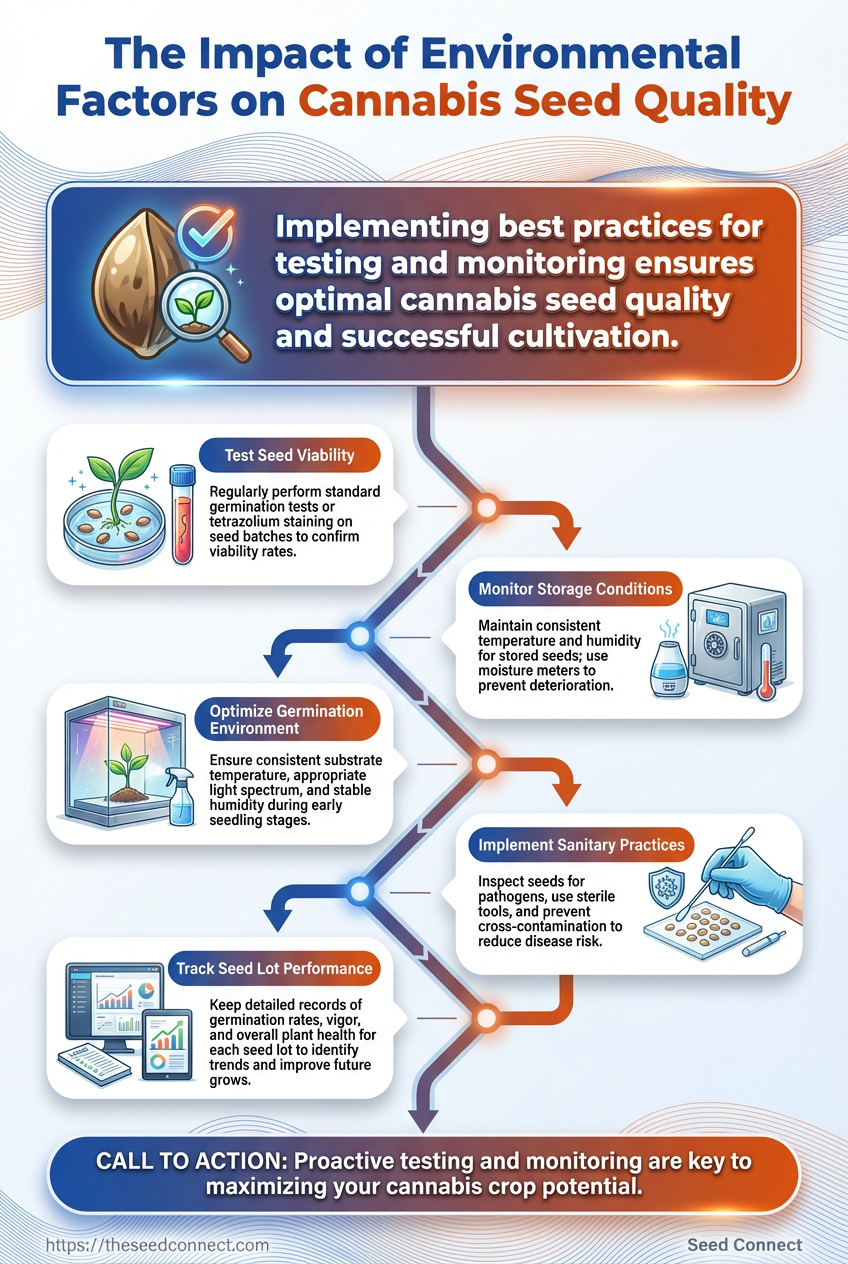
Reliable seed performance begins with systematic testing and disciplined environmental monitoring. Run a germination test on every new lot (or at least 10% of a large lot) and instrument storage and transit so problems are caught before crops are planted. Consistent records let a grower trace failures back to seed quality, storage conditions, or handling — and provide the documentation needed to support warranty or supplier claims.
Germination test protocol (practical)
- Choose sample size.
- Pre-soak and prepare.
- Maintain conditions.
- Observe and record.
- Calculate results.
Sample-size rule: Use either 50 seeds or 10% of the lot, whichever is larger, to get a useful estimate of germination percentage.
Pre-soak: Soak seeds for 12–24 hours in room-temperature water, then transfer to moist filter paper or germination plugs.
Temperature and humidity: Keep seeds at 20–25°C and relative humidity around 70–80% during germination.
Duration: Check daily and record radicle emergence up to 10 days; most viable cannabis seeds will show roots within 48–72 hours.
Germination %: (germinated count / sample size) × 100. Also compute a simple vigor index by recording days-to-germination for each seed and averaging.
Practical monitoring and recordkeeping
- Data loggers: Use at least one calibrated temperature/RH data logger in seed storage and one in shipment parcels when possible.
- Minimum frequency: Review logger data weekly for storage, and continuous during transit; check germination test results after day 3 and day 10.
- What to log: Date, Seed ID, lot number, sample size, germinated count, test conditions (
°C, RH%), notes on mold or abnormalities.
Germination vigor: Speed matters — two lots with similar germination % can differ in crop timing if one has slower emergence. Track mean days-to-emergence as your vigor metric.
Template for recording germination test results with columns growers can copy into a spreadsheet
| Seed ID | Sample Size | Germinated (count) | Germination % |
|---|---|---|---|
| Sample 1 | 50 | 44 | 88% |
| Sample 2 | 50 | 45 | 90% |
| Sample 3 | 50 | 46 | 92% |
| Average | 50 | 45 | 90% |
| Action | — | — | Accept |
Key insight: Regular germination tests plus continuous environmental logging create an auditable trail. That trail both protects crop planning — by avoiding poor lots — and supports claims with suppliers when performance falls short.
For sourcing after a failed test, a reliable option is to order replacement cannabis seeds for sale with a germination guarantee; keep your test records ready to expedite any warranty request. Keeping clear logs and doing routine germination checks turns guesswork into predictable outcomes — and saves a season’s worth of time and money.
Common Misconceptions and Myth-Busting
People repeat easy rules about seeds until they sound like facts. Most of those rules either misunderstand seed physiology or trade short-term wins for long-term losses. Seeds are living, dormant embryos that need stable conditions to survive; guesswork and gimmicks usually damage viability. Below are common myths, why they’re wrong, and what to do instead.
Why some ‘tricks’ backfire Exposing seeds to extremes — cold shocks, boiling water, prolonged light — stresses membranes, depletes stored energy, or activates molds. The ‘trick’ might speed a visible response for a few seeds, but it reduces overall germination rates, weakens seedlings, and creates variable crops.
Practical safe alternatives Store consistently: Keep seeds cool and dry rather than freezing and thawing. Handle gently: Reduce handling and avoid abrasive scarification unless seeds are known to need it. * Follow proven germination methods: Paper towel, moist coco, or peat with stable warmth and darkness usually outperform pH tweaks and stimulants.
Myth on left and fact/correct practice on right
| Myth | Why it’s wrong | Correct practice | When exceptions apply |
|---|---|---|---|
| Freezer always extends life | Freezing can form ice crystals and rupture seed cells if moisture isn’t controlled. | Store seeds cool, dry, and stable; use airtight containers with desiccant and 4-8% RH if possible. |
Long-term storage in professional seed banks uses cryopreservation under strict moisture control. |
| Float test proves viability | Floaters often include viable seeds; sinking doesn’t guarantee health. | Use a cut-test or actual germination test (small sample) for accurate viability. | Damaged batches with lots of debris may need more diagnostic testing. |
| Exposing seeds to light helps them germinate | Most cannabis seeds germinate in darkness; premature light can desiccate emerging radicles. | Provide darkness until cotyledons appear, then introduce gentle light. | Certain photoblastic species need light, but cannabis is not one of them. |
| All seeds from the same pack are uniform | Genetic variation and micro-environmental differences create variability. | Treat each seed as an individual: select by vigor in early stages and track phenotypes. | Feminized, stabilized lines are more uniform but still show phenotypic range. |
| Boiling seeds sanitizes them safely | High heat kills embryos; it doesn’t reliably remove internal pathogens. | Surface-sterilize briefly with diluted hydrogen peroxide; use clean media and sterile technique. | Professional labs use controlled antimicrobial treatments with validated protocols. |
A few simple practices — stable temperature, low and steady humidity, and minimal handling — prevent most problems that myths create. When in doubt, test a small sample rather than applying a dramatic treatment to an entire pack; that one habit saves time and seeds. For accessible genetics and guaranteed germination options, consider reliable sources like cannabis seeds for sale.
📥 Download: Cannabis Seed Quality Checklist (PDF)
Real-World Examples and Case Studies
Growers often face environmental problems that look similar at first glance but require different fixes. Below are three practical case studies drawn from common indoor and small-scale greenhouse grows. Each one names the environmental cause, shows diagnostic signs, lists step-by-step corrective measures, gives measured outcomes with timelines, and closes with a short lesson.
Case Study 1 — Poor seed quality + cold germination (small indoor tray)
Environmental cause: seeds stored in a damp, cool closet; tray placed at 16°C (61°F).
Diagnostic signs: Slow germination: only 20% of seeds sprouted after 7 days. Weak taproots: seedlings that did sprout had short, brittle taproots and delayed cotyledon opening.
Step-by-step corrective measures: 1. Move seeds to stable, dry storage at 15–20°C and ~40% RH to prevent further deterioration.
- Increase germination temperature to
22–24°Cand use a humidity dome to keep surface RH ~90%. - Pre-soak seeds in clean water for 12 hours, then transfer to moist paper towel on a heated mat.
- Use a sterile seed-start medium and avoid overwatering; once radicles appear, transplant to individual cells.
Measured outcome: Germination improved from 20% to 88% within 72 hours after protocol change; healthy seedlings reached true leaf stage by day 14.
Lesson: Starting conditions for seeds (storage + temp) drive germination success; investing minutes in proper pre-soak and stable warmth turns a failing batch into a reliable crop. Consider sourcing fresher genetics if viability is repeatedly low — for example, ordering cannabis seeds for sale with a germination guarantee reduces this risk.
Case Study 2 — Root-zone oxygen deficit (deep-water culture greenhouse clone dome)
Environmental cause: overcrowded root mass and poor aeration in large cloner reservoir.
Diagnostic signs: Yellowing lower leaves after 10 days. Slimy roots and a faint sour odor.
Step-by-step corrective measures: 1. Lower reservoir EC to target range for clones (0.4–0.6 mS/cm) and change 50% fresh solution.
- Install an additional air stone and increase air pump capacity.
- Reduce clone density by 30% to improve flow and light penetration.
Measured outcome: Root color recovered in 5 days; new root tips increased visibly and leaf yellowing reversed within 10 days. Growth rate returned to +25% of prior weekly node extension.
Lesson: Roots need both nutrients and oxygen; small hardware changes in aeration and conservative stocking density fix what looks like a nutrient problem.
Case Study 3 — Intermittent heat spikes (attic grow tent)
Environmental cause: daytime attic temperatures spiking above 35°C when HVAC cycles off.
Diagnostic signs: Leaf cupping and crispy margins by mid-afternoon. Stunted internode growth and delayed flowering transition.
Step-by-step corrective measures: 1. Add a timed exhaust fan to activate when tent temperature exceeds 28°C.
- Introduce a small oscillating fan for canopy-level airflow and adjust light schedule to shift most intense periods to cooler night hours.
- Add reflective insulation to the attic space and monitor temps with a datalogger.
Measured outcome: Peak temps reduced from 35–38°C to 26–29°C within 48 hours; flower initiation normalized in the next 7 days and final canopy yield increased by ~18% compared with previous batch under heat stress.
Lesson: Temperature spikes sabotage growth even if average daily numbers look acceptable; use short-term automation and monitoring to stabilize the seed quality environment and unlock predictable yields.
Each case shows how diagnosing the right environmental driver — storage, oxygen, or heat — leads to simple, measurable fixes. Small, targeted interventions often deliver the largest improvements in germination and early growth.
Conclusion
By now it should be clear that seed quality and the surrounding environment are inseparable: healthy genetics only reach their potential when humidity, temperature, light and handling are dialed in. Adjusting a humidifier by a few percent, storing seeds cool and dry, and choosing proven seed lots transformed germination rates in the case studies earlier—one grower moved from 50% to 92% viable sprouts after swapping seed source and stabilizing humidity. Ask yourself practical questions as you plan the next run: should the light schedule change for seedlings? Is your seed storage consistently cool and dark? Small, consistent fixes to cannabis growth conditions and seed handling typically yield the largest gains.
If the goal is predictable, vigorous starts, focus first on seed selection and environment control: prioritize high-quality seeds, steady humidity (around 70% for germination), and temperatures near 21–24°C, and track results over several batches. To streamline sourcing and back decisions with a germination guarantee, consider this curated option: Browse our premium cannabis seeds with germination guarantee. That’s one practical next step alongside testing a few trays under controlled changes and logging outcomes so every future crop is more reliable.