
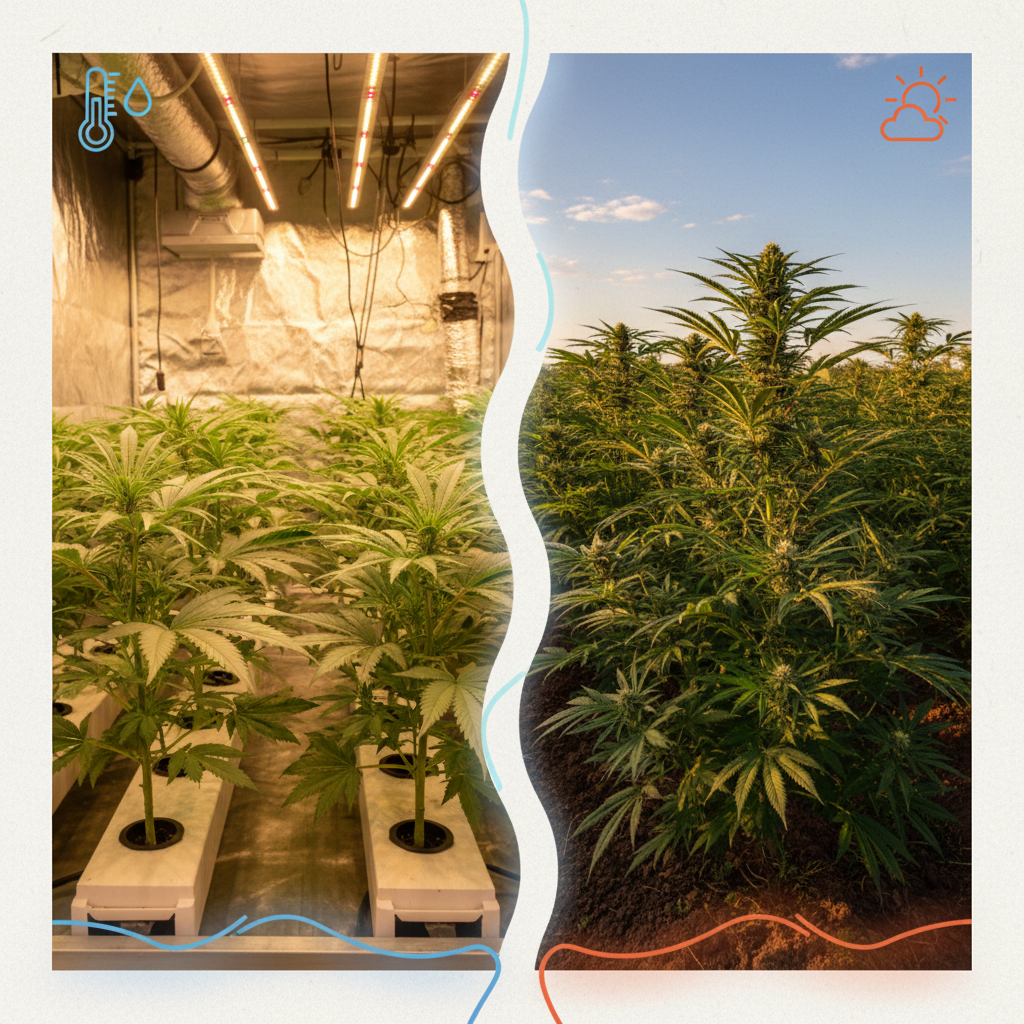
Choosing between Indoor vs Outdoor Cannabis Cultivation depends on factors such as climate, budget, available space, environmental control, and overall growing goals. Indoor cultivation gives growers more control over lighting, temperature, and humidity, while outdoor growing relies more heavily on natural conditions and seasonal timing.
According to the University of Vermont Extension, controlled growing environments can help growers manage factors such as light, temperature, and humidity more consistently.
In this guide, The Seed Connect compares the main pros and cons of indoor and outdoor cannabis cultivation to help growers understand which approach may suit their situation best.
Quick Answer:
Indoor cannabis cultivation offers precise control over conditions, letting you enjoy year-round harvests.
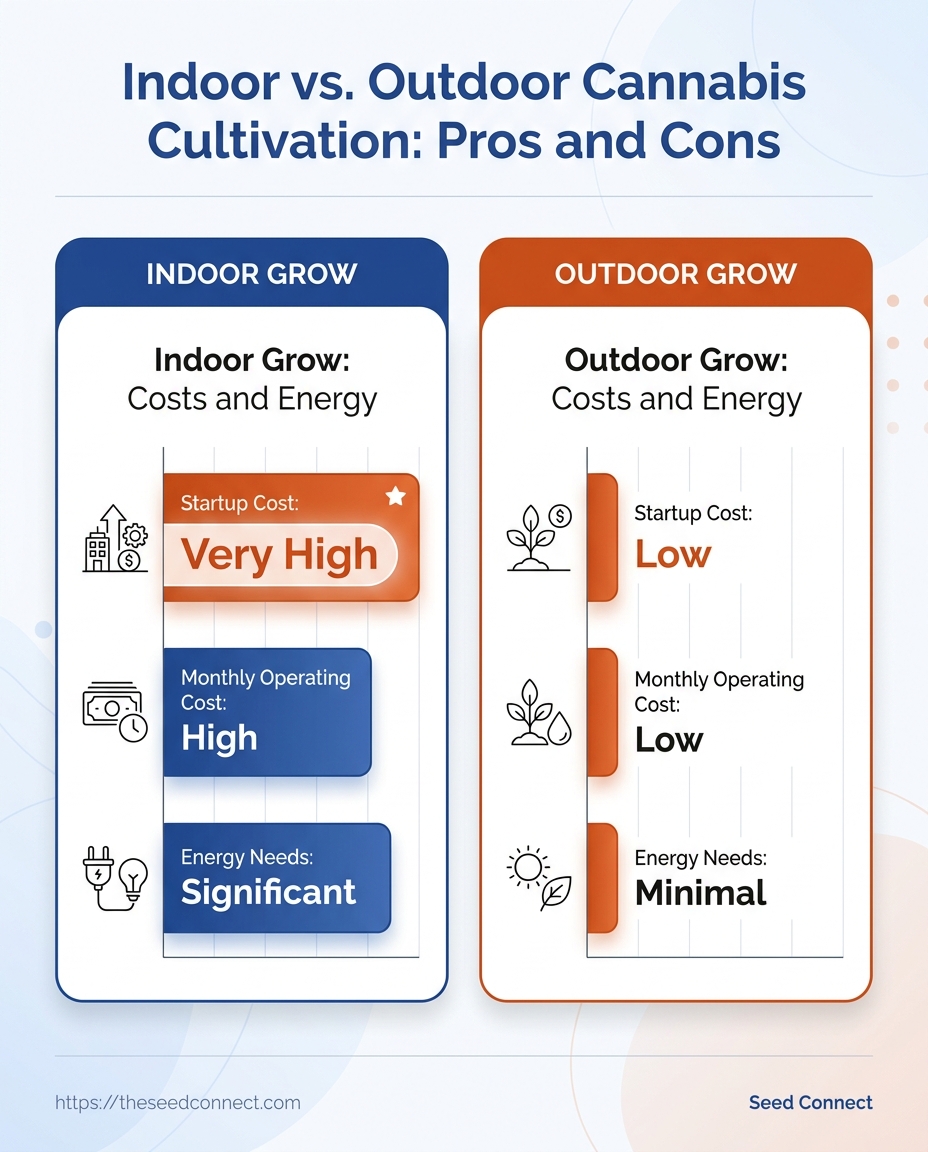
It typically costs $830 to $2,750 to set up and $270 to $530 monthly.
In comparison, outdoor cultivation depends on natural sunlight, with initial costs of $200 to $600 and monthly expenses of about $50 to $140, but has seasonal limits.
The best choice hinges on your specific budget, space, and how much environmental control you seek.
Indoor Growing vs. Outdoor Cannabis Cultivation: What Is the Real Difference?
Do you want complete control over your growing conditions, or would you prefer to let sunlight and seasonal changes do the work? This choice influences almost every other decision, including equipment, costs, harvest timing, and plant size.
Indoor growing provides control over light, temperature, humidity, airflow, and privacy.
It also supports year-round harvests, but the setup demands more equipment and regular energy use.
The latest planning ranges from our growing guidance place indoor startup costs at $830–$2,750 and monthly operating costs at $270–$530.
Outdoor cannabis cultivation follows natural light and local weather.
It usually costs less because sunlight is free, while plants can develop much larger root systems and canopies.
Outdoor plants generally need at least 6–8 hours of direct sunlight each day to thrive, and the growing season depends on regional climate.
A quick comparison of indoor and outdoor grow priorities
Table: Indoor Growing vs. Outdoor Cannabis Cultivation: What Is the Real Difference? — Factor, Indoor growing, Outdoor cannabis cultivation & more
| Factor | Indoor growing | Outdoor cannabis cultivation | Best fit for |
|---|---|---|---|
| Environmental control | Direct control of light, temperature, humidity, and airflow | Conditions depend on sunlight, rain, wind, and temperature | Precision-focused growers |
| Startup cost | About $830–$2,750 for equipment and setup | About $200–$600 for basic preparation and supplies | Lower budgets: outdoor |
| Ongoing energy needs | Moderate to high, mainly from lighting and ventilation | Low, with sunlight providing the main energy source | Lower monthly costs: outdoor |
| Space and privacy | Uses a defined indoor area and offers stronger privacy | Requires suitable outdoor space and may be visible | Private growing: indoor |
| Seasonality | Can run throughout the year with scheduled light cycles | Usually limited by frost, daylight, and local weather | Flexible timing: indoor |
| Pest and weather exposure | Easier to shield plants from rain and many pests | Greater exposure to insects, storms, mold, and temperature swings | Lower exposure: indoor |
| Potential plant size | Often limited by tent height and available floor space | Plants can grow much larger in open ground or large containers | Large plants: outdoor |
| Harvest flexibility | Multiple cycles are possible within a year | Usually follows one main seasonal cycle | Frequent harvests: indoor |
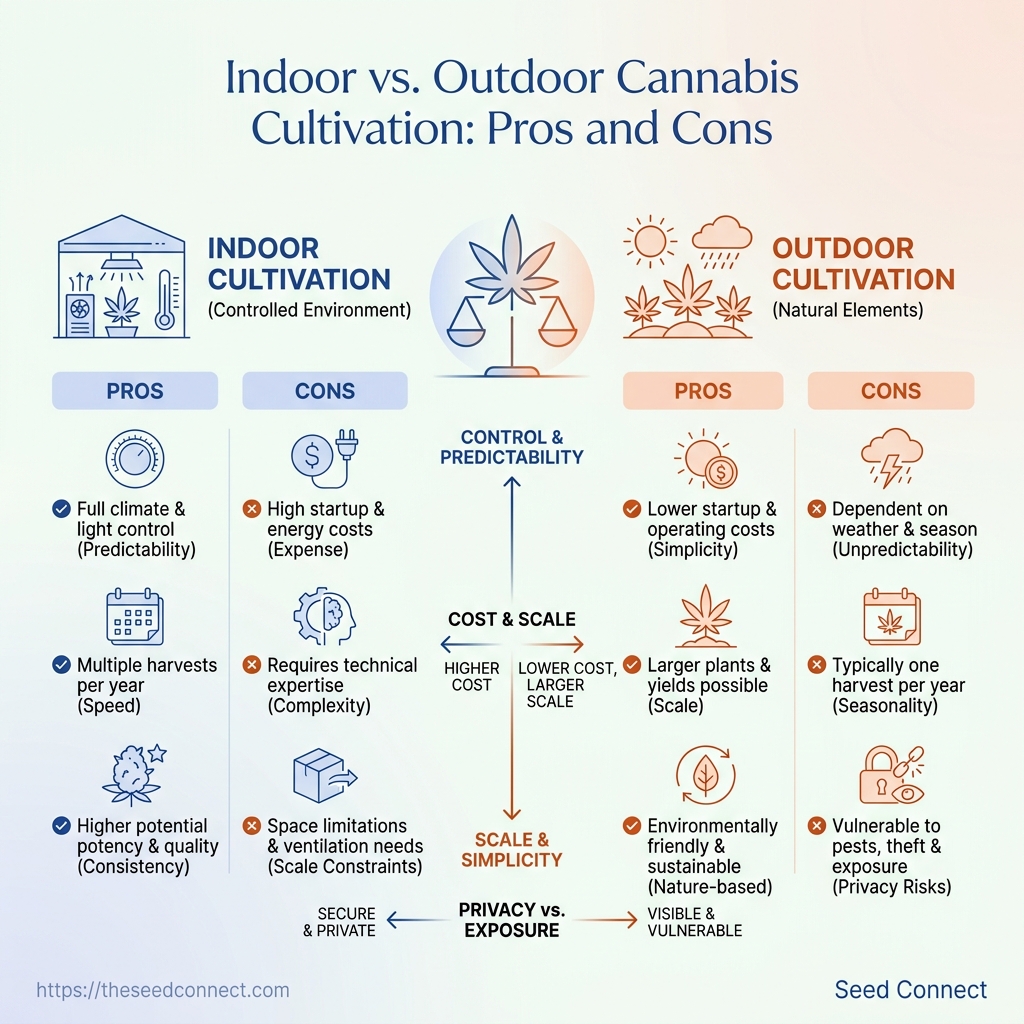
Neither method wins every category.
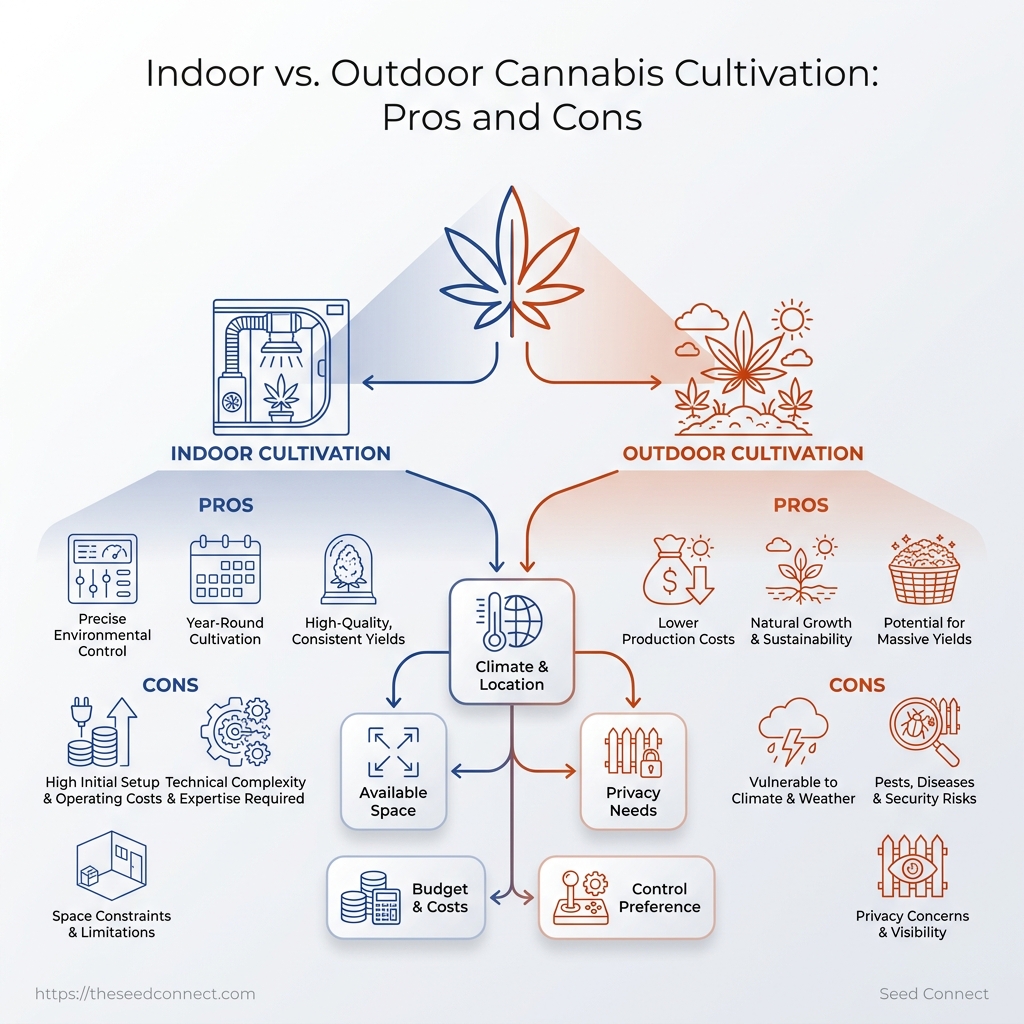
Indoor growing favors control, privacy, and timing, while outdoor cultivation favors lower costs, natural light, and larger plants.
A grower with a 4×4-foot tent may plan around an average 1–2-pound yield per cycle, while an outdoor grower may prioritize available land and sunlight instead.
The right choice depends on your climate, privacy needs, available space, time, and budget.
Always confirm local cultivation laws before starting.
Indoor Growing: The Advantages of a Controlled Environment
Indoor growing gives you total control over light, temperature, and humidity.
Indoor growers can customize their setups for plant health.
In contrast, outdoor cultivation is limited by natural conditions.
This inherent stability enables year-round planting and the ability to respond quickly to any fluctuations in plant needs.
A well-planned indoor setup creates reliable conditions, significantly minimizing outside variables that can threaten plant development.
Thus, for those who need predictability, indoor cultivation presents a unique advantage, fostering an environment where issues can be foreseen and mitigated, leading to more stable yields.
Indoor Growing: The Trade-Offs to Consider Before Starting
Could your home handle a grow room every day, not just on setup day? Indoor growing demands equipment, power, cleaning, and regular checks long after the plants are established.
The initial purchase is only part of the cost.
Lighting, timers, fans, ducting, containers, meters, and climate equipment can add up quickly, while electricity becomes a recurring expense.
Growing Marijuana Indoors vs. Outdoors also identifies startup costs and electricity use as major indoor disadvantages.
Daily responsibility creates another clear difference between indoor growing and outdoor cannabis cultivation.
A missed light cycle, clogged filter, empty reservoir, or rising humidity level can create problems before the plants show visible stress.
A simple routine helps: check temperature and humidity, inspect leaves, confirm airflow, and look for leaks or standing water.
The room itself needs planning.
Grow lights produce heat, fans create constant noise, and ventilation must move warm, humid air safely.
Odor control also requires more than placing one filter in the corner; the exhaust path must be sealed, and replacement filters need regular attention.
Indoor growing mistakes that can create avoidable problems
Table: Indoor Growing: The Trade-Offs to Consider Before Starting — Potential issue, Why it matters, Prevention step & more
| Potential issue | Why it matters | Prevention step | Early warning sign |
|---|---|---|---|
| Inconsistent light schedule | Interruptions can stress plants and disrupt flowering signals. | Use a reliable timer and check it weekly. | Plants show unusual stretching or uneven development. |
| Poor airflow | Still air encourages weak stems and fungal problems. | Position circulation fans above and below the canopy. | Leaves remain motionless or damp for long periods. |
| Excess humidity | Persistent moisture raises the risk of mold and mildew. | Track humidity with a meter and improve exhaust when needed. | Condensation appears on walls, ducts, or leaves. |
| Overwatering | Saturated roots may receive too little oxygen. | Let the growing medium dry appropriately between waterings. | Leaves droop while the medium stays wet. |
| Insufficient odor control | Escaping odor can affect nearby rooms and household privacy. | Seal exhaust connections and maintain the carbon filter. | Odor appears outside the grow area. |
| Ignoring electrical safety | Moisture and overloaded outlets create avoidable hazards. | Keep connections dry and use properly rated equipment. | Warm plugs, flickering lights, or tripped breakers. |
These checks work best when recorded rather than trusted to memory.
A small log can reveal rising humidity, repeated breaker trips, or watering patterns before they become expensive problems.
Indoor cultivation rewards consistency, but it does not forgive neglect.
Budget for ongoing power and maintenance, then choose a setup that fits your time, space, and tolerance for noise and odor.
Outdoor Cannabis Cultivation: The Advantages of Growing With Nature
Sunlight can replace one of the biggest demands of indoor growing: artificial light.
Outdoor cannabis plants benefit from the sun’s full daily cycle, without needing grow lamps, timers, or light-proof rooms.
For a 2026 growing plan, use 6–8 hours of direct sunlight as a practical benchmark, then account for shade from buildings, trees, and fences.
Our outdoor growing guide provides additional guidance on site conditions and setup.
Natural light also reaches a large plant from several angles as the sun moves across the sky.
That broad exposure can support strong branching when the plant has enough space and receives steady care.
More space for roots and plant growth
A container, raised bed, or prepared outdoor plot can give roots far more room than a compact indoor setup.
More root volume can support larger plants, particularly when the soil drains well and the growing season lasts long enough.
Outdoor conditions do not guarantee a bigger harvest.
Poor drainage, pests, storms, or a short autumn can quickly change the result.
Still, with suitable land and a favorable climate, plants can develop a wider canopy and more extensive root systems than many space-limited gardens allow.
- Choose the site carefully: Look for consistent sun, good airflow, and protection from standing water.
- Plan for mature size: Leave enough room between plants for branches, maintenance, and airflow.
- Protect the root zone: Use well-draining soil and a mulch layer that holds moisture without keeping the stem wet.
Lower equipment needs
Outdoor cannabis cultivation usually needs fewer electrical systems and fewer specialized devices.
Sunlight replaces lamps, while natural airflow may reduce the need for powered circulation.
A grower may still need containers, supports, fencing, water access, pest controls, and weather protection.
The cost advantage depends on the property and climate.
A remote garden may require irrigation, security, or soil preparation, while a ready garden plot may need very little equipment.
Growing Marijuana Indoors vs. Outdoors also identifies high startup and electricity costs as major indoor considerations.
Match seeds to the local season
Seed selection should follow the growing conditions, not only desired potency.
Choose genetics suited to the local season length, expected temperatures, humidity, and available space.
A compact plant may suit a small yard, while a vigorous variety needs room and stronger support.
Consider a gardener with suitable land, reliable sunlight, and a long, dry season.
For that grower, an outdoor garden may be the practical choice because nature supplies the light, the plot allows generous root growth, and equipment remains simple.
When the climate fits, outdoor growing turns natural resources into real advantages.
Good site planning and climate-matched seeds make that choice far more dependable.
Outdoor Cannabis Cultivation: The Risks and Limitations
A grower can follow every basic step and still lose an outdoor crop to one untimely storm.
Outdoor cannabis cultivation relies on conditions that no grower can fully control.
Therefore, ‘natural’ does not always mean simple.
The work may cost less than indoor growing, but expenses still appear in fencing, containers, soil, pest control, supports, water, and crop protection.
Published estimates suggest outdoor setup costs are approximately $200–$600, with monthly operating costs around $50–$140, based on figures accessed in 2026 from Seed Connect’s indoor and outdoor growing cost guide.
Weather creates the largest uncertainty.
Extended rain can keep flowers damp, while strong wind can split branches or topple containers.
High humidity also raises the risk of mold and mildew, a concern noted in Project CBD’s comparison of sungrown and indoor cannabis cultivation.
Problems That Outdoor Growers Cannot Ignore
A plant outside also becomes part of the local ecosystem.
Aphids, caterpillars, mites, deer, rabbits, and other animals may damage foliage or flowers before symptoms become obvious.
Dense growth near fences, paths, or neighboring properties can create visibility and security concerns as well.
Seasonal timing adds another variable.
A late spring cold spell may slow early growth, while an early autumn storm can arrive before flowers fully mature.
The general requirement for at least approximately 6–8 hours of direct sunlight per day, reported in Seed Connect’s outdoor growing guide and accessed in 2026, does not guarantee suitable temperatures, dry weather, or a safe harvest window.
Avoid these common planning errors:
- Copying another calendar: Use local frost patterns, daylight changes, rainfall, and typical autumn weather instead of copying dates from another grower.
- Ignoring drainage: Test the site after heavy rain. Poor drainage can keep roots stressed even when the soil surface appears dry.
- Waiting for visible damage: Inspect leaves, stems, and flowers regularly for pests, rot, and broken branches.
- Planting without protection: Plan supports, animal barriers, and weather shelter before the canopy becomes difficult to manage.
- Harvesting by date alone: Check plant maturity and current weather together. A calendar date cannot predict every season.
Outdoor cultivation rewards preparation, but it does not remove risk.
Growers who plan around their own climate and protect against likely threats usually make fewer costly mistakes than those following a generic schedule.
How to Choose Between Indoor and Outdoor Growing
What matters more to you: having predictable control or getting lower-cost access to natural sunlight? The best choice depends less on ambition and more on your space, climate, schedule, and risk tolerance.
Select indoor growing when privacy, year-round timing, and exact control are your top priorities.
A suitable room or tent lets you set the light cycle and respond quickly to changes in temperature, humidity, or airflow.
It also makes repeated harvest planning possible, although the setup requires more equipment and ongoing attention.
Choose outdoor cannabis cultivation when your local season provides enough sunlight, your planting area is secure, and you have room for larger plants.
Outdoor plants need at least 6–8 hours of direct sunlight each day, according to our outdoor growing guide.
Local laws, planting dates, weather patterns, and neighborhood privacy should all be checked before starting.
Decision checklist for choosing a growing method
Table: How to Choose Between Indoor and Outdoor Growing — Question, Indoor points toward, Outdoor points toward & more
| Question | Indoor points toward | Outdoor points toward | What to check first |
|---|---|---|---|
| Do you have a suitable private space? | You have room for a tent, ventilation, and safe electrical access. | You have a secure, discreet garden or permitted outdoor area. | Local rules, landlord restrictions, visibility, and household safety. |
| Is your local growing season long enough? | Your season is short, cool, wet, or unpredictable. | Your region supports a complete growing cycle before severe weather. | Frost dates, rainfall, humidity, and seasonal daylight. |
| Can you manage equipment and electricity? | You can maintain lights, airflow, timers, and climate equipment. | You prefer a simpler setup with fewer powered devices. | Electrical capacity, noise, heat, and estimated monthly costs. |
| How important is year-round timing? | You want more control over planting and harvest dates. | You are comfortable following the natural seasonal cycle. | Your schedule, storage needs, and available growing windows. |
| How much weather exposure can you accept? | You want to reduce direct exposure to storms, rain, and sudden temperature shifts. | You can protect plants from wind, heavy rain, pests, and animals. | Shelter options, drainage, fencing, and local weather history. |
| What level of daily monitoring is realistic? | You can check equipment and plant conditions consistently. | You can visit the plants often enough to spot problems early. | Work schedule, travel plans, and access to the grow area. |
The published cost estimates for planning in 2026 suggest indoor startup spending is approximately $830–$2,750, compared with $200–$600 outdoors; monthly estimates are also higher indoors at around $270–$530, versus $50–$140 outdoors (indoor and outdoor growing cost guidance).
A hybrid approach can work when you have both a controlled space and a reliable outdoor site.
It becomes impractical when managing two environments creates more work than your schedule allows.
Match the seeds to the setting
Seed choice should follow the method, not come first.
Ask whether the genetics suit indoor height limits, outdoor seasonal timing, or the level of privacy you need.
Also confirm whether the seeds are feminized, autoflowering, or selected for high THC, since each option supports different planning goals.
Before buying, ask about seed quality, germination support, replacement terms, and grower guidance.
Our Cannabis Seeds are backed by a germination guarantee and support for growers comparing indoor and outdoor conditions.
The best method is the one you can manage consistently.
Match the grow differences to your real space, climate, budget, and available time.
Legal, Safety, and Practical Planning Before You Grow
Could one overlooked rule turn a perfectly legal grow into a headache for you? Before ordering seeds or setting up a growing space, check the laws that apply to your specific location, including your country, state, province, county, or municipality.
Rules may cover the age of the grower, allowable plant counts, cultivation locations, visibility from public areas, security measures, and possession limits.
Some jurisdictions permit personal cultivation but require plants to remain indoors, locked, or hidden from public view.
Others restrict cultivation entirely, even where cannabis possession is allowed.
Seed rules can differ from cultivation rules.
A seed may be treated as a cannabis product, an agricultural import, or a controlled item, depending on the destination.
The latest indoor and outdoor growing guidance from our team can help with practical preparation, but local authorities and customs agencies determine what is lawful where you live.
Check before placing an order
International shipping adds another layer of risk.
Customs may inspect, delay, return, or seize a package if seeds cannot legally enter the destination country.
A shipping option that works for one country may not work for another, so review import rules before purchasing and never assume that discreet packaging changes the legal position.
Create a written record of the rules you found.
Save the relevant government page, note any permit requirements, and confirm whether plant limits apply per person, household, or property.
Protect people, property, and privacy
Good planning also covers ordinary household risks.
Indoor growing can involve lights, fans, pumps, timers, and extension leads running for long periods.
Use equipment rated for the load, keep electrical connections away from water, avoid overloaded outlets, and follow manufacturer instructions.
Guidance on indoor growing costs and setup requirements also highlights the added equipment and maintenance involved.
Outdoor cannabis cultivation needs its own practical safeguards.
Secure the area against unauthorized access, prevent runoff into neighboring property, and plan how water use may affect household supply or local restrictions.
Odor, noise, lighting, and visible structures can create tension with neighbors, even when cultivation is permitted.
Pre-grow checklist
- Legality: Confirm cultivation rights, plant limits, privacy rules, and security requirements.
- Location: Check whether your indoor room or outdoor area meets local visibility and access rules.
- Seed choice: Select genetics suited to the permitted plant count, available space, and local climate.
- Equipment: Inspect electrical loads, water access, ventilation, storage, and fire safety before planting.
- Shipping: Verify seed import rules, customs conditions, and delivery restrictions for your destination.
- Support: Keep reliable growing guidance available, especially for germination, plant health, and troubleshooting.
A lawful grow starts with paperwork, not germination.
Taking an hour to verify rules and safety details can protect your privacy, budget, household, and future harvest.
Is it better to grow cannabis indoors or outdoors?
It depends on your priorities.
Indoor growing provides precise control over factors like light and temperature for year-round harvests.
On the other hand, outdoor cultivation uses natural sunlight and can be less expensive.
Choose indoor for predictability and outdoor for lower costs.
What are the main differences in yield between indoor and outdoor cannabis cultivation?
Indoor cultivation typically results in more consistent yields due to controlled conditions, while outdoor yields can be variable based on weather and seasonal factors.
However, outdoor plants can grow larger due to natural sunlight, potentially resulting in higher overall biomass.
What environment is best for growing cannabis?
The best environment for growing cannabis depends on whether you choose indoor or outdoor cultivation.
Indoor growing allows for complete environmental control, whereas outdoor cultivation benefits from natural sunlight.
Consider factors like privacy, space, and climate before deciding.
How much does it cost to grow cannabis indoors?
Setup costs for indoor cannabis cultivation are approximately $830 to $2,750, with monthly operating expenses around $270 to $530.
These costs include equipment like lighting, fans, and climate control systems.
Can you grow cannabis outside in all climates?
No, outdoor cannabis growth is limited by climate conditions.
Successful cultivation typically requires a climate with sufficient sunlight and appropriate temperatures, making some regions unsuitable for outdoor growing due to extreme weather or insufficient light.
Choose the Growing Environment You Can Manage
The biggest difference between indoor and outdoor cannabis cultivation isn’t just yield or plant size.
It is control: indoors, you manage light, temperature, humidity, and timing, while outdoors, the sun and seasons do much of the work for you.
The right choice depends on which trade-offs fit your space, budget, local climate, and daily routine.
A grower with limited outdoor space may value an indoor setup because it offers privacy and more consistent conditions, even with added costs for lighting, ventilation, and electricity.
Another grower may prefer the simplicity of natural sunlight and accept weather-related risks, pests, and a shorter growing season.
These grow differences matter because the easiest environment to start with is usually the one you can monitor consistently rather than the one that sounds most productive.
Before choosing seeds or equipment, write down your available space, expected climate, budget, privacy needs, and weekly time commitment today.
Then compare those limits against the demands of each method, while checking local laws and safety requirements before planting.
A realistic plan will serve you better than chasing the biggest possible harvest, whether your next step is building a controlled indoor room or preparing a secure outdoor garden.