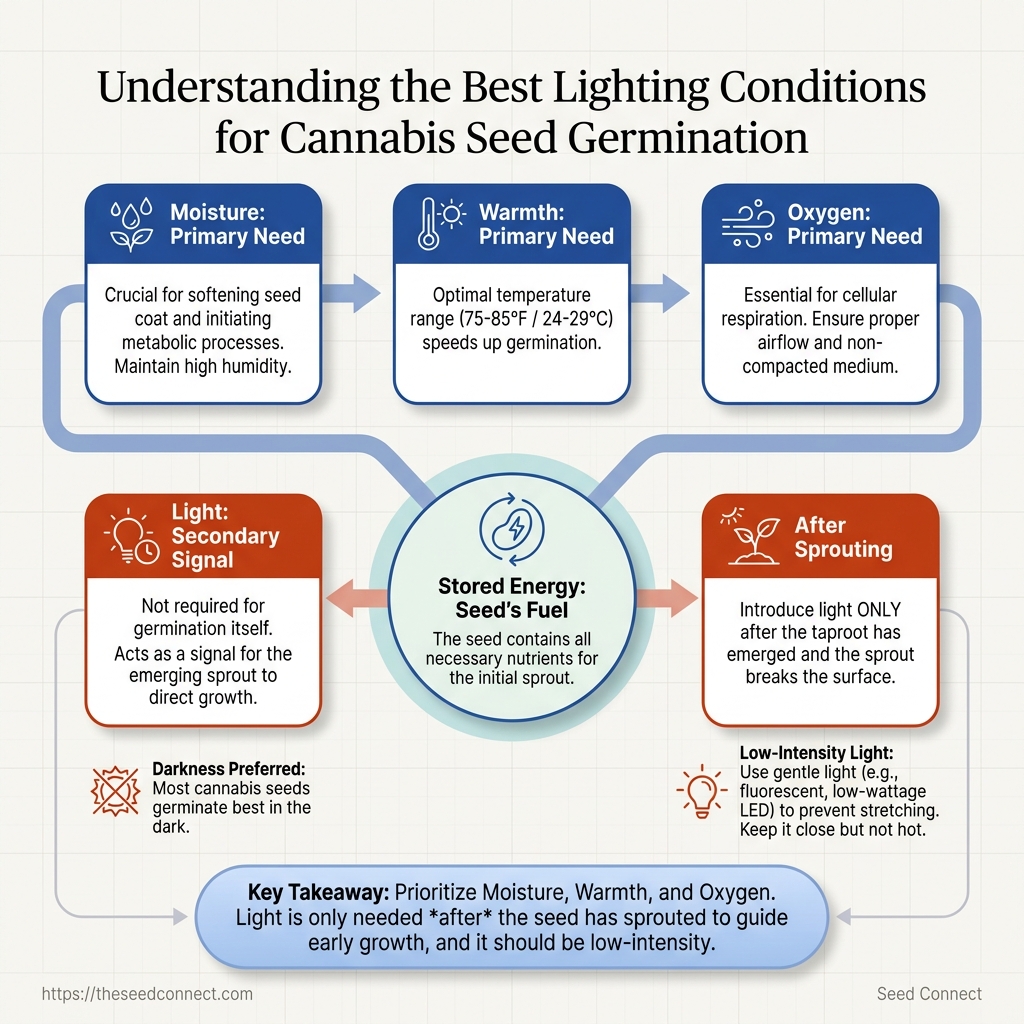

The Best Lighting Conditions for Cannabis Seed Germination depend on the stage of growth. Cannabis seeds generally begin germinating in warm, moist, and dark conditions, while light becomes important once the seedling emerges and starts developing its first leaves.
According to the University of Maryland Extension, moisture, oxygen, and suitable temperatures are the main factors that trigger seed germination, while light becomes more important after emergence. In this guide, The Seed Connect explains when to introduce light, how much seedlings need, and which common lighting mistakes to avoid.
Quick Answer: Cannabis seeds generally do not need light to germinate because the sprout mainly depends on stable moisture, warmth, and oxygen around the seed.
Using bright or direct light too soon can slow down the seed cracking.
It heats the area and dries the top of your medium too quickly.
So, keep the germination conditions calm and consistent.
Once the seed breaks the surface, lighting becomes much more important for normal seedling growth.
Table of Contents
Bright light is not the goal during germination
Many growers instinctively shine a strong lamp on fresh seeds, mistaking brightness for activity.
However, germination depends more on gentleness than on intensity.
Direct light can dry out the medium too fast, which stresses the seed at a sensitive time.
Soft, indirect light or even complete darkness can help maintain a stable environment while the seed cracks.
A tray left under a strong grow light may form a crust on the surface, which can prevent moisture from reaching the seed, despite appearing adequately moist from above.
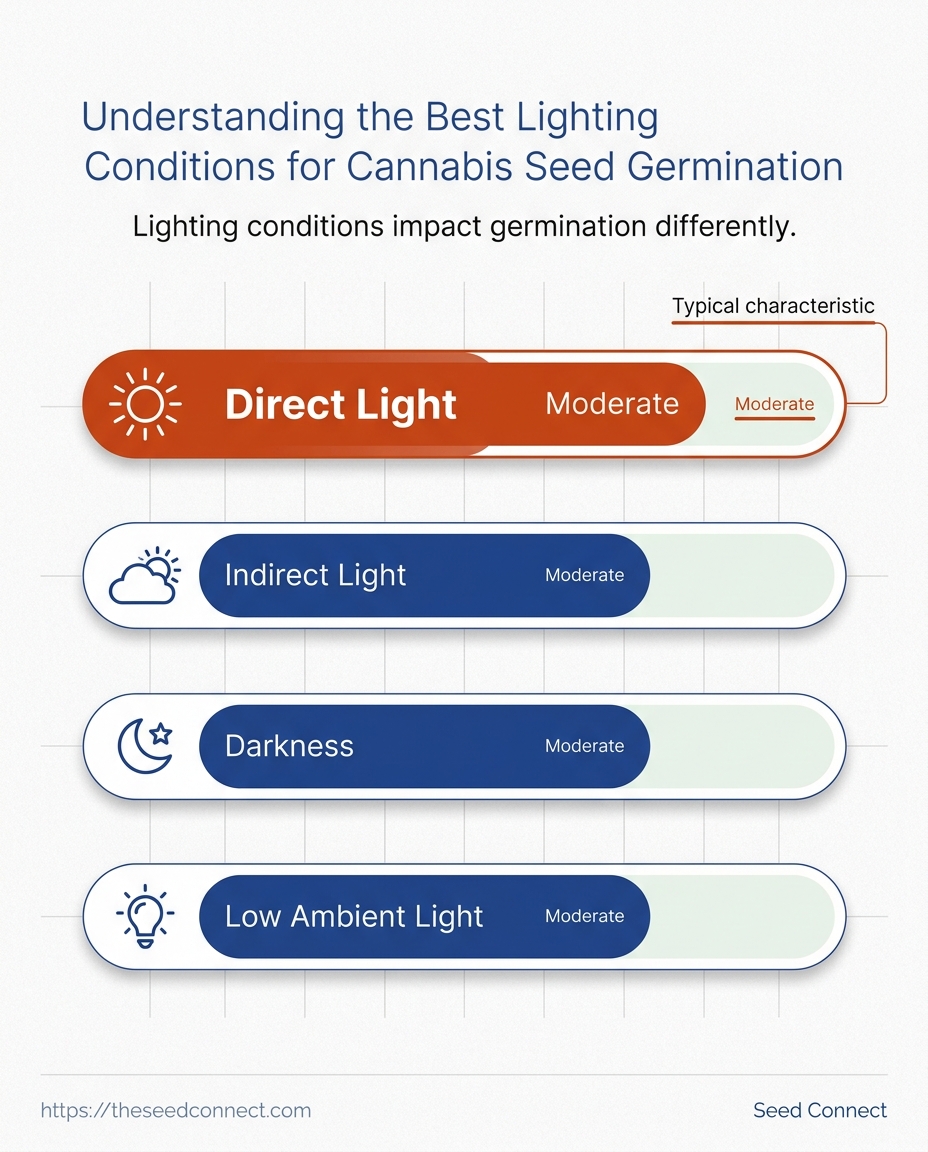
Lighting Conditions Compared
| Lighting condition | Effect on seeds | Best use case | Risk level |
|---|---|---|---|
| Direct light | Dries the surface quickly; stresses seeds | Only after sprouting | High |
| Indirect light | Provides visibility without heat | For monitoring germination | Low |
| Darkness | Maintains cool, steady conditions | Initial sprouting | Low |
| Low-intensity ambient light | Harmless if it doesn’t heat the environment | Room-temperature setups | Low to moderate |
Ultimately, ensuring that your cannabis seeds have a stable, calm environment during germination is most effective.
After sprouting occurs, then considerations of brighter light can begin.
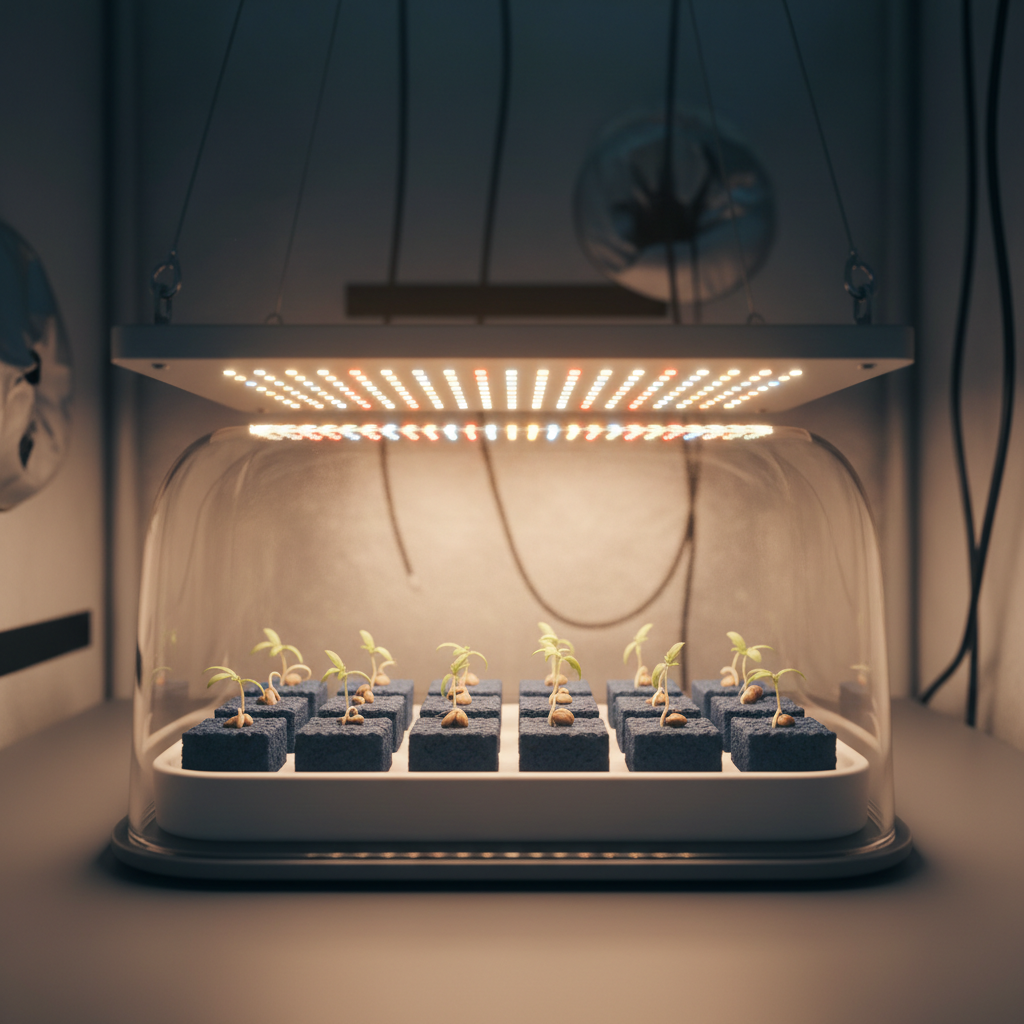
A simple germination setup that keeps light under control
A grower can do everything “right” and still lose a seed to a messy setup.
A clear tray under a hot lamp, a lid that is opened too often, and moisture that changes from wet to dry can make a simple start very stressful.
A stable germination environment usually beats a clever one.
A small opaque container, evenly damp medium, steady warmth, and soft ambient light are enough for the early stage.
Think of cannabis lighting as something that stays nearby, not something that shines on the seed itself.
The seed germination light should never be the main event while the seed is still trying to crack.
Build the setup in four moves
Start with a clean, small container that holds humidity without trapping heat.
A shallow tray, starter cube, or covered dish works well as long as it stays dark enough to protect the seed from direct light.
-
Choose the container first.
Use something that blocks harsh light and keeps the medium from drying out too fast.
-
Add moisture, not saturation.
The medium should feel like a wrung-out sponge, not a soaked towel.
-
Keep temperature steady.
Place the container where warmth stays consistent through the day and night.
-
Set the light outside the zone.
Keep the lamp high enough that it brightens the room, not the seed pocket.
Place the seed where it stays calm
The safest spot is usually just below the surface of the medium, centered rather than pressed against the edge.
That gives the seed moisture on all sides while keeping it shielded from direct light and sudden air movement.
Center placement: Keeps moisture even on every side.
Loose cover above it: Holds humidity without packing the seed down.
Indirect ambient light only: Lets the room stay usable without flooding the container.
No puddles underneath: Prevents the seed from sitting in water and losing oxygen.
A small, quiet setup often gives better results than a complicated one with too many moving parts.
Once the seed is protected from harsh cannabis lighting, the rest of the germination process usually feels much easier to manage.
Small lighting mistakes can slow germination more than you think
Ever had a seed sit there, looking alive but going nowhere?
That delay often gets blamed on the seed, but cannabis lighting can be the hidden problem.
A germination setup does not need dramatic brightness to fail; it only needs a little too much exposure, a little too much heat from the lamp, or repeated changes in the germination environment.
Tiny shifts matter because a seed is reading cues, not just soaking up water.
When the balance between darkness, warmth, and moisture keeps changing, sprout timing becomes less predictable, even when the setup looks fine to the eye.
The lighting mistakes that usually cause trouble
A seed can handle a calm, steady setup.
It struggles when the light situation keeps changing.
-
Light leaks overnight: A strip of light from a timer, closet gap, or nearby fixture can interrupt the quiet conditions seeds prefer.
-
Lamp too close to the tray: The issue is not brightness alone.
Heat from the fixture can dry the top layer faster than the root can move.
-
Frequent checks under strong light: Every opening changes the microclimate, and repeated flashes can disturb the seed’s rhythm.
-
Uneven coverage: One side of a tray may stay warmer and drier, while another stays cooler and damp.
-
Reflective surfaces overheating the space: Bright walls or plastic lids can bounce light and build more heat than expected.
A simple check helps here: if one tray corner keeps sprouting later than the rest, the light pattern is worth inspecting before anything else.
When seed quality is the real issue
Not every slow seed is reacting to light.
Some seeds are simply weaker from the start, and good seed germination light habits cannot fully fix that.
Old storage, poor maturity, or physical damage can all create a slower or uneven result.
In those cases, a careful germination environment still helps, but the seed may germinate late, unevenly, or not at all.
That is why two seeds in the same setup can behave very differently.
If the lighting looks controlled and the delays keep happening, seed quality becomes the next place to look.
Good conditions can support a strong seed, but they cannot rescue one that was never healthy enough to begin with.
Small lighting mistakes are easy to miss because they feel harmless in the moment.
In germination, though, harmless-looking changes are often the ones that slow everything down.
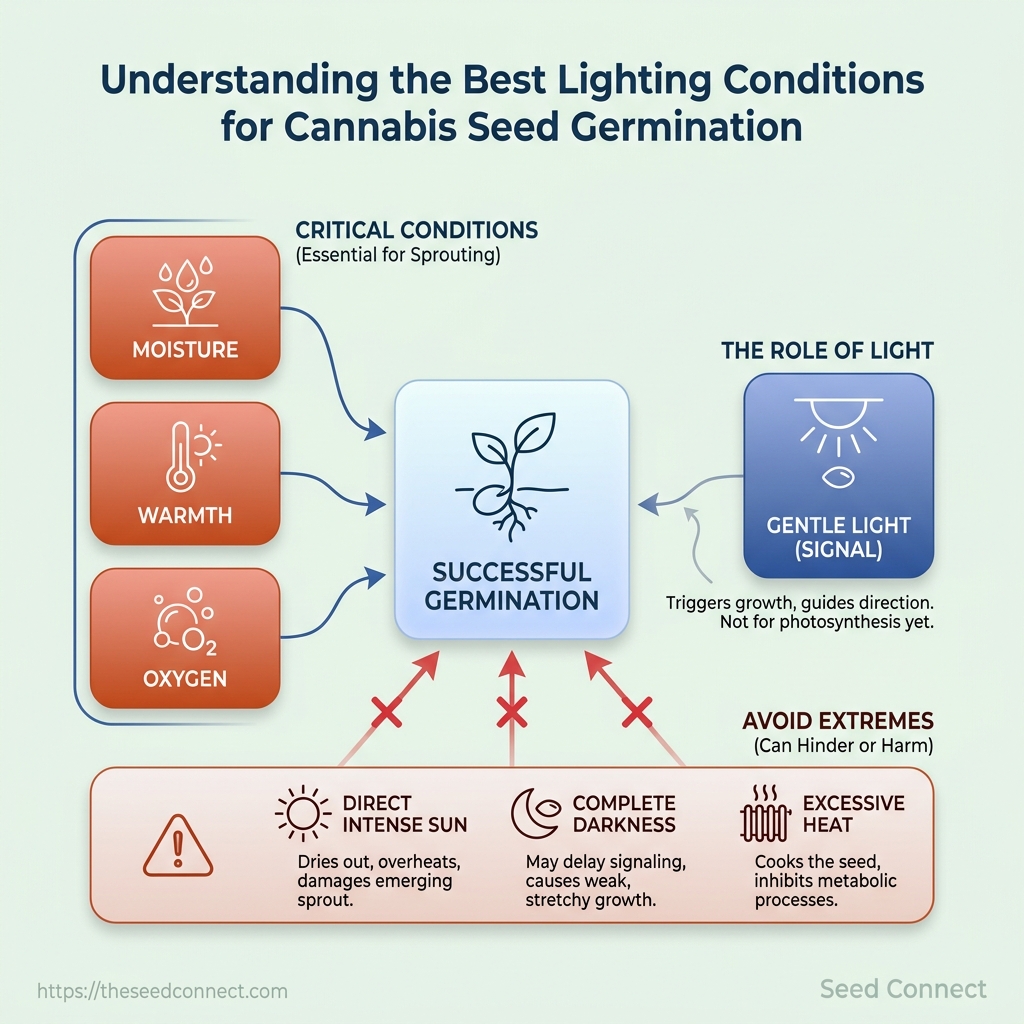
More light is not always better for cannabis seeds
A key lighting tip for successful cannabis germination is to find the right light intensity and distance.
A seed usually responds better to a calm, steady germination environment than to constant adjustments and bright exposure.
Direct light can dry out the medium quicker than you might think.
When that happens, the seed spends more energy fighting stress instead of settling into germination.
Seed germination light should feel like background light, not a spotlight.
Think of it as enough light to check progress without turning the setup into a hot, changing space.
Do vs. don’t: common lighting habits that help or hurt
| Do | Don’t | Why it matters |
|---|---|---|
| Keep seeds in a stable, covered space | Expose seeds to strong direct light | Stability helps preserve moisture and prevents unnecessary stress. |
| Use gentle ambient light only when checking progress | Leave a lamp blasting the tray all day | Soft light is enough for inspection without drying the medium. |
| Keep the setup in one consistent location | Move the tray between bright and dark spots | Constant shifts change temperature and moisture patterns. |
| Check moisture before turning lights up | Leave the medium too dry under bright lamps | Dry conditions can stall germination before the root even emerges. |
The pattern is simple: consistency beats intensity.
Good cannabis lighting for seeds is usually about reducing swings in heat, moisture, and exposure, not chasing more brightness.
A practical example makes this obvious.
Two growers can use the same seeds, but the one who keeps a covered tray in a calm corner often gets more even sprouting than the one who keeps opening the lid under a strong lamp.
That approach works because the seed is still doing quiet biological work.
It does not need a flashy setup; it needs a reliable one.
For growers comparing seed types and planning their setup, Cannabis Seeds become much easier to manage when the lighting stays simple.
Keep the light boring, and the germination environment usually becomes far more forgiving.
That is where the real progress happens.
If your seeds are slow to sprout, check the environment first
A seed that appears healthy can still stop growing for simple reasons.
If nothing is happening after a few days, the problem is usually not the seed first; it is the germination environment around it.
That is why the fastest fixes come from checking the basics in order.
Moisture comes first, temperature comes second, seed quality comes third, and cannabis lighting is usually the last thing to blame.
A common mistake is changing too many things at once.
That makes it harder to see what actually helped.
Start with moisture
A seed needs consistent dampness, not a soaked hiding place.
If the medium dries out even once, the process can pause; if it stays waterlogged, oxygen gets squeezed out.
-
Check the center, not just the surface.
The top can feel fine while the middle is already dry.
-
Aim for evenly damp.
The medium should feel like a wrung-out sponge.
-
Avoid constant opening.
Every check can change humidity fast.
Then verify temperature
Warmth matters because cold slows the whole process down.
Seeds often sit still when the room swings too much between warm and cool.
A stable spot is better than a slightly warmer one that keeps changing.
Even small drops at night can make a seed look idle when it is really just delayed.
Look at seed quality next
Sometimes the seed is the issue, even when it appears normal.
A good-looking shell does not always mean strong genetics inside.
-
Check for damage.
Cracks, dents, or very pale shells can signal weakness.
-
Compare timing.
If one seed pops and another sits for much longer, the slow one may simply be less vigorous.
-
Watch for no change after conditions improve.
That usually points away from the setup.
Leave light for last
If moisture and warmth check out, then light is not a primary concern for seed germination.
At that point, the issue is usually not “too little light,” but a messy setup that is still stressing the seed.
A seed that stays unchanged for several days is giving you information, not necessarily failure.
If the basics are right and nothing has shifted, it may be time to ask for support or replace weak seeds.
On our side, that is exactly when a germination guarantee matters most, because a stalled seed should not become a guessing game.
The cleanest path is simple: fix the environment first, then judge the seed.
That order saves time, reduces frustration, and keeps the whole start much calmer.