
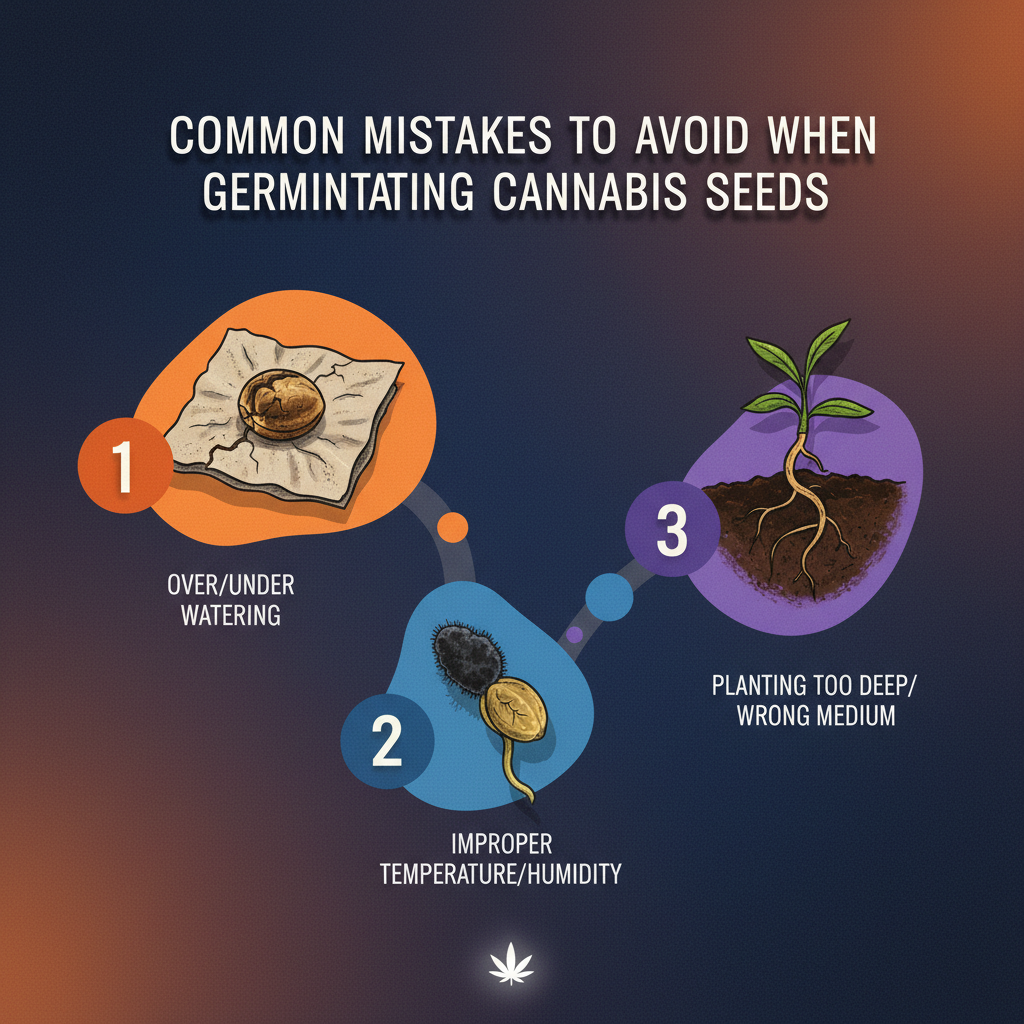
The Common Mistakes to Avoid When Germinating Cannabis Seeds are often small, but they can make the difference between a healthy taproot and a stalled seed. Too much water, unstable temperatures, rough handling, poor-quality seeds, and incorrect planting depth can all interfere with early development.
In this guide, The Seed Connect breaks down the most common germination mistakes, how to recognize them early, and the practical steps growers can take to create more consistent conditions for successful sprouting.
Quick Answer: To reliably germinate cannabis seeds, focus on three control points:
1) Moisture (damp, not dripping),
2) Air (don’t leave seeds in standing water or repeatedly soak the towel/medium), and
3) Handling (avoid touching or bending the taproot—move by the shell only when you transfer).Keep everything dark and consistently warm so the taproot can establish without pauses. If you’re germinating autoflowers, plant them directly into their final medium to avoid floating/transplant stress. Then use the numbered mistakes below for the exact fixes if something starts to stall.
Why germination goes wrong more often than people expect
A seed can look perfect and still fail for annoyingly simple reasons.
Most of the time, the seed is not the problem—the environment is.
A little too much water, a little too much heat, or one rough touch during transfer can turn a solid start into a stalled one.
That surprises people because germination sounds easy.
Common germination mistakes and the fastest fix
| Mistake | What It Looks Like | Why It Happens | Quick Fix |
|---|---|---|---|
| Overwatering | Seeds sit in standing water or a towel feels heavy and soggy | Too much moisture pushes out air | Keep the medium damp, not soaked |
| Seeds stay soggy or rot | Shell softens, smells off, or turns mushy | Water lingers too long around the seed | Drain excess water and improve airflow |
| Too much moisture and too little air | Growth stalls even though the seed looks wet | Roots need oxygen as well as water | Use a wrung-out towel or lightly moist starter mix |
| Medium dries out | The towel turns crisp or the surface crusts over | Heat or thin material causes fast evaporation | Check moisture often and re-wet lightly |
| Temperature swings | Seeds take longer than expected or stop moving | Heat is too low, too high, or uneven | Keep the space steady, warm, and dark |
| Taproot gets touched | The white root bends, snaps, or stalls after transfer | Fingers or rough tools damage the root tip | Lift seeds by the shell with clean tweezers |
| Waiting too long | The taproot grows into the towel or curls awkwardly | The seed was left in the paper towel too long | Move it as soon as the root appears and lengthens |
| Autoflowers are soaked or transplanted | Slow start, stunting, or weak early growth | Root stress hits autoflowers harder | Plant autoflowers directly into final medium |
| Tap water causes problems | Slow or patchy germination | Chlorine or mineral load can interfere | Use distilled or dechlorinated water |
| Soil is packed too hard | Seed struggles to break the surface | Pressed soil blocks the sprout | Cover lightly and avoid tamping it down |
Most common errors don’t come from one dramatic mistake—they come from stacking small ones.
Moisture, timing, and handling do the damage quietly.
That is why simple cannabis seed tips matter so much: keep things damp, steady, and gentle, and the process gets a lot less mysterious.
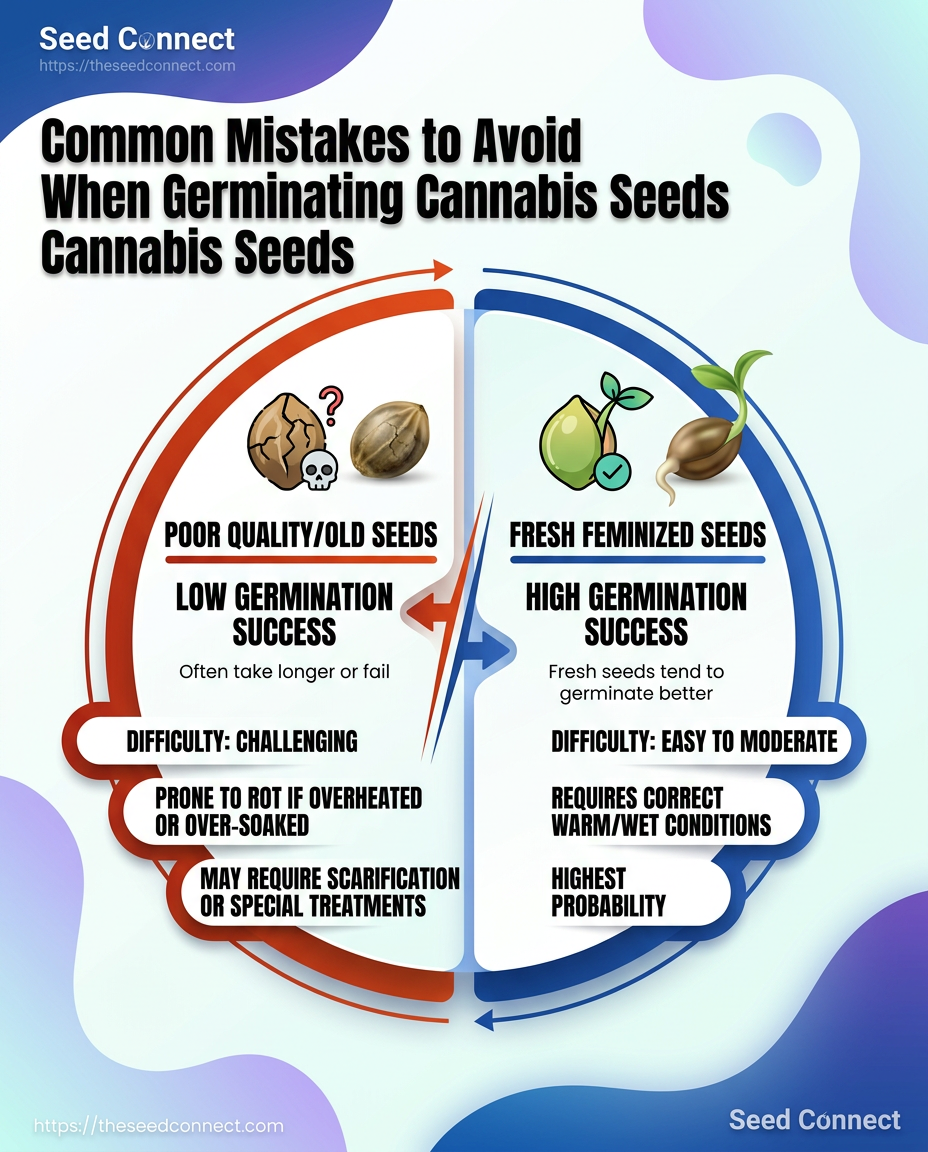
Mistake 1: Starting with poor-quality seeds
A seed can be handled perfectly and still fail in silence if it was already compromised.
Old, cracked, poorly stored, or immature seeds do not have the same energy reserve as healthy ones, so they stall before a taproot ever appears.
That is why so many cannabis germination mistakes start before water ever touches the seed.
A brittle shell can let moisture in unevenly, and a damaged embryo may never recover even under ideal conditions.
BudTrainer’s 2026 comparison puts fresh feminized seeds at 90–95% success in the paper towel method, which makes the gap painfully obvious when the seed stock is tired or weak.
According to BudTrainer’s 2026 cannabis germination guide, freshness and seed type matter more than people expect.
Poor seed quality usually shows up in a few ways.
Some seeds look dark but feel hollow.
Others have tiny cracks, flat sides, or a soft shell that dents too easily.
And sometimes the seed looks fine until it sits for a day or two and simply never changes.
- Old stock: Seeds stored too long lose vigor, even if they still look normal on the outside.
- Physical damage: Crushed shells and hairline cracks can expose the embryo to stress or contamination.
- Weak development: Small, pale, or oddly shaped seeds often lack the internal strength to push out a taproot.
Good cannabis seed tips start with a simple habit: inspect the seed before you commit time to it.
Look for a firm shell, even color, and a clean shape.
If the seed feels fragile between your fingers, it is already telling you something.
That is the painful part of common errors germinating seeds.
People blame the soak, the towel, or the soil, when the real issue was the seed itself.
Start with strong genetics and healthy stock, and the rest of the process gets a lot less dramatic.
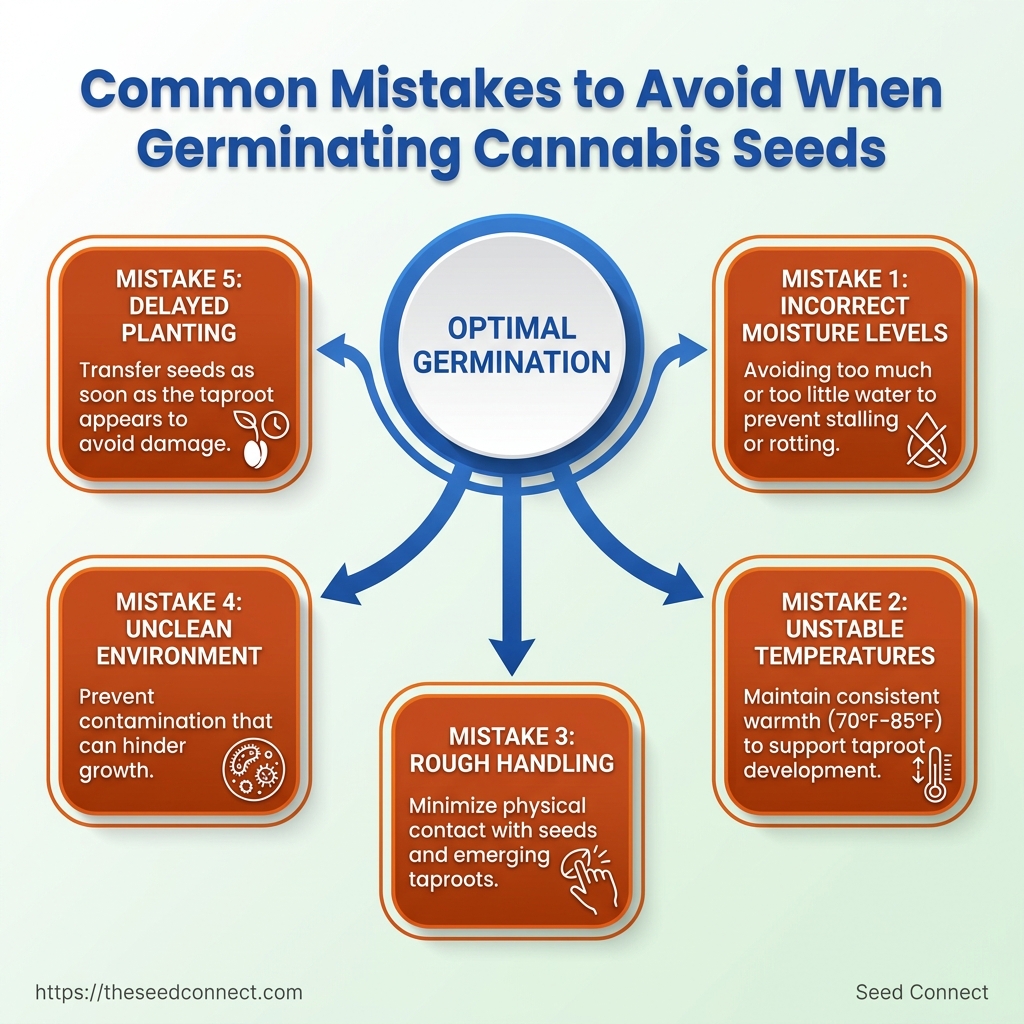
Mistake 2: Using too much water
A soaked towel feels careful, but seeds read it as trouble.
Too much water cuts off oxygen, invites mold, and leaves the seed sitting in a stale pocket instead of a living one.
The sweet spot is moist, not dripping.
If you are using a paper towel, it should feel like a wrung-out sponge, not a wet rag.
BudTrainer’s 2026 cannabis germination guide says the paper towel method works best between two damp towels, in the dark, at 70°F to 85°F, which is a good reminder that moisture and airflow have to stay in balance.
A lot of common errors germinating seeds happen after the first watering, not before.
People keep adding water because the surface looks dry, but the seed is usually sitting in a zone that stays wet much longer than the top layer.
Consider a starter cube that feels dry on top by afternoon.
A grower gives it a full pour, then does it again a few hours later.
The outside looks fine, but the root zone never gets a chance to breathe.
- Pre-moisten the medium first. Soil should hold together when squeezed lightly, then break apart with a touch.
- Use a mist, not a pour. A spray bottle wets the top without pushing the seed deeper or washing it around.
- Watch for shine. If the surface glistens or water pools, it is already too wet for germination.
- Give it time before re-wetting. The middle of the medium often stays damp long after the top layer looks dry.
Clean water matters too.
Distilled or dechlorinated water keeps the medium from carrying extra junk, but volume still matters more than anything else.
For solid cannabis seed tips, think in layers.
Keep the inside moist, keep the outside airy, and let the seed breathe while it wakes up.
Mistake 3: Letting temperatures swing too much
A seed does not like drama.
If it spends the night cold, the afternoon hot, and the next morning back in limbo, germination slows down fast.
The sweet spot is steady warmth, not heat blasts.
BudTrainer’s 2026 guide places paper towel germination at 70°F to 85°F (21°C to 29°C) in the dark, and that range is a solid target for most cannabis germination mistakes we see in home setups. Cannabis Seeds: 4 Methods Compared
The real trouble usually comes from uneven placement.
A windowsill can cool sharply at night, a radiator can dry the medium by afternoon, and a heat mat can push things from warm to cooked without much warning.
That kind of swing is one of the most common errors germinating seeds because the seed keeps trying to start, then has to pause and recover.
- Keep the spot steady. Pick one warm location and leave it there instead of moving the tray around the house.
- Avoid direct heat sources. Heat pads, appliance tops, and sunny windows can create hot spots that dry the medium unevenly.
- Watch nighttime drops. Even a room that feels fine in the day can get too cool after lights go out or the heating cuts off.
- Use warmth, not heat. SeedConnect’s germination guide points growers toward warm, dark conditions and a gentle 24–36 hour soak in distilled water before planting, which works best when the temperature stays consistent.
A grower on THCFarmer described a setup where a heating pad made the top plate too hot and caused evaporation and condensation, which is exactly the kind of swing that trips people up.
That is why steady room warmth beats chasing quick results with extra heat.
Temperature control sounds boring.
It saves a lot of headaches, though, and it gives seeds the calm conditions they need to wake up on schedule.
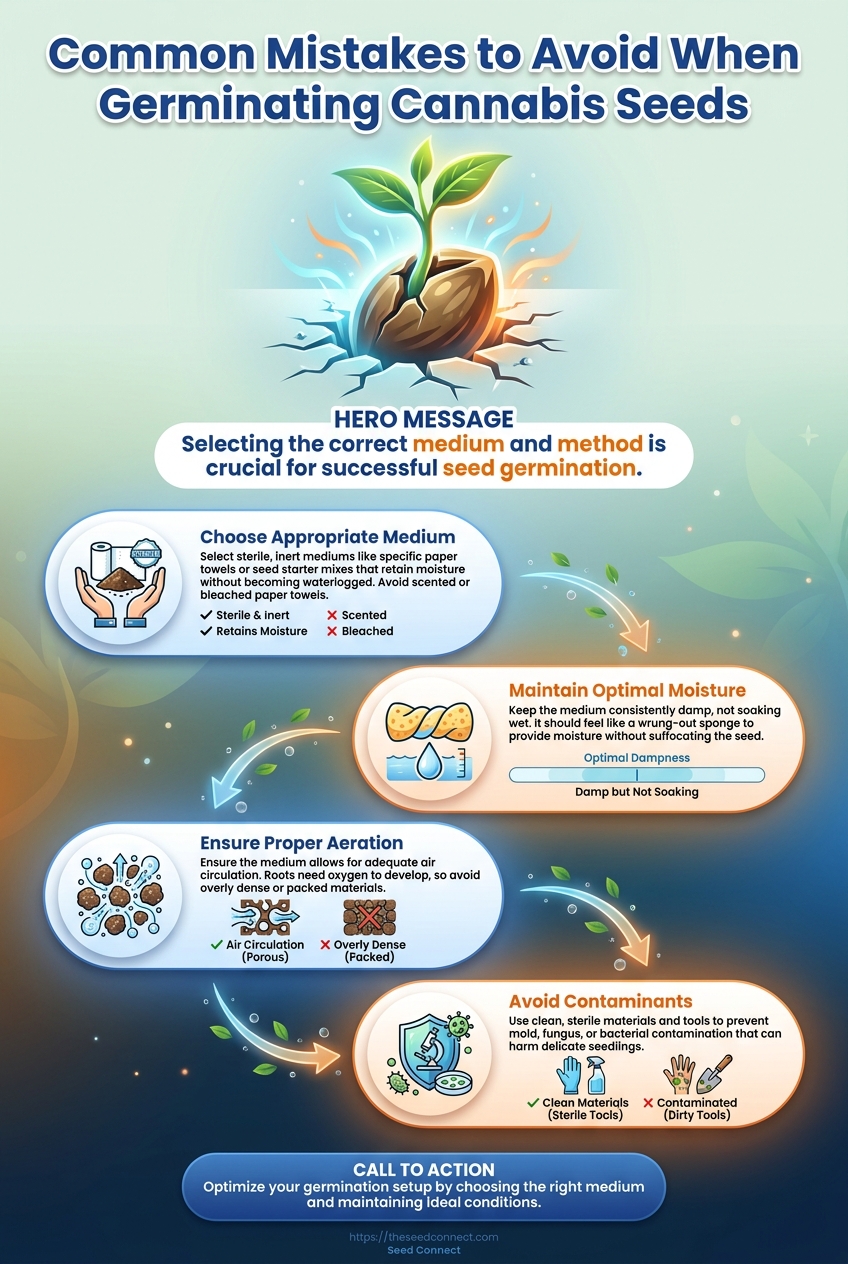
Mistake 4: Handling seeds too often
A seed does not need a babysitter.
Every time it gets picked up, rotated, squeezed, or peeked at, the odds of damage go up a little.
That damage is usually tiny at first.
A cracked shell, a bent taproot, or a disturbed seed bed can turn into a stalled sprout a day later, which is why this sits high on the list of cannabis germination mistakes.
The roughest part is timing.
BudTrainer’s 2026 guide says the taproot should be moved once it reaches about 5–13 mm, and The Seed Connect’s germination guide says to lift germinated seeds gently by the shell with tweezers, not by the root itself.
That means constant checking does not just waste time; it invites the exact mistakes that slow sprouting.
The safest habit is boring.
Open the setup as little as possible, keep your hands off the seed unless you are transferring it, and stop “just looking” every few hours.
- Check on a schedule, not by impulse. Once a day is usually enough during early germination.
- Use tweezers only at transfer time. Handle the shell, not the taproot, and move with a light touch.
- Keep the seed in place. Repositioning it again and again can break the fine root before it settles.
- Avoid constant lid-lifting. Every opening changes moisture and interrupts the quiet, steady conditions seeds prefer.
For autoflower seeds, this matters even more.
The Seed Connect recommends planting them directly in their final medium instead of floating or transplanting, since extra handling can stunt them early and there is no easy reset later.
That makes “leave it alone” one of the most useful cannabis seed tips you can follow.
If a seed looks unchanged after a few checks, that still does not mean it is failing.
It often means it is working on its own timetable, and your best move is usually to step back.
Treat germination like a setup that rewards patience.
The fewer times you interfere, the better the seed can do its job.
Mistake 5: Planting too deep or too shallow
A seed buried an inch too deep often does nothing dramatic.
It just burns through its stored energy before the sprout ever reaches light.
Too shallow causes a different kind of trouble.
The shell can dry out fast, move out of place, or sit without enough contact against moist soil.
Depth matters because it controls moisture, oxygen, and the distance the sprout has to travel.
In Seed Connect’s direct seeding guide, deeper holes are linked to seed rot or a sprout failing to break ground, while misting is used to keep moisture in place without pushing the seed lower.
A good mental model is simple: the seed wants a snug pocket, not a bunker.
Once the taproot appears, BudTrainer’s 2026 cannabis seed germination guide says to move it when it reaches about 5–13 mm, then set it gently in place instead of forcing it down.
That same idea shows up in our germination guide: the seed goes in taproot-down, gets a light soil cover, and stays undisturbed by heavy watering.
- Too deep: The sprout spends too long climbing and may stall before it reaches the surface.
- Too shallow: The seed dries out faster and loses the steady moisture it needs to finish opening.
- Packed soil: Pressing hard removes the loose air pockets roots need right away.
- Wrong seed type: Autoflowers do best planted directly into their final medium, about
¼ inch (6 mm)deep, instead of floated or transplanted later.
These common errors germinating seeds are easy to miss because the seed still looks “planted.” The real test is whether it has a clear path up and enough moisture around it without being smothered.
Keep the hole small, the cover light, and the soil gentle.
That tiny bit of restraint saves a lot of cannabis germination mistakes.
A soggy towel and a bone-dry plug often fail for the same reason: they both disrupt the seed’s balance of air and moisture.
The best germination setup keeps the medium evenly damp while still allowing oxygen to reach the seed.
Paper towel works best when it stays flat, lightly moist, and breathable. Thick, over-wet, or uneven towels trap too much water in the fibers—this is where mold and stalled growth become more likely.
Starter media behave differently. Plug/cube media (like rockwool or peat-based plugs) usually hold shape better, keep a more stable moisture pocket, and maintain steadier contact with the seed—so they can be more forgiving for people who struggle to keep a towel evenly damp.
Common errors here:
- Using a towel that’s too thick/fluffy (uneven moisture and reduced airflow).
- Choosing a plug that dries out too fast (the medium must stay lightly moist, not crusty).
- Picking the wrong medium approach for the seed type (autoflowers typically do best when planted directly into the final medium rather than being floated/transplanted).
- Ignoring structure (good starter media keep a small pocket of air instead of collapsing into sludge).
If you want fewer cannabis germination mistakes, choose a medium that stays lightly damp, stays breathable, and doesn’t turn into a wet, oxygen-poor environment.
Mistake 7: Ignoring cleanliness and contamination
A seed does not need a sterile lab, but it does need a clean start.
Mold, dust, skin oils, and old plant residue can ride in on tweezers, trays, or your hands, then hit the seed at its most fragile moment.
That’s why this is one of the more frustrating cannabis germination mistakes.
The seed looks fine right up until the taproot stalls, fuzz appears, or the whole setup smells a little off.
Moisture makes everything worse.
BudTrainer’s 2026 germination guide keeps paper towels in the dark at 70°F–85°F (21°C–29°C), which is a friendly range for sprouting but also a comfortable one for mold if the setup is dirty or left wet too long, and THCFarmer growers have noted that heat pads can create extra evaporation and condensation that only add to the mess: BudTrainer’s 2026 cannabis germination guide and THCFarmer discussion on paper towel germination problems.
Our germination guide leans on distilled water and careful shell handling for the same reason.
Fewer contaminants mean fewer chances for common errors germinating seeds to turn into full-on losses: Seed Connect germination guide.
- Dirty tools spread trouble fast. Wipe tweezers, wash hands, and avoid touching the taproot. SeedConnect specifically warns to handle sprouted seeds by the shell because the root is delicate.
- Reused materials carry mold spores. Old paper towels, dusty plates, and stained containers can keep yesterday’s problems alive. Fresh materials cost less than replacing a failed seed.
- Poor storage starts the damage early. Seeds kept warm, humid, or in light can pick up condensation and lose vigor before germination even begins. Cool, dark, dry storage is the safe lane.
- Overly wet setups invite contamination. A soggy towel or soaked plug gives mold an easy opening. Dutch Passion flags mold as a real germination risk when moisture is left unchecked: Dutch Passion’s top germination and seedling mistakes.
Cleanliness is boring in the best possible way.
It removes easy failure points, and that gives a good seed a real shot.
The best cannabis seed tips are usually the unglamorous ones: clean tools, clean water, and clean storage.
Get those right, and germination gets a lot less temperamental.
Mistake 8: Giving up too early
A seed that looks stuck on Tuesday can still crack on Thursday.
This is one of the easiest cannabis germination mistakes to make, because impatience feels productive when nothing visible is happening.
Different methods move at different speeds.
SeedConnect’s 2026 benchmark table puts paper towel germination at about 2–4 days, glass-of-water soaking at 1–3 days, starter plugs at 3–6 days, and direct soil at 4–7 days under good conditions (Cannabis Seed Germination Techniques Success).
That means the clock matters more than the mood.
BudTrainer’s 2026 guide also notes that paper towel seeds should sit at 70°F to 85°F in the dark, and that the seed should come out once the taproot reaches 5–13 mm (How to Germinate Cannabis Seeds: 4 Methods Compared (2026 Guide)).
When a seed is actually slow, not failed
A swollen shell is usually a better sign than people think.
It means the seed is taking in water, even if the split has not shown up yet.
A THCFarmer discussion on paper towel germination described heat pads running too hot and creating evaporation and condensation, which is a great reminder that a bad setup can make a healthy seed look dead (THCFarmer paper towel troubleshooting thread).
- Wait through the full window. Do not judge a paper towel seed at 24 hours if the method usually takes several days.
- Give it one extra day after conditions are fixed. If the towel dried out or the temperature swung, correct that first.
- Call it failed only after no change. When the seed stays unchanged past the normal range for the method, the odds drop fast.
- Watch for early movement. A tiny shell split, swelling, or a white tip is progress, even if it feels painfully slow.
A better rule of thumb
Count real time, not anxious time.
If the environment stayed stable and the seed still shows no change after the normal window for that method, then it is fair to move on.
That patience saves a lot of perfectly good seeds.
It also keeps growers from tossing a seed that simply needed one more day.
What to check before you start a new batch
A new batch goes smoother when the prep is boring.
Most cannabis germination mistakes happen before the seed ever touches water or soil.
At Seed Connect, the best runs start with a quick reset: check the seed condition, match the method to the seed type, and make sure the environment is ready before anything gets wet.
That lines up with current germination guidance, too; BudTrainer’s 2026 guide places paper towel germination in a dark space at 70°F–85°F (21°C–29°C), and our own germination guide uses a dark, warm soak window of 24–36 hours for weed seeds.
BudTrainer’s 2026 cannabis germination guide Our germination guide
One common slip-up is starting a batch with the wrong setup for the seed itself.
Autoflowers are the big example here, because they do better when planted directly into their final medium instead of being floated or transplanted later, which can stunt early growth.
Heat is another quiet problem; a THCFarmer troubleshooting thread notes that heating pads can run too hot and create extra evaporation and condensation around the plate.
THCFarmer paper towel troubleshooting thread
A simple seed-starting checklist for better results
| Check | Why It Matters | Pass/Fail Sign |
|---|---|---|
| Seed storage condition | Heat and moisture can reduce viability before you even begin. | Pass: Stored cool and dry. Fail: Left in a warm or damp place. |
| Seed type and method match | Autoflowers should go straight into the final medium. | Pass: Method fits the seed type. Fail: Planning to float or transplant autoflowers. |
| Water source ready | Distilled or dechlorinated water keeps impurities low. | Pass: Clean water prepared. Fail: Using questionable tap water. |
| Temperature spot checked | Stable warmth supports faster germination. | Pass: Setup stays in the 70°F–85°F range. Fail: Noticeable swings or overheating. |
| Medium pre-moistened | Seeds need damp support, not a soaked mess. | Pass: Evenly moist. Fail: Dripping wet or bone dry. |
| Tools cleaned | Dirty tweezers and trays invite contamination. | Pass: Clean, dry tools. Fail: Old residue or plant matter. |
| Transfer plan ready | Rushed handling damages the taproot. | Pass: Tweezers and holes prepared. Fail: Scrambling mid-transfer. |
| Dark, warm spot set | Seeds respond better when conditions stay consistent. | Pass: Ready before soaking starts. Fail: Still hunting for a place later. |
If more than two of those boxes fail, wait.
Fix the setup first, then start the batch with a clean slate.
That small pause saves a lot of frustration later, and it cuts down on the common errors germinating seeds for no good reason.
A calm start usually beats a rushed one.
When seed quality is the real issue
A bad batch usually leaves a pattern behind.
One stubborn seed can be a grower mistake, but several seeds from the same lot failing in a clean, steady setup points harder at the seeds themselves.
SeedConnect’s 2026 benchmark still puts paper towel germination at 80–90% under optimal conditions, so a batch that falls far below that deserves a closer look. SeedConnect’s 2026 germination techniques comparison
The fastest clue is consistency.
Healthy seeds tend to look and behave like a matched set: firm shell, intact seam, even color, and no mushy spots.
Weak batches usually show mixed age and damage markers before they ever touch water, which is why common errors germinating seeds are not always the real culprit.
BudTrainer’s 2026 cannabis germination guide and SeedConnect’s germination guide both stress careful handling by the shell, not the taproot, because once a seed is compromised, recovery gets ugly fast.
If the same method works for one seed but not for the whole batch, the seeds are probably telling the truth.
BudTrainer’s 2026 guide also reports 90–95% success for fresh feminized seeds under ideal conditions, which makes poor performance much more suspicious when temperature, moisture, and handling are already controlled.
BudTrainer’s 2026 cannabis germination guide
Signs of healthy seeds versus weak seeds
| Healthy Seed Signs | Weak Seed Signs | What It Means |
|---|---|---|
| Firm, hard shell | Cracked, soft, or dented shell | A firm shell usually protects the embryo; softness often points to poor storage, age, or physical damage. |
| Even brown, tan, or mottled color | Pale, blotchy, or faded shell | Color problems often show immature seed development or long storage exposure. |
| Intact seam and clean edges | Visible splits or shell separation | The seed may have been damaged before germination ever started. |
| Plump shape with balanced sides | Flat, shriveled, or misshapen body | Weak formation often means the seed never finished developing properly. |
| Feels heavy for its size | Feels hollow or unusually light | That usually suggests the internal tissue has dried out or never filled out well. |
| No mold, residue, or odd smell | White fuzz, dust, sticky spots, or musty odor | Contamination or bad storage is already in play. |
| Shell stays intact under light handling | Shell flakes, crumbles, or crushes easily | The seed is fragile enough that viability is already dropping. |
| Seeds in the lot look similar | Big differences from seed to seed | Mixed quality usually means uneven harvest, storage, or aging. |
A single rough-looking seed can still surprise you.
But when cracked shells, softness, faded color, and weird shape keep showing up together, the batch is carrying the problem.
That is the moment when seed quality, storage history, or age starts looking more likely than a grower mistake.
That pattern is worth trusting.
It saves time, clears up a lot of cannabis germination mistakes, and keeps the real issue from hiding in plain sight.
Choosing seeds that give you a better shot at success
A seed source matters more than most growers expect.
Freshness, storage, and seed type shape how forgiving those first few days will be, and that is where a lot of cannabis germination mistakes start.
A good match also saves you from forcing the wrong method on the wrong seed.
Seed Connect’s 2026 benchmark puts paper towel germination at 80–90% under optimal conditions, direct soil at 70–85%, and glass-of-water soaking at 70–80%, which is a strong reminder that method choice and seed quality work together.
BudTrainer’s 2026 guide says fresh feminized seeds usually do best with the paper towel method, while old, dry, or hard-shelled seeds often respond better to a brief soak in water.
Autoflowers deserve special handling.
SeedConnect’s germination guide says they should go straight into their final medium, not floated or transplanted later, because root stress can stunt them early and leave you with a plant that never quite catches up.
That one decision removes a very common error before it has a chance to start.
What a trusted source gives you
- Clear seed-type guidance: feminized, autoflower, and high-THC seeds each need a slightly different start.
- Better storage discipline: seeds handled and shipped with care keep more of their life in reserve.
- Fewer timing guesses: a defined soak window and taproot length stop you from checking too early or too late.
- Cleaner expectations: you know whether you are working with a fast paper towel start or a slower soil start.
- Real support when something feels off: a good supplier answers questions before small problems turn into dead trays.
That is why we keep our cannabis seeds focused on quality genetics, fast shipping, and a germination guarantee.
The goal is simple: fewer unknowns, fewer common errors germinating seeds, and a better shot at a healthy sprout.
Will cannabis seeds become illegal in 2026?
Cannabis seed legality in 2026 depends entirely on your local laws, not on whether seeds are germinated or how. The germination guidance here focuses on successful sprouting and avoiding taproot damage, not regulation. Check your state/country rules for any changes affecting seed possession or sale in 2026.
What are the hardest seeds to germinate?
The hardest seeds to germinate are old, cracked, poorly stored, or immature cannabis seeds. These compromised seeds have less energy reserve, so they often stall before a taproot appears even under good conditions. Damaged embryos and brittle shells can also let moisture in unevenly, reducing success rates.
How long will seeds germinate in the paper towel method?
Cannabis seeds typically show germination progress quickly in the paper towel method, but you should treat day 3 as the key checkpoint. A seed can look fine on day one yet still fail by day three if conditions are wrong. Best results come from keeping the towels moist-but-not-soaked and maintaining steady warmth in the dark.
How long does it take for a cherry seed to sprout in a wet paper towel?
Cherry seeds usually do not sprout reliably on a simple wet paper towel schedule. Most cherry seeds require cold stratification (a chilling period) before they will break dormancy. Without that cold period, sprouting can be greatly delayed or may not happen at all.
What fertilizer makes buds bigger?
Bigger buds come from correct feeding and flowering-stage nutrition, not from one magic fertilizer. During flowering, many growers use a bloom-focused fertilizer with relatively higher phosphorus and potassium and lower nitrogen compared to vegetative feeding. Still, avoid overfeeding—stressed plants can produce smaller buds even with the “right” product.
The First 72 Hours Decide More Than Most People Think
Most cannabis germination mistakes are not dramatic.
They usually come from a few small things piling up: too much water, unstable warmth, rough handling, or a starter medium that stays wet instead of evenly damp.
That is why the common errors germinating seeds can feel random when they are really predictable.
The seed that fails often is not “bad” in some mysterious way.
More often, it was buried too deep, left in a soggy paper towel, or checked so often that the taproot never got a calm start.
Keep the focus on clean tools, steady temperatures, and patience, because those cannabis seed tips matter more than fancy tricks.
Start your next batch with one clean, controlled setup and leave it alone. If you suspect seed quality is the real issue, that is the moment to switch to a fresher source instead of forcing another weak batch through the same routine.
We keep that in mind with our own seeds, because a better start makes everything that follows a lot easier.