


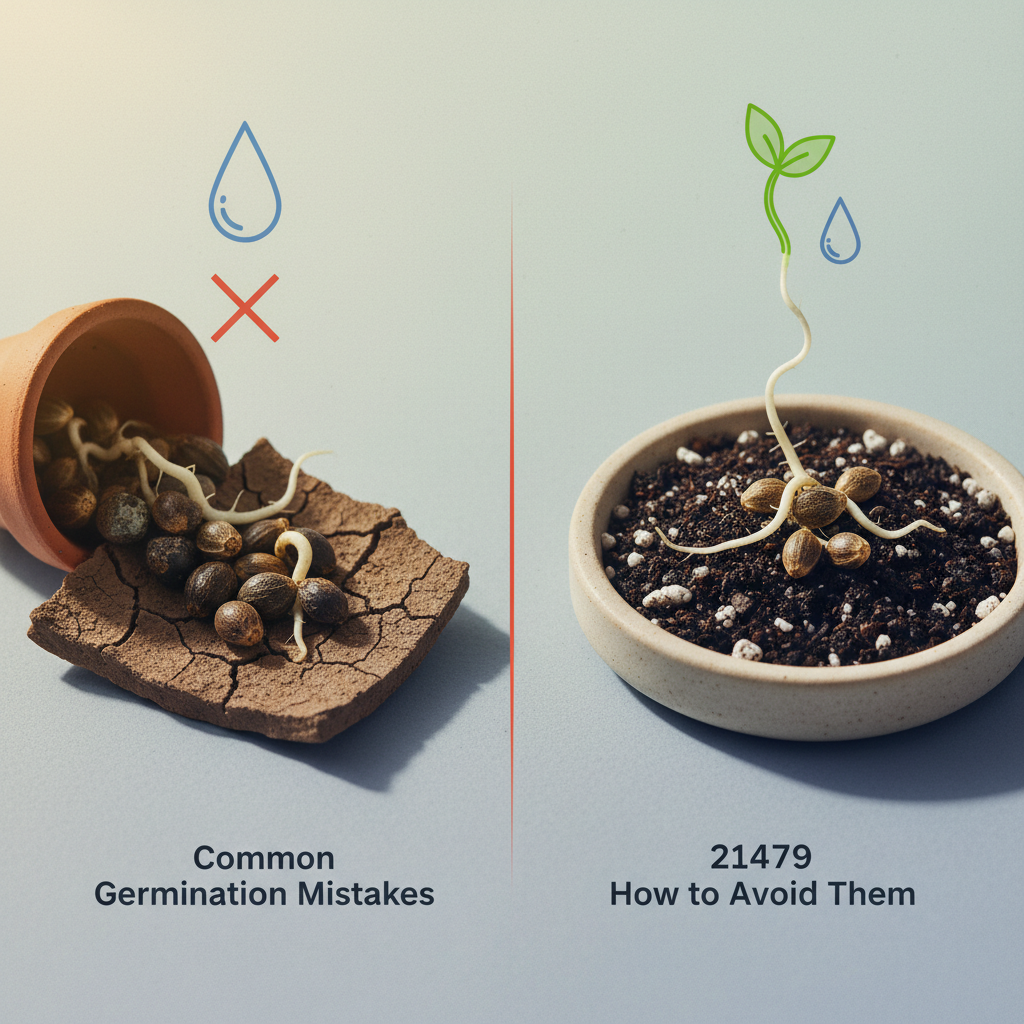
Germination can often feel uncertain, especially when a seed appears to stall after its initial crack.
You can make the process more predictable by understanding the right balance of moisture, warmth, air, and gentle handling.
Avoiding common mistakes is crucial.
These mistakes include overwatering and placing the seed in unsuitable environments.
Instead, focus on providing a reliable and stable setup to enhance the odds of successful germination.
Quick Answer: Most cannabis seeds fail to germinate from preventable conditions like overwatering, unstable temperature, incorrect planting depth, and rough handling of the taproot—often before the seed ever reaches soil.
Keep seeds cool, dark, and dry until use, start with a clean container and a well-draining medium that’s evenly damp (not soggy), and avoid changing multiple variables at once while waiting for the crack and root to form.
> Key Takeaway:
> Key Takeaway:
What If Your Germination Problem Starts Before You Plant?
Many germination mistakes happen before a seed touches soil.
> Key Takeaway:
What If Your Germination Problem Starts Before You Plant?
Many germination mistakes happen before a seed touches soil.
What If Your Germination Problem Starts Before You Plant?
Many germination mistakes happen before a seed touches soil.
A warm windowsill, damp storage area, stale growing medium, or contaminated container can lower your chances of successful germination before it even starts.
Start by checking three things: the seed’s storage history, the condition of your supplies, and the moisture level of the growing medium.
Seeds should stay cool, dark, and dry until use.
Avoid placing them near heaters, sunny windows, or areas with large temperature swings.
A seed’s appearance can offer clues, but it cannot confirm viability.
A pale or lightly marked shell may still produce a healthy taproot, while a dark, attractive seed can fail if it was damaged by heat, moisture, or age.
Check the seed without judging it by appearance alone
Look for cracks, soft spots, mold, or unusual odor.
Handle each seed gently, because pressure can damage the developing embryo inside.
Do not rely on a simple “float test” or shell color as a final verdict.
Those quick checks are not reliable enough to explain every case of cannabis seed failure.
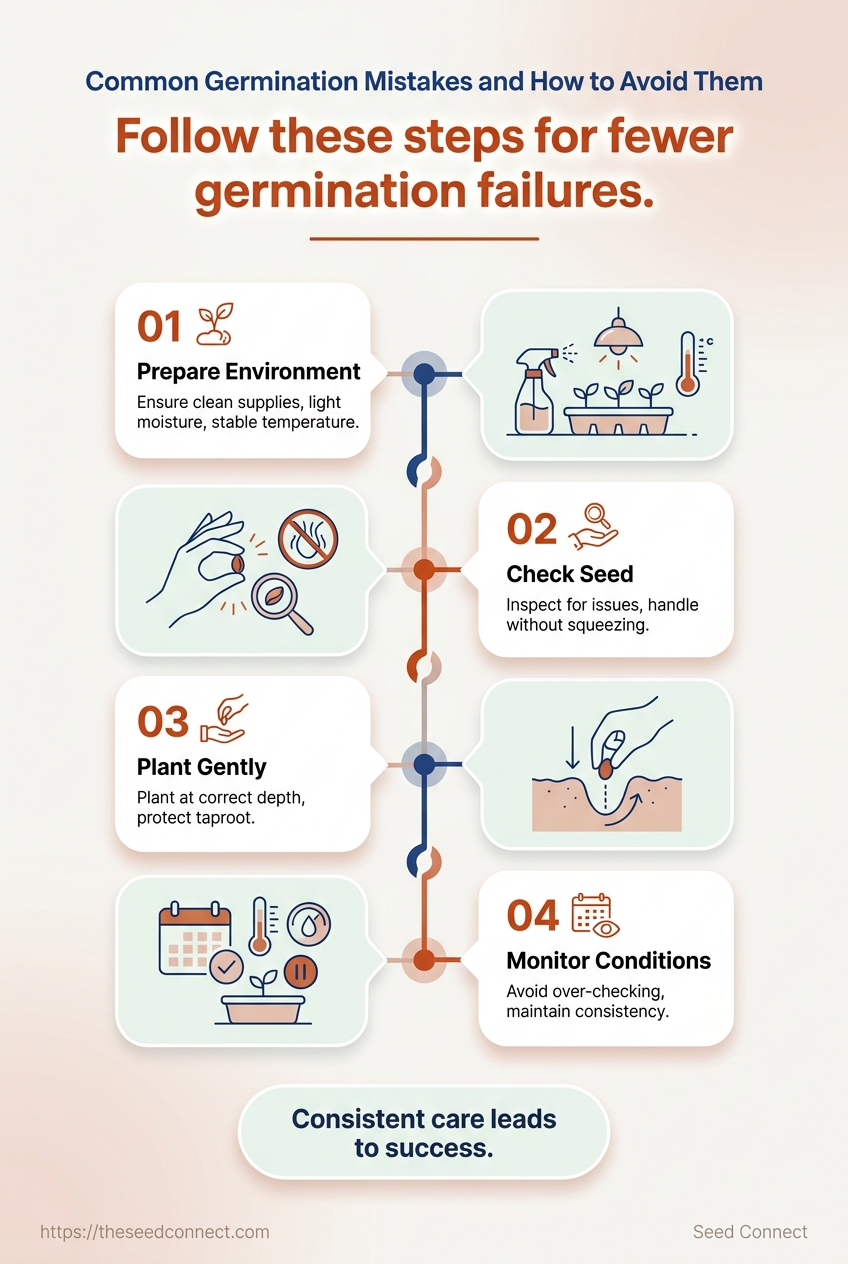
Prepare the growing environment first
Use a clean container and a light, airy medium that drains well.
The medium should feel evenly damp, not wet enough to release water when squeezed.
Temperature matters, too.
A Before planting, confirm these conditions:
- Clean supplies: Wash containers and use fresh, uncontaminated medium.
- Light moisture: Wet the medium evenly, then allow excess water to drain.
- Stable temperature: Keep the seed zone warm without placing it against direct heat.
- Gentle handling: Avoid squeezing, scraping, or forcing a closed shell.
- Legal growing conditions: Follow all local laws and age requirements before cultivating cannabis.
A reliable setup removes several variables at once.
When seeds, storage, temperature, and moisture are ready first, later germination tips become much easier to apply—and failed starts become easier to diagnose.
> Key Takeaway:
> Key Takeaway:
Mistake 1: Giving Seeds Too Much Water
Adding more water doesn’t speed up germination.
A seed needs moisture to activate, but it also needs…
> Key Takeaway:
Mistake 1: Giving Seeds Too Much Water
Adding more water doesn’t speed up germination.
A seed needs moisture to activate, but it also needs oxygen around its shell and emerging root.
Mistake 1: Giving Seeds Too Much Water
Adding more water doesn’t speed up germination.
A seed needs moisture to activate, but it also needs oxygen around its shell and emerging root.
If the growing medium stays saturated, water fills the air spaces.
This can leave the seed stalled, weak, or at risk for rot.
Aim for evenly damp, never dripping conditions.
The paper towel should feel moist without releasing water when gently pressed.
In soil or a starter plug, the surface can look slightly dark while the container still drains freely.
Budtrainer’s 2026 germination guide also recommends keeping the germination environment damp rather than waterlogged.
Moisture practices that protect oxygen
Table: Mistake 1: Giving Seeds Too Much Water — Practice, What to do, What to avoid & more
| Practice | What to do | What to avoid | Why it matters |
|---|---|---|---|
| Paper towel method | Dampen two towels, then squeeze out excess water before placing the seed between them. | Do not leave the seed floating in pooled water. | Moisture reaches the shell while air remains available around it. |
| Starter plug or soil method | Pre-moisten the medium, then place the seed at the recommended depth. | Do not saturate the container again immediately after planting. | A lightly damp medium supports hydration without blocking air pockets. |
| Watering after planting | Check the medium with a fingertip and add only a small amount when the surface begins to dry. | Do not water on a fixed schedule just because several hours have passed. | Early roots need a changing balance of moisture and oxygen. |
| Signs of excess moisture | Watch for a continually glossy surface, slow drainage, or a sour smell. | Do not ignore standing water in a tray or a plug that remains heavy for days. | These signs suggest poor air exchange before visible rot develops. |
A seed that remains unchanged while the medium stays saturated may be experiencing an oxygen problem, not a lack of water.
Check the container rather than guessing.
If it feels heavy, drains slowly, or remains wet well after watering, pause and allow excess moisture to leave.
Never compensate with more water when germination seems slow; that is one of the most common paths toward cannabis seed failures.
Healthy germination depends on restraint.
Keep the medium damp, provide drainage, and watch for early warning signs before rot has a chance to develop.
> Key Takeaway:
> Key Takeaway:
Mistake 2: Using the Wrong Temperature or Location
A grower places a cannabis seed on a cold windowsill and checks it each morning.
…> Key Takeaway:
Mistake 2: Using the Wrong Temperature or Location
A grower places a cannabis seed on a cold windowsill and checks it each morning.
Days later, the seed still looks inactive, even…
Mistake 2: Using the Wrong Temperature or Location
A grower places a cannabis seed on a cold windowsill and checks it each morning.
Days later, the seed still looks inactive, even though nothing appears obviously wrong.
The windowsill creates two problems at once.
Glass can stay cold overnight, while sunlight may heat the surface sharply during the day.
These repeated temperature changes can slow down the seed’s growth and make germination more unpredictable.
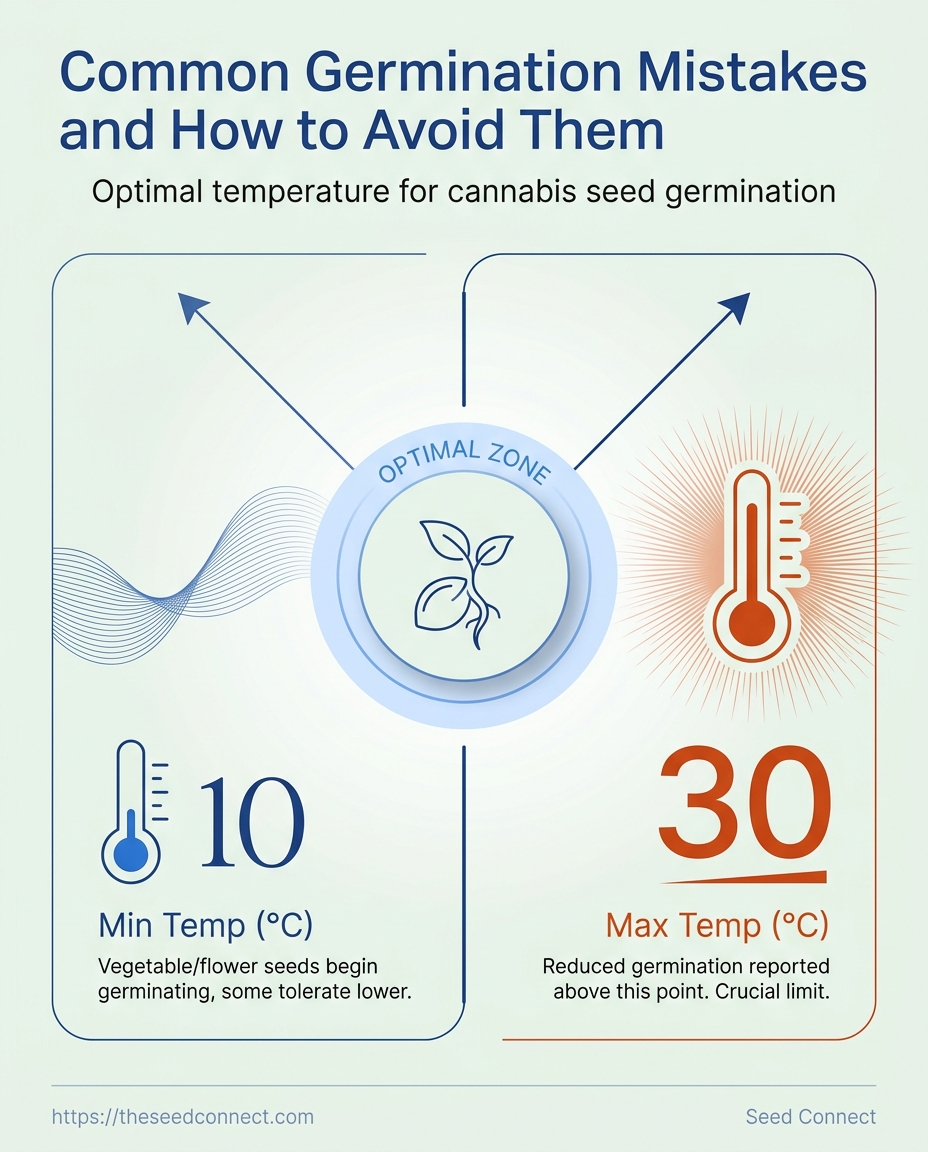
Cannabis seeds generally respond best to a steady environment around 70–85°F (21–29°C) during germination, according to this 2026 guide to germinating cannabis seeds.
The exact temperature matters less than avoiding cold corners, hot surfaces, and sudden changes.
Build a stable germination area
Choose an interior location away from windows, exterior doors, radiators, and appliances that release heat.
A small thermometer gives you a clearer answer than judging the room by touch.
Aim for conditions that remain consistent through the full day and night.
A room that feels comfortable to you may still become too cold after dark, especially near glass or uninsulated walls.
A simple location check can prevent many germination mistakes:
- Check day and night temperatures: Record both readings for a full day before placing seeds there.
- Avoid direct sunlight: Early germination does not require light, and strong sun can create damaging heat spikes.
- Keep the area dark: Use a drawer or covered space that allows some air exchange without exposing seeds to light.
- Limit movement: Do not repeatedly lift, rotate, or open the setup to inspect progress.
- Avoid direct heat: Heating mats can create hot spots when they lack a thermostat or sit directly beneath the germination container.
Give the seed quiet time
The first days call for patience.
Frequent handling can disturb the seed’s position and any delicate root that begins to emerge.
Opening the setup briefly for a visual check is enough; avoid touching the seed itself.
Heat can be just as harmful as cold.
Temperatures above the comfortable range may dry the surrounding medium, stress the seed, or create uneven conditions across the container.
A reliable routine is simple: place the seed in a dark, temperature-stable location, check the thermometer, and leave it undisturbed.
Correcting the environment often resolves apparent cannabis seed failures before any further intervention becomes necessary.
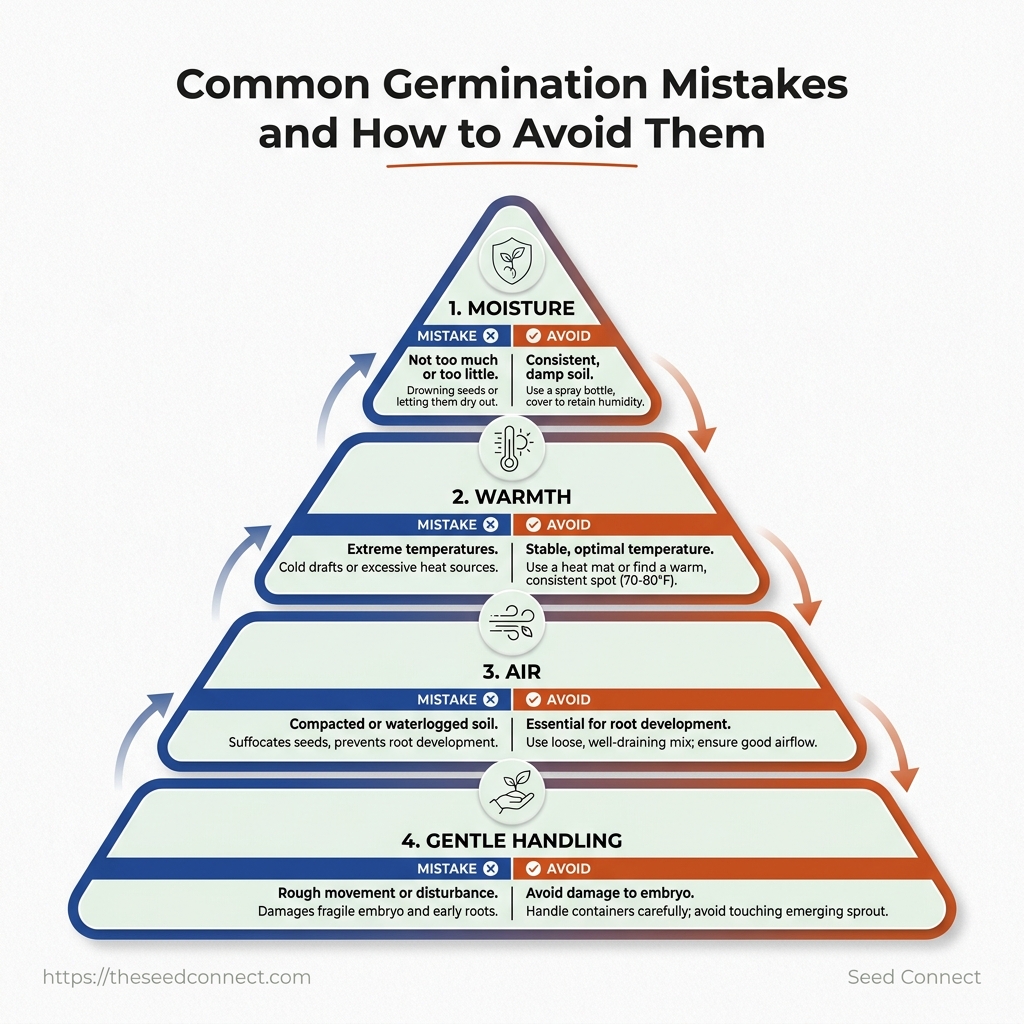
Mistake 3: Planting Too Deep or Handling the Taproot
A few millimeters can decide whether a new seedling reaches the surface easily or spends its first days pushing through resistance.
Planting too deeply makes the seedling use more energy before it can reach light and grow normally.
The goal is not exact measurement.
A cannabis seed usually performs best when covered by a shallow layer of loose growing medium, often around 0.5–1 cm deep.
Guidance from the BudTrainer cannabis seed germination guide and ILGM’s cannabis germination guide also identifies excessive planting depth as a common cause of failed emergence.
Give the seed a clear route upward
Use a pencil, dibber, or fingertip to make a narrow planting hole.
Avoid creating a deep tunnel, since loose sides can collapse around the seed and increase the distance the shoot must travel.
- Make a shallow hole: Aim for roughly
0.5–1 cm, adjusting slightly for the medium’s texture.
- Set the seed carefully: Place the seed with the emerging taproot pointing downward. If the root has already extended, avoid turning or twisting it.
- Cover without packing: Add loose medium over the seed, then leave the surface gently settled. Pressing down creates a dense cap that can restrict emergence.
- Check the surface daily: Look for a small crack, lifted patch, or curved stem. Do not dig around to confirm progress.
A loose medium should hold the seed in place while still allowing the young root and shoot to move through it.
Fine, compacted material can act like a plug; a coarse, airy mix gives the seedling a more forgiving path.
Move germinated seeds with care
The taproot is delicate before the seedling develops a stronger root system.
Handle the seed by its shell whenever possible, using clean, dry hands and a gentle grip.
Never pinch, scrape, or pull the white root.
If the seed sticks to a paper towel or another surface, add a small amount of clean moisture and wait for it to release naturally.
Pulling can tear the root tip, creating one of the avoidable germination mistakes that may lead to cannabis seed failures.
Depth and handling work together.
Plant shallowly, keep the medium loose, and treat the taproot as fragile living tissue rather than something to position repeatedly.
Those simple germination tips give the emerging seedling the easiest path to a healthy start.
Mistake 4: Checking Too Often or Changing Methods Too Quickly
Patience is key to successful germination.
Each time you check, you disturb the setup, move the seed, and expose it to changing conditions.
This can lead you to change too many factors too quickly.
A grower may start with paper towels, move the seed into soil, add a heat source, and then switch containers within a day.
That sequence creates confusion.
When the seed fails to emerge, there is no clear way to tell whether the original method, the interruptions, or the new conditions caused the problem.
The better approach is simple: choose one suitable method, record when it began, and observe it on a planned schedule.
Budtrainer’s 2026 guide to germinating cannabis seeds also emphasizes moving the seed only when the root has appeared, rather than repeatedly disturbing it during the waiting period.
Give the method a fair trial
A fair assessment needs consistent conditions and a defined review point.
Checking once in the morning and once later in the day usually provides enough information without turning the process into constant handling.
Use this sequence:
- Choose one method: Decide between a prepared growing medium or a paper-towel approach before starting.
- Record the start time: Note the date, method, container, and any treatment applied to the seed.
- Set observation windows: Check at planned times instead of reacting to every hour without visible change.
- Change only for a reason: Act when you see a clear problem, such as a damaged setup, mold, or a condition outside the method’s instructions.
- Record the result: Note whether the shell changed, the root appeared, or no visible development occurred.
A simple log might include date, time, method, visible change, and next action.
Keep observations factual. “Shell split slightly” helps later; “looks bad” does not.
> Neptune Seed Bank’s guide to common cannabis germination mistakes warns that repeated errors often come from changing conditions instead of allowing a stable process to work.
The log also separates genuine cannabis seed failures from anxious guesses.
Vivosun’s guidance on when to stop waiting for germination supports using a considered decision point rather than abandoning a method at the first sign of delay.
A calm routine protects the evidence you need.
Give one method a fair trial, make fewer changes, and let your notes guide the next decision.
Mistake 5: Ignoring Seed Storage and Age
A packet of seeds can lose quality before planting day.
Think about unused cannabis seeds sitting for months in a warm, humid room, facing daily temperature swings.
Even when they look normal, moisture and heat may have reduced their ability to germinate.
Storage damage often gets mistaken for a germination method problem.
Growers then change several conditions at once, making the real cause harder to identify.
Age matters, but storage history usually matters more than the calendar alone.
Cannabis seeds should remain in a cool, dark, dry, and stable environment until needed.
A sealed, opaque container helps limit light and humidity.
A small desiccant packet can reduce moisture inside the container, but it should not touch the seeds directly.
Protect unused seeds from moisture
Do not leave seed packs in a bathroom, greenhouse, garage, or warm grow room.
These areas often experience humidity changes that allow condensation to form inside packaging.
A refrigerator may provide a stable environment, but only when seeds are sealed properly and kept away from repeated temperature changes.
Taking a container in and out can create condensation, which is especially risky when the seeds are still cold.
The 2026 cannabis seed germination guide from BudTrainer also emphasizes controlled conditions during germination, and that control begins before the seed leaves storage.
Separate age problems from method problems
When germination fails, avoid changing every part of the process at once.
Use a simple comparison:
- Check the storage record. Note where the seeds stayed, whether the container was sealed, and how often it was opened.
- Inspect the seed batch. Discoloration, cracks, softness, or a musty smell may indicate storage damage, although appearance alone cannot confirm viability.
- Repeat one consistent method. Use a fresh seed from the same batch without changing several conditions between attempts.
- Compare batches carefully. If properly stored seeds from another batch germinate under the same setup, the older or poorly stored batch becomes more suspect.
- Record the result. Write down the seed age, storage location, container type, and outcome. This prevents guesswork during future germination attempts.
One failed seed does not prove that storage caused the problem.
Several failures from an old, warm, humidly stored batch point more strongly toward reduced viability than a single unsuccessful attempt.
Protecting seeds before planting prevents many avoidable cannabis seed failures.
Good storage preserves the opportunity for success; it cannot restore viability already lost to heat, moisture, or time.
Your Step-by-Step Germination Process
Many growers suggest that a reliable germination routine can help remove guesswork from the first few days.
We need one prepared method, a clean planting space, and a clear decision point for moving the seedling.
Choose the method before adding moisture.
Paper towels provide visibility, while direct sowing avoids a later transfer.
Starter plugs offer a middle ground when the growing space is already prepared.
The best option depends on how closely we can control each stage.
The 2026 cannabis seed germination guide from BudTrainer advises moving a seed once the root is visible instead of keeping it in the germination setup.
That simple handoff helps reduce avoidable cannabis seed failures.
From Setup to Planting: A Practical Checklist
Table: A Step-by-Step Germination Process for Fewer Failures — Stage, Action, What to monitor & more
| Stage | Action | What to monitor | Common error |
|---|---|---|---|
| Choose and inspect seeds | Select intact seeds from a trusted source and prepare only the number needed | Clean surface, no cracks, mold, or unusual odor | Sorting seeds after the process has already started |
| Prepare the medium | Fill a small container with a light, airy seed-starting medium | Even texture, drainage, and a ready planting space | Preparing the container after the root appears |
| Start germination | Use one method consistently: damp paper towel, direct medium, or starter plug | The seed coat opening and first root development | Combining methods or moving the seed repeatedly |
| Monitor moisture and temperature | Check the setup at planned intervals without disturbing the seed | Moist but not flooded conditions and steady surroundings | Making repeated changes because progress is not immediately visible |
| Plant the emerging seedling | Transfer the seed when the root is clearly visible and the seed coat has opened | Root direction, stable contact with the medium, and a secure upright seed | Waiting until the root becomes tangled or brittle |
| Begin early seedling care | Keep the newly planted seedling under gentle conditions while it establishes | A standing stem, opened cotyledons, and gradual new growth | Treating a fresh seedling like an established plant |
The grower prepares the next step before the seed reaches it, so rushed decisions do not create new germination mistakes.
Three Decisions That Matter Most
1.
Match the method to the setup.
Use paper towels when visibility matters.
Choose direct sowing when the final container is ready.
Use a plug when transferring a delicate root would add unnecessary handling.
2.
Wait for visible progress.
A split shell or emerging root gives us a better planting signal than the calendar alone.
Keep the chosen method stable, and record the date so impatience does not drive unnecessary changes.
3.
Transplant during the narrow window.
Move the seedling after the root emerges but before it grows long, tangled, or exposed.
The ILGM guide to germinating cannabis seeds also emphasizes preparing the planting medium and avoiding delays once germination begins.
A successful handoff looks simple: the seedling is upright, the root is protected, and the first leaves can open without resistance.
Preparation turns germination tips into a repeatable process rather than a series of guesses.
What to Do When a Seed Does Not Germinate
It is often suggested that one failed seed does not prove that your entire method failed.
Seeds are biological products, so individual viability can vary even when the surrounding conditions are suitable.
Instead of discarding a seed immediately, evaluate whether several seeds from the same batch fail, as this might indicate an issue with the seed’s quality rather than the germination process.
Keep the seed for inspection and record the conditions under which it was germinated.
If conditions were consistent for other seeds that germinated normally, you might have an isolated viability issue.
Use a checklist to ensure comprehensive evaluation: check the timeline against the germination window, inspect the seed’s condition without excessive handling, and compare it to adjacent seeds.
Document all observations accurately to make any necessary adjustments or reach out to the supplier with specific details.
Choosing Seeds and Support That Reduce Avoidable Risk
A viable seed can still fail when the surrounding process creates unnecessary stress.
Germination outcomes depend on both seed viability and the conditions around the seed, so buying from a dependable source only solves part of the problem.
That distinction matters when evaluating cannabis seeds.
A seller may offer strong genetics, yet provide little information about the strain, limited after-purchase support, or unclear policies for seeds that do not germinate.
Conversely, careful handling cannot fully compensate for poor-quality or badly stored stock.
Independent growing guidance makes the same point.
The Budtrainer 2026 guide to germinating cannabis seeds treats seed quality and the growing environment as connected factors, while Neptune Seed Bank’s guide to cannabis germination mistakes highlights how preventable setup problems can undermine otherwise suitable seeds.
What to check before buying
Treat the seller’s information as part of the product.
A clear listing should help you understand what you are buying and what support exists after delivery.
- Genetic description: Check whether the listing explains the strain’s type, expected traits, and intended growing profile.
- Seed format: Confirm whether the seeds are feminized, autoflowering, or another type, since each choice affects planning and plant selection.
- Quality information: Look for clear details about packaging, batch handling, and how the seller protects seeds during fulfillment.
- Germination policy: Read the guarantee terms before purchase, including eligibility, required evidence, and the time allowed for making a claim.
- Human support: A knowledgeable support team can help separate a seed issue from a process issue without encouraging unnecessary changes.
Match support to the project
The best purchase fits the grower’s actual constraints.
A beginner may value straightforward guidance and a forgiving schedule, while an experienced grower may care more about uniformity, plant size, or a particular cannabinoid profile.
Before ordering, write down the project’s legal limits, available space, desired plant traits, and experience level.
Then compare those requirements against the product description rather than choosing from a strain name alone.
For supported growing projects, our cannabis seeds include access to a germination guarantee and expert grower support.
That combination does not remove every biological variable, but it gives growers a clearer path when questions arise.
Careful buying reduces avoidable uncertainty before planting begins.
Choose genetics that fit the project, verify the guarantee, and value support as part of the overall purchase—not as an afterthought.
Do cannabis seeds germinate better in light or dark?
Cannabis seeds germinate better in dark, stable conditions.
Seeds should stay cool, dark, and dry until use, and during germination you should avoid sunny windows and other spots that create temperature swings.
Aim for a steady environment around 70–85°F (21–29°C) instead of relying on light exposure.
Will cannabis seeds become illegal in 2026?
Cannabis seed legality in 2026 depends entirely on your location and the laws there, not on germination steps.
Germination guidance focuses on moisture, temperature, handling, and seed storage—not legal status changes.
Because laws vary by jurisdiction, check your local regulations or an official government source for any 2026 updates.
How do you know if seedlings are getting too much light?
You can tell seedlings may be getting too much light when they show stress from harsh, variable conditions—especially from direct sun that creates heating spikes.
The key risk highlighted in germination guidance is temperature instability from sunny windows, which makes germination less predictable.
If you notice rapid drying or slowed, inconsistent growth, move them away from sharp sunlight and keep conditions steady.
What temperature kills cannabis seeds?
There isn’t a single “killing” temperature given for cannabis seeds in the germination guidance, but extreme heat and large temperature swings can ruin viability.
During germination, seeds are often said to respond best to a steady 70–85°F (21–29°C) environment.
Avoid placing seeds near heaters, sunny windows, or anywhere temperatures fluctuate sharply.
Does it matter how wet the paper towel is when germinating seeds?
Yes, paper towel moisture level is critical.
The medium should be moist without releasing water when gently pressed, meaning evenly damp but never dripping.
When the setup stays saturated, it can fill air spaces around the shell and emerging root, stalling germination or increasing rot risk.
Give Every Seed a Calm, Consistent Start
Most cannabis seed failures do not come from one mysterious problem.
They usually begin with a small decision—adding too much water, placing seeds somewhere too cold, planting the taproot too deeply, or checking so often that the developing root gets damaged.
The key lesson is simple: stable conditions help germination more than constant interference.
Think back to the seed with a cracked shell and pale root that stopped developing.
Moving it repeatedly, changing methods, or flooding the growing medium can create more stress than the original problem.
A controlled environment, light moisture, suitable warmth, and careful handling give the seed a far better chance than repeated adjustments ever will.
Good germination tips also begin before planting.
Store seeds in a cool, dark, dry place, inspect them before use, and choose reliable genetics when you can.
Then write down your method today—the medium, moisture level, temperature, planting depth, and date—and leave the seed undisturbed while you monitor it once or twice daily.
That small record will help you avoid repeated germination mistakes, identify patterns, and approach your next seed with far more confidence.