


A handful of seeds crushed, a damp packet sprouting in transit, or customs refusing entry — these are the small disasters that turn an international order into a loss. For anyone buying or sending seeds abroad, understanding **packaging cannabis seeds** well enough to prevent moisture, odor, and damage is the difference between a successful grow and wasted time.
Protecting genetics starts before the box is taped: choose materials and packing methods that control humidity, cushion impact, and mask scent without harming viability. Practical choices rooted in science and shipping realities make **seed protection during shipping** a predictable process rather than a gamble.
Regulatory nuance matters too; the safest-looking package can still trigger inspections that damage seeds or delay delivery. Applying smart, discreet preparation alongside sensible **shipping best practices** reduces risk and keeps seeds viable from pickup to seedling.
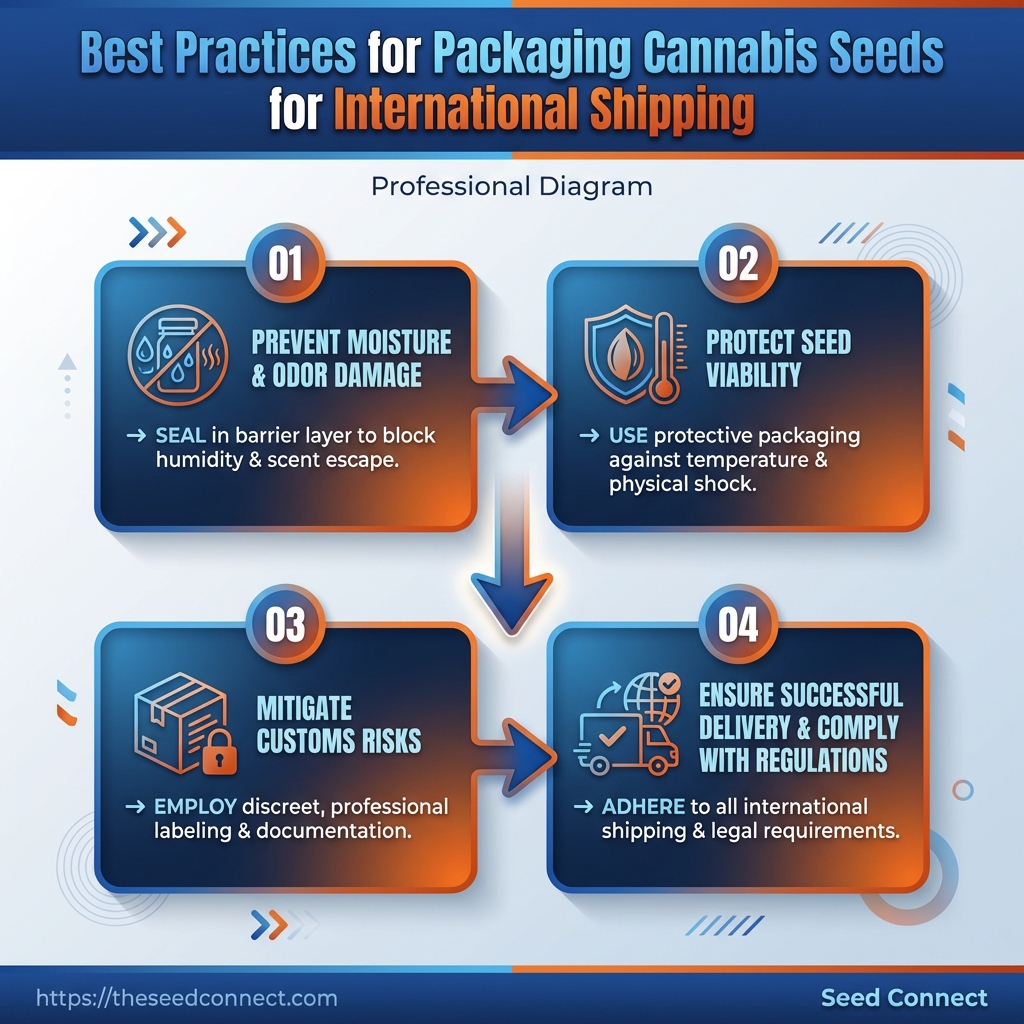
What You’ll Need (Prerequisites)
Start with the reality: shipping cannabis seeds internationally or preparing them for commercial distribution is as much paperwork and process as it is packaging. Material choices protect genetics; documentation keeps shipments moving through customs; environmental controls preserve viability. Below are the tangible items, the legal documents, and the baseline knowledge an operation must have before packing seeds for transit.
**Materials & basic supplies**
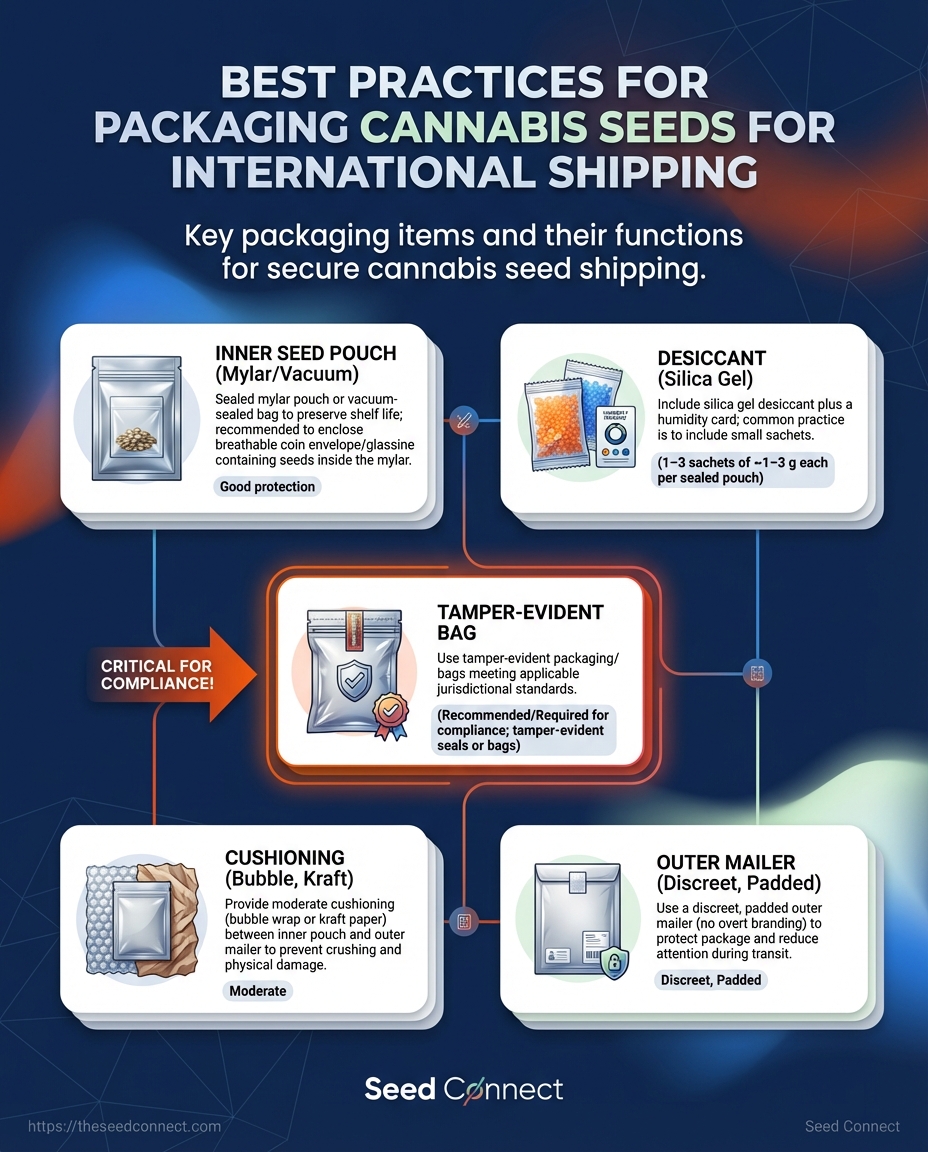
* **Inner seed pouch:** Mylar or vacuum-sealed pouches sized to batch — protects against light and oxygen.
* **Desiccant:** Silica gel packs rated for small-volume seeds — controls moisture and prevents mold.
* **Tamper-evident bag:** Heat-seal or adhesive bags for chain-of-custody and tamper visibility.
* **Cushioning:** Bubble wrap or kraft paper to prevent crushing during handling.
* **Outer mailer:** Discreet padded mailers that withstand transit without advertising contents.
**Environmental controls**
* **Temperature control:** Store and ship within `5–15°C` for long-term viability; avoid exposure above `25°C`.
* **Humidity control:** Aim for stable relative humidity around `30–40%`; desiccants sized to package volume.
* **Short-term cold packs:** Use when transit crosses hot climates, but avoid freezing.
**Essential documentation (common export markets)**
* **Phytosanitary certificate:** Required by many countries to prove plant health.
* **Commercial invoice:** Accurate contents, HS codes, and declared value.
* **Export permit / local compliance letter:** When originating country requires permission.
* **Import permit / end-user declaration:** Some destinations require pre-approved import clearance.
* **Customs forms and manifest:** Completed per carrier rules, with clear description (e.g., “seeds — non-food, non-viable” if applicable and accurate).
**Knowledge prerequisites**
* **Familiarity with destination rules:** Understand whether seeds are allowed, restricted, or require permits in the receiving country.
* **Customs classification:** Know relevant HS codes and duty treatments for seeds in each target market.
* **Carrier policies:** Some carriers prohibit seeds or have extra paperwork; verify before booking.
* **Germination expectations:** Know baseline viability rates for the cultivar and plan buffer stock accordingly.
1. Confirm destination legality and required permits well before shipping.
2. Assemble packaging and documentation as a single kit to avoid last-minute delays.
3. Test-pack one sample shipment to validate environmental controls and paperwork flow.
### Packaging items by function: protection, moisture control, tamper evidence, and customs friendliness
| Item | Primary function | When to use | Approx. cost (USD) |
|—|—|—|—|
| **Inner seed pouch (mylar/vacuum)** | Barrier against oxygen and light | Use for all batches; vital for medium/long-term storage | $0.10–$0.50 per pouch |
| **Desiccant (silica gel)** | Moisture control, prevents mold | Always include sized to package volume | $0.05–$0.30 per pack |
| **Tamper-evident bag** | Visible evidence of interference | Use for regulated or high-value orders | $0.20–$1.00 each |
| **Cushioning (bubble, kraft)** | Physical protection from shocks | For any shipment prone to rough handling | $0.05–$0.50 per unit |
| **Outer mailer (discreet, padded)** | External protection and discretion | Standard for retail and export parcels | $0.30–$2.00 each |
*Key insight: Choosing the right combination of inner barrier, desiccant sizing, tamper evidence, and a discreet outer mailer dramatically reduces loss of viability, customs hold-ups, and customer complaints—small per-unit costs often prevent large downstream losses.*
For reliably sourced genetics that fit these packaging workflows, consider stocking multiple batch sizes and pairing them with appropriately sized pouches and desiccants. If selling commercially, list required paperwork clearly for buyers and carriers to avoid surprises. These preparations cut friction at origin and destination and protect the seed investment through transit.
Step-by-Step Packaging Process
Packaging cannabis seeds starts with controlling moisture and contamination, then moves to tamper-proof sealing and logical staging so shipments leave the facility intact and audit-ready. Follow these three focused steps—Conditioning, Sealing, and Staging for Dispatch—to cut damage, maintain compliance, and minimize customer complaints.
**Cleanroom or dedicated packing bench:** A dust-free, low-humidity area for final handling.
**Materials on hand:** desiccant packets, heat-seal pouches or child-resistant jars, tamper-evident tape, thermal label printer, and tray liners.
**Basic training:** Staff trained in seed handling, allergen controls, and local mailing restrictions.
1. Conditioning
1. Begin by equilibrating seeds to a stable relative humidity (RH) of ~6–8% using desiccant chambers or a controlled humidity cabinet.
Time estimate: 15–60 minutes per batch (depends on starting moisture).
Difficulty level: Moderate.
Success criteria: No visible clumping, packets feel dry, and weight variance across sample seeds is <1%. When to seek expert help: If seeds show mold, unusual odors, or >3% weight variance after conditioning, consult a seed lab or supplier—these signs indicate compromised viability.
2. Sealing
2. Transfer conditioned seeds into their primary package (heat-seal pouch, foil packet, or child-resistant jar) and add a calibrated desiccant packet. Apply a heat seal or child-resistant lid, then add tamper-evident tape.
Time estimate: 1–3 minutes per package.
Difficulty level: Easy–Moderate (heat sealer setup is technical).
Success criteria: Seal integrity tested by gentle squeeze—no air ingress, desiccant shows no color-change (if applicable), and a tamper band is intact.
When to seek expert help: If heat seals fail repeatedly or tamper mechanisms don’t meet legal specs, contact equipment vendors or compliance consultants.
3. Staging for Dispatch
3. Affix printed labels with SKU, batch number, and handling marks. Place packages into cushioned outer cartons with clear orientation markings and a packing slip. Group by carrier and service level on the staging rack, and perform a final QC spot-check (5–10% of batch).
Time estimate: 5–15 minutes per carton plus QC time.
Difficulty level: Easy.
Success criteria: Correct label data, damage-free outer packaging, and all items accounted for per packing slip.
When to seek expert help: If recurring labeling errors or carrier rejections occur, involve operations or fulfillment specialists to audit workflows.
Practical tips
* **Consistent humidity** preserves germination rates.
* **Printed batch codes** reduce traceability headaches.
* **Photograph each outbound pallet** to support claim resolution.
Include product context where relevant: if packaging actual product lines, reference quality control back to your seed source, for example [cannabis seeds for sale](http://theseedconnect.com/marijuana-seeds/), to keep traceability tight.
Doing these steps reliably prevents most shipping issues and protects germination guarantees, so packages arrive as intended and customer trust stays intact.
Labeling, Documentation, and Customs Considerations
For cross-border shipments of cannabis genetics, paperwork and subtle labeling matter more than flashy packaging. Customs officers look for clarity and compliance; carriers look for acceptability; import regulators look for traceability. Preparing the right documents, choosing *discreet but honest* label language, and keeping records that prove lawful intent and chain-of-custody dramatically reduce seizure risk and speed clearance.
**Preparing documents and discreet labeling — core checklist**
1.
Gather export paperwork in this order:
1. Commercial invoice with accurate HS code and value.
2. Export declaration (where required by origin country).
3. Phytosanitary certificate or germination certificate when requested.
4. Certificate of origin or EUR.1 for preferential tariffs.
5. Import permits or correspondence from the importer (if the destination requires one).
6. Carrier-specific paperwork (air waybill, dangerous-goods declarations if flagged).
2.
Labeling phrasing options (use depending on destination legal context):
1. **Transparent but neutral:** `Plant genetic material — non-viable sample` (only if seeds are sterilized or non-viable).
2. **For fully legal commercial shipments:** `Horticultural seeds — not for food` or `Research seed sample`.
3. **Discreet commercial:** `Botanical seed sample` with accompanying paperwork that clarifies species.
4. **When in doubt:** use importer’s required wording exactly as on their permit.
*Retention and proof of compliance*
* **Retention period:** Keep export, import, and carrier records for at least five years or as required by local law.
* **Proof of compliance:** Maintain scanned copies of permits, buyer-seller correspondence, and test/germination results.
* **Audit trail:** Log shipment steps in a timestamped shipment ledger or compliance tool; export-friendly platforms help.
**Definitions**
**Commercial invoice:** A document describing goods, value, HS code, and seller/buyer details submitted to customs.
**Phytosanitary certificate:** Government-issued certificate that the shipment meets plant health requirements.
### Documentation requirements for major destination types (e.g., EU, North America, parts of Asia/Latin America)
| **Destination region** | Common documentation required | Labeling best practice | Risk level (low/medium/high) |
|—|—|—|—|
| **European Union** | Commercial invoice, phytosanitary certificate, import permit (varies), CN tariff code | Label as `Horticultural seeds` + attach phytosanitary cert | Medium |
| **United States/Canada** | Commercial invoice, phytosanitary certificate, APHIS/CFIA import permit (often required) | Declare species; use `Research seed sample` when applicable | High |
| **Latin America** | Commercial invoice, certificate of origin, phytosanitary cert sometimes required | `Botanical seeds` with accompanying import permit copy | Medium |
| **Asia (varies by country)** | Commercial invoice, strict import permits (Japan, China strict), phytosanitary cert | Use importer-mandated phrasing; avoid explicit cannabis mention where prohibited | High |
| **Oceania** | Commercial invoice, phytosanitary cert, Biosecurity approvals (Australia/New Zealand strict) | `Horticultural seed sample` + permit copy | High |
*Key insight: Documentation expectations vary widely. Regions with strict biosecurity or unclear cannabis laws (certain Asian, Oceania, and North American jurisdictions) carry higher risk and demand explicit permits and phytosanitary proof. Matching label wording exactly to permit language and retaining a full, timestamped record set reduces delays and legal exposure.*
Practical tools to streamline this include checklists, a central digital folder of scanned permits, and using consistent HS codes. When shipping commercial seed orders, list available [cannabis seeds for sale](http://theseedconnect.com/marijuana-seeds/) only after confirming the buyer’s local import rules. Keeping paperwork tight is the single most effective step to protect shipments and the business reputation.
Protecting Seed Viability During Transit
Seeds are small but vulnerable: moisture, heat, and crushing are the three killers. Keep relative humidity low, temperatures stable, and physical shock to a minimum, and germination rates stay high. For typical retail shipping windows, aim for **target RH between 20–35%**, control temperature swings when possible, and use desiccants sized to the package volume and transit length. Position desiccants so they protect the seed packet directly, and cushion the packet to prevent mechanical abrasion or compression.
**Moisture control and RH targets**
* **Short transit (1–3 days):** Keep RH near 30–35% to prevent condensation during handling.
* **Medium transit (4–10 days):** Aim for 25–30% RH; longer exposure raises mold and fungal risk.
* **Long transit (>10 days):** Target 20–25% RH and use oxygen-absorbing packaging when feasible.
**Desiccant sizing and placement rules**
1. Use pharmaceutical- or food-grade silica gel or molecular sieve; they’re predictable and food-safe.
2. Place desiccant inside the inner pouch directly next to seeds — _not_ loose in the outer mailer.
3. If using multiple desiccant packets, distribute them (one per corner or one adjacent to the seed packet) rather than stacking in one spot.
4. Match desiccant grams to package volume and transit time (table below).
### Provide desiccant sizing and recommended RH targets for common package volumes and transit durations
| Package volume (L) | Transit duration (days) | Recommended desiccant (g) | Target relative humidity (%) |
|—|—:|—:|—:|
| 0.1 L (small pouch) | 1–3 | 1–2 g | 30–35% |
| 0.5 L | 1–5 | 2–4 g | 28–33% |
| 1 L | 1–7 | 4–6 g | 25–30% |
| 5 L (small box) | 3–10 | 10–20 g | 22–28% |
| 10 L (padded mailer) | 5–14 | 20–40 g | 20–25% |
*Key insight: Smaller packages need surprisingly little desiccant, but correct placement matters more than raw grams. Larger boxes gain diminishing returns without distributed packets; for long transit, err toward the higher end of the desiccant range.*
**Temperature management**
* **Avoid extremes:** Keep packages out of direct sun and away from heaters during transit; temperature spikes accelerate seed aging.
* **Insulate for hot/cold climates:** Use a thin layer of bubble wrap or foam inside the outer mailer to buffer short-term temperature swings.
* **Cold shock caution:** Very low temps combined with moisture can cause internal ice formation; keep RH low when shipping in freezing weather.
**Physical protection strategies**
* **Cushioning:** Use soft barrier (bubble wrap, foam peanuts) to prevent compression and abrasion.
* **Rigid outer envelope:** For fragile seed inventories, ship in a small cardboard box inside the mailer to prevent bending.
* **Prevent movement:** Immobilize the inner pouch so it can’t rub against packaging walls.
1. Place seeds in an inner sealed pouch.
2. Add desiccant(s) inside the inner pouch, adjacent to seeds.
3. Wrap the pouch in cushioning material.
4. Insert into rigid or padded outer mailer; seal.
For customers ordering [cannabis seeds for sale](http://theseedconnect.com/marijuana-seeds/), these simple steps preserve the germination guarantee and reduce the need for replacements. Treat packaging as part of the product: small investment in desiccants and proper cushioning delivers big wins in germination and customer satisfaction.
Discreet Packaging and Risk Mitigation
When shipping seeds, the packaging and carrier choice determine privacy exposure more than product value. Use discreet outer packaging, sensible service levels, and a fulfillment/insurance plan that matches your risk tolerance so shipments arrive intact without drawing attention.
### Outer packaging and shipment basics
* **Plain outer packaging:** Use plain, unbranded mailers to avoid advertising contents.
* **Minimal inner labeling:** Keep invoices and packing slips generic — avoid seed-specific terms.
* **Tamper-evident seals:** Simple tamper tape deters casual inspection and protects integrity.
* **Concealment, not deception:** Concealment for privacy is wise; mislabeling contents can trigger legal risk.
### Carrier and service-level trade-offs
1. Choose the carrier based on tracking needs versus privacy.
1. For maximum privacy with basic tracking, standard postal services (e.g., USPS First-Class) are usually lower-profile.
1. For reliable, time-sensitive deliveries choose courier services (UPS/FedEx) with strong tracking and signature options.
1. International shipments require extra care: customs declarations must be accurate and may increase inspection risk.
### Third-party fulfillment and insurance
* **Fulfillment centers:** Outsourcing packing to a reputable third-party provider reduces direct handling risk and scales well.
* **Insurance:** Insure high-value batches and require `signature-required` or `adult-signature` for riskier shipments.
* **Returns handling:** Use fulfillment partners that manage returns discreetly and provide chain-of-custody records.
### Practical examples and recommendations
* **Low-cost, low-risk:** Ship small orders in a **plain padded envelope** via standard postal service without signature; include generic packing slip.
* **High-value, time-sensitive:** Use a **courier box with tracking** and `adult-signature` for delivery; add insurance equal to declared value.
* **Scaling operations:** Use **third-party fulfillment** to standardize discreet packaging and to take advantage of bulk shipping rates and fulfillment SLAs.
### Tools and checklist suggestions
* **Packing checklist:** Plain exterior, tamper tape, generic invoice, internal cushioning, insured value recorded.
* **Carrier comparison tip:** Test three routes at low volume to measure inspection rates and delivery times before committing.
### Outer packaging types and service levels by privacy, cost, and inspection risk
### Outer packaging types and service levels by privacy, cost, and inspection risk
| Packaging type | Privacy level | Cost | Best use case |
|—|—|—|—|
| **Plain padded envelope** | High | Low | Small, low-value orders |
| **Rigid box (discreet wrapping)** | Very high | Moderate | Fragile seeds, medium orders |
| **Poly mailer** | Moderate | Very low | Lightweight bulk shipments |
| **Courier box with tracking** | Low (visible tracking) | High | High-value, fast delivery |
| **Third-party fulfillment** | High (professional) | Variable | Scale operations, returns handling |
*Key insight: Plain, unbranded packaging and low-profile postal services minimize attention and cost for most seed orders, while courier services and fulfillment centers are worth the premium when tracking, speed, or scale matter.*
For product-specific sourcing and germination support, consider pairing these practices with quality stock such as [cannabis seeds for sale](http://theseedconnect.com/marijuana-seeds/). Thoughtful packaging choices reduce unnecessary risk and protect customer privacy without adding complexity.
Labeling Sensibly: What to Say and What to Avoid
Labeling should get customs through quickly without creating needless risk. Use clear, factual botanical language on paperwork, avoid slang or medical claims, and never call a packet “for consumption” or use street names. A well-chosen few words can mean the difference between smooth transit and a seized shipment.
**Practical wording templates for customs forms**
1. **Use botanical precision:** *“Cannabis sativa seeds — non-viable/for germination research”* only when accurate.
2. **Use neutral commercial language:** *“Plant seeds — ornamental/collector sample”* or *“Horticultural seeds — species: Cannabis sativa”*.
3. **Declare quantity and value plainly:** *“10 units, weight 2 g, commercial sample, invoice value $5.”*
4. **Avoid action-directed phrases:** Do not write `grow`, `cultivate`, `for smoking`, `medicinal`, `THC`, or brand claims like `high-THC`.
Common red-flag phrases that increase seizure risk
* **“For consumption”:** implies ingestion or use.
* **“High THC” / “Psychoactive” / “Medical”**: triggers stricter controls.
* **Street names or slang**: e.g., “weed,” “pot,” “dank.”
* **Vague descriptors like “drug paraphernalia”** or overstated health claims.
When to be fully explicit vs. botanical descriptors
Use explicit detail only when legally required or when the law in origin/destination demands full disclosure. Otherwise, neutral botanical descriptors reduce attention. If importing for breeding or research and permits exist, include permit/reference numbers on paperwork.
**Seed lot:** A unique identifier assigned to a single production batch for traceability.
**Genotype:** The genetic identity of the seed line; useful on internal labels but usually unnecessary on customs forms.
Step-by-step labeling and documentation process
1. Prepare internal label with cultivar name, lot number, and germination guarantee.
2. Prepare customs declaration using neutral botanical terms and accurate quantity/value.
3. Attach any required permits or import/export authorizations; reference permit numbers on the declaration.
4. Double-check no marketing language or cultivation instructions appear on any external paperwork.
*Practical tip:* For small retail orders, describing items as “horticultural seeds” and including an accurate commercial invoice usually avoids scrutiny. For regulated shipments, keep permits visible and consistent across documents.
Pair sensible labeling with secure packaging and clear paperwork and shipments will face fewer delays. Clear, factual language protects both the sender and the recipient.
Troubleshooting Common Issues
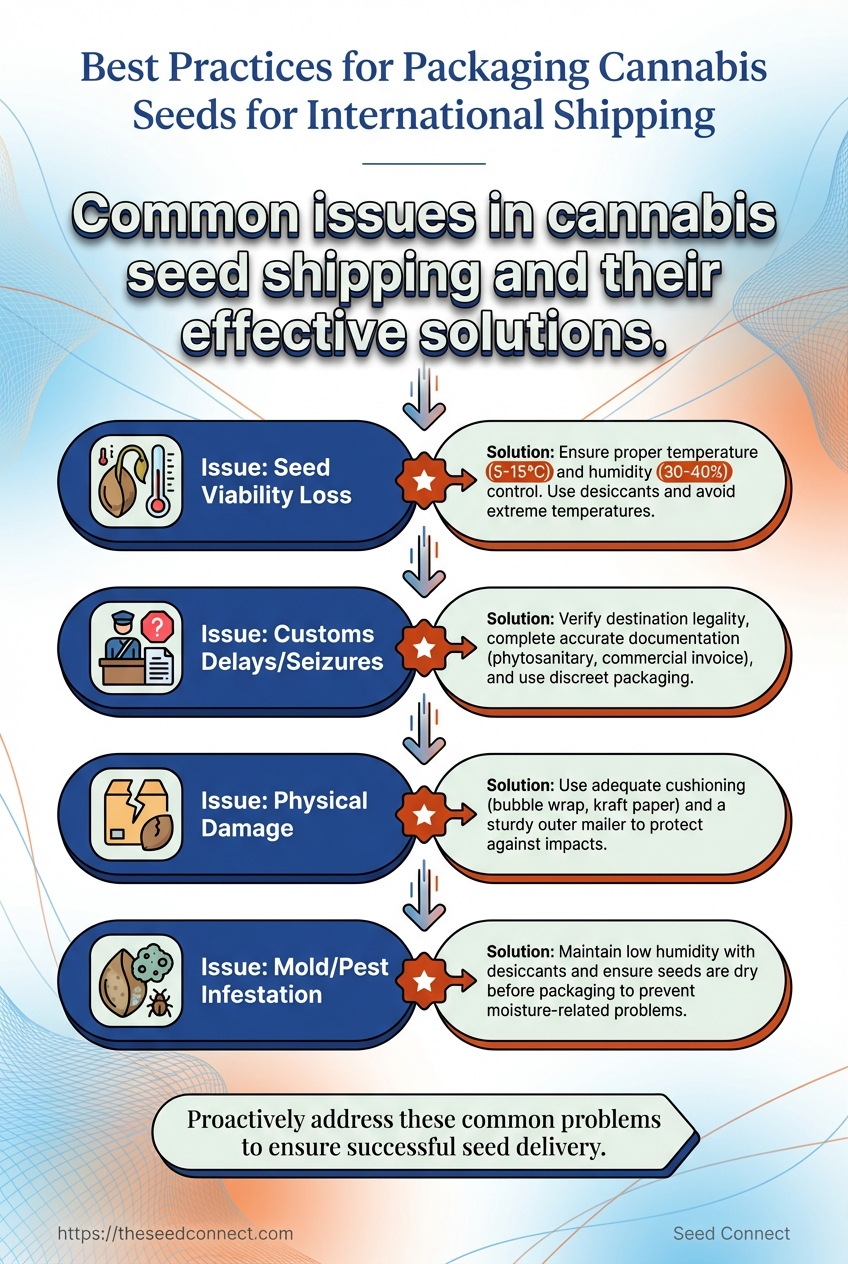
Moisture, customs holds, and physical damage are the three headaches that show up most often when shipping cannabis seeds. Tackle each with a clear diagnostic step, an immediate fix, and prevention measures so the same problem rarely returns.
Common problems and fixes
* **Moisture inside package:** If seeds arrive swollen, moldy, or sprouted, excessive humidity during transit is the culprit.
Immediate fix: Isolate the affected batch and dry seeds slowly at room temperature on absorbent paper; discard any visibly moldy seeds.
Prevention: Pack with desiccant packets and a moisture indicator card; target `RH 20–30%` for seed-safe packing.
* **Customs detention or seizure:** Shipments held or flagged by carriers or customs usually lack acceptable documentation or trigger local controlled-substance rules.
Immediate fix: Contact the carrier and request the detention reason; prepare to supply invoices, phytosanitary certificates (if required), and proof of non-viability where applicable.
Prevention: Verify destination country regulations before shipping, include clear paperwork, and use discreet but compliant labeling.
* **Physical damage to packaging or seeds:** Crushed envelopes or tampered boxes can destroy seed viability.
Immediate fix: Photograph damage immediately, quarantine the shipment, and file a damage claim with the carrier within their stated window.
Prevention: Use rigid inner supports, bubble-wrap, and a tamper-evident outer layer; choose a carrier with good handling reputation.
Documentation and escalation timelines
**Proof of loss/damage:** Keep photos, tracking logs, and the original order invoice.
**Claim filing window:** Most carriers require claims within `7–30 days` of delivery—file as soon as possible.
**Escalation steps:**
1. Contact the carrier support and open a formal claim.
2. Gather and attach photos, tracking history, and recipient statement.
3. If unresolved after carrier response, escalate to payment provider or file a dispute through the shipping insurer.
Prevention checklist before sending seeds
* **Use desiccants** and humidity cards inside packages.
* **Confirm destination rules**—some countries prohibit seed imports.
* **Reinforce packaging** with rigid inserts and tamper-evident seals.
* **Label thoughtfully**: accurate but compliant. Consider discreet labeling when permitted.
**Germination guarantee:** When purchasing, choose suppliers that offer a germination guarantee. For example, orders of [cannabis seeds for sale](http://theseedconnect.com/marijuana-seeds/) that include clear packing and support reduce dispute cycles and improve recovery options.
Practical handling and prompt documentation cut most losses. Take photos, file claims early, and tighten packing standards—small process changes prevent the bulk of repeat problems.
Tips for Scaling and Compliance when Shipping at Volume
Scaling shipping while staying audit-ready depends on three things done consistently: repeatable SOPs, smart batching rules, and records that survive scrutiny. Build SOPs that make every pack identical, batch so quality checks catch problems before they multiply, and instrument KPIs that surface trends before audits do.
**Standard operating procedures (SOPs)**
**SOP scope:** Define receiving → storage → picking → packing → carrier handoff with acceptance criteria for each step.
**SOP elements:** List materials, step-by-step actions, acceptable ranges (temperature, humidity), QC checkpoints, escalation paths, and required sign-offs.
**Documentation:** Attach printable checklists, template photos, and version control metadata to every SOP.
Batching and QC to reduce errors
1. Decide batch size based on throughput and QC capacity.
2. Group orders by similarity: same product line, destination region, or carrier to reduce packing variability.
3. Run an inline QC sample on every batch (1–3% of units) and a full QC on the first and last pack of each shift.
*Batching rule:* Keep batches small enough to contain failures, large enough to be efficient—typical ranges are 50–500 units depending on SKU velocity.
Operational records and KPIs to monitor
**Order accuracy:** Percent of orders shipped without item/count errors.
**First-pass QC rate:** Percent of batches passing initial QC sample.
**Carrier On-Time Performance:** Percent of pickups delivered to carrier within scheduled window.
**Damage-in-transit rate:** Claims per 1,000 shipments.
**Inventory variance:** Monthly variance as % of book stock.
Practical examples and playbook items
* **Pick-pack SOP:** Use `lot-number` and `expiry` checks at pick, then scan at pack to lock traceability.
* **Batch QC:** For seed lots, verify viability on a rotating monthly sample and attach results to the batch record.
* **Carrier scoring:** Score carriers weekly on damage, transit time, and claim resolution; reroute high-risk lanes.
### Outline an audit and SOP timeline for monthly/quarterly checks and record retention
| Task | Frequency | Owner | Documentation to retain |
|—|—|—|—|
| Sample viability test | Monthly | QC Manager | Viability report, batch ID, lab notes |
| Carrier performance review | Monthly | Logistics Lead | Carrier scorecard, claims log |
| Compliance document verification | Quarterly | Compliance Officer | Licenses, manifests, SOP revisions |
| Inventory reconciliation | Monthly | Inventory Controller | Cycle count sheets, discrepancy reports |
| Customer complaints review | Monthly | Customer Success | Complaint log, resolution evidence |
*Key insight: Keeping a disciplined cadence of small, documented checks turns chaotic scaling into predictable operations. Clear owners and short retention trails make audits straightforward and reduce penalties or shipment delays.*
If shipping volumes grow quickly, prioritize making SOPs enforceable (training + signoffs) and automating records where possible. Small investments here remove big headaches later, and keep product moving without regulatory surprises.
For guidance on seed-specific handling, consider product packaging standards and viability safeguards when shipping [cannabis seeds for sale](http://theseedconnect.com/marijuana-seeds/).
Final Checklist Before Dispatch
Before a package leaves the facility, a quick but strict verification run prevents the most common fulfillment failures. Run through the following checks and sign-offs exactly as written — they’re the last chance to catch mislabels, incorrect quantities, or packaging that won’t protect seeds in transit.
1. Confirm order contents and varietal match with packing slip.
2. Verify seed count and quality against `batch ID` and germination test records.
3. Inspect packaging integrity and cushioning for moisture and physical shock protection.
4. Confirm correct external labeling for destination, handling instructions, and any required compliance marks.
5. Ensure payment and any export/shipping permits are cleared and attached.
6. Final documentation capture: photo of package, packing slip, and `seal` code (if used).
7. Sign-off by packer and supervisor with timestamp and initials.
Use these micro-checks to make each step actionable:
* **Contents:** Confirm varietal names, fem/auto/THC classification, and counts match the order.
* **Quality:** Scan batch records for germination guarantee status and flag any batches below threshold.
* **Packaging:** Use moisture-absorbing insert and tamper-evident seal when shipping seeds sensitive to humidity.
* **Labeling:** Include `Handle With Care` and any region-specific restrictions plainly on the outer box.
* **Records:** Save a high-resolution photo of the sealed package for at least the retention period required by local rules.
**Sign-off procedure:**
Packers sign and date the packing slip. Supervisors visually verify and add their initials. Electronic systems should log `userID`, timestamp, and location. If using paper, scan and attach to the shipment record.
**Record retention:**
Keep digital copies of packing slips, photos, and germination certificates for a minimum of 2 years or as required by local regulations. Store files with searchable filenames: `Order#_BatchID_Date`.
If a check fails, follow these next steps immediately:
1. Quarantine the package and tag with failure reason.
2. Notify quality control and customer service with photos and `batch ID`.
3. Decide whether to repackage, replace seeds from a verified batch, or cancel with refund/communication to the customer.
4. Log corrective action and update the batch disposition record.
A final glance and the right paperwork save time and customer trust. Treat this checklist like a habit: consistent checks mean fewer returns and a stronger reputation for quality.
Conclusion
This guide leaves behind clear, actionable steps to prevent the small disasters that turn a routine shipment into a lost order: pack to control moisture, shield seeds from physical shock, and choose documentation that keeps packages moving through customs. Remember the two cautionary examples earlier — a damp packet that sprouted en route and a shipment returned for mislabeling — they show how small mistakes cascade. For anyone wondering whether seeds will survive transit, the pattern is clear: proper **seed protection during shipping**, correct desiccants, and discreet, compliant labeling dramatically reduce loss. If the question is about customs, follow the documentation checklist and local rules; if scaling is the concern, automate inventory and standardize your packaging workflow.
– **Use moisture-control packets and tamper-resistant inner pouches.**
– **Match outer labeling to destination requirements while staying discreet.**
– **Test one carrier and packaging combo before scaling operations.**
When ready to source high-quality genetics that survive the journey, consider this as one practical next step: [Shop premium cannabis seeds with germination guarantee](http://theseedconnect.com/marijuana-seeds/). To streamline ongoing operations, adopt shipping best practices outlined above and run small, repeatable tests so packaging cannabis seeds becomes a reliable, scalable part of the business.