

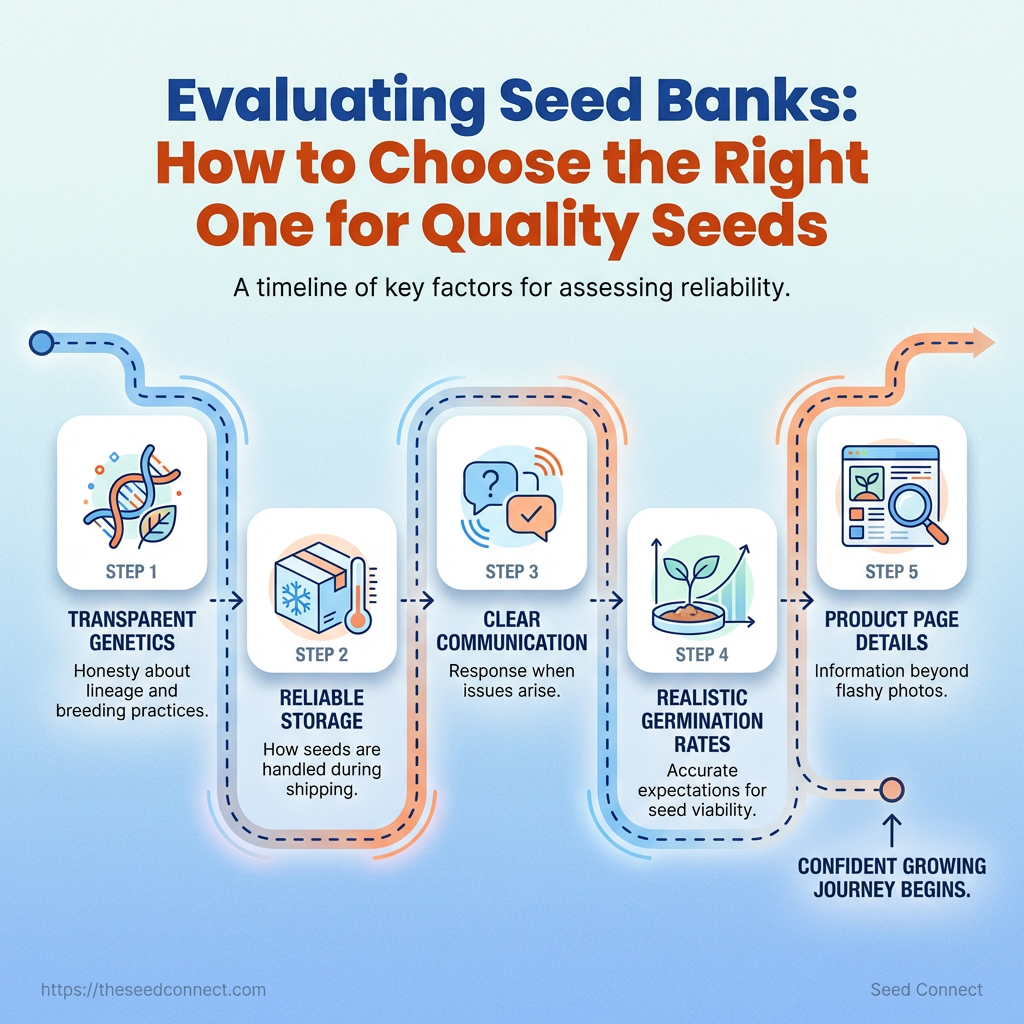
Most growers recognize the same uneasy moment: seeds arrive, some sprout, others don’t, and suddenly the grower is left guessing whether the problem was genetics, storage, or the seller. When choosing cannabis seed banks, that uncertainty usually traces back to a few invisible choices—breeding practices, honesty about genetics, and how seeds are handled during shipping. Spotting those signals before buying saves time, space, and a lot of wasted effort.
A reliable seed source isn’t just about flashy strain photos or big catalogs; it’s about transparent lineage, realistic germination rates, and honest communication when things go wrong. Evaluating quality seed sources means learning to read product pages the way a breeder reads a phenotype chart: selectively and skeptically. Start by treating every claim as a starting point for verification, not an endpoint for trust.
What Is a Seed Bank?
A seed bank is a specialized repository that acquires, preserves, catalogs, and distributes plant genetics — in this context, cannabis genetics — so growers can access stable, named varieties when they need them. It functions like a living library: seeds are the items on the shelf, each entry has provenance and description, and the bank’s job is to keep those genetics viable and true-to-type over time.
Seed banks do four practical things well: Collect and curate: acquire genetics from breeders, stabilize strains, and decide which varieties to catalogue. Preserve viability: use controlled storage (temperature, humidity) and rotation practices so seeds remain germination-ready for years. Document genetics: provide lineage, phenotype notes, expected cannabinoid/terpene profiles, and grower tips. Sell and support: supply seeds to customers and often offer germination guarantees or growing guidance.
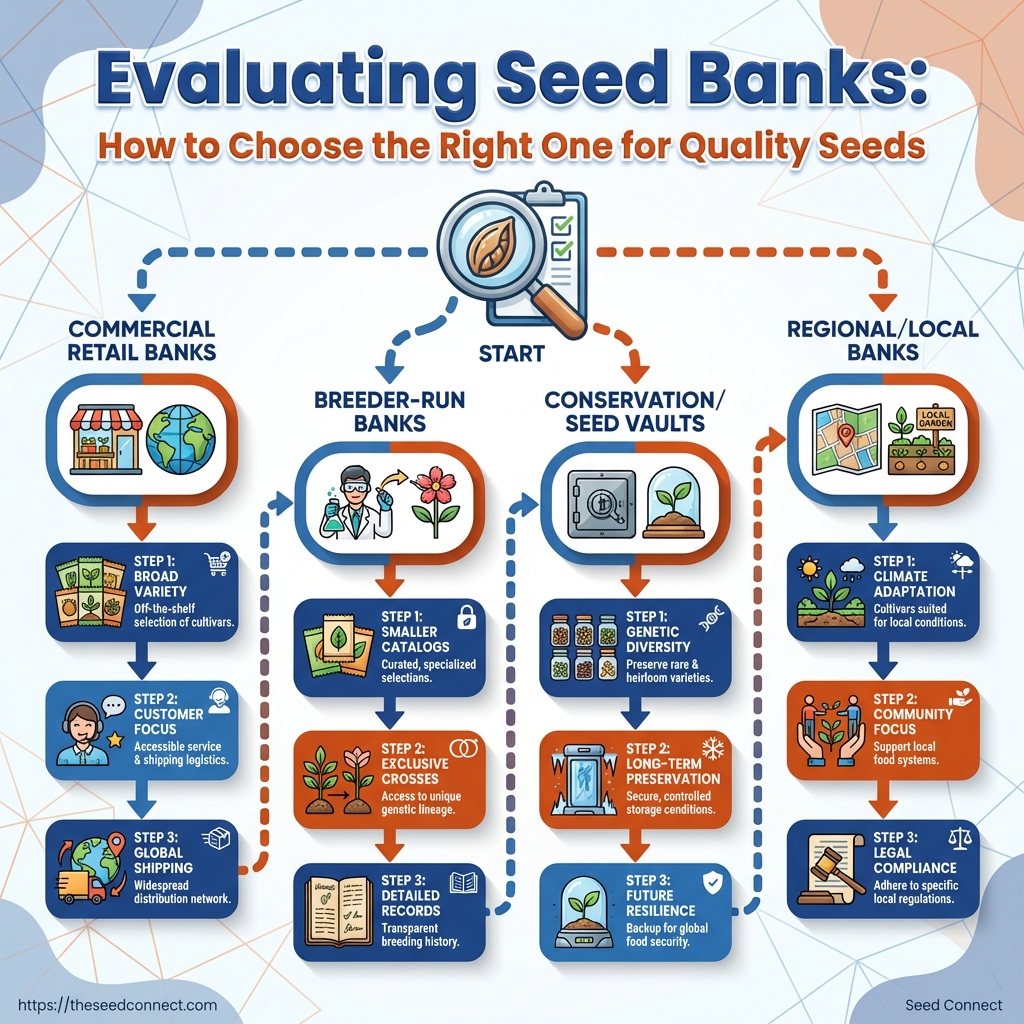
Types of seed banks and how they differ Commercial retail banks: focus on variety breadth, customer service, and shipping; they stock feminized, photoperiod, and autoflower seeds. Breeder-run banks: smaller catalogs, tighter control of lineage, often offer exclusive crosses and more detailed phenotype records. Conservation or seed vaults: prioritize genetic diversity and long-term preservation rather than sales. Regional/local banks: specialize in cultivars adapted to specific climates or legal/regulatory environments.
Practical example: a breeder-run bank might release a new high-THC cross with detailed phenotype photos and limited packs, while a commercial retail bank scales that variety alongside staples and guarantees germination for home growers.
Quick glossary to orient beginners
Genetics: The inherited traits (lineage, dominant characteristics) that determine a plant’s growth and chemical profile.
Feminized seed: Seeds bred to produce only female plants, which are the flowering, cannabinoid-producing plants growers want.
Autoflower: Seeds that switch from vegetative growth to flowering based on age rather than light cycle.
Stabilized/stable strain: A cultivar that reliably produces consistent traits over generations.
Phenotype: Observable traits of a plant (shape, color, aroma) which can vary even within a strain.
When choosing a seed source, look for clear lineage, storage and germination practices, and transparent customer support. For growers seeking a wide selection backed by germination guarantees, options like
How Does a Seed Bank Work?
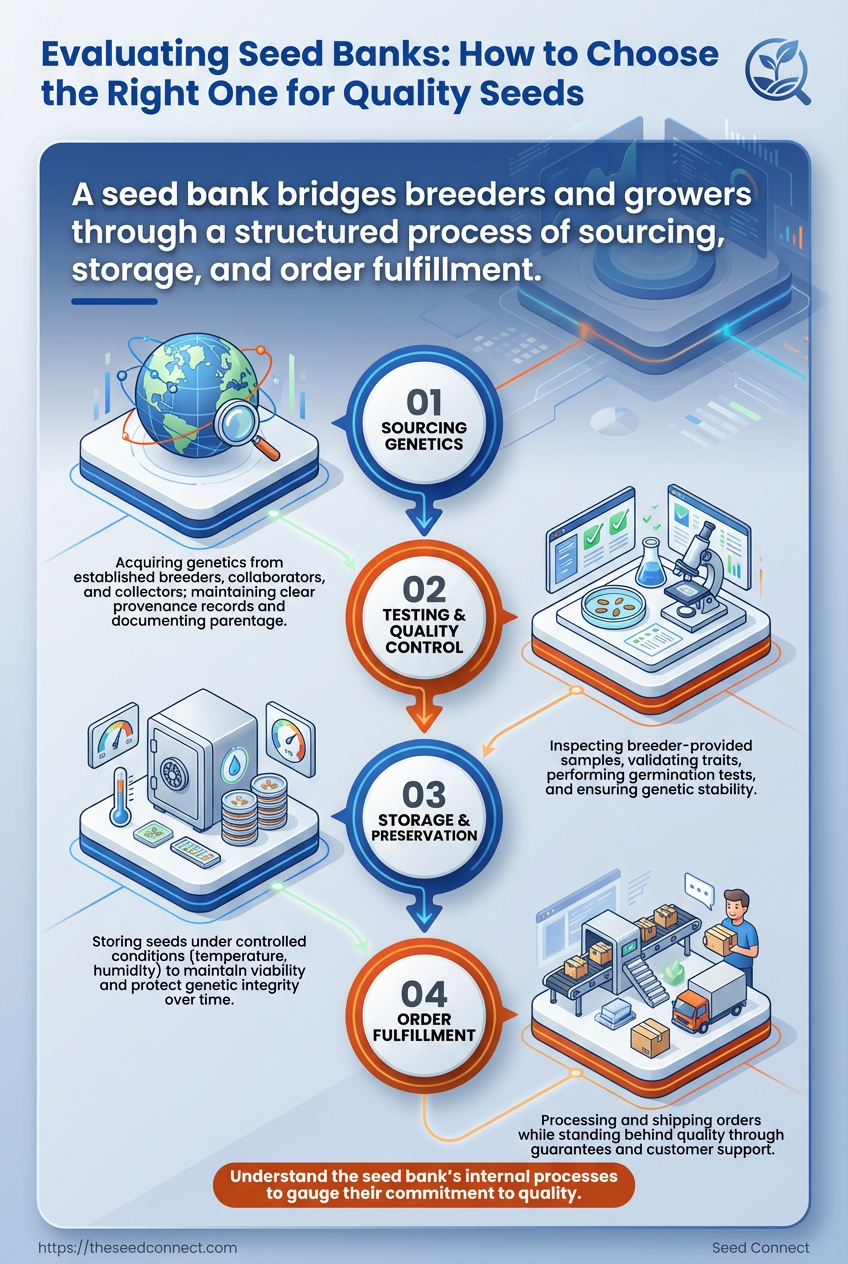
A seed bank is the bridge between a breeder’s genetics and a grower’s rack. At its simplest: breeders provide genetics, the bank validates and stores those genetics under controlled conditions, and then fulfills orders while standing behind quality through testing and guarantees. That straightforward flow masks a lot of work — sourcing, verification, storage, and careful logistics all protect the genetic promise inside each tiny seed.
Sourcing and provenance
Breeder partnerships: Seed banks source genetics from established breeders, collaborative breeders, and collectors of landrace varieties. Good banks keep clear provenance records. Hybrid development: Many offerings are deliberate crosses — breeder notes explain parentage and expected traits. * Acquisitions: Some seed banks acquire legacy or rare lines through trusted exchanges, maintaining paperwork on origin and breeder permissions.
Breeder record: A documented history of a strain’s parentage and breeder contact information.
Testing and quality control
- Breeder-provided samples are inspected visually and for labeling accuracy.
- Banks run
germination ratetrials on batches to check viability and confirm percentages match claims. - Phenotype stability checks follow: multiple plants grown to verify the strain expresses the advertised traits.
- Purity and contamination checks screen for off-type genetics and seed-borne issues.
- Germination testing: Periodic small-batch sprout tests to establish expected success rates.
- Phenotype verification: Grow-outs to ensure the strain’s look, smell, and cannabinoid profile align with breeder claims.
Storage, packaging, and shipping
- Optimal storage: Seeds are kept cool and dry — typically refrigerated at stable low temperatures with desiccant and humidity control.
- Batch tracking: Lots are labeled with harvest date, breeder, and test results so traceability is possible.
- Secure packaging: Light- and moisture-proof packaging protects viability during transit.
- Inventory is pulled and double-checked against order paperwork.
- Orders are packaged in protective materials with humidity control.
- Shipments use carriers and timing strategies that minimize exposure to extreme heat or cold.
What to ask or expect when evaluating a seed bank
- Ask for germination figures and whether there’s a guarantee.
- Request provenance details for the genetics you want.
- Check storage practices and whether batch tracking is available.
- Look for phenotype data or grower photos from test runs.
- Consider seller support — expert troubleshooting after purchase matters.
A well-run seed bank turns breeder promises into predictable results for growers. Knowing how they source, test, store, and ship makes it simple to judge which banks are worth trusting with your next pack of seeds. For shoppers wanting a starting place, look at offerings like cannabis seeds for sale that advertise testing and germination support.
Evaluating Seed Bank Quality: Criteria and Checklist
Start by treating a seed bank like any other vendor: transparency, verifiable promises, and clear channels for recourse. A trustworthy seed bank makes germination terms explicit, shows breeder lineage, posts lab or third-party test results when relevant, and is easy to contact. Below are the criteria that matter, how to score them, and a compact comparison you can use on the spot.
Core criteria (what to inspect first)
- Transparency: Clear product descriptions, origin stories, and breeder names.
- Germination guarantee:
germination guaranteeterms spelled out (length, conditions). - Genetic provenance: Breeder credit, landrace notes, and phenotype stability data.
- Lab testing / certificates: Pesticide, heavy metals, or cannabinoid testing where claims affect product value.
- Shipping options: Discreet packaging, international vs. domestic, and clear shipping timelines.
- Customer support: Live chat, email response time, and refund handling.
- Customer reviews: Recent, platform-diverse, and specific (not all-star fluff).
- Price tier: Low-cost vs. premium genetics; factor quality over bargain when starting.
How to score and weigh criteria
- Assign 1–5 points to each criterion for a given seed bank.
- Multiply priorities by weight (example: germination ×2 for new growers).
- Sum scores; anything above 30/40 is generally reliable for quality genetics.
Example weighting for a first-time buyer: 1. Germination guarantee: weight 2 2. Genetic provenance: weight 1.5 3. Customer support: weight 1.5 4. Price: weight 1 5. Remaining criteria: weight 1 each
Red flags to watch for
- Missing germination data or vague “high germ rate” claims.
- Generic product photos reused across varieties.
- No contact information or only a web form with no response history.
- Long, unclear shipping policies with no tracking promise.
Allow readers to compare seed banks side-by-side on the most important quality metrics to make a quick decision
| Seed Bank | Germination Guarantee | Genetic Provenance / Breeder Info | Lab Testing / Certificates | Shipping Options | Customer Support | Average Review Score | Price Tier |
|---|---|---|---|---|---|---|---|
| Seed Bank A | 90-day replacement ✓ | Breeder listed, lineage notes | Partial tests posted ✓ | Domestic + EU tracked | Email <48h | 4.4/5 | Mid |
| Seed Bank B | No formal guarantee ✗ | Generic strain descriptions ✗ | No lab certificates ✗ | International untracked | Limited FAQ | 3.2/5 | Low |
| Seed Bank C | 1-year germination policy ✓ | Collaborations with known breeders | Full COA available ✓ | Tracked worldwide | Live chat + phone | 4.7/5 | Premium |
| Local Boutique Bank | Customer-exchange guarantee ✓ | Local breeder provenance ✓ | Tests on request ✓ | Local pickup + discreet | In-person support | 4.6/5 | Mid-High |
| Theseedconnect | 60-day germination guarantee ✓ | Breeder info and strain histories | Lab testing where applicable ✓ | Tracked domestic shipping | Expert support + email | 4.5/5 | Mid |
Key insight: The table shows that guarantees, verified COAs, and responsive support cluster with higher review scores. Prioritize germination and provenance when starting; prioritize lab testing and breeder reputation when selecting high-THC or medicinal lines.
A clear scoring approach and one quick side-by-side comparison will save hours of guesswork. Use the checklist and table as a repeatable tool every time a new vendor appears on your radar, and you’ll reduce surprises in the grow tent.
Common Misconceptions When Choosing a Seed Bank
Pick a seed bank for more than price or slick marketing — the real indicators are guarantees, transparent breeding info, and consistent proof that seeds perform as claimed. Many growers get tripped up by familiar signals that feel reassuring but don’t actually predict success. The following four myths come up again and again; each one is busted with practical checks and examples to use the next time a catalog tempts you.
Myth 1 — Higher price always means better genetics.
High price can reflect rarity or marketing, not guaranteed performance. Look for detailed phenotype notes, parental lineage, and grower photos instead of trusting a premium tag. Example: two similar high-THC varieties might differ because one lists stable traits across multiple seasons while the other relies on a single “run” photo.
Myth 2 — Published germination rates are accurate by default.
Publicized percentages are useful, but they’re only meaningful when backed by a replacement policy or warranty. A strong seller will offer guaranteed germination or replacement seeds if a specified percentage fails. When germination rates are given with no guarantee, treat them as optimistic estimates rather than promises.
Myth 3 — Positive reviews mean a seed bank is trustworthy.
Reviews get cherry-picked, faked, or left vague. Prioritize reviews that have dated reports, cultivar-specific photos, and descriptions of growing conditions. A reviewer saying “great seeds” is weaker than one stating: “Germinated 9/10, flowered in 9 weeks, 450 µmol light, outdoor, zone 7.” That level of detail tells you the seeds behaved consistently under known conditions.
Myth 4 — Marketing language about “elite breeders” equals transparency.
Fancy breeder bios and buzzwords can mask poor documentation. Real transparency shows up as batch numbers, breeding lineage, and test results when applicable. Prefer seed banks that publish batch or lot identifiers and will discuss how selections were stabilized over generations.
Practical checks to apply immediately: Verify guarantees: Does the seller replace failed seeds? Ask for lineage: Are parents and stabilizing generations listed? Inspect reviews: Do reviews include dates, photos, and grow conditions? Look for batch info: Are lot numbers or testing details available?
Choosing wisely reduces failed grows and wasted time. When evaluating options, prioritize verifiable safeguards — guarantees, clear breeding information, and detailed evidence from growers — over glossy photos and lofty claims. If a vendor provides those, the odds of a smooth grow improve markedly.
Real-World Examples: Case Studies and Anecdotes
Real growers learn fastest from other peoples’ wins and mistakes. Below are three concise, practical case studies that show how provenance, customer service, packaging, and guarantees play out in the real world — with actions and outcomes you can apply the next time you evaluate a seed source.
Positive: germination trials + timely replacement A boutique grower ordered 200 feminized seeds for a new phenotype trial. They tracked germination rate across two batches and discovered one tray stalled at 76% compared to the expected 92%. Action taken: The grower contacted the seed supplier with photos, germination logs, and lot numbers. Outcome: The supplier honored a germination guarantee, shipped replacements within five days, and provided a short troubleshooting checklist to prevent recurrence. Lesson: A visible guarantee plus responsive support turns a potential crop loss into a quick recovery. For growers prioritizing reliability, consider suppliers that explicitly offer replacements — for example, many reputable shops list their seed guarantees alongside their cannabis seeds for sale.
Negative: unknown provenance + no customer response A community grower purchased a low-cost bulk lot from an unbranded seller on a forum. The seeds looked promising but arrived with no lot info, no germination guidance, and after poor results the seller stopped responding. Consequence: Mixed genetics, wasted time, and the grower had to re-source seeds mid-season — increasing costs and delaying harvest. Practical red flag: Lack of provenance, no batch numbers, and absent customer support usually signal a higher risk of mixed or low-viability stock.
Mixed: excellent genetics but poor shipping practices A small breeder produces award-winning strains but ships seeds in flimsy envelopes without moisture control or tracking. Several customers received damaged packets after transit through hot climates. Mitigation: The breeder introduced insulated packaging, silica pouches, and optional tracked shipping. Customers who paid for tracking avoided losses. Takeaway: Genetics matter, but so does packaging and shipping choice — especially across long distances or extreme temperatures.
Quick checklist for evaluating seed vendors: Proof of provenance: batch IDs, photos, lineage. Customer support: responsive channels and clear replacement policy. * Shipping options: tracked, insulated, and moisture-controlled choices.
These examples show once you start treating seeds as a system — genetics, documentation, service, and logistics — you reduce surprises and protect your season. Choosing a supplier that covers those bases saves money and headache down the line.
Buying, Germination Guarantees, and Aftercare
Start by treating seed purchase like any small-investment experiment: choose good genetics, confirm a clear germination promise, and plan the first two weeks of care before the seeds arrive. That reduces surprises and makes claiming replacements straightforward if something goes wrong.
Purchase checklist: Verify the guarantee: Confirm what the seller covers (full replacement, partial credit) and the claim window. Read the policy: Check exclusions (mold, improper germination method) and required documentation. Check shipping options: Faster, tracked shipping reduces cold/damp exposure during transit. Look for seller transparency: Germination rates, strain lineage, and customer reviews show reliability. * Consider genetics fit: Match feminized/autoflower choices to your grow setup and experience level.
Germination protocol (reliable, repeatable method)
A simple, high-success approach uses the paper towel method with small refinements.
- Prepare materials: two clean plates, paper towels, distilled water, tweezers, and a labeled tray or cups.
- Moisten paper towels evenly (not dripping), lay seeds spaced at least 2 cm apart, cover with another towel, and seal plates loosely or use a humidity dome.
- Keep temperature at
21–25°Cand a gentle, dark environment until taproots appear—check twice daily. - Transfer seedlings to starter medium once taproot reaches 2–5 mm, handling by the seed shell, not the radicle.
Common troubleshooting: if seeds fail to swell, increase warmth slightly; if mold appears, improve airflow and replace towels. Autoflowers often germinate faster than photoperiod strains, so expect variation.
How to document and claim replacements: Photograph sequence: Image of the packet (showing strain/date), seeds before germination, setup, and daily progress. Log dates and method: Record purchase date, germination start date, temperature, and moisture notes. * Contact promptly: Send photos and the log within the guarantee window; include order number and preferred remedy.
When choosing a supplier, consider purchasing cannabis seeds for sale from vendors who publish clear germination policies and offer expert support. That combination of genetics transparency plus a straightforward replacement process saves time and stress, and it makes successful germination more predictable for every grower.
📥 Download: Seed Bank Evaluation Checklist (PDF)
Why It Matters: Impact on Your Grow
Starting with quality genetics changes almost everything about a run: vigor, uniformity, pest resilience, and final yield. Choosing reliable seeds narrows variability between plants, reduces surprises during flower, and turns guesswork into predictable decisions — which directly affects time spent, inputs used, and ultimately profit or personal satisfaction.
How seed quality translates to garden outcomes
- Consistency: Uniform genetics mean plants hit nutrient, training, and flowering windows at similar times, simplifying canopy management.
- Germination success: Higher germ rates cut wasted pots, soil, and labor — every failed seed represents both a direct cost and time lost.
- Trait reliability: Stable genetics deliver expected cannabinoid profiles, terpene aromas, and growth habits, which matters if growing for potency, flavor, or processing.
- Stress tolerance: Stronger lines resist pests and environmental swings better, lowering pesticide or remediation costs.
Real example: swapping cheap open-pollinated seeds that germinated 60–70% for a reputable feminized batch that reliably hits 90–95% can save dozens of dollars per run in media, lights, and labor — and avoids the hassle of re-seeding mid-cycle.
Cost vs. value: the numbers gardeners actually care about
- Start with the up-front price per seed.
- Factor in replacement costs for failed germination, extra veg time, and lost yield from late or weak plants.
- Calculate labor and electricity for re-runs or longer veg periods.
When those are added up, paying a premium upfront for verified, feminized, or autoflower genetics often breaks even quickly. It’s not about spending more — it’s about reducing hidden costs and tightening timelines.
Practical decision cues
- If consistency matters: prioritize reputable, known genetics.
- If budget is tight: buy fewer high-quality seeds rather than many cheap unknowns.
- If scaling up: reliable seed performance becomes exponentially more valuable as each failed plant multiplies cost.
For those ready to upgrade genetics, consider browsing cannabis seeds for sale for options with germination guarantees and support. Investing in quality seed stock streamlines operations, reduces surprises, and makes planning future runs much easier — the initial outlay pays off in time saved and cleaner, more consistent harvests.
Conclusion
After working through how seed banks operate, what to look for when evaluating them, and the real-world stories of growers who improved outcomes by switching suppliers, it’s clear that attention to provenance, storage practices, and germination assurances separates reliable sources from risky ones. Practical steps matter: verify third-party testing or breeder reputation, check storage and shipping policies, and prioritize vendors that back their product with clear germination guarantees. Examples earlier in the article showed a small home grower recovering lost yields by choosing a supplier with documented cold-chain practices, and a commercial operator minimizing wasted trays after adopting guaranteed seed lots — both illustrate that quality seed sources pay off quickly.
If you’re weighing options, start by narrowing vendors using those evaluation checkpoints, then test a single variety before scaling. Order small, track germination closely, and document storage/handling so you can isolate issues quickly. To streamline the next step, explore available varieties and guarantees directly: Browse germination-guaranteed cannabis seeds. If questions remain about germination policies or aftercare, the patterns described here point to what to ask your supplier and how to judge their answers.