

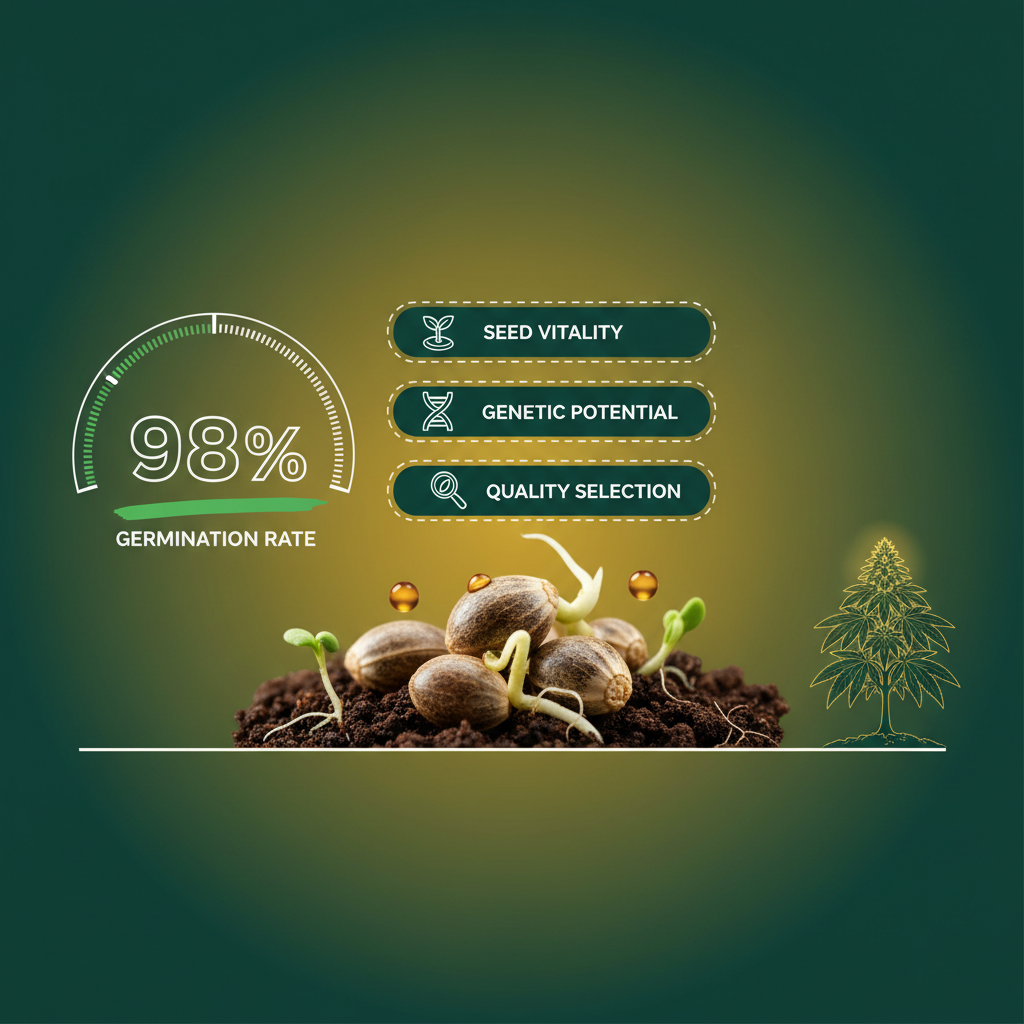
The Importance of Seed Quality in Cannabis Germination Success becomes clear when two seed batches are given the same germination conditions but perform very differently. Viability, vigor, seed health, genetics, and previous storage conditions can all influence how quickly and consistently seeds establish healthy seedlings.
According to the University of Florida, seed vigor helps determine the potential for rapid, uniform emergence and normal seedling development, especially when conditions are less than ideal. In this guide, The Seed Connect explains how cannabis seed quality affects germination and what growers should look for before starting a new batch.
Quick Answer: Cannabis germination differences usually come down to seed quality—viability, health, vigor, and genetic fidelity—not the towel or soil. Even a visually “good” batch can underperform if storage/handling damaged seed vigor or if genetics aren’t consistent, which shows up as patchy emergence or seedlings that stall after the first week. For example, heat and stress during seed development can reduce vigor and delay germination—so the traits you need aren’t only about what you do during germination, but what happened before the seed ever reached your hands.
Why seed quality matters before germination even begins
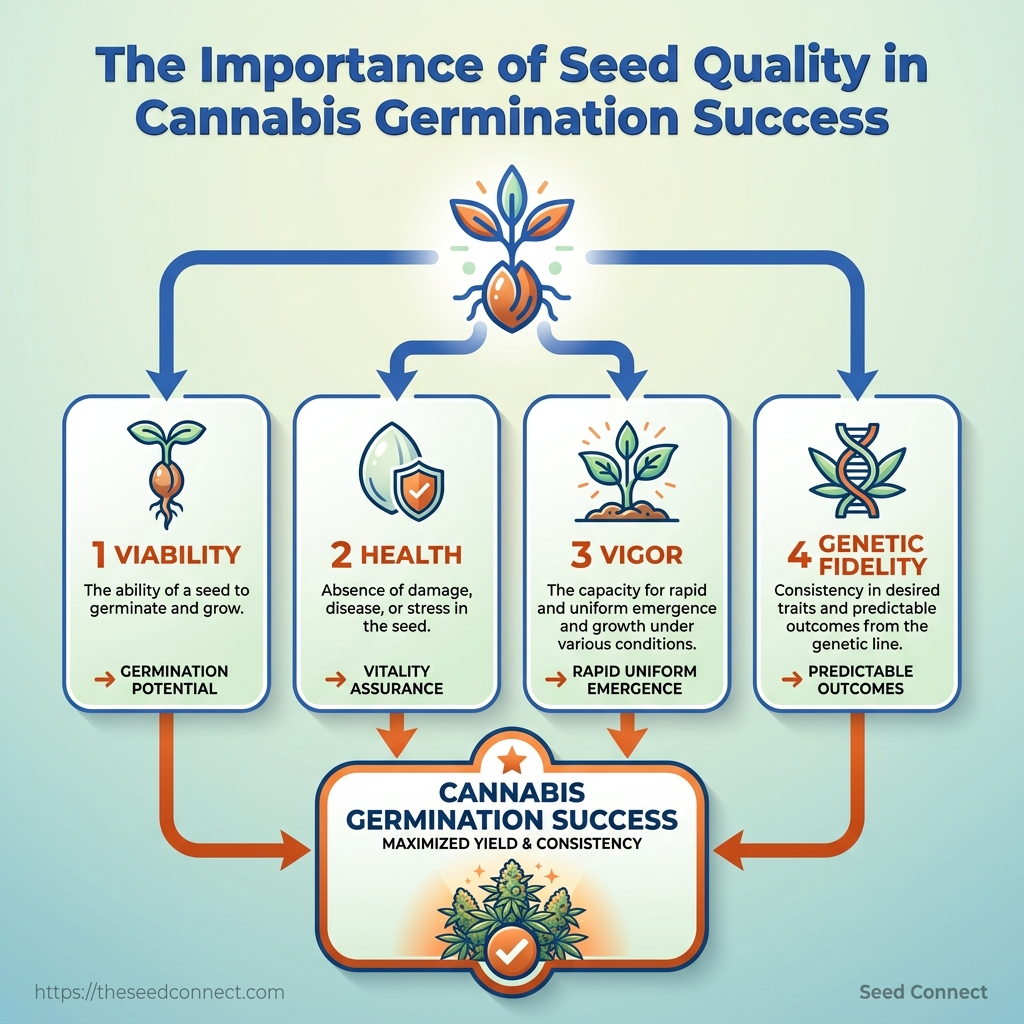
You don’t actually start germination when the seed cracks—you start it the moment the seed lot was stored, handled, and shipped. Cannabis seed quality is a bundle of traits that determine how much of the seed’s potential survives that waiting period: viability, genetic fidelity, health, and vigor.
If one of those traits is weak, the trouble usually appears later as slow sprouting, patchy emergence, or seedlings that stall after the first week.
A seed can be alive and still be a poor bet.
That’s where the impact of seed genetics gets practical. A batch may germinate well yet still produce uneven plants when the genetics aren’t stable.
Seed Connect’s quality framework helps you spot that split: one lot can show high germination and still vary widely if seed health or genetic consistency is uneven; another can be genetically true-to-type yet underperform because storage or handling reduced vigor.
For a closer look at what to check before you buy, see our guide on how to evaluate cannabis seed quality before purchase for the physical signs that matter.
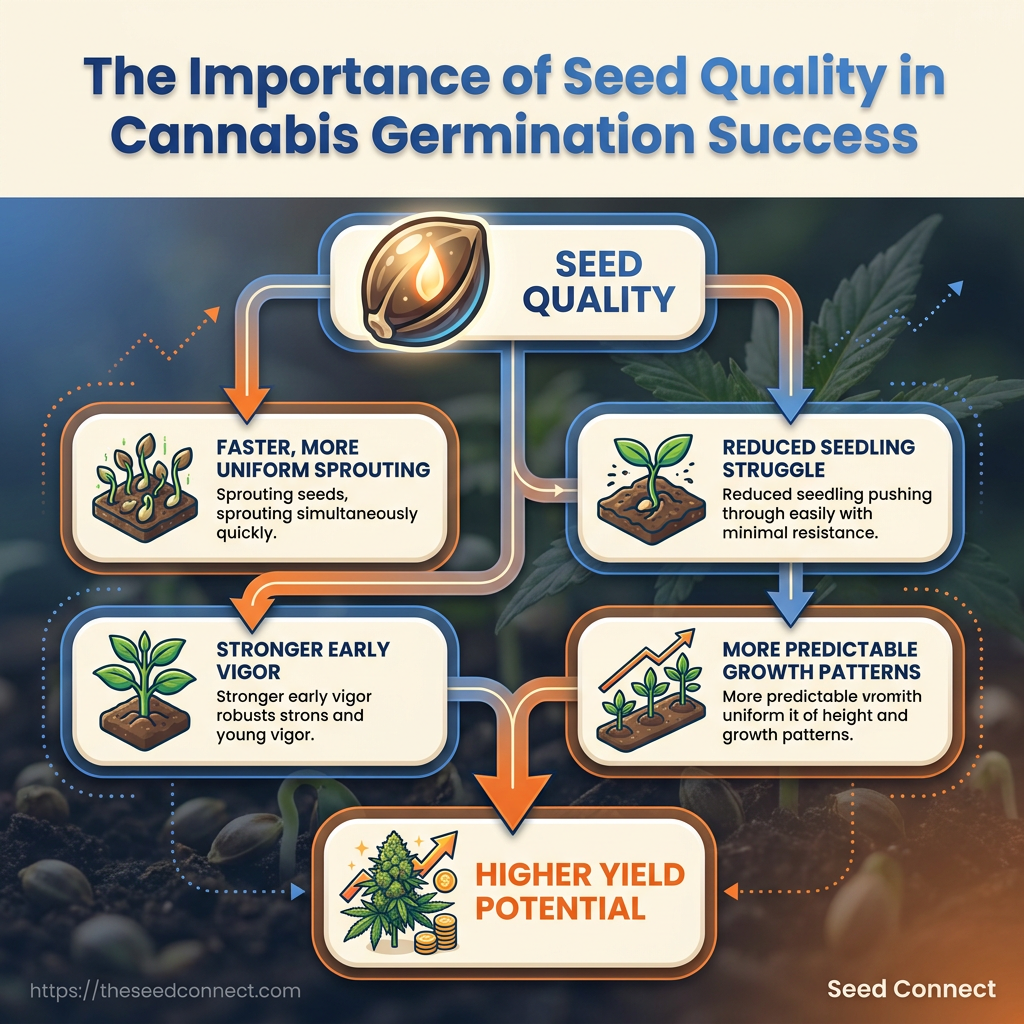
Seed quality also shapes early vigor—the part most growers notice most. And in testing, that’s why we treat germination rates as a planning metric (what you can reasonably expect) rather than a guarantee.
Genetics tells you what the plant is supposed to become.
Storage tells you how much of that potential survives the wait.
Germination method tells you how cleanly you can pull that potential out—so you can’t separate “how it was made and stored” from “how you germinate.”
High-quality cannabis seeds don’t just sprout better—they give you a cleaner start, fewer surprises, and a better shot at an even canopy later on.
What makes a cannabis seed high-quality
A “pretty” seed isn’t the same thing as a seed that will perform. High-quality cannabis seeds are the ones that still have strong biology behind the appearance.
Seed genetics set the baseline. They influence how stable the offspring stay, how uniform seedlings look, and how reliably the traits breeders intended show up in the first place.
Even so, appearance isn’t useless: high-quality seeds are typically mature, feel firm, and show even color rather than looking pale, soft, or chalky.
Freshness matters too. Over time—especially with heat and humidity—seed vigor can quietly decline long before the seed ever touches water.
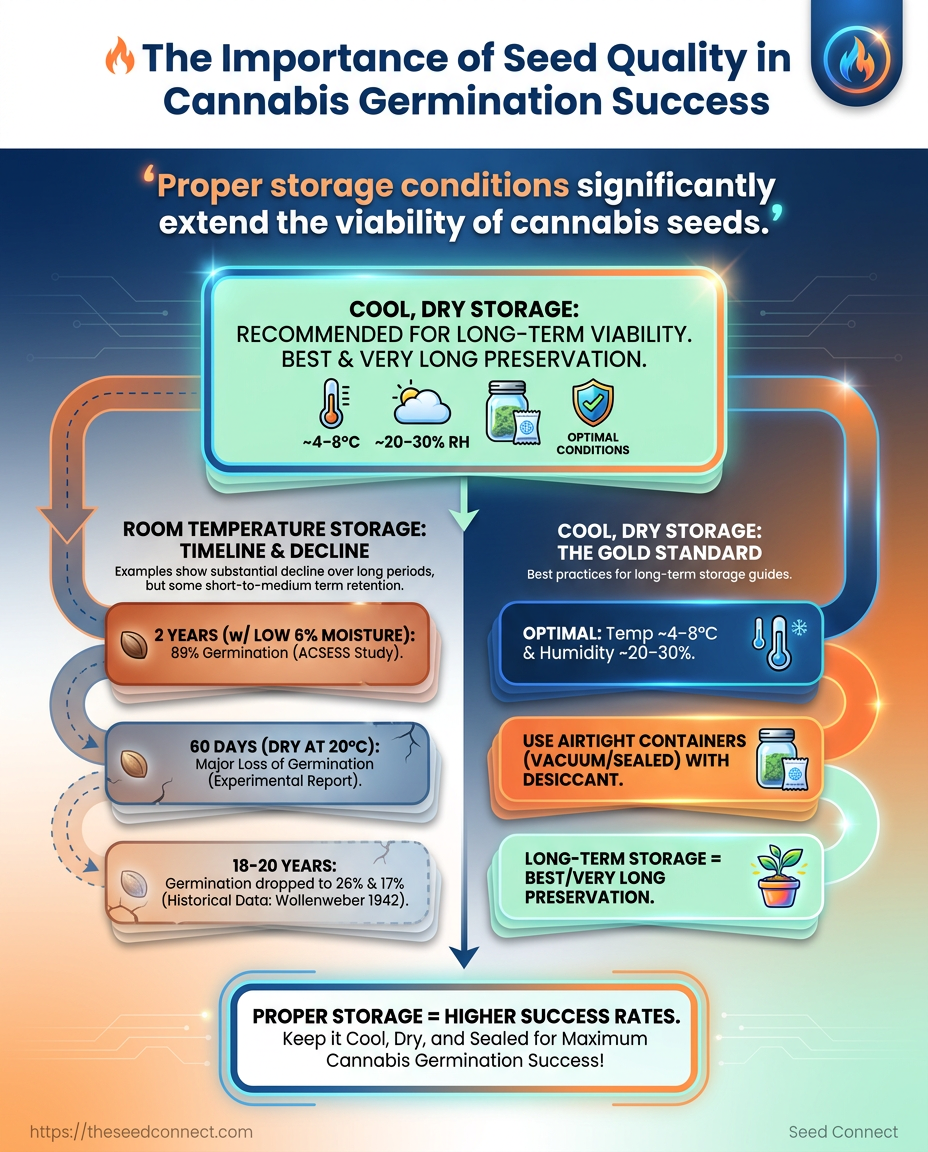
A 2026 storage guide from SeedCellar on preserving weed seeds notes that room-temperature storage can preserve viability for about 1–2 years, while cool, dry storage extends that window much longer.
Genetics, appearance, and storage all work together
| Seed quality factor | What it looks like | Why it matters for germination |
|---|---|---|
| Genetic stability | Offspring stay close to the expected traits, with less random variation | Stable lines tend to give more predictable germination and early growth |
| Seed maturity | Dark brown, light brown, or gray seeds with a full, finished look | Mature seeds usually have a developed embryo and better odds of sprouting |
| Seed coat condition | Firm shell, no cracks, dents, or chalky spots | A damaged coat can speed dehydration and let pathogens in |
| Freshness and storage | Seeds stored cool, dry, and dark; minimal time in warm, humid air | Poor storage drains vigor and can cut germination fast |
| Supplier quality control | Clean handling, sorted lots, and consistent labeling | Better QC reduces the chance of buying mixed or weakened seed lots |
A quick visual check can catch a lot. Firmness, color, and shell integrity are the first clues worth trusting—and they generally line up with what seed testing labs look for when judging viability and vigor.
If you want the practical takeaway: good genetics set the ceiling, good handling protects it, and good storage keeps it from slipping. When those three line up, strong, even seedlings become much more likely.
How impact of seed genetics shows up in real grows
Ever watched a tray of seedlings come up like cousins instead of twins? That is usually where genetics starts to show its hand.
Uniform genetics give you a calmer grow.
Plants tend to emerge at a similar pace, build similar structure, and ask for the same feeding rhythm.
When the line is messy, one plant races ahead while another lags, and the whole room starts feeling harder to read.
A 2025 hemp study in Scientific Reports is a good reminder that cultivar response still varies even when the treatment is the same.
One cultivar reached an 83% germination response after IBA priming, while other lines did not perform the same way.
Genetics do not just influence whether a seed pops; they shape how predictably that plant behaves once it does.
- Uniformity saves time: similar plants usually mean similar stretch, feeding needs, and training response. That makes canopy management much easier.
- Unstable genetics feel random: one seed may grow fast, another stays squat, and a third shows odd leaf structure or delayed flowering. The batch is not necessarily “bad,” just inconsistent.
- Vigor changes the first month: vigorous seedlings usually push roots faster and handle small mistakes better, even when conditions are not perfect.
Breeders protect genetic quality by selecting parent plants with stable traits across multiple generations.
Seed banks do the next part by keeping lots well documented, storing them properly, and removing weak or off-type material before it reaches growers.
That is why genetics matter so much in With high-quality cannabis seeds, the grow still has personality, just not chaos.
When the genetics are stable, germination feels cleaner, seedlings behave more evenly, and the whole run becomes easier to plan.
When they are not, the tray spends the season reminding you that “same strain” does not always mean “same result.”
Common signs of poor seed quality to watch for
Ever opened a pack and had one seed look solid while the next feels almost brittle? That unevenness is often the first hint that a lot has taken a beating before it ever reached your hands.
Poor seed quality usually shows up in three places: the shell, the first few days of germination, and the seller’s answers.
Storage matters more than most people think, too; one hemp seed storage trial found some lots lost 50% germination after only one year under poor conditions, which is a brutal reminder that old handling habits leave a mark. hemp seed storage trial showing germination loss after one year
Physical red flags before soaking
A healthy seed should feel like it has structure.
When the shell looks tired, scratched up, or strangely soft, that usually means trouble.
- Pale or washed-out color: often a sign of immaturity or rough drying.
- Cracks, dents, or pinholes: these can let moisture escape or contaminants get in.
- Chalky or fragile shell: a weak coat tends to fail under soaking pressure.
- Musty smell or loose debris: possible mold, dust, or poor storage hygiene.
- Big size differences in one batch: not always fatal, but worth a closer look.
Germination warning signs that point back to seed quality
The seed can tell on itself once it hits water.
If it cracks and then stalls, or if several seeds in the same lot move at wildly different speeds, the problem may be the seed rather than your method.
- Split shell, no taproot: a common sign of tired viability.
- Taproot that looks thin or bent: often linked to stress or aging.
- Slime, fuzz, or a sour smell: usually a storage or moisture problem.
- Some seeds pop fast, others lag hard: the lot may be uneven in vigor.
- No movement after the usual 7–14 day test window: worth suspecting seed quality.
What to ask a seller before you buy
A seller who knows their stock should be able to answer simple questions without dodging.
If the answers are vague, that tells you plenty.
- When was the lot harvested and packed?
- How was it stored before shipping?
- Was germination tested recently, and on what batch?
- What is the replacement policy if a lot underperforms?
- Can you share the batch or lot number?
Those questions cut through the fluff fast.
Good sellers welcome them, because high-quality cannabis seeds should come with real support, not crossed fingers.
How to judge high-quality cannabis seeds before you buy
Would you trust a seed pack just because the photo looks clean? The better test is simpler: check who bred it, how it was stored, and what happens if it underperforms.
That matters because seed condition can change fast when heat and moisture creep in.
A 2026 cannabis seed preservation guide estimates room-temperature storage at 1–2 years, refrigerated storage at 5+ years, and freezer storage at 10+ years if done perfectly, which is why storage notes are not filler text.
Strong cannabis seed quality also shows up in how openly the seller explains the lineup.
If the breeder, variety type, and support policy are easy to find, you are usually dealing with a seller that expects harder questions.
A simple pre-purchase checklist for buyers
Before money changes hands, run the pack through these five checks.
| What to check | Good sign | Red flag |
|---|---|---|
| Breeder information | The breeder or line is named, and traits are described plainly. | Generic “premium genetics” language with no breeder or line details. |
| Storage and shipping details | Seeds are kept dry, shipped fast, and packaged to protect them from moisture. | No storage policy, no shipping window, or vague warehouse claims. |
| Germination guarantee | The terms are clear, with replacement or credit steps spelled out. | “Guaranteed” appears with no policy, limits, or claim process. |
| Customer support access | There is a real support path and a response window for grower questions. | Only a contact form, no follow-up promise, and no support detail. |
| Variety descriptions | Feminized, autoflower, and high-THC lines are explained with expected traits. | Hype words with no useful detail about what you are buying. |
The pattern is easy to spot once you use it.
Clear breeder info and storage notes point to better handling, while a real guarantee lowers the risk of a bad lot.
Our team built that same logic into how we present our own lineup, because buyers should not have to guess at the basics.
If you want a place where quality notes and support are easy to find, our cannabis seeds page keeps both in one spot.
A clean listing saves time.
A clear guarantee saves money.
High-quality cannabis seeds are easier to trust when the seller makes the hard parts visible.
Ever notice how the cleanest germination routines usually come from the cleanest seed lots? Good seeds don’t eliminate care requirements, but they make your routine easier to repeat—and your results easier to interpret.
That matters because germination is part biology and part habit.
When your seeds are healthy, viable, and vigorous, small mistakes are less punishing. When they are not, every little wobble in moisture or temperature turns into another mystery to solve.
The better the seed quality, the simpler the routine can be
- Keep moisture steady. Fluctuating soak times and soggy media create stress, even for strong seeds.
- Hold a consistent temperature. Germination likes stability more than excitement—aim for a warm, even range.
- Handle seeds gently. Even firm shells can be damaged by rough handling, hard drops, or repeated drying out.
- Track each lot separately. Different seed lots can behave differently, so mix-ups blur the pattern fast.
Seed storage habits still matter
Even the best method can look “bad” when the seed is already declining. Warm, humid storage (or long delays with temperature swings) can reduce vigor and slow emergence—so it’s often the seed health that explains the uneven performance, not your technique.
A practical way to stay confident: treat germination results as baseline data you can act on. Run a small test batch when you’re working with a new lot, then scale up once the emergence pattern matches your expectations.
If a batch starts behaving oddly, or one pack performs very differently from the others, don’t immediately change multiple variables at once. Pause, isolate the lot, and ask for help—because the fastest fix is usually identifying whether the issue is the seed quality, storage history, or your process.
The role of seed quality in international buying decisions
What happens when a buyer in another country never gets to see the grow room, meet the breeder, or inspect the seeds in person?
That’s where cannabis seed quality stops being a nice-to-have and becomes the whole decision.
Overseas buyers aren’t just judging genetics on paper.
They’re judging whether a pack can survive distance, handling, and time without losing the traits they paid for.
A polished product page can look great and still hide a weak lot.
International buyers usually need more than strain names and pretty photos.
They need proof that the seeds are healthy, stored well, and backed by people who can answer real questions before the package even lands.
Why the label is not the full story
A good-looking listing tells you almost nothing about how the seeds were handled last week.
That matters because seed quality isn’t only about the impact of seed genetics.
It also includes health and vigor—and how well the lot was protected before shipping.
A seed can have strong genetics and still arrive tired, especially after heat swings or poor storage.
- Genetic promise: Buyers want trait consistency, not lottery-ticket results.
- Physical condition: Firm shells and intact coats matter more than glossy photos.
- Handling history: Storage mistakes can quietly cut performance before sowing ever begins.
Shipping stress changes the equation
Temperature and moisture are not small details.
They can reduce viability faster than many buyers expect—so the practical question becomes: what stress did the seeds face before they reached the mailbox?
Why expert support matters across borders
Cross-border buying gets easier when someone can explain what a result really means.
A germination percentage alone doesn’t tell the full story. One lot may sprout well but show uneven seedlings, while another may need better storage before use.
That’s why expert support helps buyers separate high-quality cannabis seeds from seeds that merely look credible online.
At Seed Connect, that support is part of the experience, especially when buyers want confidence before ordering Cannabis Seeds.
Good guidance removes a lot of guesswork—and in international buying, guesswork gets expensive fast.
A strong lot, careful shipping, and real support travel better than marketing copy ever will.
That combination is what makes the difference between a hopeful order and a reliable one.
Will cannabis seeds become illegal in 2026?
No—there is no universal, nationwide rule that cannabis seeds will become illegal in 2026. Seed legality depends on your specific jurisdiction and evolving cannabis regulations, which vary widely. The safest approach is to check your local laws and enforcement status for both seed possession and cultivation.
What temperature is best for germinating cannabis seeds?
There is no single “best” temperature stated here because germination outcomes are driven primarily by seed viability, health, vigor, and genetic fidelity. What matters most is consistent, gentle conditions that avoid stress. If your seeds are low-vigor from heat or poor storage, even ideal warmth won’t reliably produce uniform sprouting.
Is 50 degrees too cold for seeds to germinate?
Yes—50°F is typically too cool for fast, reliable germination because low temperatures slow metabolism and delay sprouting. The article emphasizes that poor seed vigor from storage damage can also cause stalling even when everything else is done “right.” For best results, use a stable, moderate warmth and focus first on seed quality.
Will 20 year old seeds still germinate?
They might, but it’s unlikely unless they were stored under near-perfect freezer conditions for most of that time. A preservation guide cited here estimates room-temperature storage at only 1–2 years, refrigerated storage at 5+ years, and freezer storage at 10+ years if done perfectly. After 20 years, most lots will have lost vigor to the point of patchy or no emergence.
Which cannabis seed company has the best genetics?
No single seed company can be guaranteed to have the best genetics for every grower. Genetics performance depends on genetic fidelity and stability, which determine uniform sprouting and early growth. The most reliable choice is a breeder/seller that clearly supports lineage and quality, because inconsistent seed lines can produce uneven outcomes even when germination rates look decent.
When Genetics Decide the First Week
The one thing worth remembering is that cannabis seed quality starts working long before a seed cracks open.
Strong genetics shape vigor, uniformity, and resilience, which is why two seeds that look almost identical can produce very different results once they hit water and soil.
That was the whole point behind the example of the fast, even batch versus the stalled one.
Good storage and proper germination habits matter, but they cannot fully rescue weak seed genetics or poor seed handling.
The real difference usually shows up early: quicker root growth, steadier seedlings, and fewer surprises later.
So the smartest move today is simple: check the genetics, ask about storage, and buy with enough confidence to start small if needed.
If you want a practical place to begin, our cannabis seeds are chosen with that exact standard in mind, because high-quality cannabis seeds make every later step easier to trust.