

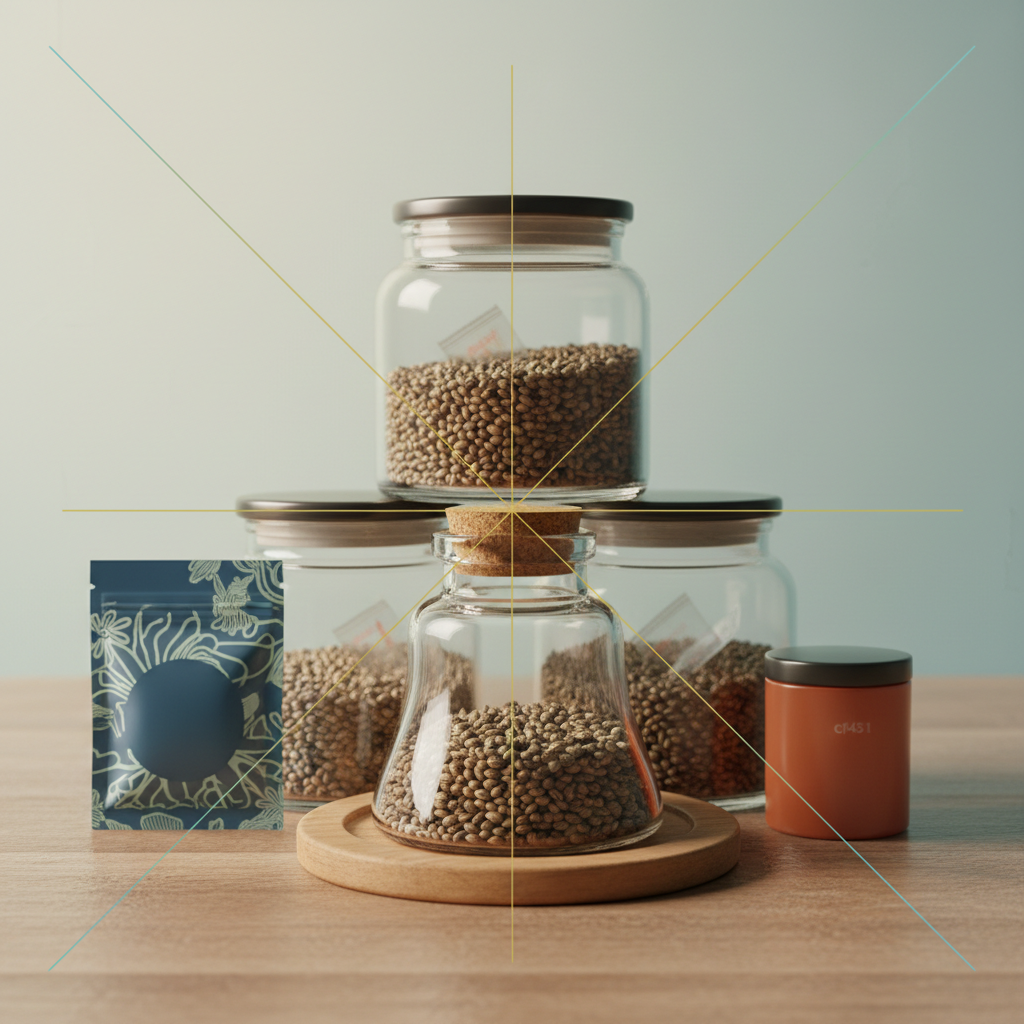
Learning how to store cannabis seeds for optimal quality starts with protecting them from the main factors that speed up deterioration: heat, moisture, light, and unstable storage conditions. The right storage setup can help preserve seed viability and reduce the risk of damage before germination.
According to research on long-term seed preservation, cooler temperatures and lower seed moisture generally help extend the storage life of orthodox seeds. The Seed Connect recommends using stable, dry, dark conditions and suitable containers to protect cannabis seeds until they are ready to be planted.
In this guide, we’ll cover the best storage methods, container options, temperature considerations, and common mistakes to avoid.
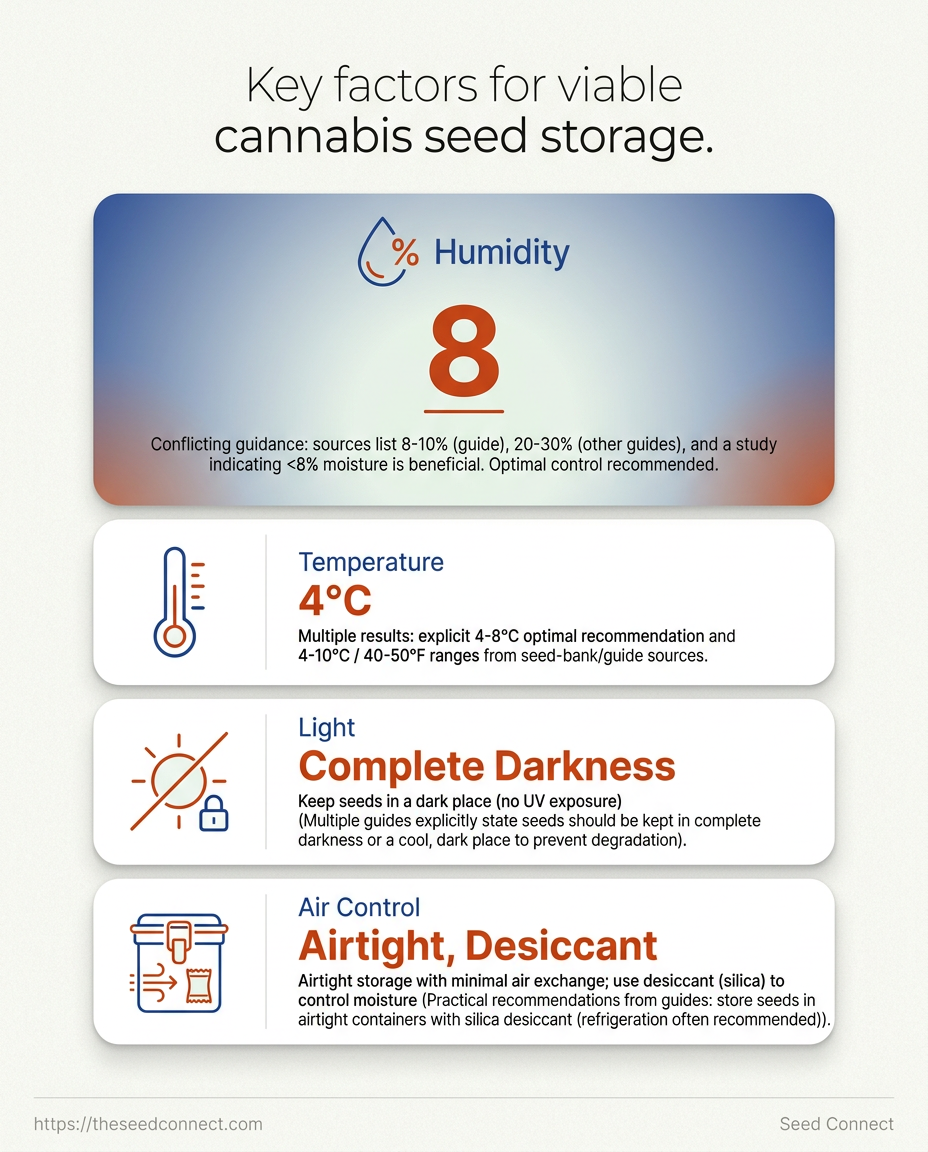
Quick Answer: Store cannabis seeds in a cool, dark, dry, and stable environment—ideally around 40–50°F (4–10°C)—and keep them in an airtight container to minimize light and oxygen exposure. Keep moisture extremely low (aim for below 10% humidity inside the storage setup).
Most importantly: avoid condensation. Let a cold container warm to room temperature before opening, then reseal immediately.
Table of Contents
What if your seeds could stay viable for years with just a few simple storage habits?
What if the difference between a strong seed bank and a dead stash came down to four quiet habits: cool, dark, dry, and steady? That is usually the whole game.
Seeds are living material, not inert collectibles.
Heat, moisture, light, and oxygen slowly chip away at germination success, which is why storing cannabis seeds well matters as much as buying quality genetics in the first place.
As Washington City Paper’s guide to storing cannabis seeds notes, the basics never change: block light, reduce moisture, and keep temperatures cool.
The good news is that the list of needs is short.
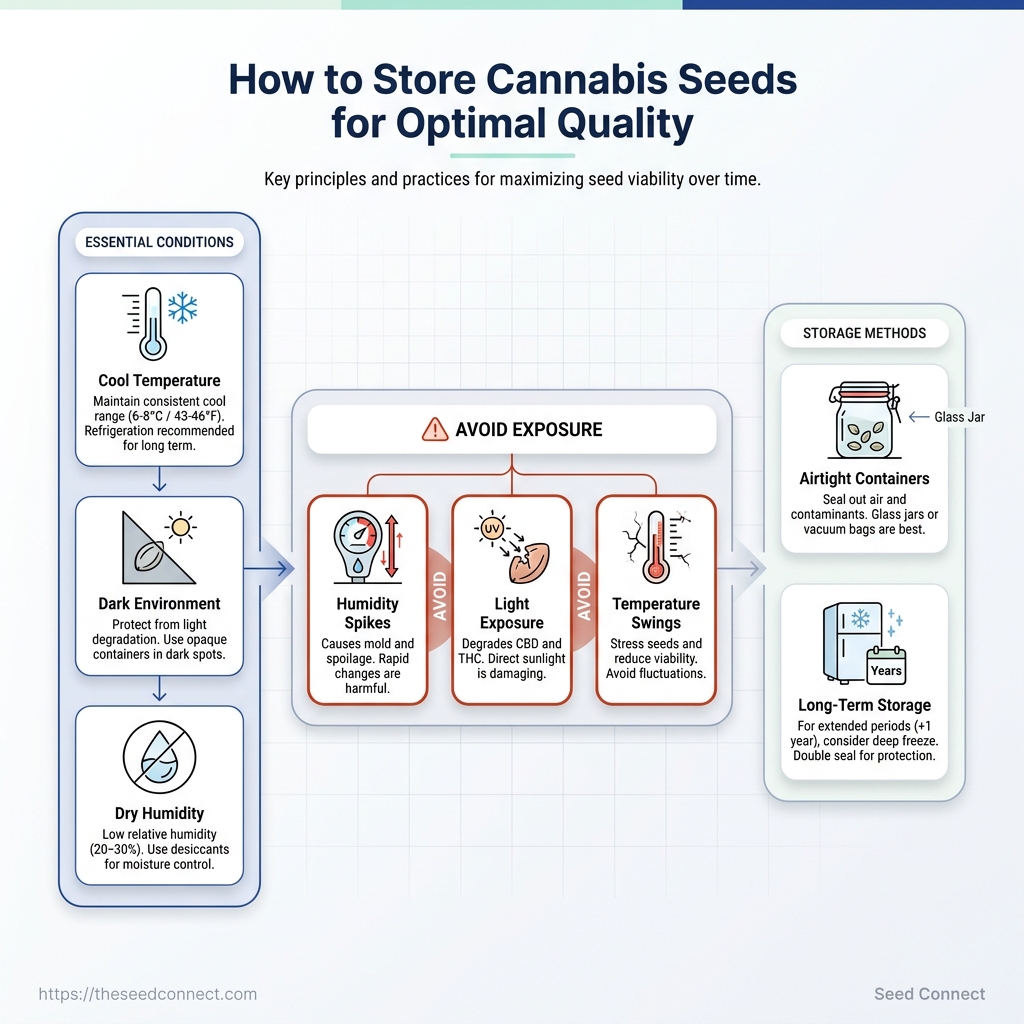
Cannabis seeds stay healthiest when they sit in stable temperatures, low humidity, complete darkness, and minimal air exposure.
> Under proper storage, seeds can remain viable for 5–10 years or more. Humboldt Seed Company reports that range for well-managed storage, while Seed Connect’s 2025 storage guide puts proper preservation at up to 8 years.
Cool temperatures: Aim for refrigeration range storage, around 40°F–50°F (4°C–10°C), and avoid frequent door opening.
Temperature swings are rough on seed coats.
Low humidity: Keep relative humidity around 8–10% if possible.
Moisture is the fastest route to mold and premature sprouting attempts.
Darkness: Use opaque containers or keep seeds in a sealed, light-proof setup.
Light speeds up aging even when everything else looks fine.
Air control: Airtight containers or vacuum-sealed packaging reduce oxygen exposure and help keep conditions stable over time.
A simple example makes this easier to picture.
A grower who stores seeds in a labeled airtight jar with a desiccant packet, then keeps that jar in a steady fridge, is doing far better than someone who leaves seeds in a warm drawer.
The habit that trips people up most is opening cold containers too soon.
Let the container warm to room temperature before opening it, or condensation can undo all that careful storage.
When storage is calm, dry, and consistent, seed preservation stops feeling like guesswork.
It becomes a repeatable routine, and that protects both germination rates and the genetics you want to keep.
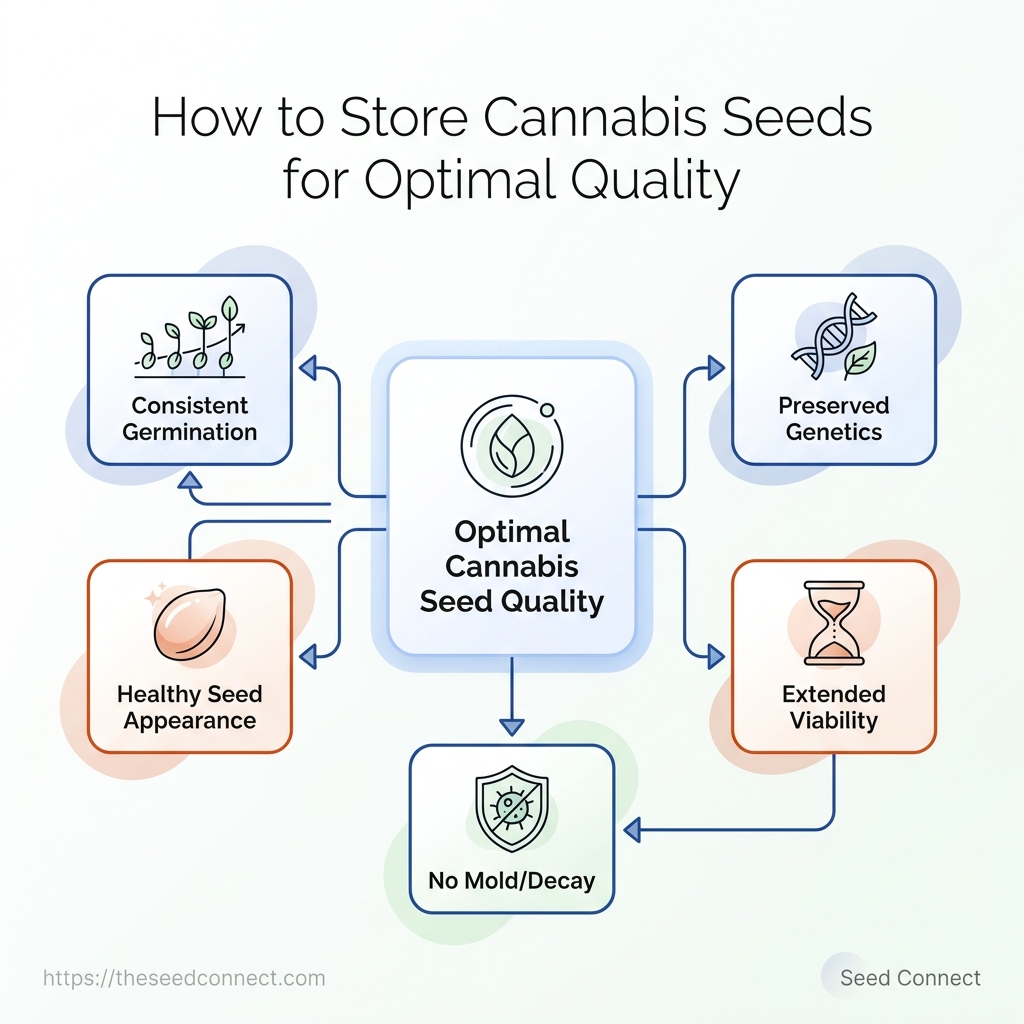
A seed container fails quietly long before it looks damaged.
Clear plastic, loose lids, and warm cupboards let light and humidity creep in fast.
A dark, airtight container placed in the right spot gives seeds a much calmer life.
Glass usually beats thin plastic here, especially when paired with a desiccant packet and a tight seal.
Our beginner’s guide to cannabis seed storage makes the same case from a preservation angle: protect the seed coat, block moisture, and keep the environment steady.
As Washington City Paper’s guide to storing cannabis seeds explains, the best setups keep out light, limit moisture, and stay cool.
Choosing the right storage spot
| Storage location | Temperature stability | Moisture risk | Light exposure | Best for |
|---|---|---|---|---|
| Drawer | Moderate in an interior room, poor near heat sources | Medium | Low when closed | Short-term backup storage in a dry room |
| Kitchen cabinet | Poor because ovens, kettles, and daily cooking create swings | High | Low when closed | Very temporary storage only |
| Fridge | High if the container stays sealed and away from the door | Medium if condensation is not managed | Very low | Medium-term storage for most growers |
| Freezer | Very high if the contents stay frozen without thaw cycles | Low when vacuum sealed well | None | Long-term archival storage |
| Room-temperature closet | Moderate to good in a cool interior closet | Medium | Low when closed | Short-term storage in dry homes |
A kitchen cabinet looks convenient, but cooking heat and steam make it a shaky home for seeds.
A fridge is usually the sweet spot for most growers, while a freezer makes sense only when the seal is excellent and the container will stay closed for long stretches.
Room-temperature storage can still work well in the right house. Choose the coolest interior closet you have—not an outside wall, a laundry room, or a shelf that catches afternoon sun.
One small detail matters more than people expect: prevent handling-related moisture exposure when you open the container. (Use the routine/checklist guidance in the next section.)
Good storage starts with a container that blocks trouble and a location that stays boring.
Boring is perfect when the goal is strong seeds later.
Here’s a simple routine that helps seeds stay protected from the biggest storage risks
What ruins a careful seed stash faster than a warm shelf? It is usually trapped moisture, not age alone.
Dry the seeds fully before anything else.
If they go into storage while they are still carrying hidden dampness, you invite mold, condensation, and faster decline once the container closes.
A Washington City Paper guide on cannabis seed storage makes the same point: the best methods focus on cool temperatures, blocked light, and reduced moisture.
That is why this routine starts with the seed itself, not the box around it: a Washington City Paper guide on cannabis seed storage.
Once the seeds are dry, add a fresh desiccant pack and label the storage date right away.
The packet helps protect against humidity creeping in later, and the label saves you from guessing how old the batch is when you return to it months down the line.
This is one of those seed preservation tips that pays off quietly.
A neat label with the strain, batch, and date makes long-term tracking far easier, especially when several packets start looking identical.
Use this quick checklist before the container goes away:
- Dryness check: Seeds should feel fully dry and clean, with no tacky or cool spots.
- Desiccant check: Add a fresh packet and make sure it stays separated from the seeds.
- Label check: Write the strain, batch, and storage date on the outside.
- Seal check: Close the container fully and confirm it is not pinched open at the edge.
- Handling check: Move the container to storage only after the outside is clean and dry.
That small routine does a lot of heavy lifting.
It cuts down on the biggest storage risks before they have a chance to start, which is the heart of good seed preservation and one of the most practical ways to use optimal seed storage methods without overcomplicating the job.
Surprising statistic: small storage mistakes can shorten viability faster than you expect
In Seed Connect’s 2025 storage guide, improper handling can cause up to 90% viability loss in just 12 months.
That number gets attention for a reason.
Heat, moisture, light, and air do not need years to damage seeds; they can quietly chip away at quality long before the stash looks different.
Heat speeds aging.
Moisture wakes up unwanted biological activity and invites mold.
Light and oxygen push oxidation, which wears down the seed coat and the embryo inside, as outlined in our com/blog/beginners-cannabis-seed-storage-quality/”>beginner’s guide to cannabis seed storage and Humboldt Seed Company’s storage guidance on cool, dark, dry conditions with no temperature swings.
Fridge storage can work because it slows those processes, but only when the setup is disciplined.
A household fridge is helpful when the container stays sealed, moisture stays low, and the seeds are allowed to warm before opening so condensation does not form.
SeedCellar’s 2026 preservation guide and Seed Connect’s storage article both point to cold, stable conditions as the difference between long life and fast decline.
A few common mistakes separate a healthy stash from a ruined one.
- Do: Keep seeds in opaque, airtight packaging with a desiccant packet. Don’t: Leave them in thin bags or loose jars that trade air and humidity with the room.
- Do: Use the fridge only when the container can stay sealed and undisturbed. Don’t: Park seeds near the door, where temperature swings hit every time someone grabs milk.
- Do: Let cold containers reach room temperature before opening. Don’t: Open them straight from the fridge, because condensation can form on the seed surface.
- Do: Store away from light and warm appliances. Don’t: Trust a shelf above a fridge, oven, or sunny window.
The fridge is useful, but it is not forgiving.
For storing cannabis seeds well, the real win is control: steady temperature, low moisture, little air, and no surprise condensation.
That is where seed preservation tips actually pay off.
Contrarian take: freezing is not the best answer for every grower
What if the coldest option is not the smartest one?
Freezing can protect genetics for years, but it also raises the stakes.
A freezer works best when seeds are fully dry, tightly sealed, and warmed back to room temperature before opening, because condensation is where trouble starts.
That caution shows up in storage guidance from Humboldt Seed Company’s cannabis seed storage recommendations and Seed Connect’s 2025 storage guide.
For most growers, a fridge is the more forgiving choice.
It keeps seeds cool without the harsher freeze-thaw cycle, and it fits short- to medium-term storage better than a deep-freeze archive.
Even Washington City Paper’s storage guide from 2025 points back to the same core idea: stability matters more than chasing the coldest setting.
Freezing makes sense when you are holding rare genetics for the long haul.
It does not make sense if your freezer gets opened often, your packaging is weak, or you are storing seeds you plan to use within a year or two.
Compare short-term and long-term storage methods before you decide
| Method | Pros | Risks | Best use case | Viability impact |
|---|---|---|---|---|
| Room temperature | Easy access, no special equipment, fine for very short holding periods | Faster aging, higher moisture exposure, more sensitivity to light and heat swings | Seeds you will plant soon, usually within weeks to a few months | Lowest protection; best only for short-term use |
| Refrigerator | Cooler and steadier than room temp, widely practical, lower condensation risk than freezing | Door openings, temperature swings, and poor sealing can still hurt seeds | Most growers storing seeds for months to a few years | Strong mid-range preservation; often the best balance |
| Freezer | Best for long-term archiving when done correctly, especially with vacuum sealing and desiccant | Condensation, moisture damage, and thaw/refreeze mistakes | Rare genetics you want to keep for many years | Highest long-term potential, but also the most failure-prone |
That comparison matches what SeedCellar’s 2026 preservation guide and Humboldt Seed Company both suggest: refrigeration is the safer default for most growers, while freezing is a specialist move.
Community reports on Overgrow’s freezer-versus-fridge thread also underline the same point, because success depends on handling as much as temperature.
Pick the method that matches your timeline, not your ego.
For many growers, the smartest storage plan is simply the one that avoids unnecessary risk.
A sealed jar can still surprise you.
The safest way to inspect without harming stored seeds is to minimize exposure: open briefly, remove only what you need, then close the container right away to keep conditions stable.
Seed Connect’s storage guidance highlights this idea—many careful stashes go wrong during inspection, when the batch is exposed longer than necessary.
Inspect one seed, not the whole stash
Our approach treats this as a quick quality check, not a full unsealing.
That keeps the rest of the batch from taking on extra light, humidity, or temperature change while you work.
- Color: Healthy stored seeds usually look brown, tan, or mottled.
- Shell: The coat should look intact, not cracked, flat, or split.
- Texture: Good seeds feel hard and dry, not soft or spongy.
- Finish: A faint sheen is fine, but dull fuzz or slime is not.
- Smell: Fresh seeds should smell neutral, not musty or sour.
A magnifying glass helps here, especially with older stock. It makes hairline cracks, tiny mold spots, and early wrinkling easier to spot.
Knowing when to use or replace older seeds
Age matters, but appearance and condition matter too.
Seed Connect’s note on germination testing cites Iowa State Extension: if a seed doesn’t look fresh or is more than one year old, testing the germination rate before planting is worthwhile.
That test can save you a lot of guesswork. And even well-kept seeds can remain viable for years under ideal conditions, so older stock isn’t automatically “bad”—it just deserves proof.
- Use first: Seeds with clean shells and firm bodies.
- Test next: Seeds that are older, lighter in color, or slightly dull.
- Retire: Seeds with mold, deep cracks, softness, or a sour smell.
- Recheck later: Seeds you’re unsure about—especially if the batch matters.
That habit makes seed storage calmer and more reliable: you know which seeds still earn a place in the tray.
What humidity should cannabis seeds be stored at?
Store cannabis seeds in very dry conditions, ideally with humidity below 10%. The safest overall target is a cool, dark, dry, stable environment around 40–50°F (4–10°C) while keeping moisture out of the storage container to prevent condensation and mold.
Will cannabis seeds become illegal in 2026?
Whether cannabis seeds are legal in 2026 depends entirely on your jurisdiction’s laws, not on storage practices. Because regulations can change by country and even by state or province, you should check current local rules or consult a legal resource before purchasing or keeping seeds.
What is the James rule of seed storage?
The James rule states that seed storage life roughly doubles when you reduce temperature by about 10°F (around 5°C) and/or reduce seed moisture by about 1%. In practice, this means cool, dark, dry, airtight storage slows viability loss far more effectively than relying on any single factor alone.
How long to keep cannabis seedlings under a humidity dome?
Keep a humidity dome over cannabis seedlings until they are established enough to handle lower humidity, typically about 7–14 days. Once seedlings sprout and start forming strong growth (often around the first true leaves), ventilate more and remove the dome gradually to reduce the risk of mold and damping-off.
How long can cannabis seeds be stored and still germinate?
With proper storage, cannabis seeds can remain viable for about 5–10 years or even longer, and one 2025 guide cites viability up to 8 years. Poor storage can rapidly cut germination success—up to 90% viability loss in just 12 months when heat, moisture, light, or oxygen get trapped during storage.
Keep the Stash Cold, Dark, and Steady
When storing cannabis seeds, consistency beats clever tricks.
Cool, dark, dry, and sealed are the conditions that protect viability, and the best seed preservation tips usually sound boring because they work.
The stash that survives months or years is the one that never gets surprised by heat, light, or humidity swings.
That is why the jar-by-the-window example matters so much: a container can look perfect and still fail if the room changes every day.
Freezing can help in the right setup, but it is not one of the universal optimal seed storage methods, especially if temperature changes are likely.
A steady cupboard with an airtight container and a desiccant pack often beats a dramatic solution done inconsistently.
Check your storage spot today. Move any seeds out of bright, warm, or damp areas, then seal them in a clean container with a dryness aid and label the date.
Do that now, and the next time you open the stash, you are far more likely to see seeds that still look and perform the way they should.