

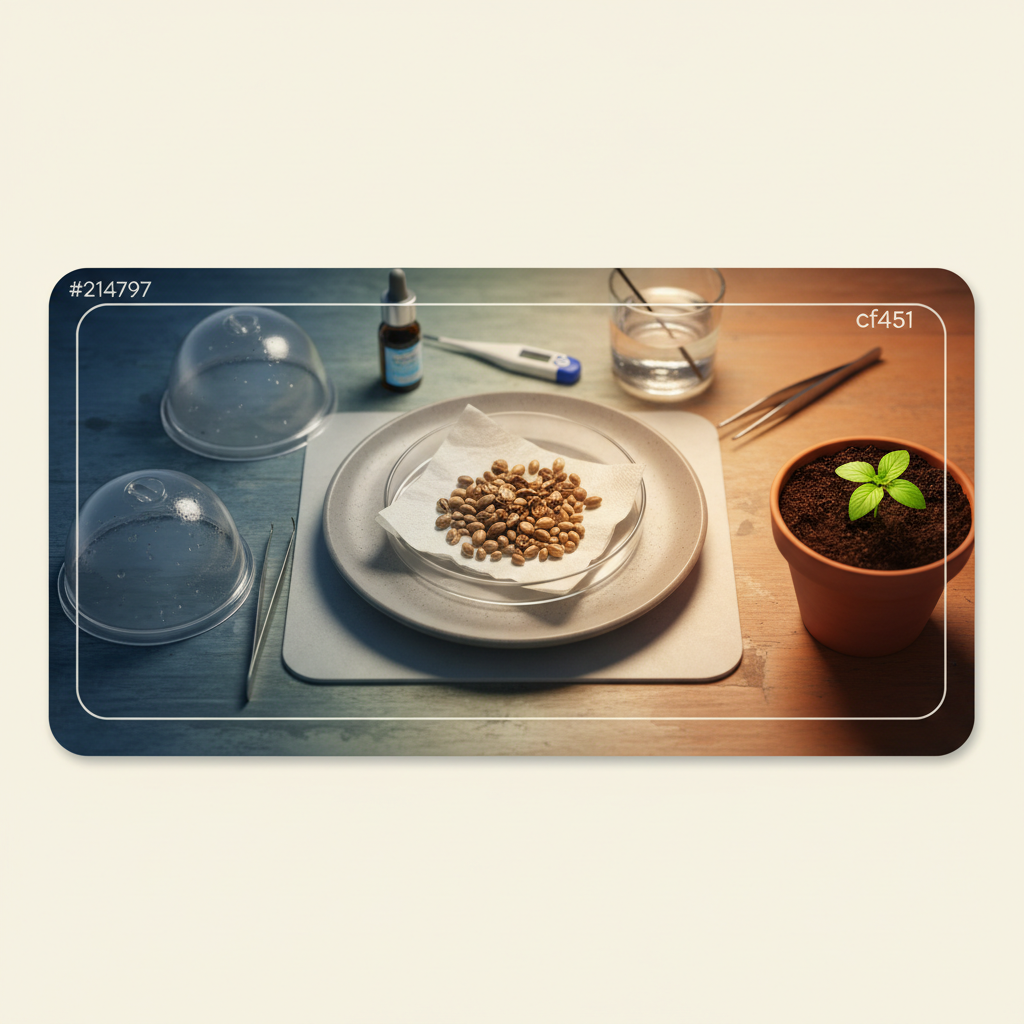
Digging through a drawer and finding a five-year-old seed packet is a strange kind of hope.
Is it worth the space, the water, the waiting — or are you just germinating dust?
Most guides skip that question.
They jump straight to paper towels and water ratios, as if every seed in the jar were equally alive.
Old seeds aren’t dead seeds, though.
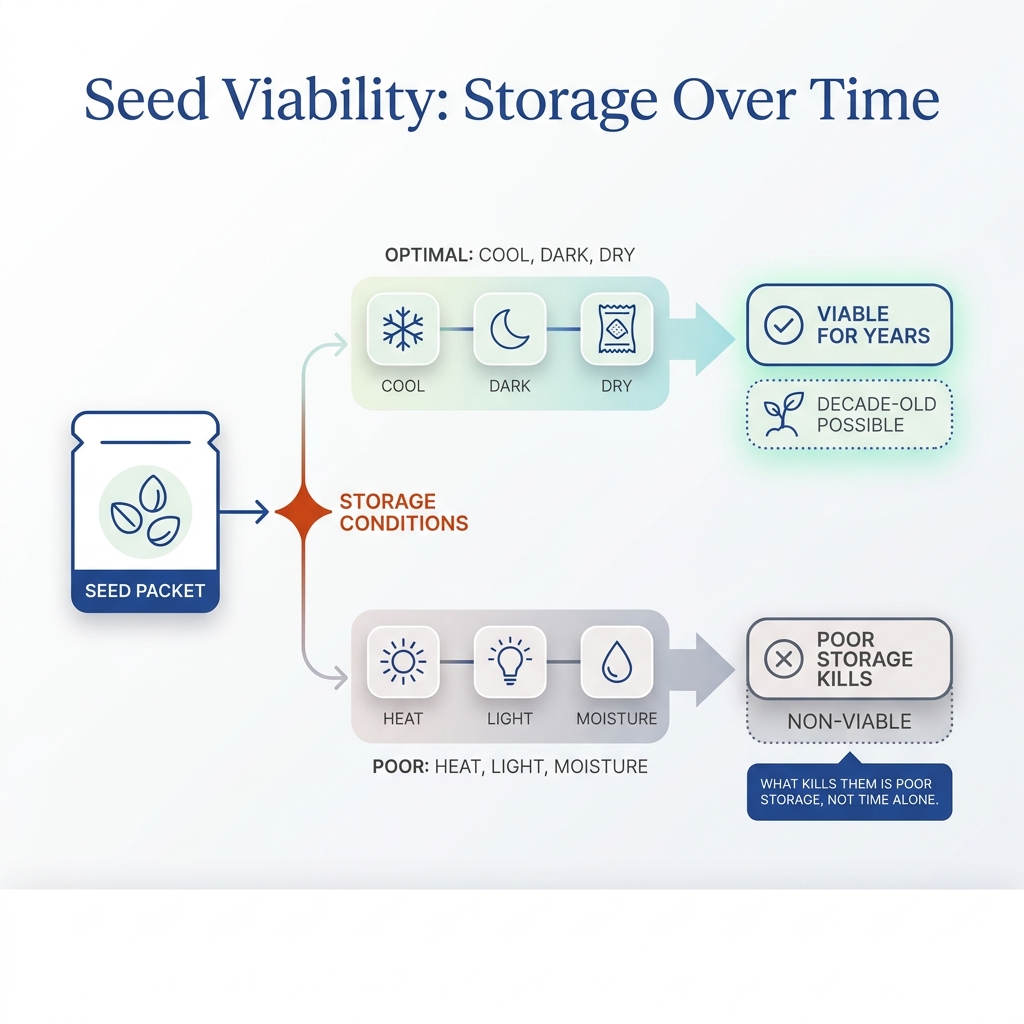
Cannabis seeds can stay viable for years when they’ve been kept cool, dark, and dry, and even a decade-old seed sometimes cracks open.
What kills them is poor storage, not time alone.
That changes the plan.
Whether you’re working with a pack bought a few seasons ago or something a friend saved from a home cross, the best techniques for cannabis germination start with reading the seed’s history — not the calendar.
Quick Answer: Yes, you can germinate old cannabis seeds, as viability depends more on storage conditions than age. Seeds kept cool, dark, and dry can remain viable for years, with even a decade-old seed potentially germinating successfully. However, germination rates decline over time, so optimal care during the germination process is crucial.
Can you germinate old cannabis seeds?
Yes, but age alone won’t tell you whether it’s worth the effort.
Plenty of growers germinate old cannabis seeds; the calendar is rarely the deciding factor.
The history of how they’ve been stored matters most.
A five-year-old seed kept in a cool, dark jar with a silica pack can pop faster than a six-month-old seed left in a hot car.
Viability lives in the storage story, not the harvest date on a breeder pack.
Age still carries weight.
Germination rates tend to slip over time, and seeds held warm and humid lose vigor faster than seeds kept cool and dry.
You can’t read that from the outside.
Appearance scrambles expectations.
A pale, slightly cracked seed can still be alive.
A dark, plump, glossy one can be dead.
Color and heft tell you how mature the seed was at harvest, not whether the embryo inside still respires.
The factors that decide the attempt are moisture, warmth, oxygen, and gentle handling.
Nail those, and an old seed has a genuine shot.
Botch them, and fresh seed fails too.
For US home growers, state cultivation rules vary widely, and federal law still classifies cannabis as Schedule I.
What’s allowed in your state may not match federal rules, so confirm your state’s home-grow status before planning.
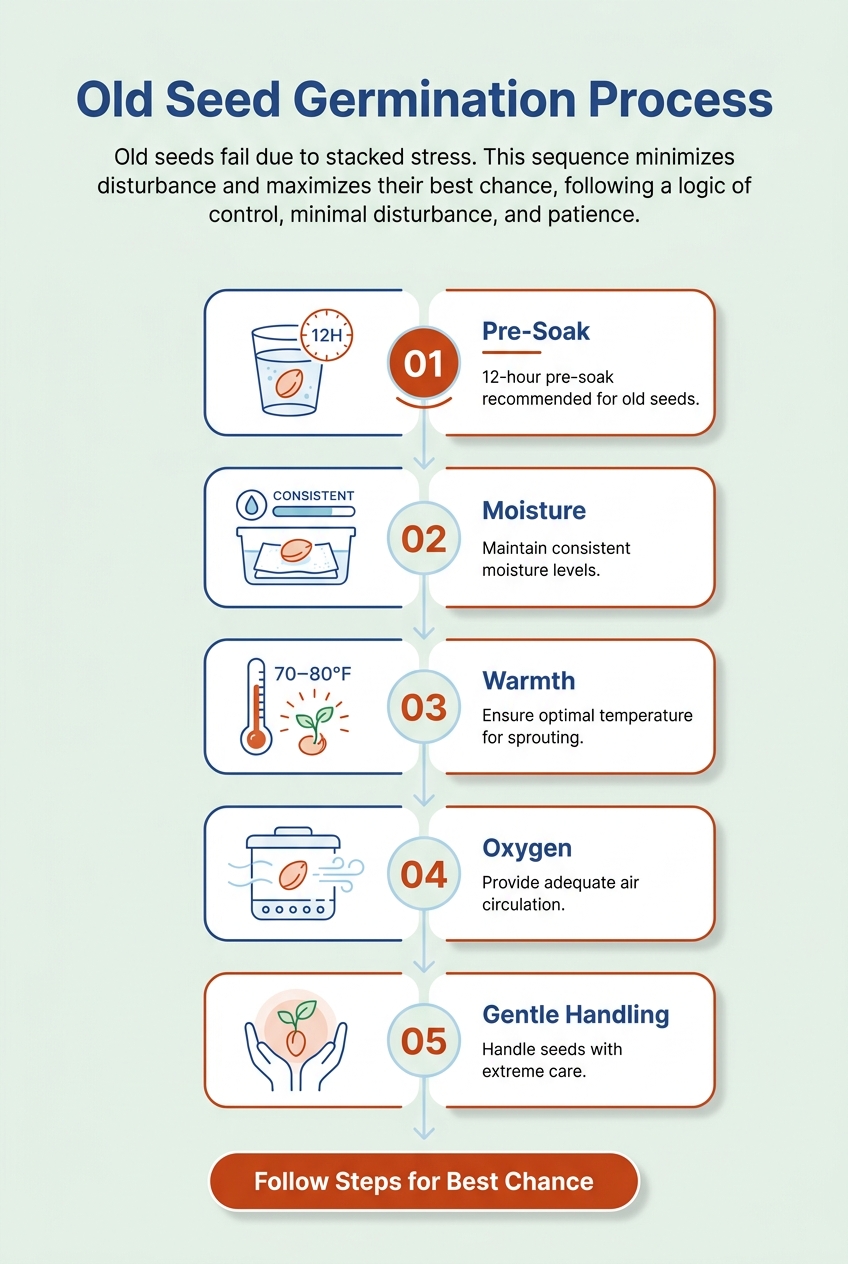
With unknown-age seed, start with a 12-hour pre-soak, as Royal Queen Seeds outlines for old seed germination.
The best techniques begin well before the soak, though.
Knowing storage history saves you from guessing.
Old seeds aren’t hopeless—they’re unpredictable, and predictability is earned through how they were kept.
Why old-seed viability matters before you start
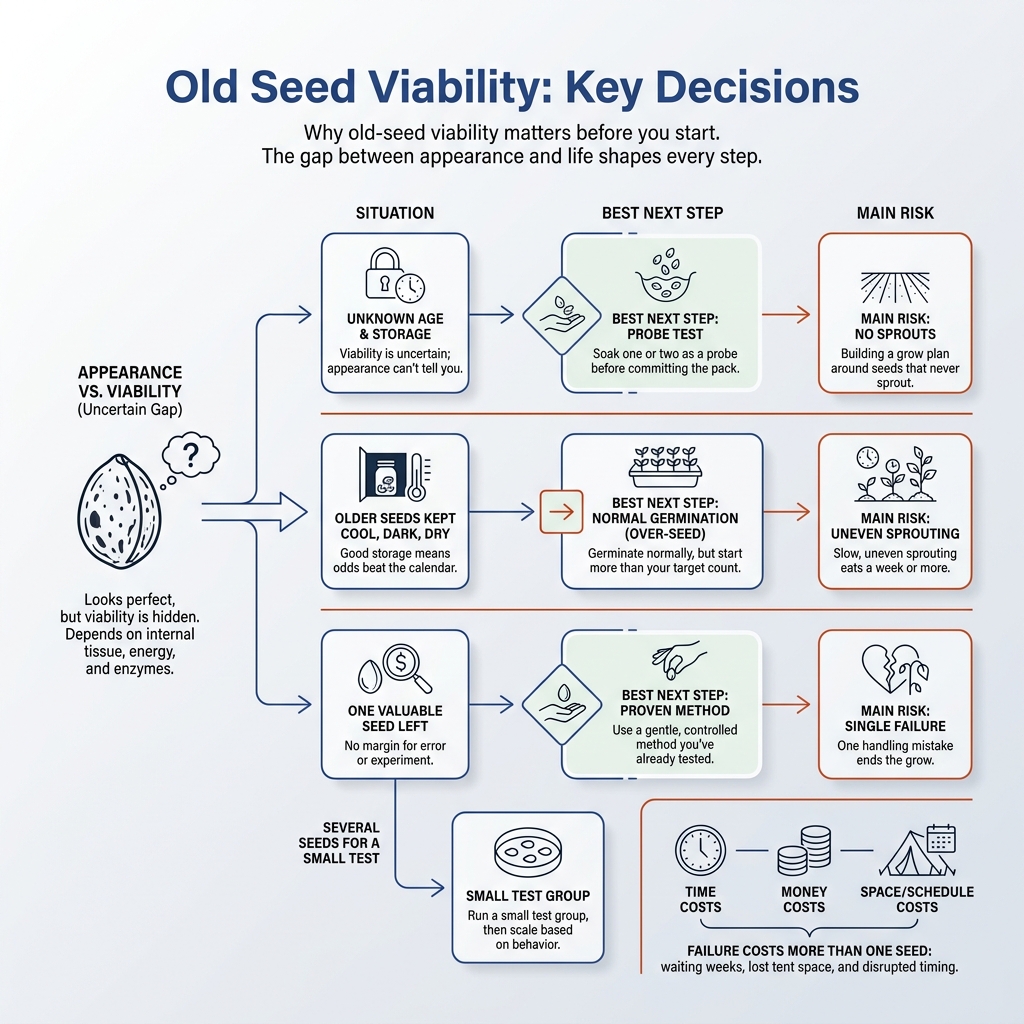
A seed can look perfect — dark, firm, mottled — yet hold almost nothing alive.
The shell may look healthy, but what’s inside — the tissues, energy reserves, and enzymes — determine if it can grow.
That gap between looking healthy and being viable is why this decision comes first.
It also shapes which cannabis germination technique fits the seed in your hand.
Failure costs more than one seed: waiting weeks, tent space, and, with autoflowers, the schedule tied to a fixed finish.
Autoflower timing starts at sprout, so a two-week delay can push harvest into cold weather or the next round.
Money follows the same math.
A cheap ten-pack that sprouts half the time can cost more per plant than a smaller, fresher pack that mostly delivers.
| Situation | What it may indicate | Best next step | Main risk |
|---|---|---|---|
| Unknown age and storage | Viability is uncertain; appearance can’t tell you | Soak one or two as a probe before committing the pack | Building a grow plan around seeds that never sprout |
| Older seeds kept cool, dark, dry | Good storage means odds beat the calendar | Germinate normally, but start more than your target count | Slow, uneven sprouting eats a week or more |
| One valuable seed left | No margin for error or experiment | Use a gentle, controlled method you’ve already tested | One handling mistake ends the grow |
| Several seeds for a small test | You can learn how the batch behaves | Run a small test group, then scale what you learn | Waiting too long and missing your window |
| Recently purchased with a germination guarantee | The seller stands behind viability, so most risk is financial | Follow the seller’s documented steps exactly, then claim if needed | Voiding the guarantee by skipping the required method |
A guarantee covers the outcome you care about — whether the seed sprouts — not the appearance you can inspect.
That’s part of why our cannabis seeds for sale ship with a germination guarantee.
Coverage is a feature, not a footnote.
Look at the seed’s history and the seller’s terms before the technique.
The gentlest method can’t rescue a seed that was never going to wake up
How old cannabis seeds germinate, step by step
Old seeds rarely fail from one bad move.
They tend to fail when several small stresses add up.
The sequence below keeps that stack low.
It follows the same logic behind the best techniques for cannabis germination: control what you can, disturb as little as you can, and give the seed time to answer.
Start with a viability check before anything else.
Drop the seed into room-temperature water.
One that sinks within a few hours has a permeable shell and hydrated tissue, which is a good sign.
Floaters that linger past 12 hours are not dead, but they need the gentlest route available.
Next, set up clean, controlled conditions.
Aim for 70–80°F, clean hands, clean water, and a clean container.
Old seeds have weakened defenses, and a stray bacterium can win the race before the root does.
Cleanliness is not a formality here; it is part of keeping the seed’s remaining energy pointed toward germination.
Then choose moisture over force.
A seed needs steady moisture to soften its shell and begin metabolism, but it does not need to be drowned.
Excess water reduces oxygen, which is exactly what a struggling old seed cannot spare.
The goal is a damp, airy environment where the shell can take on water gradually and the root can emerge without resistance.
These steps work together.
The viability check tells you how much help the seed may need.
Clean conditions remove competitors.
Gentle moisture lets the seed hydrate without pressure.
When you control those variables, you give an old seed the best chance to do what it already knows how to do: wake up, split, and grow.
Examples, misconceptions, and seed-type differences
Imagine finding a four-year-old pack of feminized seeds while cleaning out a desk drawer.
The shells look fine.
Now there’s a real decision sitting there: spend the next few weeks on them, or buy fresh genetics.
Feminized, autoflower, and regular seeds all age the same way.
Time doesn’t change the shell or the mechanism underneath — it only lowers the odds.
What changes is the cost of a failure.
Bust one feminized seed and you’ve lost one guaranteed female.
Bust a regular seed and you were gambling on sex anyway.
Autoflowers are the least forgiving, because a delayed sprout eats into a fixed, short life cycle and shows up later as a smaller plant.
Three ideas worth correcting before you plan anything:
- A hard shell means the seed is dead — not necessarily. Old shells are drier, not empty. Scarification can help a live seed, but nothing revives dead tissue.
- Soaking longer always helps — past roughly 12 hours, extra soaking invites rot rather than speed. Royal Queen Seeds’ guide to germinating old cannabis seeds suggests about a 12-hour pre-soak before anything more involved.
- Every slow seed needs a stronger move — slow usually means slow to hydrate. Added heat, peroxide, or cracking piles stress onto a seed that’s already working.
That math gets simple at the batch level.
Take twelve old seeds, test four in a paper towel, and read the result.
Two or more tails means the batch deserves the space.
Zero tails says storage won, and fresh genetics are the better buy — ideally from a seller who backs germination in writing.
Seed type doesn’t change whether an old seed wakes up.
It changes how much that answer costs you
Practical decisions after an old-seed germination attempt
The hardest part of germinating old seeds isn’t the method.
It’s knowing when to stop.
A tail means the seed is alive.
Nothing after a week of gentle conditions usually means storage already made the call for you.
That answer—not another soak—should decide where your next three weeks and your next dollar go.
Before you try again
| Do | Why it helps | Don’t | Why it creates risk |
|---|---|---|---|
| Keep conditions consistently moist, not flooded | Seeds hydrate evenly without drowning | Soak seeds for days in standing water | Oxygen-starved seeds rot before they split |
| Hold warmth steady around 70–80°F | Enzymes wake reliably within a stable range | Move trays near cold windows or heat vents | Temperature swings stall the process mid-split |
| Handle the seed as little as possible | Less handling means less chance of damaging the emerging root or seed coat | Dig around to check for progress | Disturbance can break the root tip or invite rot |
The table is not a checklist to run through once.
It’s a way to read the seed’s own signals.
A tail is a green light.
A week of nothing is a red light.
Most old seed failures happen because a grower treats a red light as a reason to try harder, adding more water, more heat, more handling.
That extra effort usually kills the seed that might have just needed patience.
If you get a tail, you have a plant.
If you don’t, you have information.
Either way, you’re done guessing.
Will 20 year old seeds still germinate?
Twenty-year-old cannabis seeds can still germinate, especially if they have been stored in ideal conditions — cool, dark, and dry. However, germination rates are likely to be lower than for fresher seeds, so success is not guaranteed.
Can expired seeds still germinate?
Expired seeds can still germinate if they have been kept in optimal storage conditions. The storage history is more significant than the age of the seeds, although viability does diminish over time.
Can you grow 10 year old seeds?
As of 2023, it was possible to grow 10-year-old seeds as long as they were stored properly, though viability may have decreased since then. Viability does depend on storage conditions, and seeds that have remained cool and dry retain a higher chance of germination.
Will 4 year old seeds still grow?
Four-year-old seeds can still grow if kept in good storage conditions. While they may still be viable, the likelihood of successful germination decreases with age, so conditions during the growing process should be carefully managed.
The Seed You Start With Shapes Every Method That Follows
No germination technique outruns a seed that was stored badly.
That’s the idea worth carrying out of all this: the sink test, the paper towel, the warm windowsill — none of them revive a seed whose embryo dried out three summers ago.
Think back to that five-year-old packet from the start.
Soaking it costs you almost nothing, and if it sinks within a few hours, you’ve earned yourself a real shot at a plant.
Soak one seed today, keep the rest cool and dark, and give it five days before you decide anything. If you’d rather begin with stock that arrives fresh and covered by our germination guarantee, that’s always an option worth knowing about.