

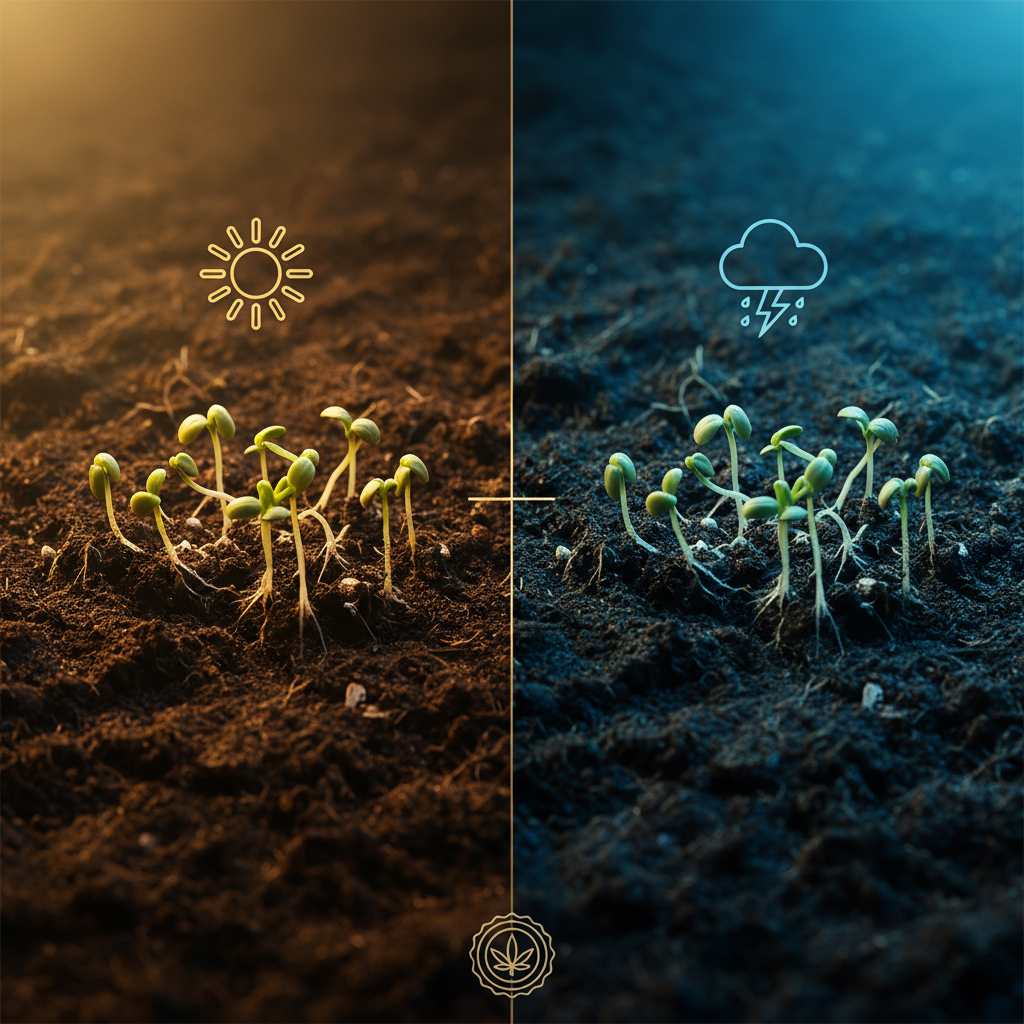
The Role of Light in Cannabis Seed Germination is often misunderstood because germination and seedling growth have different lighting needs. Cannabis seeds can begin germinating without light when moisture, warmth, and oxygen are available, but light becomes important once the seedling emerges and starts developing leaves.
In this guide, The Seed Connect explains when cannabis seeds should stay dark, when to introduce light, and how to avoid common problems such as excessive heat, drying, and stretched seedlings.
Quick Answer: Cannabis seeds do not need light to germinate; they can crack and develop a root in darkness as long as moisture, warmth, and oxygen are present. Light becomes important after the sprout breaks the surface, when it drives compact stem and leaf growth and helps prevent stretching.
Table of Contents
Understanding the Question: Do Cannabis Seeds Need Light to Germinate?
“Do cannabis seeds need light?” sounds simple, but it trips people up fast.
The confusion usually comes from mixing up germination with seedling growth, and those are not the same thing.
A seed can crack open in darkness.
The first job is to absorb moisture, wake up, and push out a root.
Light starts to matter later, after the sprout breaks the surface and needs energy for leaf growth.
That’s why the question about light for germinating seeds comes up so often.
People see seedlings thriving under strong lamps and assume the same rules apply from day one.
They do not.
During germination, light is not the main trigger.
Moisture, warmth, and oxygen do the heavy lifting.
Grow Light Central puts it plainly: cannabis seeds need no light when they are germinating, and the process is meant to happen in darkness (How Much Light Do Cannabis Seeds Need?).
Once the seedling emerges, the story changes.
Now the plant needs light to build a stem, form leaves, and stay compact instead of stretching.
That shift is where cannabis germination light requirements stop being the real question, and early plant care takes over.
Think of it like this: a seed is a sleeping package, a sprout is a newborn, and a seedling is a hungry little plant reaching for the sun.
The impact of light on seeds is small at first, then becomes important almost immediately after emergence.
The timing matters more than most new growers expect.
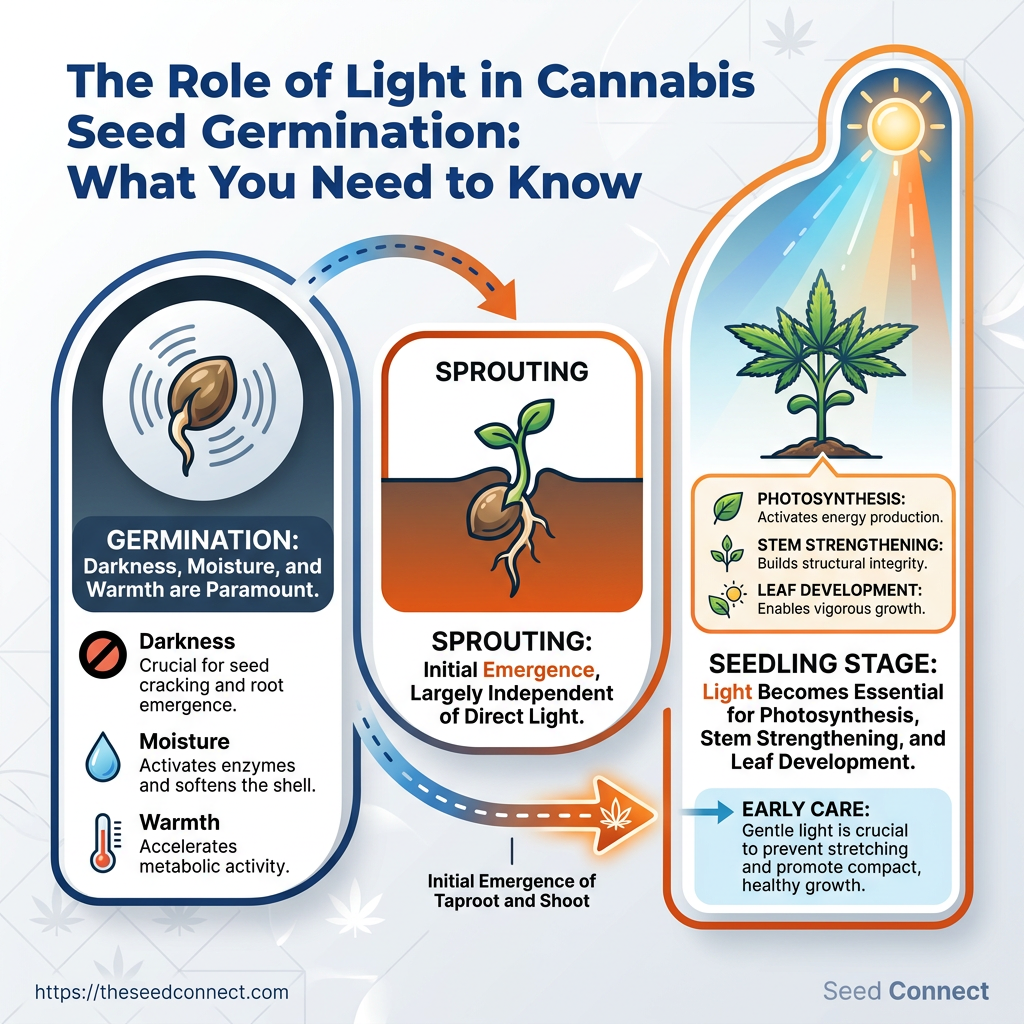
- Germination: darkness, moisture, and warmth matter most.
- Sprouting: the taproot and first shoot emerge.
- Seedling stage: light becomes essential for steady, healthy growth.
- Early care: gentle light prevents stretching and weak stems.
That split is the whole reason this topic causes so much debate.
People are often asking about two different stages without realizing it.
Once you separate them, the answer gets a lot cleaner.
How Light Affects Seeds During Germination
Light rarely acts like a switch for cannabis germination. Instead, it usually affects germination indirectly—by changing the conditions around the seed.
The real impact of light: heat + drying
When light hits a germination setup, two things are most likely to go wrong:
- Temperature creep: Grow lights, warm LEDs, or direct sun can raise the local temperature around the seed before it’s ready.
- Humidity loss: Even short periods of bright exposure can increase evaporation, lowering the moisture level the embryo needs.
Meanwhile, inside the seed, germination is driven by the basics:
- Moisture softens the shell
- Warmth supports embryo activity
- Oxygen availability prevents the seed from stalling or rotting
Once the shell cracks and the sprout emerges, then the plant starts needing light for structure and orientation—which is why “light for germinating seeds” is mostly about keeping conditions stable rather than providing strong illumination.
Light, moisture, and oxygen at a glance
| Condition | Effect on germination | Best practice | Common mistake |
|---|---|---|---|
| Light exposure | Not a trigger; usually problematic via heat/drying | Use indirect/brief light only when checking | Leaving seeds under a bright lamp or window for long stretches |
| Darkness | Helps keep conditions calm and humid | Keep seeds covered (dome/tray/opaque container) with safe airflow | Assuming “dark” means “no air exchange” |
| Moist but not soaked medium | Supports uptake while keeping oxygen available | Evenly damp medium; check before it fully dries | Letting it dry hard between checks |
| Warm room temperature | Speeds metabolism and enzyme activity | Keep a stable, comfortable warm range | Frequent cold/hot swings |
| Cold environment | Slows metabolism and delays sprouting | Move to a warmer spot | Trying to force germination in a chilly room |
| Low oxygen from waterlogging | Can stall germination or encourage rot | Drain excess water; use an airy, well-prepped medium | Soaking too long or keeping media soggy |
A practical “safe check” rule
If you need to look, do it quickly under room-level, indirect lighting (no intense lamp heat aimed at the seed). The goal is simply to confirm whether the shell has opened—not to provide a growth-light environment.
That’s the main way light fits into germination: not as food, but as something you control so moisture, temperature, and oxygen stay in balance.
Best Light Conditions for Cannabis Seed Germination
Can a seed be “too safe” under light? Absolutely.
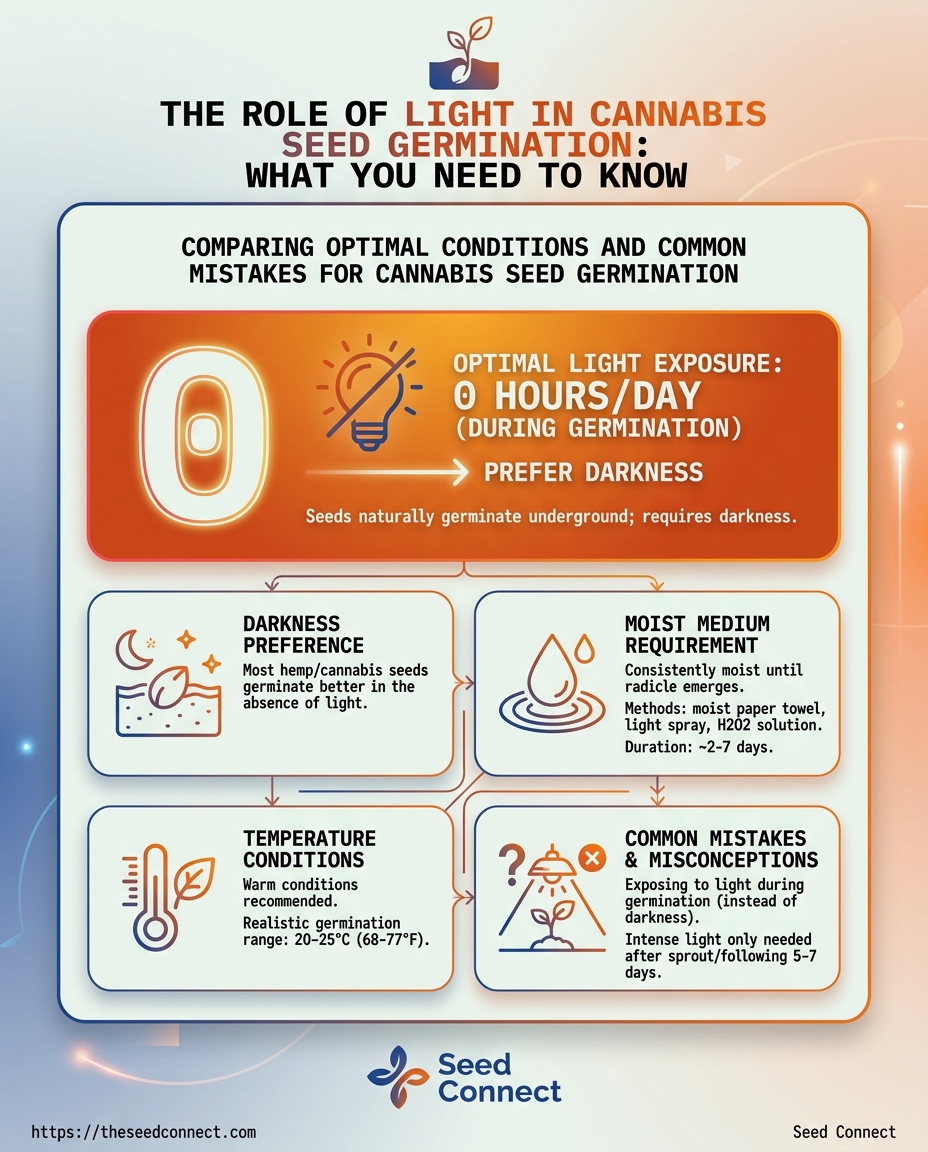
For germination, the cleanest setup is dark or nearly dark, with only brief light exposure when you check progress.
The seed is busy doing basic work underground or inside a starter medium, so bright light just adds noise to the process.
The real mistake is not a little room light.
It is strong, direct light for long stretches before the seed has actually broken open.
Once the seedling emerges, the game changes fast.
At that point, a proper vegetative light schedule matters, and Cannabis Light Schedules: Vegetative vs Flowering Stage is a useful reference for the next stage after sprouting.
- Paper towel method: Keep the towel inside a dark drawer or lidded container, then check once or twice a day under normal room light.
- Starter cube or plug: Place it in an opaque tray or under a humidity dome, away from sunny windows and grow lights.
- Soil in small cups: Set the cups in a dim cabinet, then move them only when the seedling pops above the surface.
- Pre-soaked seed in water: Keep the glass in a dark corner, not on a bright sill. Light is the smaller issue here; heat swings are usually worse.
A practical rule works well: if you can read comfortably by the light, it is more than enough for germination checks.
If a seed sits under that level for hours, you are no longer talking about a gentle environment.
That is where the impact of light on seeds starts to matter in a real-world way.
The light itself is not magic, but strong exposure can make your setup harder to control, especially when moisture and temperature are already tight.
For most growers, the sweet spot is simple: dark place, quick checks, then immediate return to cover.
Keep the seed stage calm, and the seedling stage gets a much cleaner start.
Germination Methods and Where Light Fits In
The fastest way to confuse a seed is to mix up its jobs.
During germination, the seed is busy absorbing water and waking up, not shopping for sunlight.
That is why the method matters.
Paper towel, direct-to-medium, and soaking all handle light a little differently, and each one changes how steady the seed’s environment stays.
Paper Towel Method
The paper towel setup works because it creates a small, controlled pocket of moisture.
Light should stay out of that pocket, since the goal is steady humidity and minimal disturbance, not a bright workspace.
A towel left under a lamp dries unevenly.
A towel kept in a dark container or covered tray stays far more stable, which is exactly why this method is popular with cautious growers.
- Best use: checking progress without digging up the seed.
- Light role: keep it shaded until the root appears.
- Main risk: frequent peeking adds heat and dries the edges.
That dark, controlled approach matches the basic advice in Grow Light Central’s guide on cannabis seeds and light, which notes that seeds are normally started without light.
Direct-to-Medium Germination
Direct-to-medium removes the transfer step, and that is the big win.
Less handling means less chance of nicking a tiny root or disturbing the seed before it settles.
Here, light only matters after the sprout breaks the surface.
Before that, the medium should stay evenly moist and lightly covered, because the seed is still doing its quiet underground work.
- Best use: growers who want fewer moving parts.
- Light role: hold off until emergence.
- Main risk: planting too deep or letting the surface dry out.
Once the seedling is up, light becomes a different conversation.
For the early seedling stage, Dutch Passion’s guide to putting cannabis seedlings under light points to 18–24 hours of daily light for indoor grows, while Grow Weed Easy’s light schedule guide notes that plants need at least 13 hours of light daily to stay vegetative.
Soaking Seeds Before Planting
Soaking is simple, but it is easy to get sloppy with it.
The seed should be in clean water only long enough to soften the shell, then moved out before the situation turns stale.
The trap is leaving seeds in water under bright light or in a warm spot for too long.
That raises the odds of poor oxygen exchange, cloudy water, and a seed that goes from promising to mushy.
- Best use: giving stubborn seeds a head start.
- Light role: keep the cup out of direct light.
- Main risk: forgetting the soak and leaving seeds stranded.
Soaking works best as a brief pre-step, not a holding tank.
The method is simple; the discipline is in knowing when to stop.
Pick the method that fits your style, then keep light in its lane.
During germination, that lane is usually dark; after emergence, it finally earns its place.
Common Mistakes Growers Make With Light and Germination
The mess usually starts when a grower treats a fresh seed like a tiny plant that already knows what to do.
It does not.
Before the root has properly anchored itself, strong light, hot spots, and constant fiddling can create more trouble than the seed can handle, which is why the impact of light on seeds matters more than most people think at this stage.
A second trap is mixing up germination with seedling care.
Once the sprout appears, the rules change, but not before then.
That distinction matters because the light for germinating seeds is a different discussion from the lighting setup a young plant needs later, as outlined in Grow Weed Easy’s cannabis light schedules guide and Photone’s cannabis lighting requirements guide.
The three mistakes that cause the most trouble
- Using grow lights too early: Strong lights aimed at a seed that has not fully opened can dry the medium fast and add heat stress. That is a bad trade when the seed is still focused on root development, not leaf production.
- Confusing sprouting with seedling care: A sprout is not ready for the same routine as a young plant with a working root zone. Growers often rush into long light hours, airflow, and handling before the plant can actually use them, which is why timing matters more than enthusiasm.
- Letting moisture swing around: Seeds hate the roller coaster. A mix that starts soggy, then dries hard, then gets soaked again can delay or stall germination, especially when paired with uneven room temperatures. Dutch Passion’s seedling light timing guide makes the same basic point: stability beats drama.
A simple example: imagine a tray sitting under a bright lamp near a warm window.
The top layer dries out, the bottom stays wet, and the seed never gets a steady signal to keep moving.
That kind of setup looks busy, but it usually performs worse than a calm, consistent one.
Good germination is less about doing more and more about removing the unnecessary chaos.
Keep the environment steady, wait to treat the plant like a seedling, and let the seed finish its job before the lights take over.
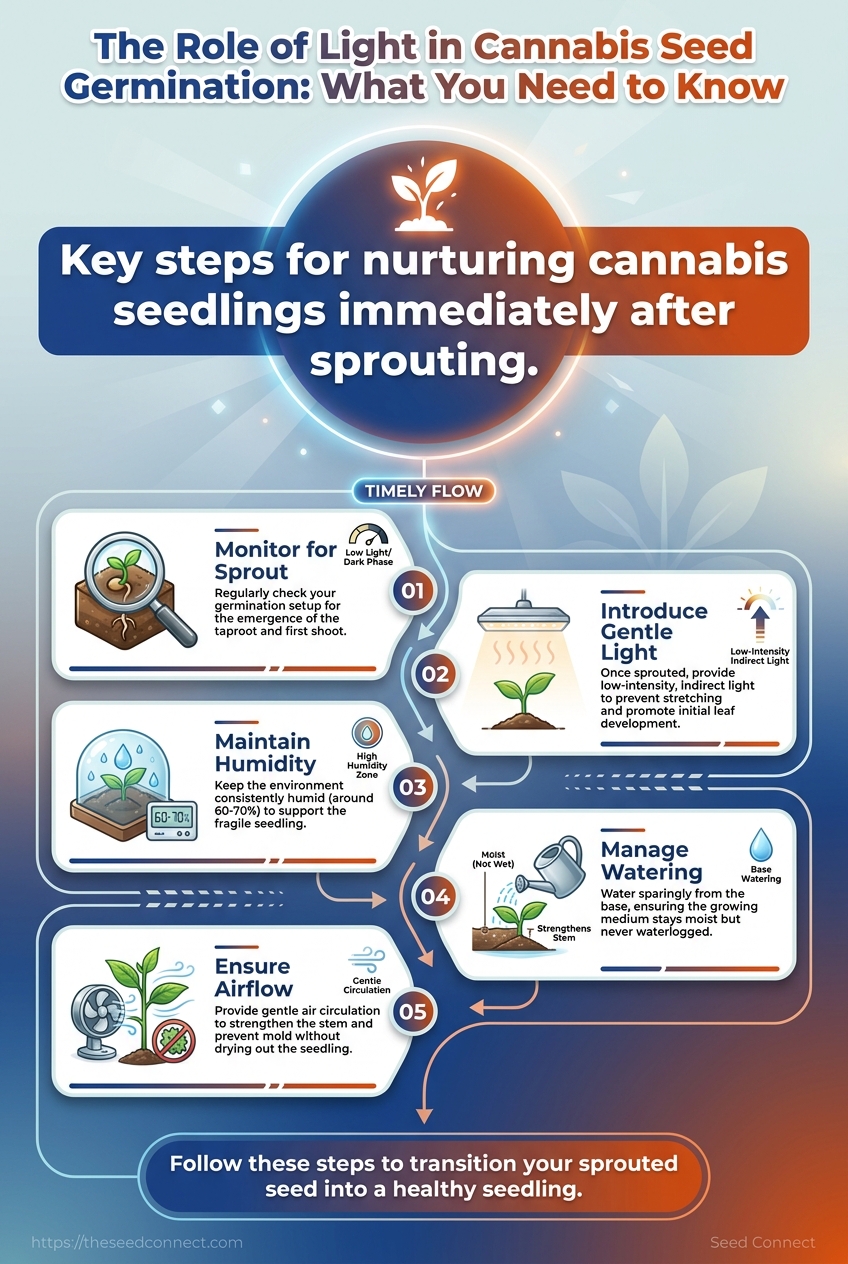
What to Do After the Seed Sprouts
The first white stem above the soil is the handoff moment.
The light for germinating seeds has done its job, and now the plant wants a gentle, steady introduction to light instead of a dramatic one.
A newborn seedling does not need a flood of intensity on day one.
It needs consistency, enough distance from the lamp to avoid heat stress, and enough brightness to stop it from reaching for the sky.
Bring light in right away, but gently
As soon as the sprout breaks the surface, place it under a mild indoor light schedule rather than waiting for it to “strengthen up” in the dark.
For young indoor plants, growers commonly use 18 to 24 hours of daily light, a range noted in Dutch Passion’s seedling lighting guide.
That early light helps the seedling build structure before it starts stretching.
If the light is weak or too far away, the stem elongates fast and the plant gets leggy, which is hard to fix later.
Keep the lamp close enough to matter, far enough to stay cool
The sweet spot is bright light without cooking the top layer of the medium.
A quick hand test works well: if the canopy feels hot to your skin, the seedling probably feels it too.
Light intensity is the real balancing act here.
Photone’s cannabis DLI guide explains that cannabis needs a measured approach across the grow cycle, not a blast of light that looks impressive but stresses young growth.
First-week care that keeps seedlings steady
- Moisture control: Keep the medium lightly moist, not soaked. Wet roots struggle to breathe.
- Air movement: Use soft airflow. It helps stems thicken without blasting the plant around.
- Heat watch: Keep lights and reflective surfaces from trapping extra warmth near the seedling.
- Daily checking: Look at leaf shape, stem color, and whether the plant is leaning toward the light.
If you are growing photoperiod plants indoors, the long-view matters too.
Grow Weed Easy’s light schedule guide notes that vegetative growth holds with at least 13 hours of light per day, which is why young plants are usually kept on long days early on.
A healthy seedling should look calm, not frantic.
Once it settles into the light, the rest of the early grow becomes much easier to manage.
How Seed Quality Changes the Equation
Why do two seeds in the same tray act like they came from different planets? One pops cleanly, stands up fast, and keeps moving.
The other drags its feet, opens unevenly, or never really gets started.
Seed quality changes the whole start.
A healthy seed usually has a solid shell, intact embryo tissue, and enough stored energy to handle the early jump from dry storage to a moist medium.
That gives it more room to respond well when the environment is right, and less chance of getting knocked off course by small mistakes.
The cannabis germination light requirements get a lot of attention, but seed quality decides how forgiving that first stretch will be.
Once a seedling is above ground, growers often move into steadier light schedules; Grow Weed Easy notes that vegetative growth depends on at least 13 hours of light per day, while Dutch Passion discusses 18–24 hours for many young indoor seedlings (Grow Weed Easy light schedules, Dutch Passion seedling light timing).
Photone’s DLI guidance also shows how quickly light demand rises as the plant develops, which is easier to manage when the seedling starts strong (Photone DLI for Your Full Grow Cycle).
What to look for when choosing cannabis seeds
| Quality signal | What it looks like | Why it matters |
|---|---|---|
| Firm seed shell | Hard, dry shell with no soft spots | Protects the embryo and handles moisture more evenly |
| Healthy color and pattern | Brown, tan, or dark tones with natural mottling | Usually points to mature, well-developed seed stock |
| No cracks or damage | No chips, splits, dents, or crushed sides | Lowers the risk of rot and uneven hydration |
| Clear source information | Strain name, breeder, and seller details are easy to verify | Helps you compare genetics and avoid mystery stock |
| Support or germination guarantee | Written guarantee plus responsive grower help | Gives you a safety net if a batch underperforms |
A good-looking seed is not just about appearance.
It usually means fewer hidden problems, better storage resilience, and a cleaner start once moisture hits the shell.
That matters because weak seeds waste your time before the light even becomes the issue.
Strong ones give you a steadier handoff from germination into early growth, which is where a lot of growers either gain momentum or lose it.
That is why we back our seeds with a germination guarantee and expert support on our Cannabis Seeds page.
Quality at the start makes the rest of the run a lot less dramatic.
How to Think About Light in the Bigger Germination Process
Why does light matter if a seed does its first real work underground? Because light is less of a trigger and more of a timing signal.
It tells the plant when the hidden part is over and the visible part begins.
That shift matters more than people think.
The impact of light on seeds is not about making germination happen faster; it is about helping the young plant move into a stable rhythm once the root has emerged.
For cannabis germination light requirements, that means treating light as one step in a wider chain, not the whole show.
A simple way to stage the process
The cleanest framework is almost boring, and that is a good thing.
First comes moisture, then warmth, then darkness or very low light, then a fast handoff to steady light after sprouting.
- Start with even moisture. A seed needs a damp environment, not a soaked one.
- Keep temperatures stable. Big swings slow the whole process down.
- Use light only when it fits the stage. Before sprouting, less is usually more.
- Move quickly after emergence. Once the seed breaks the surface, give it a consistent light schedule.
- Think in days, not moments. Seedlings respond better to routine than to constant tweaks.
Consistency beats the “perfect” setup
A grow room can look dialed in and still frustrate seedlings if the routine keeps changing.
Seeds and seedlings care more about repeated conditions than about fancy gear.
That is why light for germinating seeds works best when the rest of the environment is equally steady.
Indoor growers usually think ahead to the next phase, too.
Grow Weed Easy’s cannabis light schedule guide notes that vegetative plants typically need long light days, while flowering shifts to 12 hours.
For the broader energy side of growth, Photone’s cannabis DLI overview shows how light intensity needs rise as the plant develops.
A practical seedling rule is simple: do not keep changing the plan just because you can.
Dutch Passion’s guide on when to put cannabis seedlings under light makes the same basic point in a different way, by focusing on a controlled transition rather than constant adjustments.
When the process stays steady, the light does its real job.
It supports the next stage without fighting the one before it.
Will cannabis seeds become illegal in 2026?
No germination guidance can determine whether cannabis seeds will become illegal in 2026. Cannabis legality depends on your specific country, state, or province and changes through local legislation. For an accurate answer for 2026, check the current laws and upcoming regulatory updates where you live.
How much light does a cannabis seed need to sprout?
Cannabis seeds do not need light to sprout. They can crack and develop a root in darkness as long as moisture, warmth, and oxygen are present. Light becomes important after the sprout breaks the surface, when it supports compact stem and leaf growth and helps prevent stretching.
What fertilizer makes buds bigger?
The article does not name a specific fertilizer to make buds bigger. It focuses on germination lighting and how light can affect heat and humidity around seeds, influencing early root and stem development. Bud size is driven more by genetics and later vegetative/flower-stage nutrition than by any single fertilizer recommended for germination.
What is the light schedule for photoperiod seeds?
For photoperiod seeds, the key point is stage-based timing:
- During germination (cracking/sprouting): no light is required; focus on moisture, warmth, and oxygen.
- Right after emergence (seedling/early vegetative): the article references common indoor ranges such as ~18–24 hours of light for young plants and notes that vegetative growth generally holds with at least ~13 hours of light per day (stage-appropriate schedules).
- Flowering: when you move into flowering, standard practice is a 12/12 light/dark cycle (as discussed/referenced in the article’s stage-transition guidance).
Choose a schedule designed for your stage and whether you’re growing for vegetative growth vs flowering.
Is red or blue light better for seed germination?
Neither red nor blue light is necessary for cannabis seed germination. Seeds can germinate in darkness as long as moisture, warmth, and oxygen are present. Light color becomes more relevant after emergence, when consistent brightness helps prevent stretching and supports compact seedling growth.
Keep the First Light Soft and Steady
The part worth remembering is simple: seeds are not chasing brightness, they are reacting to the conditions around them.
Light for germinating seeds matters most because of temperature, moisture, and what happens right after the shell opens.
That is why cannabis germination light requirements look different from later growth; the seed does not need a spotlight, it needs a stable start.
The mistake we talked about earlier is a good example of the impact of light on seeds in real life.
A seed can sprout just fine and still turn into a stretched, weak seedling if the light is too far away or too dim once it emerges.
After that first crack, the goal changes fast: steady light, even moisture, and no guessing.
If you want a cleaner start today, choose one germination method and set up the first seedling light before the sprout appears. Check your setup now, not after the seed has already opened.
If you are starting fresh, our seeds are one solid place to begin when you want quality genetics and support behind the first stage.